AgentCrew
Health Warn
- License — License: MIT
- Description — Repository has a description
- Active repo — Last push 0 days ago
- Low visibility — Only 6 GitHub stars
Code Pass
- Code scan — Scanned 12 files during light audit, no dangerous patterns found
Permissions Pass
- Permissions — No dangerous permissions requested
No AI report is available for this listing yet.
AgentCrew is a Markdown workflow for coordinating AI agent teams with roles, playbooks, skills, handoffs, and human approval gates.
AgentCrew
Turn your coding agent into a disciplined software team.





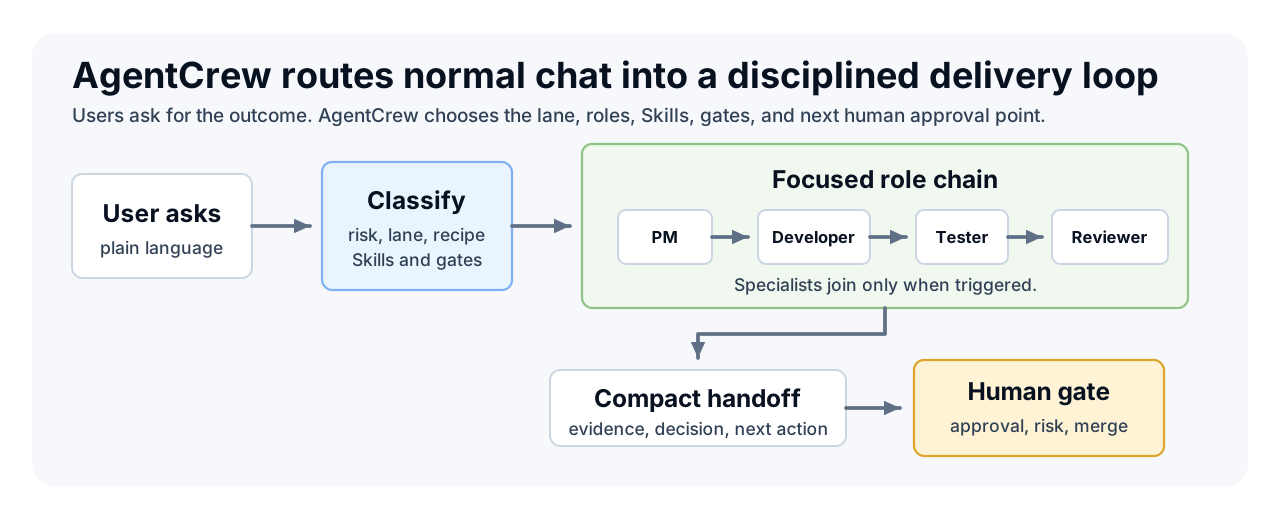
AgentCrew is a conversation-first, Markdown-first methodology for AI coding agents. Install it once, open any project, and ask normally. AgentCrew routes the request to the right role, applies the right workflow, loads only the needed context, and stops where human approval is required.
It works with host agents such as Codex, Claude Code, Cursor, OpenClaw, Hermes Agent, and similar coding assistants.
AgentCrew is not a daemon, CI/CD system, autonomous engineer, or replacement for human product judgment. It is a lightweight workflow layer that helps coding agents act with clearer roles, safer gates, and better handoffs.
Quick Start
git clone https://github.com/mlguyYT/AgentCrew.git ~/AgentCrew
~/AgentCrew/bin/agentcrew install
~/AgentCrew/bin/agentcrew doctor
Then open any project and ask for the outcome:
Fix the login form so empty email shows a validation message.
Or start from a product idea:
I want to add team billing to this app. Help me shape it and implement the first safe version.
You do not need to say "use AgentCrew", name a role, choose a lane, or run workflow commands during normal use. AgentCrew is loaded by the host agent and should classify the request automatically.
For any host with persistent custom instructions but no automatic installer target, run ~/AgentCrew/bin/agentcrew loader and place the output in that host's instruction surface.
Why AgentCrew
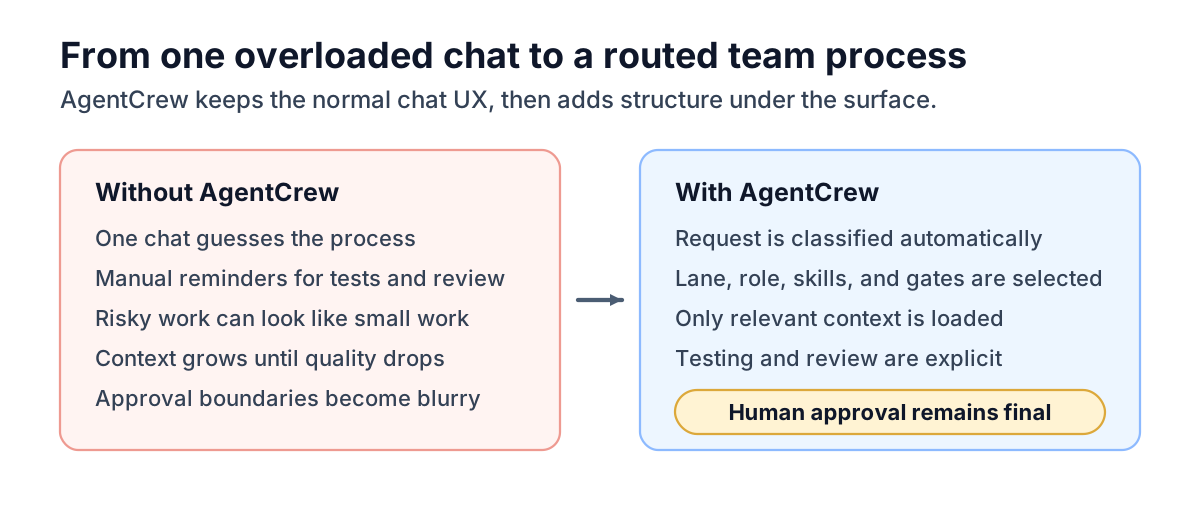
Most coding-agent sessions put too many jobs into one chat: product thinking, planning, implementation, testing, review, documentation, and approval. That creates predictable failures: unclear scope, giant diffs, skipped tests, weak review, lost context, unrelated edits, and agents acting like they can approve their own work.
AgentCrew gives the agent a team process before it touches the code.
roles define responsibility
playbooks define process
skills define technical guidance
templates define output shape
policies keep human approval final
AgentCrew lets agents do the work, testing, review, and preparation, but keeps final product direction, risk acceptance, PR approval, and merging with the human.
What You Experience
For a simple request, AgentCrew can use a lightweight path:
Developer -> Tester -> Human
For meaningful risk, it adds review and product checks:
Developer -> Tester -> Reviewer -> Product Manager if needed -> Human
For ambiguous, high-impact, security-sensitive, migration-heavy, public API, billing, auth, customer-data, or hard-to-rollback work, it uses a fuller process:
Advisor -> Idea Consultant -> Product Manager -> Developer -> Tester -> Reviewer -> Specialist if needed -> Human
AgentCrew can also estimate execution cost before spending meaningful model tokens, then ask for confirmation before the implementation phase.
What Is Included
AGENTS.md              entry point for host agents
bin/agentcrew          install, generic loader, doctor, routing, engine commands
agent-team/            roles, playbooks, skills, templates, policies, gates
engine/                optional executable layer for orchestration
docs/                  installation, usage, examples, customization
examples/              scenario examples and workflow examples
.github/               optional issue and PR templates
AgentCrew lives outside your project repositories. It does not require copying workflow files into every codebase.
Project-specific runtime state, when needed, belongs in the target project:
.agent-state/
Each project gets separate state so memory does not mix across projects.
Optional Engine
AgentCrew works without the engine. The Markdown methodology is the default contract and remains readable, portable, and vendor-neutral.
The included engine/ is the optional executable layer for teams that want more automation:
- classifier-driven routing;
- structured role execution;
- cost previews before execution;
- project-local run artifacts;
- handoffs, decisions, audits, and summaries;
- provider-neutral model backends.
Install the engine only when you want executable runs:
cd ~/AgentCrew/engine
python3 -m venv .venv
.venv/bin/pip install -e .
Then from any project:
~/AgentCrew/bin/agentcrew route --task "Fix login validation" --project .
~/AgentCrew/bin/agentcrew run --task "Fix login validation" --project . --backend mock-demo
The engine supports local and OpenAI-compatible backends, plus optional provider-specific adapters. No provider is required by the core methodology, and human approval remains final.
Roles
AgentCrew can route work through focused roles:
- Advisor for early reasoning, feasibility, and tradeoffs.
- Idea Consultant for turning rough ideas into clearer briefs.
- Product Manager for scope, acceptance criteria, and product decisions.
- Software Architect Agent for boundaries, contracts, data ownership, quality attributes, and consequential design decisions.
- Developer for focused implementation.
- Tester for validation and test reporting.
- Reviewer for correctness, maintainability, and risk.
- Security Reviewer for auth, secrets, data, dependencies, and infrastructure risk.
- UX / Design Reviewer for usability, accessibility, responsive behavior, and user-facing flows.
- Documentation Agent for docs, examples, changelog, and public API behavior.
- Release Manager for release readiness and handoff quality.
- Skill Validator for adding or changing reusable skills.
The user can name a role manually, but does not have to. AgentCrew should choose the right starting role from the request.
Skills And Gates
Skills provide stack-specific and practice-specific guidance. AgentCrew loads them only when relevant, for example:
- Python, TypeScript, JavaScript, Go, Rust, SQL, Shell;
- React, FastAPI, Kubernetes;
- software architecture, reviewer, product, research, LLM, CNN, documentation, and release practices.
Quality gates are triggered by risk. Examples include architecture decisions, security review, dependency and supply-chain checks, integration-test escalation, default-branch merge readiness, shared-memory refresh, and human-only decision logging.
Safety Model
Agents must not:
- merge pull requests;
- approve as the human;
- bypass branch protection;
- hide failing tests;
- commit secrets;
- silently expand scope;
- make unrelated changes;
- store personal credentials or local machine setup in shared state.
Only the human may approve product direction, accept security or migration risk, approve PRs, merge, deploy, force-push, rewrite shared history, or override required gates.
Why Markdown-First
AgentCrew is intentionally transparent. Roles, playbooks, policies, templates, skills, and gates are plain files that humans and agents can inspect, edit, review, and version.
The optional engine adds executable orchestration, but the core methodology stays readable and portable.
Documentation
- Installation
- Automatic Loading
- Setup Doctor
- Usage Guide
- Examples
- Project Presets
- Quality Profiles
- Workflow Recipes
- Software Architecture
- Session Checkpoints
- Security
- Customization
- FAQ
- Roadmap
Status
AgentCrew v0.1.0 is usable today as an external methodology package for coding agents. The optional engine/ is the next evolution of AgentCrew and remains vendor-neutral.
License
MIT.
Reviews (0)
Sign in to leave a review.
Leave a reviewNo results found