clawvet
Health Gecti
- License — License: MIT
- Description — Repository has a description
- Active repo — Last push 0 days ago
- Community trust — 11 GitHub stars
Code Basarisiz
- rm -rf — Recursive force deletion command in action.yml
- process.env — Environment variable access in apps/api/drizzle.config.ts
- process.env — Environment variable access in apps/api/src/db/index.ts
- process.env — Environment variable access in apps/api/src/queue/scan-queue.ts
- process.env — Environment variable access in apps/api/src/queue/scan-worker.ts
Permissions Gecti
- Permissions — No dangerous permissions requested
Bu listing icin henuz AI raporu yok.
Offline AST security scanner & install gate for AI agent skills, rules, hooks, and MCP configs (OpenClaw, Claude Code, Cursor, Codex, Windsurf). Catches credential theft, RCE, and rug-pull updates.
ClawVet



Static and install-time security scanner for AI agent skills, rules, hooks, and MCP configs (OpenClaw, Claude Code, Cursor, Codex, Windsurf). ClawVet vets SKILL.md and every bundled script it references for prompt injection, credential theft, remote code execution, typosquatting, and rug-pull updates. It runs fully offline by default, with optional LLM (--semantic) and OSV.dev (--osv) passes when you turn them on.
Try it with zero install: clawvet.vercel.app (100% client-side WebAssembly Tree-sitter AST dataflow, nothing uploaded).
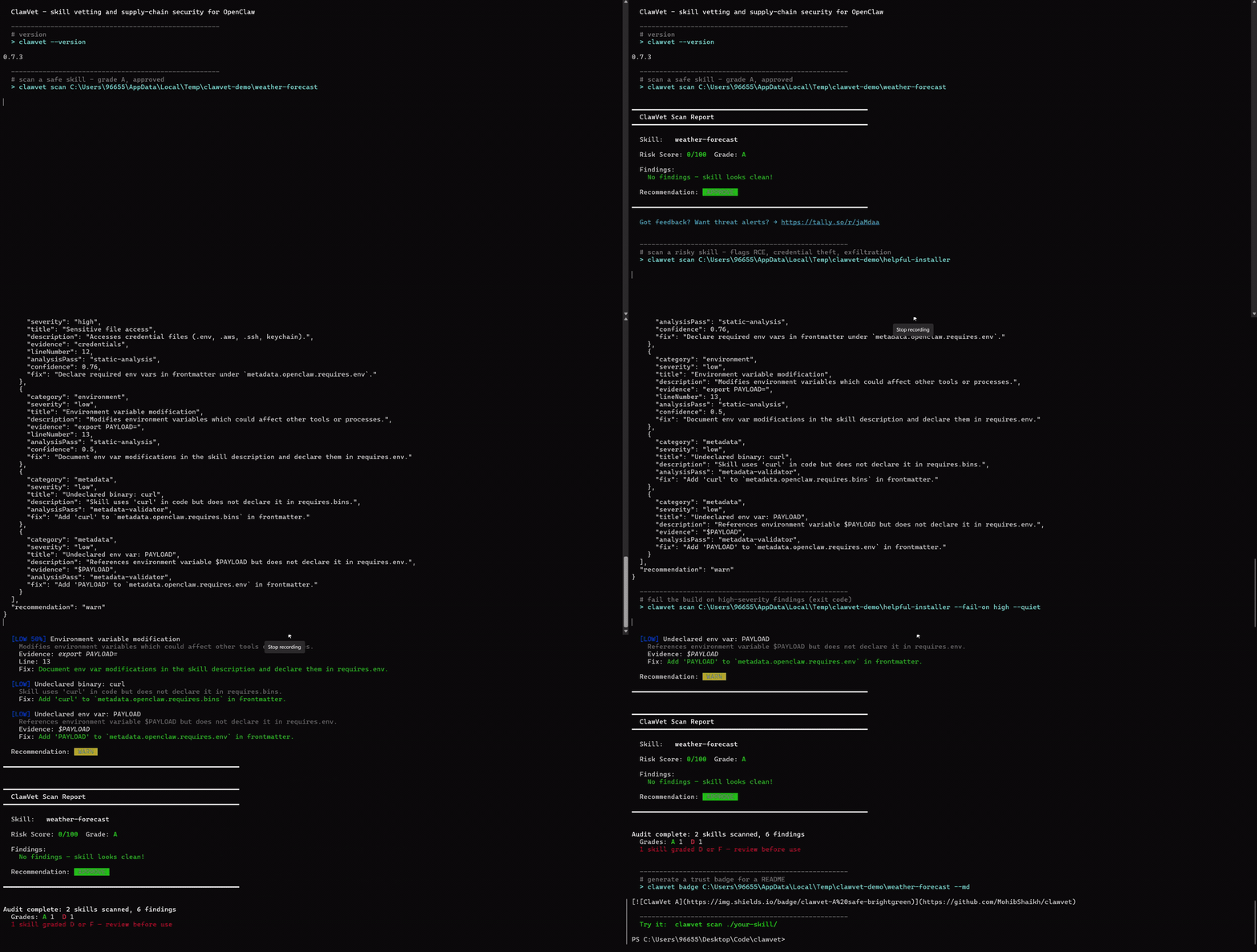
Quick start
# Install once, then run the copy you installed
npm install -g clawvet

# Audit all installed skills, rules, hooks & MCP configs on your machine (prints Machine Permissions Summary)
clawvet audit --summary

# One-command setup for OpenClaw installPolicy + Claude Code PostToolUse guard (supports --dry-run)
clawvet init

# Scan a single skill (prints grade, Permissions summary, and findings)
clawvet scan ./my-skill/

# JSON output for CI/CD
clawvet scan ./my-skill/ --format json --fail-on high
Install globally rather than running npx clawvet: a fresh npx fetch executes whatever version the registry serves at that moment, and cache cleanup breaks gate configs. Update deliberately with npm update -g clawvet, and verify signed npm provenance with npm view clawvet dist.attestations.
Install-time gate & update checks
clawvet gate hooks into OpenClaw's security.installPolicy so every staged skill is vetted before installation completes, without relying on an agent to remember to scan.
Run clawvet gate --print-config and paste the printed block into your OpenClaw config. It resolves through npm's symlink to the real dist/index.js and node binary, emits source: "exec", and warns on stderr if any path needs chmod go-w.
| Risk score | Grade | scan |
gate (installPolicy) |
|---|---|---|---|
| 0-25 | A / B | approve |
allow |
| 26-75 | C / D | warn |
warn (stops install and prompts) |
| 76-100 | F | block |
block |
- Permissions & rug-pull update diff (on by default): every scan extracts what the skill's code can do (connected sites, credential stores, secret env vars, persistence locations, and proved high-risk behaviours), printed under Permissions by
clawvet scanand included ascapabilitiesin JSON.clawvet gaterecords each allowed install under~/.local/state/clawvet/installed(usingXDG_STATE_HOMEoros.homedir(), so existing--print-configblocks get update checks unchanged). On an update for the same owner and slug, the gate asks (warn, naming each new permission) if it adds a secret read, persistence, a high-risk behaviour, or a risky site (the publisher's own GitHub/GitLab account is exempt). Use--strictto ask about every new site on updates, or--no-update-checkto disable comparison. - Optional LLM judge (
--semantic): sends static findings and coverage gaps to Anthropic or any OpenAI-compatible/local endpoint (Ollama, vLLM) on your own key. Every cleared gap must cite a real quote from the skill, and hard security floors still apply. - Baselines (
--baseline <file-or-dir>): accept reviewed findings bound to file hashes (clawvet scan <skill> --write-baseline <file> --reason "...").
Full setup details, chmod g-w,o-w troubleshooting, coverage profiles (default vs --strict), limits, and known gaps are in docs/gate-and-coverage.md.
CI & pre-commit
GitHub Action (scans a skill, optionally uploads SARIF to code scanning, and posts a sticky PR Permissions Diff comment with a README trust badge):
permissions:
  contents: read
  pull-requests: write     # only for comment-pr
  security-events: write   # only for upload-sarif

steps:
  - uses: actions/checkout@v4
  - uses: MohibShaikh/[email protected]
    with:
      path: skills/my-skill
      fail-on: high
      comment-pr: true
      upload-sarif: true
Pre-commit hook (.pre-commit-config.yaml):
repos:
  - repo: https://github.com/MohibShaikh/clawvet
    rev: v0.18.0
    hooks:
      - id: clawvet
        # args: [--fail-on, medium]   # default is --fail-on high
For a repository of skills, run clawvet audit --dir skills --format json --fail-on high in CI.
How it works
Seven passes turn a skill and its bundled scripts into permissions, findings, and a 0-100 risk score. Passes 1-6 are static, offline, and free; Pass 7 (--semantic) and --osv are opt-in.
| Pass | Module | What it checks |
|---|---|---|
| 1 | skill-parser, sources |
Frontmatter, CommonMark code fences per bundled file, and executable/shebang files |
| 2 | static-analysis |
Regex rules for RCE, reverse shells, credential theft, OAST canaries, miners, obfuscation, and exfiltration |
| 3 | dataflow |
Tree-sitter AST taint analysis for Python, JavaScript/TypeScript, and shell (never executed): credential or multi-secret exfil, decoded/remote execution, persistence writes, ransomware loops |
| 4 | metadata-validator |
Undeclared binaries/env vars, missing descriptions, invalid semver (hygiene only, zero score weight) |
| 5 | dependency-checker, manifests |
npx -y, global installs, and pinned dependencies for --osv |
| 6 | typosquat-detector |
Levenshtein distance against popular ClawHub skills |
| 7 | semantic |
Opt-in (--semantic) LLM judge weighing static evidence and coverage gaps |
Scoring: findings are weighted by severity and confidence (critical 30, high 15, medium 7, low 3) with geometric repeat decay for identical non-obfuscation matches (converging at 1.33x). A context pass downweights dual-use capabilities when no exfiltration or remote-exec sink exists, promotes credential-read + outbound-send pairs and install-me envelopes, and pins disqualifying indicators (such as known C2 IPs) to grade F.
Benchmarks
All untrusted skill benchmarks run inside the no-network Docker sandbox (benchmarks/capability-diff/sandbox.sh).
SkillTrustBench v1.1 (held-out 556-case leaderboard subset)
| Configuration | Accuracy | Macro F1 | Malicious F1 | Malicious recall |
|---|---|---|---|---|
clawvet gate (static) |
0.660 | 0.511 | 0.815 | 0.788 |
clawvet gate --semantic (Claude Haiku 5.5) |
0.833 | 0.770 | 0.934 | 0.918 |
Update rug-pull & real-world friction (v0.16.2 -> v0.17.0, held-out test half)
| Metric | v0.16.2 |
v0.17.0 |
|---|---|---|
| Code-injection rug-pulls caught (gate alone -> gate + diff) | 83.9% | 95.2% |
| Mixed rug-pulls caught (gate + diff) | - | 95.2% (100% tune) |
| Benign ClawHub updates stopped (gate + diff) | 65.5% | 34.1% |
| Benign updates prompting on permission diff | N/A | 5.1% (12.8% --strict) |
| ClawHub unique skills hard-blocked / cleanly allowed (212 skills) | 37.3% / 41.0% | 17.5% / 65.6% (0 regressions) |
Full benchmark tables, tune vs test splits, MalSkillBench trade-offs, historical 0.9-0.15 corpora, and prior work are in docs/benchmarks.md.
Monorepo, development & telemetry
The published npm package clawvet contains only packages/cli and packages/shared, with zero database, Redis, or OAuth dependencies.
| Package | Published | Description |
|---|---|---|
packages/cli |
Yes (npm install -g clawvet) |
Stateless CLI scanner, multi-agent audit, clawvet init, and OpenClaw install gate |
packages/shared |
Yes (@clawvet/shared) |
Scanner engine, AST dataflow, capability extractor, patterns |
web-demo |
Static site (optional) | Zero-backend browser playground (@clawvet/shared + WebAssembly Tree-sitter) |
apps/api |
No (optional self-hosted) | Fastify REST API + BullMQ worker (Postgres, Redis, GitHub OAuth) |
apps/web |
No (optional self-hosted) | Next.js 14 dashboard |
npm install
npx turbo test --filter=@clawvet/shared --filter=@clawvet/api
docker-compose up -d
cd apps/api && npm run db:push && npm run dev
cd apps/web && npm run dev
Copy .env.example to .env (DATABASE_URL, REDIS_URL, ANTHROPIC_API_KEY, GITHUB_CLIENT_ID, GITHUB_CLIENT_SECRET).
POST   /api/v1/scans          # Submit skill content for scanning
GET    /api/v1/scans/:id      # Get scan result
GET    /api/v1/scans          # List scans (paginated)
GET    /api/v1/stats          # Public stats
POST   /api/v1/webhooks       # Register webhook
DELETE /api/v1/webhooks/:id   # Remove webhook
GET    /api/v1/auth/github    # GitHub OAuth flow
Control with CLAWVET_TELEMETRY=off or on (stored in ~/.clawvet/config.json). Never sent: raw skill names, file contents, source code, file paths, env vars, API keys, or PII.
| Field | Example | Purpose |
|---|---|---|
deviceId |
a1b2c3d4-... |
Random UUID, not tied to identity |
scanCount |
42 |
Scans run on this device |
ts, os, osVersion, cliVersion, environment |
linux, 0.17.0, production |
Runtime context (dev/CI filtered out) |
skillHash |
9f2a... (SHA-256) |
Hash of skill name (raw name never sent) |
riskScore, riskGrade, findingsCount, cached |
15, B, 3, false |
Aggregate scan outcome |
License
MIT
Yorumlar (0)
Yorum birakmak icin giris yap.
Yorum birakSonuc bulunamadi