autodev
Health Uyari
- License — License: MIT
- Description — Repository has a description
- Active repo — Last push 0 days ago
- Low visibility — Only 7 GitHub stars
Code Gecti
- Code scan — Scanned 8 files during light audit, no dangerous patterns found
Permissions Gecti
- Permissions — No dangerous permissions requested
Bu listing icin henuz AI raporu yok.
Open the black box of vibe coding. A clarify-first Agent Skill: agree on a target — blueprint, passing test set, or benchmark threshold — then loop inside a judged worktree and hand off visible evidence. | 打开 VibeCoding 的黑盒:先与人对齐目标(blueprint/全绿测试组/benchmark 阈值),在裁决脚本监督的 worktree 中迭代,交付看得见的证据
English · 简体中文

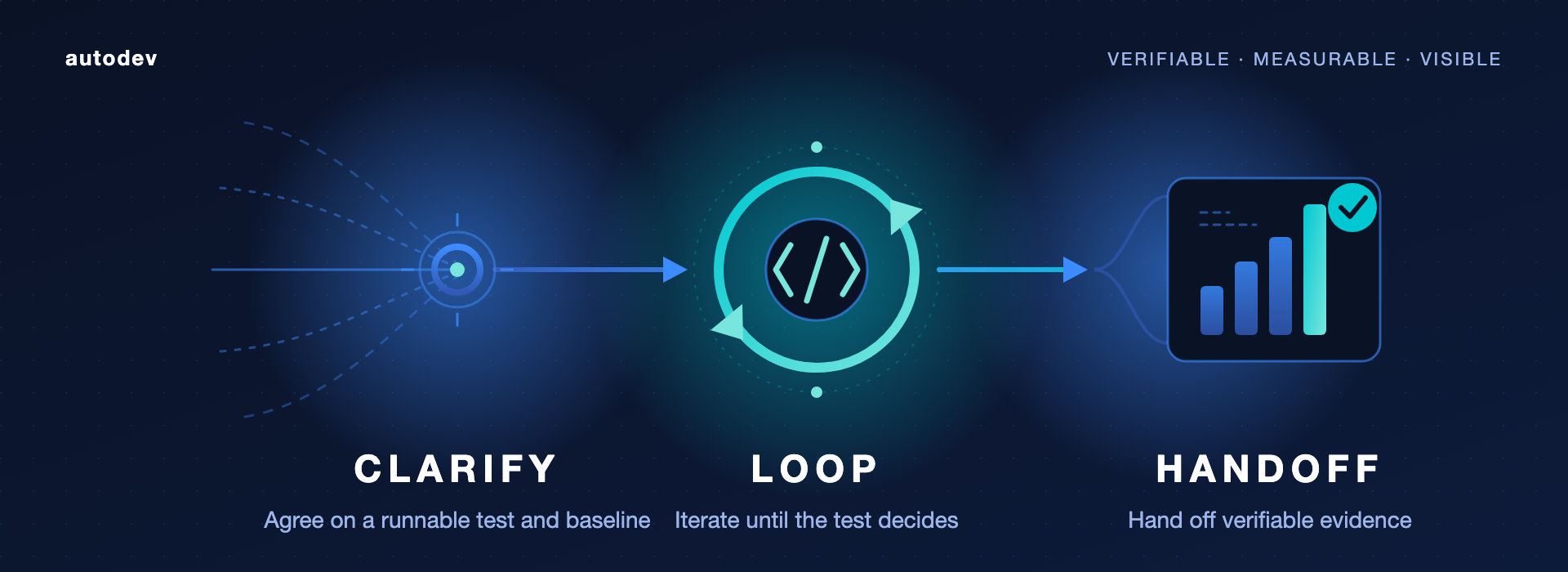
autodev is a clarify-first Agent Skill: align with the human, implement within the agreement, and hand off visible evidence.
npx skills add Momoyeyu/autodev -g
For feature development, bug fixes, and performance optimization. It works with agents that load SKILL.md and reuses the target project's existing tools.
Why autodev exists
Natural-language agreement does not guarantee shared understanding. An agent may implement the wrong behavior, change a workflow the human wanted to preserve, or optimize a number that does not represent the goal.
autodev exists to align the agent and the human, reduce misunderstanding, and reduce rework. Clarify turns intent into a human-approved target — a blueprint, a passing test set, or a benchmark threshold — plus a recorded baseline and explicit boundaries before implementation begins.
The intended benefit is better quality, stability, and overall efficiency, while improving the human's understanding of the project and ability to take over. Autonomous execution is useful only when both sides agree on what it should achieve.
Verifiable & Measurable & Visible
| Principle | Meaning |
|---|---|
| Verifiable | The agreed target, exact commands, and recorded outputs let the human check the result |
| Measurable | Baseline and final results use the same acceptance basis and comparable conditions |
| Visible | A feature ends with as-built diagrams, a bug fix with the passing test set, an optimization with a chart of its measured process |
These are requirements across the workflow, not three separate stages. Neither a passing test that misses the intent nor an attractive chart built from invented data is evidence of success.
How it works
User input → Clarify → Loop → Handoff. User input triggers the workflow; the three working stages are shared, while their scenario-specific details differ.
| Stage | Feature development | Bug fix | Performance optimization |
|---|---|---|---|
| Clarify | Draw as-is diagrams; draft the blueprint; propose scope; the human reviews the whole pass | Prepare runnable tests; record baseline; propose impact; the human reviews the whole pass | Prepare one runnable benchmark; record baseline; propose target, editable files, and time budget; the human reviews the whole pass |
| Loop | Implement until the as-built state realizes the blueprint and checks stay green | Fix until all agreed tests pass | Optimize until the target is met or time expires |
| Handoff | As-built diagrams checked against the blueprint | The agreed test set passing | One chart showing baseline, optimization attempts, and the final result |
Clarify is not just a conversation. Inspecting code, drawing diagrams, maintaining tests, trial runs, and baseline measurement are part of establishing the agreement. The human-in-the-loop cycle wraps the whole Clarify pass: the agent prepares the target artifact, records baseline, and proposes the scope, then the human reviews all of it once and decides whether to revise or enter Loop. Loop implements that agreement rather than deciding what success means along the way. It runs in a dedicated git worktree and branch so the user's checkout is never touched; every attempt is a commit, a rejected optimization attempt is reset to the best commit, and Handoff merges the branch back.
Feature development
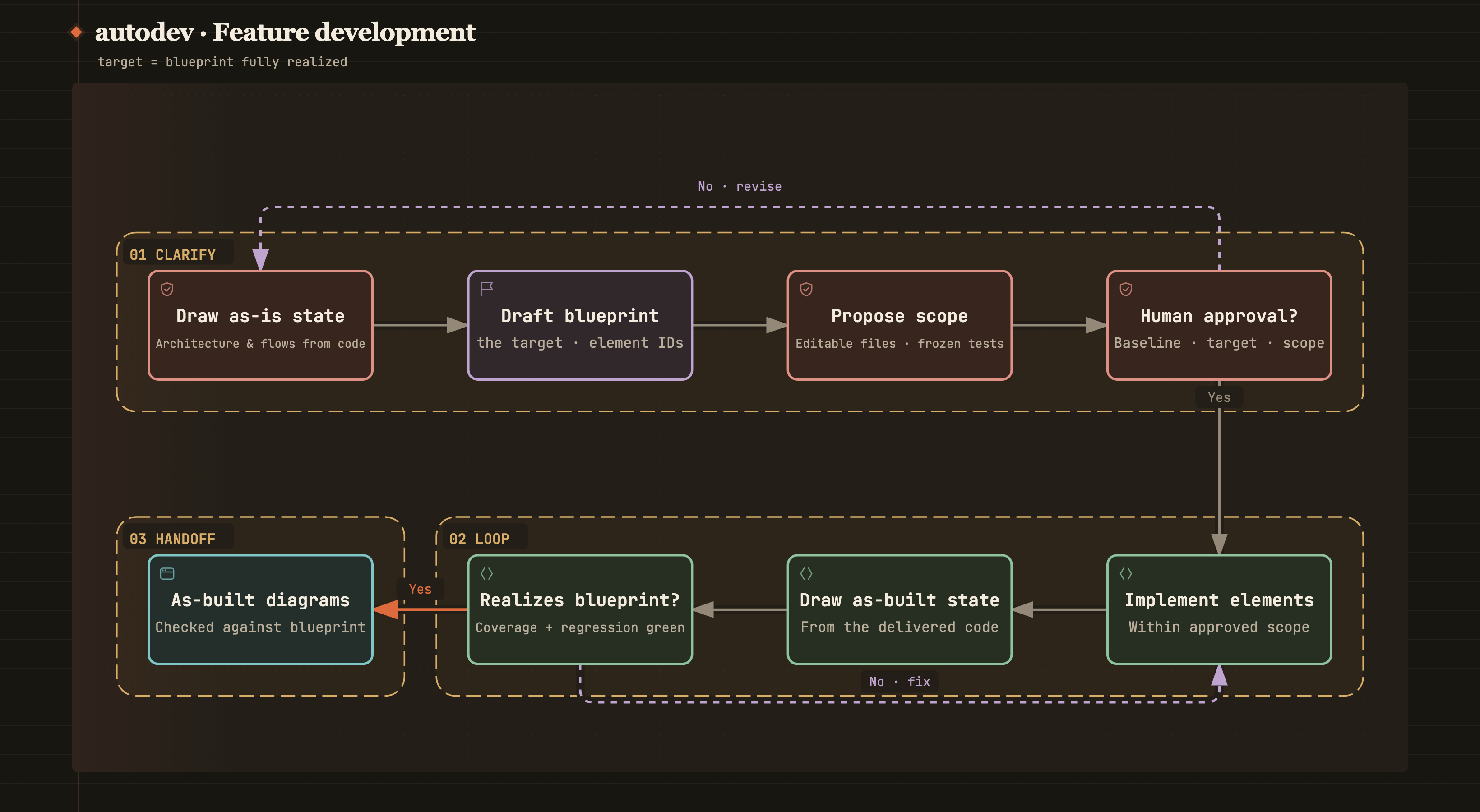
Feature work is driven by a blueprint, not by new tests — writing correct tests up front is often harder than the feature itself. One Clarify pass is: draw the as-is architecture and flow diagrams from the actual code (the baseline); draft the to-be blueprint in Mermaid with stable element IDs; then propose the editable scope, including whether existing tests stay frozen.
The human reviews the whole pass at once — as-is picture, blueprint, and proposed scope — and either sends it back for revision or approves it. Approval concerns an agreed design, not just a feature description.
Loop implements the blueprint element by element in a worktree. When the code is done, the agent draws as-built diagrams from the delivered state at the agreed path; the judge reports handoff only when every blueprint element is covered there and the regression check is green. If the as-built state does not truly realize the blueprint, the development is wrong — keep looping instead of exiting. Handoff shows blueprint and as-built side by side so the human can see the target and what was actually built.
Bug fix
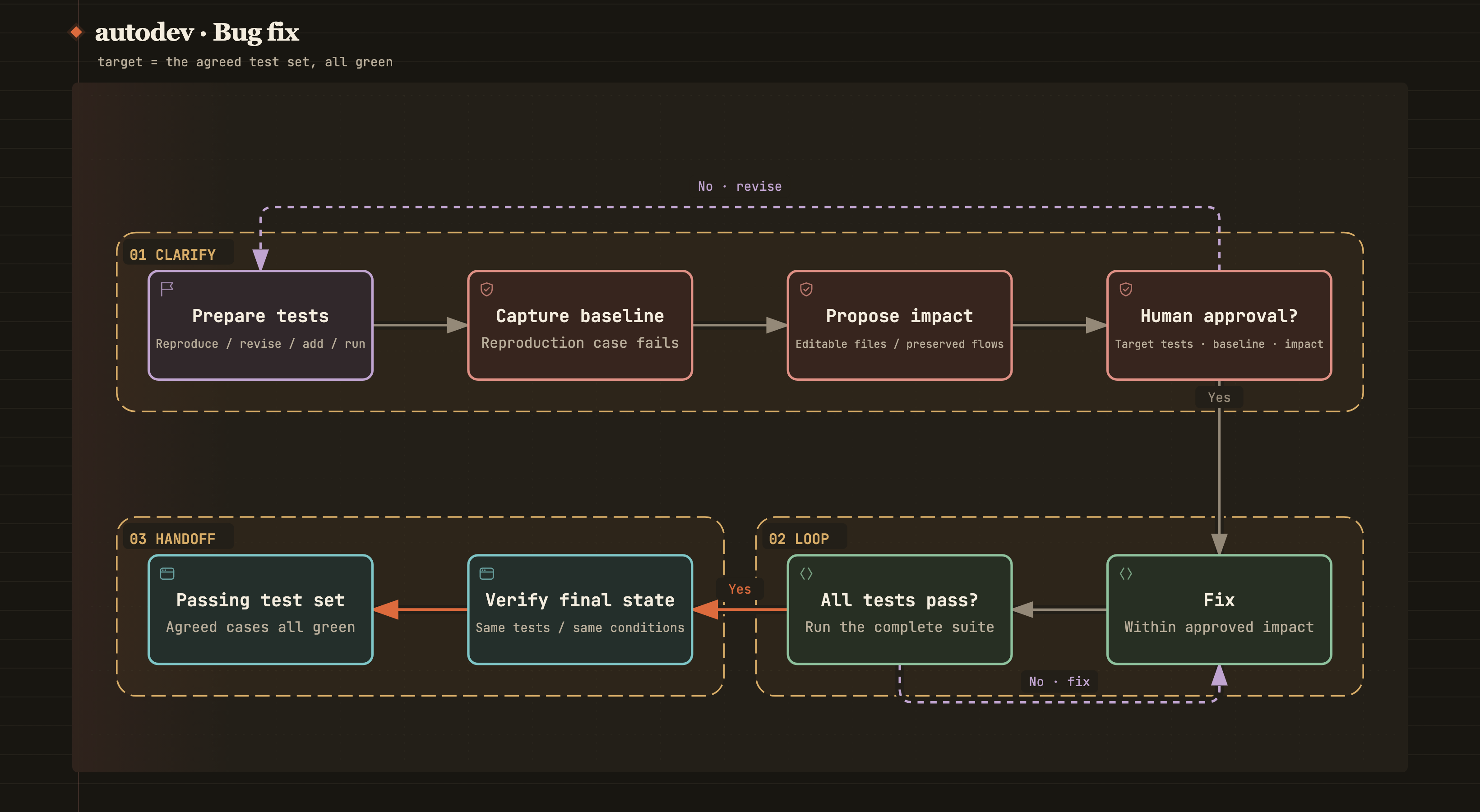
A bug report usually names the concrete failing case, which makes the target easy to pin down: a passing test set. One Clarify pass is: write the reproduction test that must fail on the unchanged source; query, revise, and add regression tests; run the set for the baseline; then propose the impact.
The human reviews the whole pass at once — runnable tests, baseline results, and proposed impact — and either sends it back for revision or approves it. “Can execute” does not mean “already passes”: the reproduction case should fail at baseline, and broken setup is not useful evidence.
Loop fixes until every agreed test passes; the test files are frozen and hash-checked each round. Handoff delivers the passing test set — each agreed case shown green with its raw output — not just a claim that the bug is gone.
Performance optimization
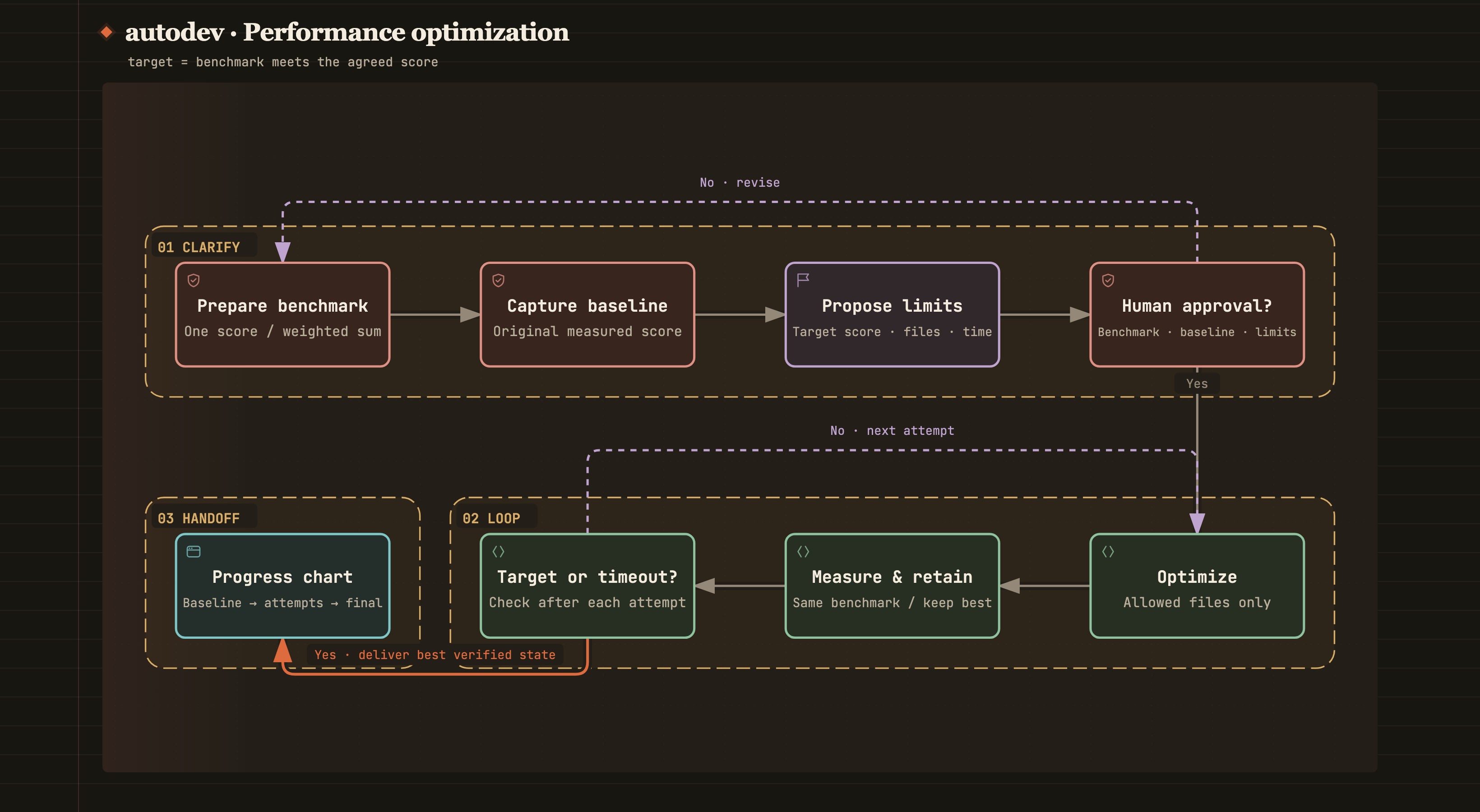
One benchmark, one score: an executable benchmark or a fixed weighted sum. Follow the solid arrows from benchmark preparation through baseline and proposed limits to one human review; the dashed paths repeat the Clarify pass or the optimization attempt. Loop uses do-while order: optimize, measure and retain the best verified state, then check the target and deadline. Repeat only if neither exit condition holds. Bound each run by the remaining wall-clock budget.
Fix the workload, unit, direction, measurement method, and any weights or normalization before baseline; the human confirms them together with the baseline and the limits. Multiple benchmark components still produce one score, not separate optimization targets. Do not change the ruler during Loop.
Retain the best verified candidate and record every attempt, including rejections and failures, so the chart describes what actually happened. A timeout ends the loop but does not imply the target was met. If baseline already meets the target or no improvement is verified, show that honestly rather than inventing a trajectory.
Reuse decisions already supplied by the human. Do not impose a fixed question count, invent a convergence stop, or silently extend a time budget.
What the human receives
| Feature development | Bug fix | Performance optimization | |
|---|---|---|---|
| Required artifact | As-built architecture and flow diagrams against the blueprint | The agreed test set passing | One chart of baseline → attempts → final result |
| What it shows | The approved target design next to what was actually built, per element | Outcomes of the same approved tests, including totals and unresolved failures | The one score over attempt order or time, target, retained result, and stopping outcome |
| What makes it verifiable | Blueprint and as-built diagrams, element coverage, and the rerun command | Test/source identities, raw results, and the rerun command | Benchmark/source identities, actual history, measurement conditions, and the rerun command |
Add concise notes about relevant changes, limitations, and where to continue. The human should be able to understand the result and take over without reconstructing the agent's decisions.
The artifact choice is part of the contract: a prose summary does not replace the as-built diagrams or the passing test set, and a table or a final number does not replace the optimization chart. The chart must show the recorded process, not only two favorable endpoints. Do not fabricate scores for failed or timed-out attempts.
If intent, target meaning, or permitted scope changes, return to Clarify and establish a comparable new baseline. Do not splice results from different baselines into a single improvement claim. If the human is not satisfied with a handoff, the follow-up is a fresh autodev round — typically a bug fix against the concrete problem.
What is enforced, and by what
autodev is a protocol plus one small judge. The Markdown tells the agent what to do; autodev/scripts/autodev_verify.py (Python 3, standard library, installed with the skill) makes the parts that can be checked mechanically actually checked, every round, with raw output kept.
| Guarantee | Provided by |
|---|---|
| Frozen files unchanged (tests, benchmark, blueprint), changes only inside the approved scope, time budget respected, score compared in the agreed direction with the agreed margin, rejected attempts rolled back with no residue, blueprint elements covered by the as-built file, every verdict logged with its raw output | autodev_verify.py: init in Clarify, start/attempt/status in Loop, report in Handoff. start first proves the checks bite by editing a frozen file and adding an out-of-scope file and requiring both to be rejected. |
| The blueprint is the right design, the tests measure the right thing, the proposed impact or limits are reasonable, as-built diagrams truly match the blueprint, the contract itself is approved | The agent's judgment where a check cannot be mechanical, and the human's single review of the whole Clarify pass |
| The artifact is read, the merged branch is accepted | The human at Handoff |
Installing the skill therefore does not by itself guarantee compliance; the contract directory it leaves behind does let the human check, round by round, whether the rules were executed rather than merely written. Nothing here is a runtime or a test framework: the judge only runs the project's own commands.
Get started
Install the skill with the command above, then describe the task normally:
Add CSV export for the filtered transaction list.
CSV export drops rows containing commas in the customer name.
Bring API p95 latency below 200 ms. Limit implementation changes to src/api/ and use a 20-minute optimization budget.
The first request starts with as-is diagrams and blueprint agreement. The second starts with a reproduction test that fails on the unchanged source. The third starts with benchmark agreement and baseline measurement; supplied limits are reused rather than asked for again.
Skill structure
| File | Load when |
|---|---|
autodev/SKILL.md |
At entry: purpose, principles, scenarios, and the three-stage contract |
references/clarify.md |
Starting Clarify or revisiting an agreement |
references/clarify-development.md |
Clarifying a feature request (blueprint) |
references/clarify-bugfix.md |
Clarifying a defect report (test set) |
references/clarify-optimization.md |
Clarifying a performance goal (benchmark) |
references/loop.md |
Starting Loop after agreement and baseline are ready |
references/handoff.md |
Preparing the required artifact |
scripts/autodev_verify.py |
Run, not read: init in Clarify, start/attempt/status in Loop, report in Handoff |
Read the current stage's shared rules and the applicable scenario only. Do not preload later stages or the other Clarify branch. Progressive disclosure is about providing detail when it is needed, even when a task eventually visits all three stages.
This repository distributes the skill and its judge script, not a test runner or evaluation suite. Targets are agreed with the human in the project where the skill is used; the judge only executes the agreed commands and records the verdicts. The README illustrations show the workflow itself, not example results.
Contributing
Keep the skill, bilingual READMEs, and diagram sources consistent. See CONTRIBUTING.md for diagram regeneration and verification, and AGENTS.md for repository conventions.
License
Yorumlar (0)
Yorum birakmak icin giris yap.
Yorum birakSonuc bulunamadi