guru-maker
Health Pass
- License — License: Apache-2.0
- Description — Repository has a description
- Active repo — Last push 0 days ago
- Community trust — 11 GitHub stars
Code Fail
- rm -rf — Recursive force deletion command in scripts/test-env.sh
Permissions Pass
- Permissions — No dangerous permissions requested
No AI report is available for this listing yet.
The memory layer for investment agents.
Guru Maker
Turn your ape agent into an investing guru.



Your ape agent is capable but stateless between investment tasks. It can
produce a sharp investment thesis today, then rebuild the same context from
scratch next month—or ask you to paste its old answer back into the prompt.
Guru Maker gives that work a durable, project-owned memory. It becomes a guru
not because it always knows the answer, but because it remembers what it knew,
why it decided, and what happened next.
Quick start
1. Install
For Codex:
codex plugin marketplace add monarchjuno/guru-maker
codex plugin add guru-maker@monarchjuno
For Claude Code:
/plugin marketplace add monarchjuno/guru-maker
/plugin install guru-maker@monarchjuno
/reload-plugins
Start a new task or session after installation.
2. Initialize
From the project whose investment memory you want to grow:
$guru-memory Initialize Guru Maker in this project.
In Claude Code, use/guru-maker:guru-memory Initialize Guru Maker in this project. Guru Mode
starts as auto and retains only small, reviewable improvements. Set it tooff when every memory update should require an explicit request.
3. Ask naturally
What's changed in this investment since the last review, and does it alter the
thesis?
After initialization, the host selects the fitting public Skill and uses
relevant project memory even when you do not mention Guru Maker, a Skill, or a
memory kind. In Guru Mode auto, an eligible durable result is also filed as
Wiki, Lens, Method, Evidence, or Decision without a separate save request.
Narrow answers and transient exploration remain conversational.
Use it naturally
1. Give it a map
Start by researching a reusable part of the world:
$guru-research Research the semiconductor manufacturing process. Retain the
reviewed, reusable process and value-chain map as a Wiki, including its scope
and limits.
The Wiki can preserve how wafer fabrication, HBM, advanced packaging,
substrates, testing, work in process, qualification lead times, shipments, and
revenue timing fit together. It keeps the stable causal map, not a permanent
view on any company or a stale market claim.
Wiki is not limited to finance or named securities. Reusable scientific and
technical knowledge, such as how quantum error correction constrains logical
qubit scaling, belongs there when it can materially improve later company or
industry research. Current experimental results, benchmark results, dated
vendor roadmaps, and current company claims remain provenance-bound Evidence
rather than timeless Wiki facts.
2. Make the next research task better
Later, ask a broad question:
$guru-research Research fictional Atlas Silicon as an AI semiconductor
investment using current sources and relevant project memory.
| Without the Wiki | With the Wiki |
|---|---|
| Reconstructs the industry or gives a generic growth and valuation review. | Starts from the reviewed process map and spends the task on company-specific evidence. |
| Asks broadly about capacity and orders. | Traces bottlenecks across wafers, HBM, packaging, substrates, test, and qualified output. |
| May repeat old process research. | Reuses the stable map while re-checking every current company and market claim. |
The Wiki does not make Atlas Silicon bullish. It gives the agent a better map
of what to investigate and makes the remaining evidence gaps more precise.
3. Turn reviewed experience into a Lens
A material judgment can use that Wiki together with current Evidence:
$guru-decision Should we initiate a position in Atlas Silicon? Record the
judgment, assumptions, risks, and invalidation conditions.
After the thesis has had time to meet reality:
$guru-decision Review the outcome. Separate what the process got right from
what was luck, and preserve the later judgment without rewriting the first.
Suppose the review finds that demand was correctly identified but value accrued
elsewhere in the supply chain. That is a candidate lesson, not yet a rule. Test
it against an adjacent case and a counterexample:
$guru-train Test whether this review supports a reusable constraint-migration
Lens. Record it only if the interpretation survives a counterexample, with
clear applicability, falsifiers, and limits.
If the lesson survives, the Lens can guide future research toward the binding
constraint, how quickly it can move, and where economic value accrues. It
guides the next investigation without dictating its answer.
From ape to guru
The example above compounds through a reviewable loop:
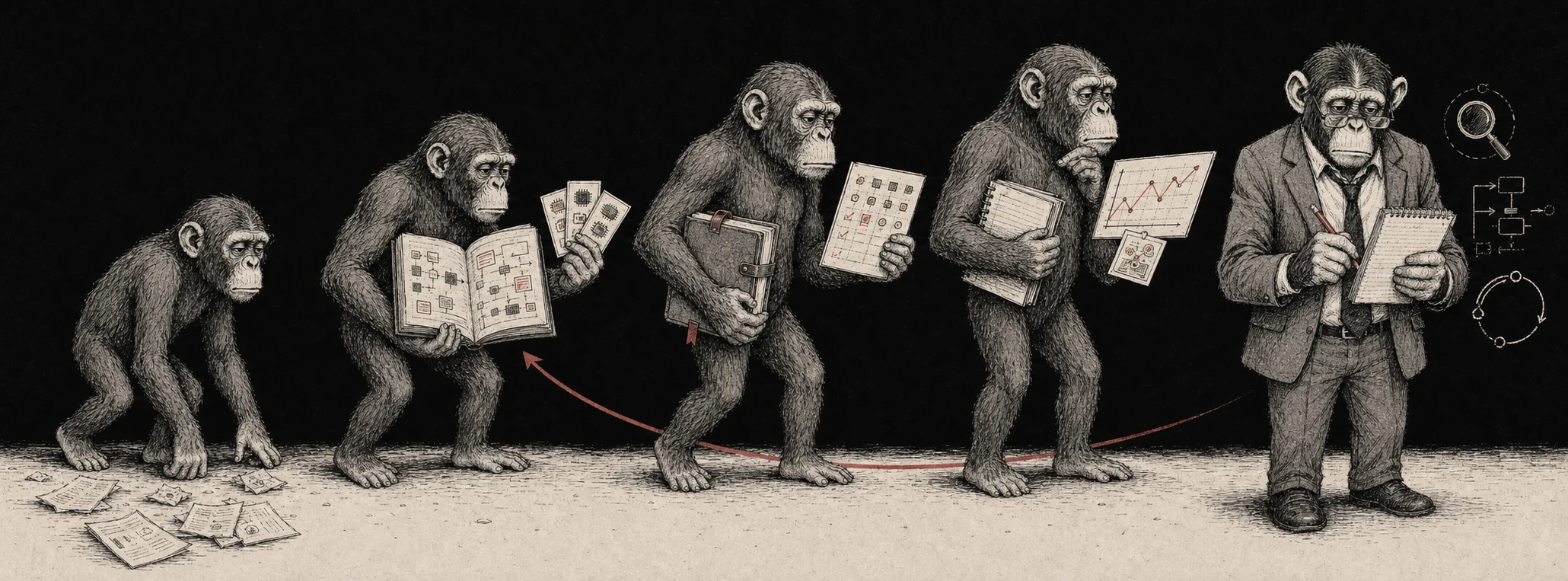
Wiki makes it informed. Lens makes it discerning. Decisions make it
accountable. Reviews make it better.
This is capability growth, not a mandatory workflow. A factual question can
remain conversational. Research may stop with sourced Evidence or a reusable
Wiki. Only a material judgment becomes a Decision, and only a lesson that
survives review deserves to improve a Lens or Method.
Generalize without overfitting
Guru Maker escalates abstraction, not confidence.
One observation       ──X──> Universal Lens
One winning Decision  ──X──> Permanent rule

Repeated cases + counterexample + process-versus-luck review + explicit limits
                              └──> Reusable Lens or Method
- Put current observations and material judgments in point-in-time Evidence and
Decisions. - Put stable structure in Wiki and repeatable procedures in Method.
- Promote an interpretation to Lens only with counterexamples, applicability,
falsifiers, and limits. - Treat memory as context, not authority. Current claims still require current
evidence.
The same contract applies across equities, rates, FX, crypto, technical, and
quantitative work. The semiconductor walkthrough is an example, not a required
workflow.
Memory model
The host agent owns research, judgment, tools, and permissions. Guru Maker owns
the project-memory contract and deterministic operations around it.
Each project keeps five kinds of durable investment memory:
| Kind | Directory | Purpose |
|---|---|---|
| Wiki | guru-maker/wiki/ |
Stable descriptive context, conventions, constraints, and domain knowledge |
| Lens | guru-maker/lens/ |
An interpretation, heuristic, or hypothesis with scope and limits |
| Evidence | guru-maker/evidence/ |
A provenance-bound observation or reproducible derived result at a stated time or data window |
| Method | guru-maker/method/ |
A repeatable research, calculation, model, or review procedure |
| Decision | guru-maker/decision/ |
A material judgment under stated information, constraints, and uncertainty |
Records stay as ordinary project-owned Markdown. See the
knowledge model for schemas, relationships,
point-in-time rules, retrieval, and Guru Mode behavior.
The kinds share a small Markdown envelope but not one lifecycle. Wiki is a
connected explanatory library; Lens is a small set of bounded
interpretations; Method is a procedure catalog; Evidence is an append-oriented
observation log; and Decision preserves judgment revisions.
Wiki records may name a few related local Wiki IDs with see_also. Guru Maker
validates those exact references and derives backlinks on demand for explicit
one-hop navigation. It does not infer links, recurse through a graph, add Wiki
links to the Decision Graph, rank search by backlinks, or automatically load
neighbor content.
Ordinary retrieval uses small candidate cards, then exact-reads only the
selected records. Exact IDs, entities, and numbers remain deterministic; the
host agent owns semantic selection. Lightweight subagent reranking remains an
evaluation-gated host option, not recommended default behavior, until it
improves Top-1 selection by at least five percentage points on a representative
ambiguous holdout. No fixed router is required.
In Guru Mode auto, an eligible memory write also keeps its immediate
neighborhood tidy: it checks for an existing concept, uses the kind-specific
update policy, reuses stable subject folders, and performs bounded local
cleanup before validation. It never runs in the background or silently
performs bulk moves, ID changes, deletion, history rewriting, Pack work, or Git
work.
Auto works from ordinary natural-language investment requests after the
project is initialized. Material research and judgment tasks reuse targeted
project memory first; completed work is stored only when it is independently
useful and likely to change a later task. The host classifies the durable
payload rather than asking the user to choose: stable explanation becomes
Wiki, a reviewed bounded interpretation becomes Lens, a repeatable procedure
becomes Method, a dated sourced observation becomes Evidence, and a material
point-in-time judgment becomes Decision. Ordinary tasks normally make one
primary memory improvement.
Public Skills
Host agents discover five public Skills:
| Skill | Use it for |
|---|---|
guru-research |
Research with current evidence and relevant project memory. |
guru-memory |
Initialize, find, retain, correct, and curate memory or change Guru Mode. |
guru-decision |
Analyze, record, and review point-in-time judgments. |
guru-train |
Turn reviewed scenarios and corrections into reusable improvements. |
guru-packs |
Explicitly manage and share GitHub-backed data-only memory packs. |
Documentation
- Installation
- Knowledge model and retrieval
- Decision memory and graph
- Guru Pack contract
- Architecture and product boundaries
Measured evolution
Markdown records and authored relationships remain canonical. These are
evaluation gates, not promised features. The current retrieval remains
project-scoped lexical candidate search followed by exact-ID reads. Any future
derived layer must be rebuildable from local Markdown and ignore Pack source
checkouts.
- Hybrid semantic retrieval. Only if a labeled project corpus shows lexical
Recall@K missing a stated target across terminology, language, or conceptual
variation, evaluate a rebuildable semantic index as a supplement to lexical
search. Exact IDs, numeric literals, and authored metadata remain
authoritative. Embeddings or a vector store require an explicit revision of
the current product boundary before implementation.
Any accepted extension must improve a stated retrieval or navigation metric
without unacceptable precision, context-token, latency, or migration cost.
Development
See CONTRIBUTING.md and the
development guide.
Reviews (0)
Sign in to leave a review.
Leave a reviewNo results found