Monet
Health Warn
- License — License: MIT
- Description — Repository has a description
- Active repo — Last push 0 days ago
- Low visibility — Only 5 GitHub stars
Code Fail
- process.env — Environment variable access in electron.vite.config.ts
- rm -rf — Recursive force deletion command in install.sh
Permissions Pass
- Permissions — No dangerous permissions requested
This application is a local-first, macOS desktop video editor that integrates coding agents like Claude Code or Codex. It allows AI agents to directly manipulate a multi-track video timeline, perform local transcriptions, and manage media through a built-in terminal.
Security Assessment
The overall risk is Medium. The tool functions by executing shell commands and running an embedded terminal, which is its intended purpose but inherently exposes the system to agent-driven actions. A notable security concern is the installation method, which heavily encourages piping a remote script directly into bash (`curl | bash`). An automated audit fails this installation script because it contains a recursive force deletion command (`rm -rf`). While this is common in cleanup scripts, it is highly dangerous if the remote repository is ever compromised or the script is altered. Additionally, the codebase accesses environment variables, which is expected for fetching API keys for OpenAI, but requires careful handling. No dangerous broad system permissions or hardcoded secrets were found.
Quality Assessment
The project is very new and currently has extremely low community visibility with only 5 stars on GitHub. However, it appears to be under active development, with repository pushes occurring as recently as today. The code is properly licensed under the standard MIT license, and the documentation clearly outlines its capabilities and limitations.
Verdict
Use with caution—the agent-driven shell execution and risky remote installation script pose potential threats, so developers should thoroughly inspect the `install.sh` file before running it.
Edit videos with Claude code or Codex
Monet
AI video editor for coding agents

Local-first editing, terminal-native agent workflows, real timeline operations, local transcription, and export in one macOS app.
Built by Het Patel
curl -fsSL https://raw.githubusercontent.com/Monet-AI-Editor/Monet/main/install.sh | bash
What Monet Is
Monet is a desktop video editor designed for people who want coding agents to work on video directly, not through a fragile bridge into another editor.
The app combines:
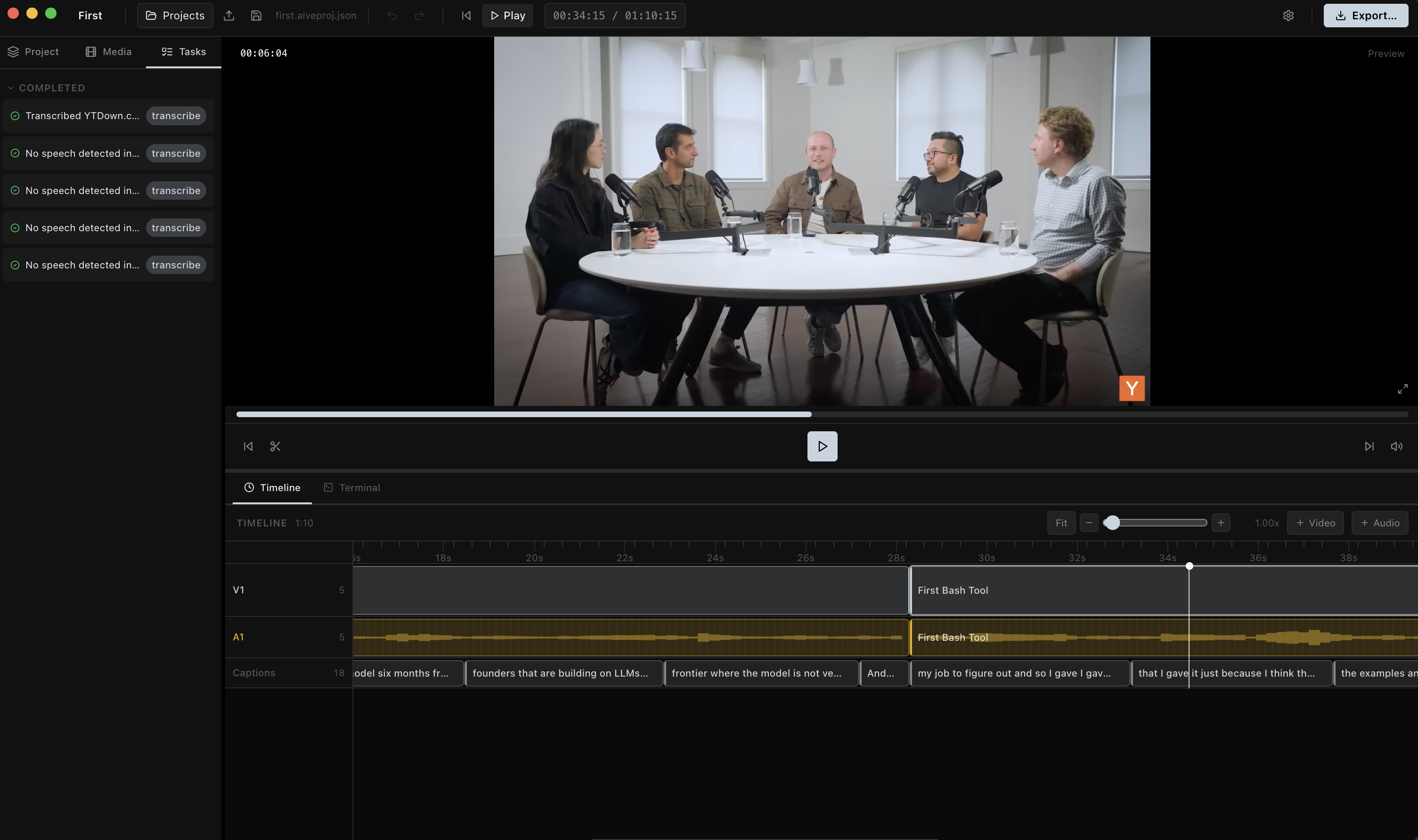
- a real timeline and preview
- local project files with autosave and recovery
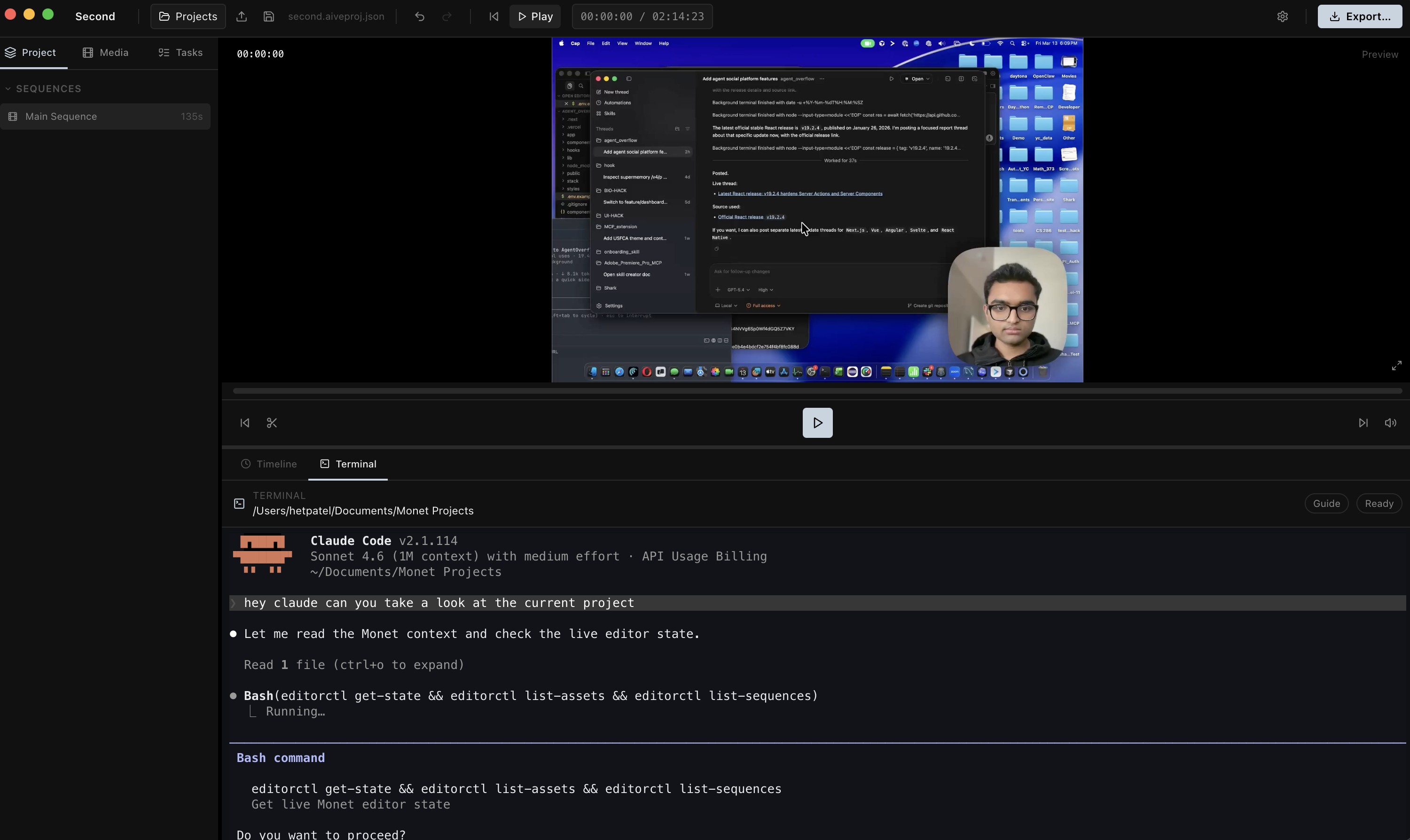
- an embedded PTY terminal for Claude Code, Codex, and other terminal agents
- deterministic editor tools through
editorctl, a local API bridge, and MCP - local transcription with
faster-whisper - semantic search powered by embeddings when an OpenAI key is configured
- the same OpenAI key can also be reused for GPT Image 2 generation
Monet is not a chat demo wrapped around a timeline. The terminal, project graph, and editor runtime are the product.
Features
Agent-native terminalClaude Code and Codex can run inside Monet's built-in terminal with project-aware context, live editor access, and deterministic commands througheditorctl.
|
|
Real timeline editingImport media, scrub, trim, split, move, duplicate, ripple edit, generate captions, add markers, and export from a real multi-track timeline. |
|
- Terminal-first AI workflow — Use Claude Code or Codex directly in the app instead of relying on a built-in chatbot abstraction
- Deterministic editing tools —
editorctl, local API bridge, and MCP entrypoint for inspect/edit/export operations - Local transcription — Uses
faster-whisperon-device by default, with OpenAI fallback when configured - Semantic search — Search spoken content, metadata, and embedded project context
- Autosave and recovery — Reopen current work, recover sessions, and manage multiple saved projects
- Export pipeline — 720p, 1080p, and 4K outputs, export progress UI, and one-click
Show in Finder - Basic motion and compositing — transforms, opacity, text overlays, chroma key, and layered export baking
- Privacy-aware telemetry — Anonymous usage analytics are optional; Sentry handles crash reporting
Why Monet
Most AI video workflows today still depend on a human driving Premiere, Resolve, or another editor by hand. Even when tools exist, they usually stop at prompts, scripts, or rough cuts.
Monet is built around a different model:
- the project is a structured graph, not an opaque binary
- the terminal is a first-class editing surface
- agents can inspect the live editor state, import media, search transcripts, cut sequences, and export results
The goal is simple: make video editing something coding agents can actually operate.
Install
macOS app
Monet is currently macOS-first. Install with one command — no Gatekeeper prompts:
curl -fsSL https://raw.githubusercontent.com/Monet-AI-Editor/Monet/main/install.sh | bash
This fetches the latest release ZIP directly (bypassing browser quarantine), installs Monet.app to /Applications, and launches it.
For a local packaged build from source:
npm install
npm run dist:mac
That produces stable release artifact names like:
release/Monet-macOS-arm64.dmgrelease/Monet-macOS-arm64.ziprelease/mac-arm64/Monet.app
Run from source
Requirements:
- Node.js 18+
ffmpegon your system path- macOS
- optional telemetry env vars via a local
.env
Optional local transcription runtime:
npm run setup:local-transcription
Start the app:
npm install
npm run dev
If you want Sentry and Aptabase enabled locally or in release builds, set env vars outside git-tracked files:
cp .env.example .env
Available vars:
MONET_SENTRY_DSNMONET_APTABASE_APP_KEYVITE_MONET_SENTRY_DSN
For local use, VITE_MONET_SENTRY_DSN can usually match MONET_SENTRY_DSN.
First Run
On first launch, Monet asks for:
- an OpenAI API key for embeddings and semantic search, with the same key reusable for GPT Image 2 generation
- an explicit anonymous usage analytics choice
- nothing else up front
Claude Code and Codex installation help is shown next to the terminal when needed, instead of blocking onboarding.
What Agents Can Do
Through the embedded terminal, editorctl, API bridge, and MCP surfaces, agents can:
- inspect the current project and active sequence
- list assets, tracks, clips, markers, and segments
- import media from disk
- split, trim, move, duplicate, rename, and remove clips
- add tracks and transitions
- generate captions from transcript segments
- create rough cuts and selects from search results
- extract frames and create contact sheets
- run transcription
- export the active sequence
Example:
editorctl get-state
editorctl list-assets
editorctl search-segments "terminal workflow"
editorctl export /tmp/monet-export.mp4 high 1080p mp4
Local AI Stack
Monet is intentionally local-first.
- Transcription: local
faster-whisperby default - Embeddings: OpenAI API key required
- GPT Image 2 generation: the same OpenAI API key can be reused
- Export: local
ffmpeg - Project files: plain
.aiveproj.jsonfiles plus autosaves
If embeddings or transcripts do not exist yet, Monet should say that directly instead of pretending otherwise.
Project Model
Monet projects are structured, inspectable, and tool-friendly.
That includes:
- assets
- sequences
- tracks
- clips
- transcript segments
- markers
- captions
- effects
- exports
This is what allows coding agents to operate the editor directly instead of scraping the UI.
Current Scope
Monet already supports:
- timeline editing
- preview and scrubbing
- autosave / recover
- local transcription
- semantic search foundations
- captions and markers
- terminal-native agent workflows
- packaged macOS app builds
Monet is still evolving in areas like:
- richer color finishing
- deeper motion tooling
- broader codec coverage
- more advanced compositing
- wider platform support beyond macOS
Privacy
Monet does not collect project content for analytics.
That means:
- no filenames
- no prompts
- no transcript text
- no media content
- no API keys
Anonymous usage analytics are optional. Crash reporting is handled separately.
Telemetry keys are injected from environment variables at build time and are not stored in the repository.
Build
npm run build
Other useful scripts:
npm run dev
npm run typecheck
npm run build:cli
npm run build:mcp
npm run dist:mac
Repository Layout
src/main— Electron main process, project store, export, transcription, terminal, updater, analyticssrc/renderer— React app UIsrc/cli—editorctlsrc/mcp-server— MCP server entrypointresources— screenshots and app icon assetsrelease— packaged macOS artifacts
Status
Monet is already usable as a real macOS app, but it is still best described as an early public alpha rather than a finished mass-market editor.
If you want to help shape it:
- open issues
- test the app on real media
- try the terminal agent workflow
- report reliability problems before polish problems
License
Monet is released under the MIT License.
Reviews (0)
Sign in to leave a review.
Leave a reviewNo results found