forge
Health Gecti
- License — License: MIT
- Description — Repository has a description
- Active repo — Last push 0 days ago
- Community trust — 10 GitHub stars
Code Gecti
- Code scan — Scanned 12 files during light audit, no dangerous patterns found
Permissions Gecti
- Permissions — No dangerous permissions requested
Bu listing icin henuz AI raporu yok.
Local-first action assistant for durable, reviewable software work.
Forge
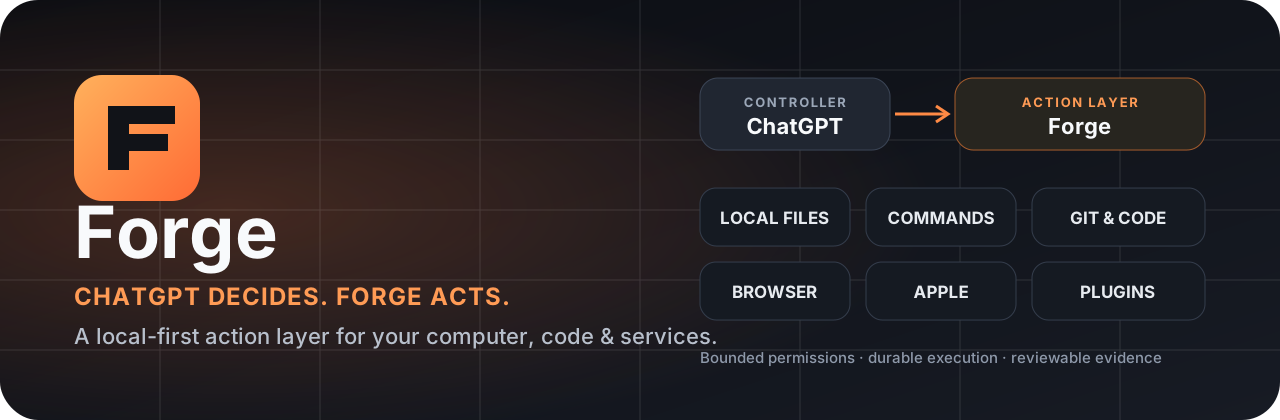
Your local-first action assistant for software work.
Forge connects ChatGPT to your real local development environment so it can inspect current project state, make bounded changes, run checks, manage long-running commands, and return reviewable evidence instead of relying only on chat memory.
What Forge can do
- Work with real local repositories — register multiple repositories once, then bind every operation to an explicit repository and checkout.
- Keep small work lightweight — understood, bounded changes use the Direct path; inspection alone does not force a Plan, Issue, Agent, or worktree.
- Manage long commands without re-running them — builds and tests use one stable Process lifecycle that can be queried, waited on, inspected, or cancelled.
- Run independent work concurrently — unrelated repositories can progress in parallel; one repository can use separate worktrees when isolation is actually needed; the same checkout remains single-writer.
- Reuse valid verification — equivalent checks can coalesce or reuse evidence while content or environment changes invalidate stale results.
- Inspect explicit unregistered folders — bounded one-off local workspace actions do not silently register a repository or initialize Git.
- Recover execution state — repository identity, work, processes, verification, release state, and recovery facts survive individual chat turns.
- Keep hard boundaries explicit — remote writes, destructive effects, outside-workspace access, and secrets remain policy-gated.
- Extend through typed plugins — optional capabilities reuse the same local Controller without widening the normal ChatGPT surface.
How ChatGPT uses Forge
The normal ChatGPT connector exposes a bounded 19-tool MCP surface. Five stable facades — rh_status, rh_access, rh_inbox, rh_context, and rh_work — cover most orchestration; repository, source/patch, check, Process, plugin-dispatch, and result tools complete the default surface.
You normally do not choose tools yourself. Ask for the outcome in natural language; Forge is designed to choose the shortest valid execution path.
Small task:  inspect -> relevant context -> Direct Edit -> focused check -> commit
Long task:   resolve identity -> durable work only if needed -> Process/worktree -> verify -> integrate -> clean
Examples:
- “Use Forge to find why this test fails, fix it, run the focused tests, and commit.”
- “Compare these two registered repositories and update them independently.”
- “Run the build; if it takes time, keep using the same Process instead of starting it again.”
- “Inspect this local folder without registering it.”
- “Check the current Runtime and tell me what actually blocks release.”
Why Forge
- Real state lives outside the chat — Git state, repository identity, execution state, checks, and evidence remain locally addressable.
- Direct-first execution — heavier workflow machinery is reserved for recovery, isolation, dependencies, long-running work, or real risk.
- Explicit execution identity —
repoIdpluscheckoutIdprevents one session from silently acting on another checkout. - Reviewable effects — localized diffs, exact checks, Process receipts, and release evidence show what actually happened.
- Local control — the Canonical Runtime and recovery authority stay on the local machine.
- Stable client contract — tool-schema changes are fenced as recoverable reinitialization instead of silently using a stale schema.
Release status
The current source version is 1.4.0-rc.6. The npm package @moretea-labs/forge is not public yet. Source version, release readiness, GitHub Release, and npm publication are separate facts; an immutable revision must pass the release gate before publication.
Quick start
Requirements: Git, Node.js 20.10 or newer, npm, and a writable home directory. Bun 1.0+ is optional for installed use and recommended for source development and the complete test suite.
git clone https://github.com/moretea-labs/forge.git
cd forge
npm ci --ignore-scripts --no-audit --no-fund
npm install -g . --omit=optional --no-audit --no-fund

forge --version
forge setup open --target both
# complete the printed action, then continue:
forge setup next
forge setup close
forge doctor
Register or adopt a repository:
forge adopt --repo /path/to/your-project --dry-run
forge adopt --repo /path/to/your-project
forge repo list --json
Maintained first-use path:
When the npm RC is published:
npm install -g @moretea-labs/forge@next
# or consume the same package with Bun:
bun add -g @moretea-labs/forge@next
Execution model
Direct is the default for bounded, understood work. Process Runtime owns commands and checks that need a process lifecycle: a command is spawned once and later status/wait/log/cancel operations attach to that same execution. Durable work and worktrees are used when recovery, isolation, dependencies, concurrency, or a longer lifecycle actually requires them. Canonical Runtime + Recovery provide one active local Runtime authority and an independent recovery boundary.
See Core Concepts, Work Lifecycle, Runtime Architecture, and Implementation.
Safety and product identity
Forge separates observation, normal local changes, remote effects, destructive actions, outside-workspace access, and secrets. Full Access removes repetitive approval for ordinary local repository work; it does not weaken destructive, remote, or secret boundaries. See Security Model.
The active product identity is Forge. Public commands are forge, forge-hook, and forge-runtime. Historical legal attribution and explicit read-only migration fallbacks may retain former upstream identifiers because rewriting historical evidence would be incorrect.
Documentation and support
- Documentation hub · Wiki · Architecture · Implementation
- Public usage guide · Platform support · Troubleshooting · Release process
- Bugs/docs: GitHub Issues · Usage: SUPPORT.md · Security: SECURITY.md
- Contributions: CONTRIBUTING.md · Releases: CHANGELOG.md
Forge remains in release-candidate hardening; releases are created only from a revision that passes the published release gate.
License and attribution
Licensed under the MIT License. Upstream copyright and permission notices remain part of the distribution; see NOTICE and THIRD_PARTY_NOTICES.md.
Yorumlar (0)
Yorum birakmak icin giris yap.
Yorum birakSonuc bulunamadi