jacobian
Health Warn
- License — License: MIT
- Description — Repository has a description
- Active repo — Last push 0 days ago
- Low visibility — Only 5 GitHub stars
Code Pass
- Code scan — Scanned 12 files during light audit, no dangerous patterns found
Permissions Pass
- Permissions — No dangerous permissions requested
No AI report is available for this listing yet.
Jacobian: an MCP server, CLI, and Python library that gives AI agents a composable toolbox of mathematical capabilities with inspectable artifacts and independent verification.

Jacobian
Executable mathematics for agents. Evidence an independent checker can replay.
An MCP server, CLI, and Python library for conjectures, counterexamples, exact computation, and formal proof.




Quickstart · Verification · Capabilities · Documentation · Contributing
Jacobian gives AI agents small, composable mathematical operations rather than
one opaque solver. An agent can construct an object, compute an invariant,
search for a witness, and submit exact evidence to a separate checker. Every
step remains visible as a typed result or artifact.
The trust boundary is deliberate: a search result, solver status, model answer,
timeout, or score is never promoted directly to VERIFIED. Only an
operator-authorized checker may emit a verified record, bound to the exact
claim, candidate, scope, semantics, certificate format, and checker identity.
Quickstart
The npm launcher installs Jacobian and configures supported MCP clients:
npm install -g jacobian
jacobian setup
jacobian doctor
The launcher supports Claude, Codex, Cursor, Gemini, and OpenCode. It requires
Node.js 18 or newer, Python 3.12, anduv. Run jacobian mcp to start the server
directly.
git clone https://github.com/morluto/jacobian.git
cd jacobian
uv sync --dev
uv run jacobian --state-dir .jacobian init
The default init output is a short onboarding summary. Add init --json
when a script needs the complete reference catalog.
Use uv run jacobian --help to inspect the CLI or uv run jacobian-mcp to
start the MCP adapter.
How verification works
Jacobian separates finding evidence from deciding what that evidence proves.
Suppose an agent is testing the claim “F is injective.”
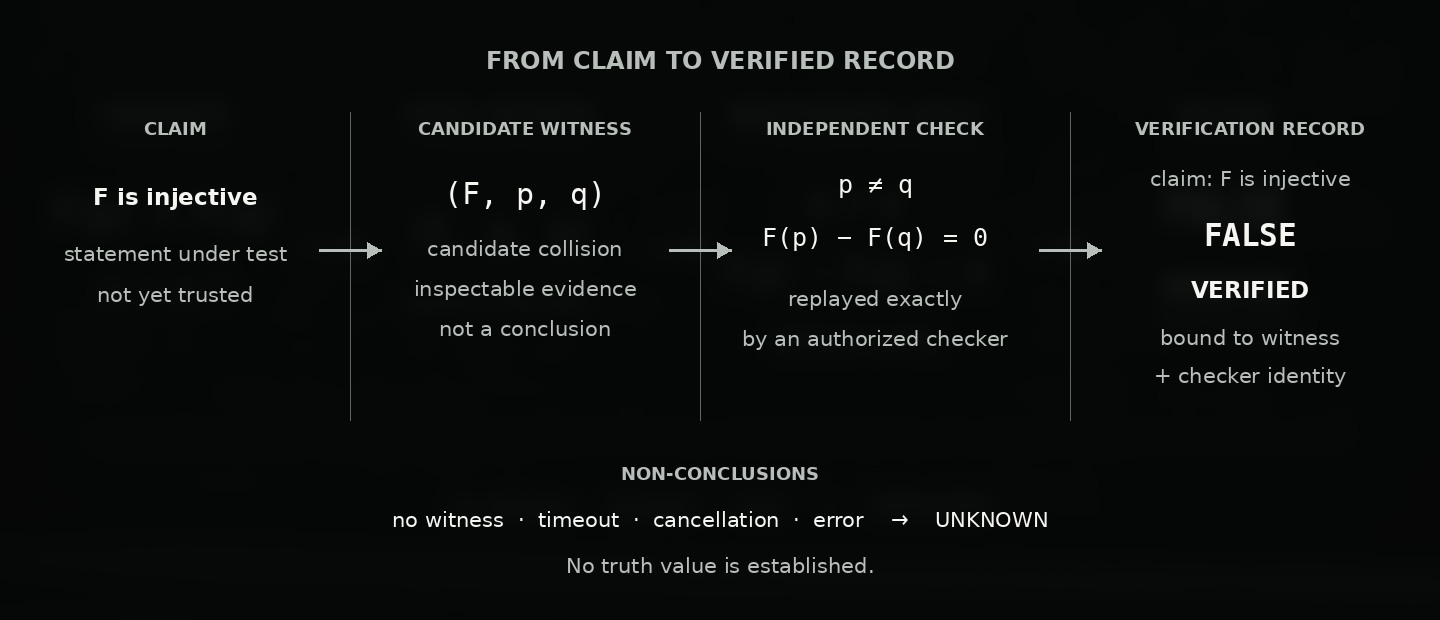
Claim → candidate witness → independent check → verification record
| Stage | Output | What it establishes |
|---|---|---|
| Claim | F is injective |
The statement to investigate; not yet trusted |
| Search | A candidate witness (F, p, q) |
Inspectable evidence, not a conclusion |
| Independent check | Confirm p ≠ q and F(p) − F(q) = 0 exactly |
The candidate is a genuine collision |
| Record | Bind the checked collision to the original claim and checker identity | The injectivity claim is FALSE · VERIFIED |
No witness is not proof. A failed search, timeout, cancellation, or error
leaves the claimUNKNOWN.
In the introductory tutorial, the same boundary appears as:
evaluate.batch   →  FALSE  · HEURISTIC
witness.find     →  exact witness artifact
witness.verify   →  FALSE  · VERIFIED
FALSE · HEURISTIC is an evaluation. FALSE · VERIFIED is a conclusion
backed by independently checked evidence. Follow
Find and verify a counterexample
for a runnable example.
Capabilities
Capabilities are discovered at runtime through capability://catalog,
described with capability.describe, and executed withcapability.invoke. The installed catalog is the source of truth because
availability can depend on local backends.
| Domain | Agent-visible outcomes |
|---|---|
| Polynomial maps | Evaluate maps, compute Jacobians, search for collisions, independently verify collisions |
| Polynomial algebra | Normalize typed expressions, factor univariate polynomials, verify identities, verify exact system solutions |
| Exact linear algebra | Compute determinants, rank, kernels, and integer row Hermite normal forms; find and independently verify rational solutions or inconsistency certificates for Ax = b |
| Graphs | Construct and inspect graphs, enumerate paths, realize degree sequences, test isomorphism, search colorings |
| SAT and SMT | Find models or proof artifacts; independently replay assignments, DRAT proofs, and Alethe proofs |
| Universal algebra | Evaluate finite magma laws and search for countermodels |
| Polytopes | Compute convex combinations and linear separations |
| Lean | Discover declarations, retrieve premises, inspect proof states, and check proofs in pinned environments |
| Research memory | Store revisioned scratch work, findings, attempts, focus, and dependency-linked context |
See the tool reference for the public surface and
the atomic capability portfolio
for portfolio design and evaluation gates.
Design
Jacobian keeps four responsibilities separate:
- Agents own strategy. The kernel supplies mathematical operations, not a
prescribed research workflow. - Capabilities expose one coherent outcome. Useful intermediate objects,
failures, and proof obligations remain visible. - Artifacts carry context. Results report execution status, provenance,
scope, completeness, exactness, assurance, and available certificates. - Checkers own trust. Plugins and search code cannot authorize a checker or
change verification policy.
The public MCP surface stays small: the capability catalog pluscapability.describe, capability.invoke, and three direct workspace tools.workspace.open, workspace.write, and workspace.query manage durable
agent-authored state; workspace entries remain UNVERIFIED.
Documentation
| Start here | When you need detail |
|---|---|
| Documentation home | Tutorials, how-to guides, reference, and explanation |
| Architecture | System shape and the independent verification boundary |
| Product model | Capability contracts, ownership, artifacts, and assurance |
| Product goals | Active priorities and research direction |
| Tool surface | MCP resources, tools, and invocation contracts |
| Domain operation library | Built-in producer, bounded-search, artifact, and exact-replay contracts |
| Provider runtime | Backend availability, compatibility, and identity |
| v0.2 specification | Last frozen release snapshot and conformance baseline |
| Testing strategy | Validation layers, commands, and CI responsibilities |
| Capability development handoffs | Evidence-preserving agent handoffs between discovery, implementation, checking, and evaluation |
Specialized contracts cover
SAT artifacts,
SMT/Alethe artifacts,
exact rational linear-system evidence,
exact rational matrix determinants,
integer matrix HNF, and
Lean declaration discovery.
The domain-capability how-to
demonstrates discovery, computed invocation, bounded-result interpretation,
and exact replay. The
Lean formal-intermediates reference
covers proof states, premise retrieval, dependency graphs, and checked edits.
Architecture decisions are recorded in the
ADR index.
MCP clients and deployment
jacobian setup registers the local server with one or more supported clients.
The server advertises the capability entry points and direct workspace tools;capability.describe(query=...) searches compact installed outcomes before an
agent inspects an exact contract and invokes it. This is a toolbox interface:
agents own mathematical decomposition, exploration, and composition.
Clients with MCP resource support can read jacobian://instructions for the
operating guide and capability://catalog for the complete machine inventory.
Clients with prompt support can optionally request jacobian-discover orjacobian-check-evidence for protocol scaffolding.
Remote clients can connect through Streamable HTTP or SSE with bearer-token
authentication and subject-bound tenant state. See
Deploy the remote MCP server. Static tokens
are intended for controlled deployments, not as a hosted identity system.
From a clean clone on a systemd host, the maintained installer can deploy a
localhost endpoint, a Caddy-managed public domain, or Tailscale Funnel:
sudo ./deploy/install.sh
sudo ./deploy/install.sh --mode domain --domain math.example.org
sudo ./deploy/install.sh --mode tailscale
Run ./deploy/install.sh --help or add --dry-run to inspect the plan first.
The public modes require a reviewed Caddy installation; Funnel additionally
requires a connected Tailscale installation. Authentication is enabled by
default, and a newly generated bearer token is printed once.
Optional backends
Some capabilities use backends that are not installed by default:
- CaDiCaL finds SAT models and UNSAT proof artifacts.
- cvc5 produces SMT UNSAT proofs; Carcara independently checks Alethe.
- The
flintextra provides Python-FLINT/Arb operations for exact rational
systems, integer matrices and lattices, polynomials, and validated numerical
computation. Individual capabilities and independent replay support depend
on the installed catalog. - Pinned Lean
COREandMATHLIBenvironments check formal certificates.
Backend availability is not verification authority. Provider output remains
unverified until the appropriate independent checker accepts its bound witness
or certificate.
The lean.check capability binds an exact proposition and proof body to its
result. The bundled environments pin Lean, imports, and their allowed trust
bases; model-supplied imports and packages are rejected.
Prepare the pinned runtime with:
elan toolchain install leanprover/lean4:v4.31.0
cd lean
lake update
lake build
Proof-state interaction and premise retrieval are exploration aids. Their
output cannot become VERIFIED without a successful lean.check. See the
guided declaration-discovery tutorial.
The locked environment uses z3-solver 5.0.0.0. Its upstream macOS wheels
target macOS 13 or newer on Apple silicon and Intel. On an older release, uv
falls back to a source build that requires CMake, make, and a C++20 compiler.
Install the Xcode Command Line Tools and CMake before retrying uv sync --dev.
These commands report the relevant environment without changing it:
sw_vers -productVersion
uname -m
xcode-select -p
clang++ --version
cmake --version
make --version
See thez3-solver 5.0.0.0 files on PyPI
for the upstream wheel tags.
Status
Jacobian is pre-stable. Experimental contracts may change between releases;
release specifications describe supported snapshots, not the order of ongoing
capability research.
The Python distribution contains the mathematical kernel, CLI, and MCP server.
The npm package is a thin launcher and MCP client installer for that same
implementation; it is not a separate JavaScript API.
The visual motif comes from the three-dimensional counterexample to the
Jacobian conjecture: an exact constant Jacobian determinant alongside three
distinct rational inputs with the same output. The equations are unusually
good shorthand for Jacobian's purpose—surprising candidates are valuable, but
exact computation and independent checking establish what can be trusted.
Terence Tao gives an
accessible mathematical account.
The determinant identity and collision have also been
independently formalized in Isabelle/HOL.
The two-dimensional conjecture remains open.
Jacobian does not aim to put a universal mathematical ontology, a
natural-language-to-formal-mathematics translator, distributed search
infrastructure, or an opaque generic solver into the kernel. It does not
reimplement theorem provers or SAT/MIP solvers, accept arbitrary
model-supplied executable bundles, or treat floating-point scores, timeouts,
and solver labels as proofs.
Contributing
Jacobian uses Python 3.12, uv, and a small Makefile:
make setup
make test-fast
make check
Read CONTRIBUTING.md before changing code. It documents
focused test commands, verification rules, documentation placement, and
pull-request expectations.
License
Reviews (0)
Sign in to leave a review.
Leave a reviewNo results found