anneal
Health Uyari
- License — License: MIT
- Description — Repository has a description
- Active repo — Last push 0 days ago
- Low visibility — Only 5 GitHub stars
Code Gecti
- Code scan — Scanned 12 files during light audit, no dangerous patterns found
Permissions Gecti
- Permissions — No dangerous permissions requested
Bu listing icin henuz AI raporu yok.
Anneal is a local control plane for coding agents. You write the spec; a twelve-step chain plans, reviews, implements, verifies and merges it. Orchestrates Codex CLI, Claude Code and Pi on your own Mac.
Anneal
AI can write code now. Nobody has the capacity to review all of it.
Anneal is the part that reviews it: a local control plane for coding agents.
You write the spec. A chain takes it from there — plan, review, implement,
verify, merge — and every run stays observable and reviewable.
Annealing is the heat treatment that relieves the internal stresses left in
worked metal. The defects come out in the process.




Install · Docs · Status · 简体中文
What it is
Anneal connects tasks, agents, repository and file grants, isolated run
records, provider event streams, human questions, review gates and git delivery
into one workflow that runs entirely on your own machine.
It orchestrates the official Codex CLI, Claude Code and Pi that you have
already installed and signed in to, so the subscription logins those CLIs
already hold are what it runs on. Anneal supplies no credential of its own and
resells no subscription. See
Authentication and subscriptions.
What it changes
A task chain covers the whole delivery path: specification, plan, plan review,
implementation, two independent code reviews, fix application, regression
verification, merge readiness and the merge itself. Each step carries its own
role, prompt, model and reasoning effort, and each step's output becomes the
next step's input.
Once a chain starts it advances on its own. You step in when an agent asks you
something through the Inbox, when a step you marked as gated needs a human
decision, or when a run escalates. Everything between those points
runs unattended, including delivery: a branch, an optional pull request, and a
merge behind the merge gate.
That changes what limits you. Throughput comes from how many runners you have
registered rather than from your hours: chains for different tasks and different
repositories are in flight at the same time, and you read review output instead
of typing the implementation.
Long-horizon autonomy is not wired yet. A Goal is stored and edited but nothing
schedules work from it, so a chain is still started by you or by a webhook
trigger, not by a standing objective. See Status.
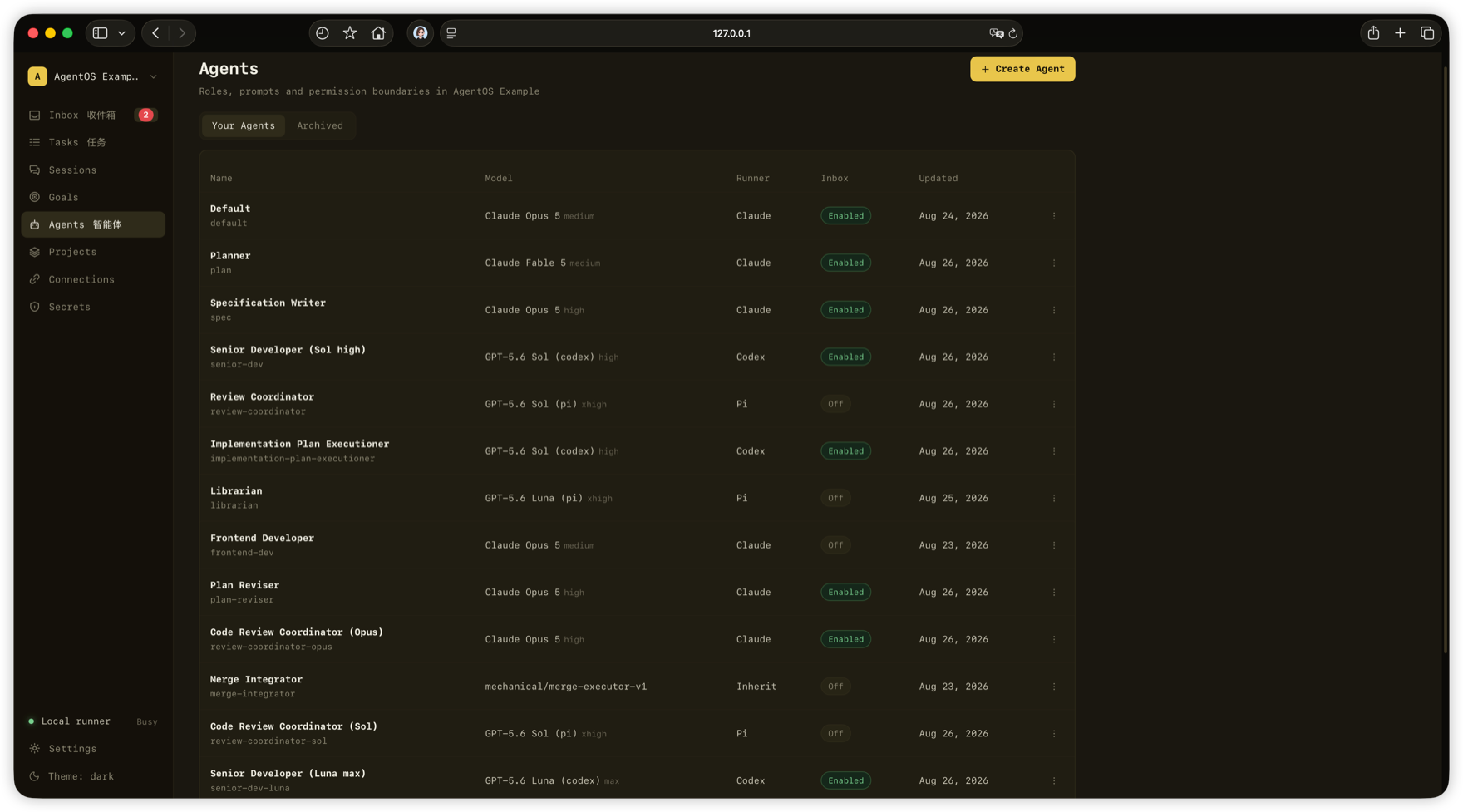
Agents: a role, a prompt, a model and effort, and the runner it goes to.
Board columns
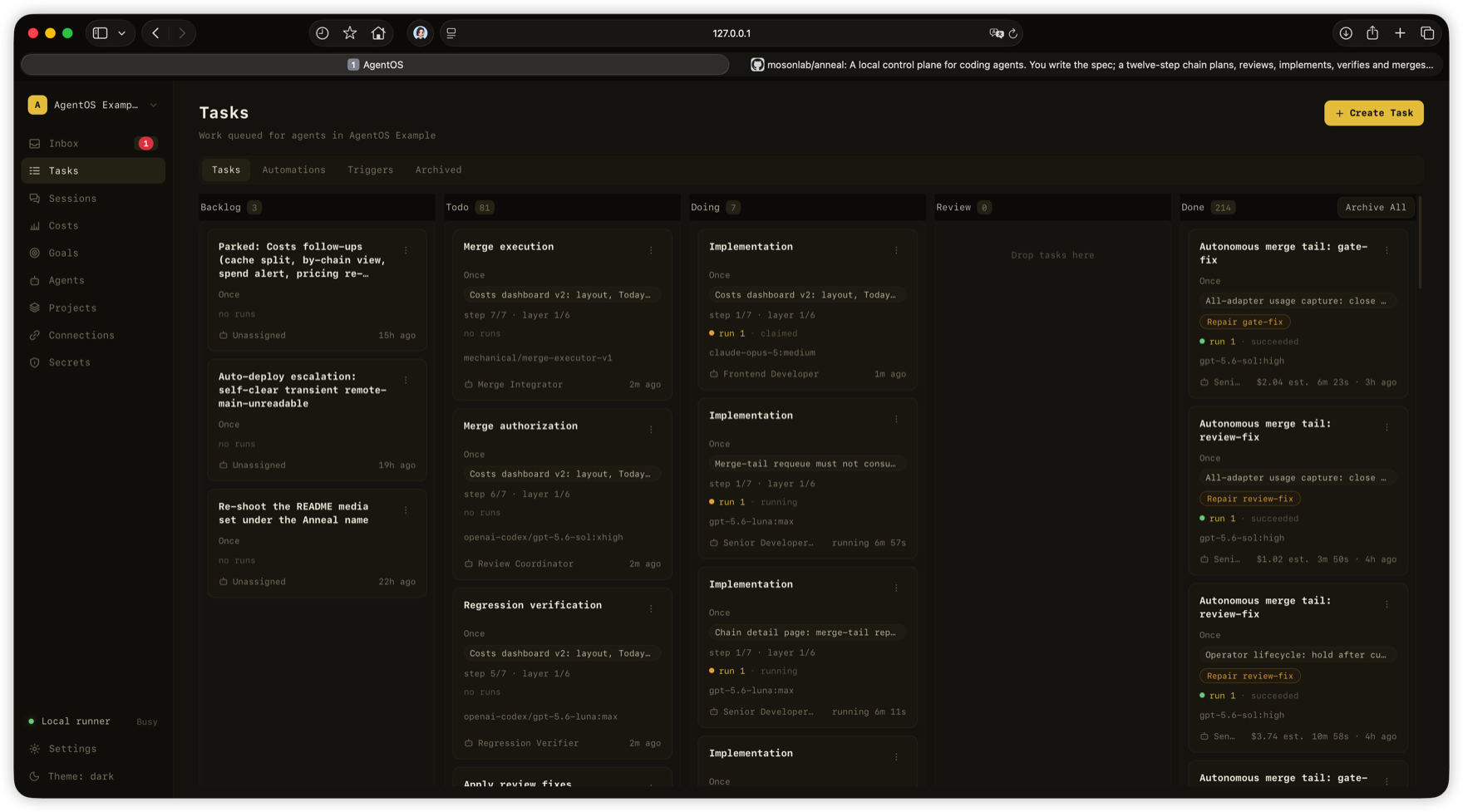
The board shows where work sits in the intent-to-delivery flow. The Backlog
card lifecycle in
the task-routing contract defines card creation, dispatch, and archival; the
definitions here cover the column semantics.
- Backlog — intent. An un-instantiated brief that is still being refined,
awaits a decision, or is deliberately parked; it is not connected to
execution. For an indefinitely parked HUMAN card, prefix its title withParked:. - Todo — runnable execution. An instantiated chain or step whose
specification of record is final, runnable now or waiting for activation or
a dependency unlock. The entry boundary is explicit: un-instantiated intent
enters the board in Backlog; instantiated chains and their steps enter in
Todo and then move through the later columns. - Doing — active execution. The runner has activated an AGENT task and work
is in progress. - Review — awaiting a lifecycle decision. An AGENT task is paused for an
approval or review gate, or has surfaced a run issue that needs attention
before the chain can continue. - Done — complete. The task or chain step is finished.
An operator can stop and park a running chain step, which returns it to Backlog
as a parked step. Resume it with Start now or Recover parked step, not
ordinary card dispatch.
The operator owns Backlog and Todo transitions and marking HUMAN tasks Done.
The runner and chain scheduler own Doing, Review, and Done transitions for
AGENT tasks. In the usual flow, the operator moves finalized intent from
Backlog to Todo, then the runner advances each instantiated step through Doing,
Review, and Done.
It is built by its own chains
The pull requests in this repository are specified, planned, reviewed,
implemented and merged by the chain below, running on one Mac. That is what the
eight days between the first preview release and the third look like from the
inside.
Attribution for chain-delivered commits is not yet explicit in git history, so
treat this as a statement about how the work is done rather than a number you
can check. Making it checkable is the next preview's job.
The twelve-step chain
The Full Assurance template that ships with Anneal. Every step binds a role,
and every role carries its own runner, model and reasoning effort.
Sol and Luna in the table below are not Anneal names: they are the GPT-5.6
variants the Codex CLI exposes, bound as gpt-5.6-sol and gpt-5.6-luna.
| # | Step | Agent role | What it does | Runner | Model · effort |
|---|---|---|---|---|---|
| 1 | Write a spec | spec |
Turns the task into the specification of record | Claude | Claude Opus 5 · high |
| 2 | Plan | plan |
Cuts the spec into parallel vertical tracer-bullet slices | Claude | Claude Fable 5 · medium |
| 3 | Plan review | review-coordinator |
Reviews every slice against the spec and the frozen base | Pi | GPT-5.6 Sol · xhigh |
| 4 | Revise plan | plan-reviser |
Edits the slice set against the findings, in a fresh session | Codex | GPT-5.6 Sol · high |
| 5 | Implementation | implementation-plan-executioner |
Executes the slice set from the live dependency frontier and opens the pull request | Codex | GPT-5.6 Sol · high, with GPT-5.6 Luna · max subagents |
| 6 | Code review | review-coordinator-sol |
Reviews the integrated diff at the pinned base and head | Pi | GPT-5.6 Sol · xhigh |
| 7 | Blind code review | review-coordinator-opus |
Reviews the same diff again, blind to step 6's findings | Claude | Claude Opus 5 · high |
| 8 | Apply review fixes | senior-dev |
Dispositions every finding from both reviews and applies the adopted ones | Codex | GPT-5.6 Sol · high |
| 9 | Documentation | librarian |
Updates internal documentation to match the delivered code | Pi | GPT-5.6 Luna · xhigh |
| 10 | Regression verification | regression-verifier |
Refreshes onto the target branch and reruns the regressions | Codex | GPT-5.6 Luna · max |
| 11 | Merge readiness | — | Recomputes the head, requires every open review to clear, emits an exact-head authorization | — | mechanical, no model run |
| 12 | Merge execution | merge-integrator |
Re-verifies every precondition against the live pull request, then merges | — | mechanical, no model run |
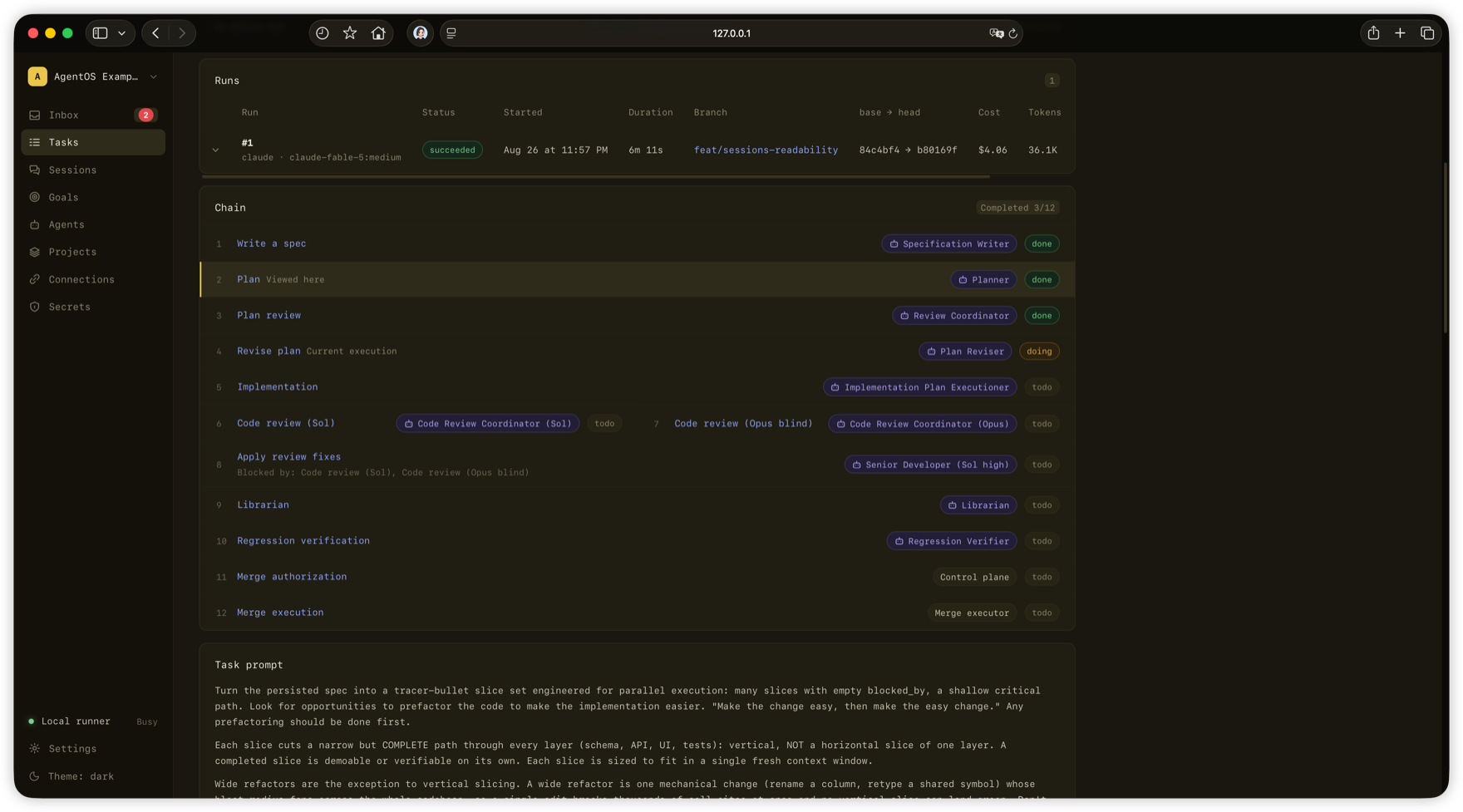
A chain in flight: step 4 running, steps 6 and 7 waiting as parallel siblings.
Steps 6 and 7 are parallel siblings: the blind review never sees the other's
output, and step 8 adjudicates both. Step 5's root session dispatches native
subagents pinned to Luna at maximum effort, at most eight concurrent.
Role bindings live inagents/templates/compound-engineer-workflow/
and the models in agents/roles/. A model or effort changed in
the console is a persisted runtime override and is not replaced by a later
seed.
Developer Preview 4 (v0.4.0). Interfaces, configuration and stored data
shapes may change between preview releases, and the only upgrade path is a
fresh install.Host execution. Anneal launches coding CLIs with non-interactive
permission bypass. By default they run as your macOS user, outside a sandbox,
with that user's filesystem and network authority. Anneal grants constrain
Anneal APIs; they are not host containment. Use a disposable repository and a
machine you are willing to let an agent modify.
Quick start
You need an Apple Silicon Mac with Node.js 22.17.0 from .nvmrc (installation requires
Node.js satisfying ^20.19.0 || ^22.13.0 || >=24 and refuses anything else), npm 10.9.2+,
Docker Compose, Git, and the official Codex CLI already signed in under the same
macOS account. Claude Code and Pi are optional.
git clone https://github.com/mosonlab/anneal.git
cd anneal
git checkout v0.4.0
npm ci
npm run setup:local
npm run build
docker compose up -d --wait --wait-timeout 60 postgres
npm run db:migrate:release -- --fresh
Then start npm run dev:api, npm run dev:runner and npm run dev:web, in
that order, in three terminals, and open http://127.0.0.1:5173.
This is the short form. The literal sequence, including its filesystem, port,
runner identity and repository preflights, is indocs/release/developer-preview.md,
with the remaining installation detail in docs/install.md.
Status
Developer Preview. What is supported, and the evidence behind every claim, is
recorded in docs/release/support-matrix.md,
the authoritative support statement. It describes evidence held in this
repository, not compatibility promises by the CLI providers.
Anneal targets macOS on Apple Silicon. Linux is unverified, and Windows is
unsupported by design: the runner relies on POSIX process-group, path and
command behavior.
Provider CLIs, accounts, authentication, subscriptions, usage allowances, rate
limits, models, and provider-side availability remain yours. Anneal supplies no
provider credential and no entitlement.
Authentication and subscriptions
Anneal holds no provider credential. It launches the official CLIs you have
already installed and signed in to (Codex CLI, Claude Code and Pi), and their
authentication stays where each CLI keeps it, in that CLI's own configuration.
Anneal neither reads it nor forwards it, and there is no Anneal account, no
API proxy and no key to paste in.
Whatever authentication those CLIs support is therefore what Anneal runs on: a
ChatGPT subscription login, a Claude Pro/Max login, or each CLI's own API-key
mode, exactly as you already configured it. Pi carries no account of its own
either: it authenticates through the Codex login.
You can check this. The runner constructs the
child environment for the provider process rather than copying the host
environment wholesale
(docs/architecture.md, packages/runner/src/adapters/),
and the release check scans this checkout for token variables, bearer headers
and Authorization (docs/release/security.md).
None of that settles a provider's terms for you. Plan limits,
rate limits, usage allowances, and whether your plan permits this kind of
orchestration are between you and the provider. Anneal grants no entitlement
and makes no compatibility promise for a CLI provider.
Documentation
- Architecture and security model: how the console,
API, runner and provider CLIs fit together, and what the grants do and do not
contain. - Installation notes and verification: environment file,
migrations, merge executor, and the check sequence. - Security: read before pointing this at
anything you care about. - Migration and recovery: read
before putting data in it. - Release notes ·
Contributing
Support
Anneal is a personal project with no support or response-time commitments. Send
security reports through the private channel in SECURITY.md,
and see docs/release/support-matrix.md for
the authoritative support statement.
Credits and license
The chain's role and step prompts owe more than inspiration: five skills from
mattpocock/skills supply their working
text, carried verbatim and wrapped in paragraphs written here for this
platform's contracts. That work is MIT-licensed, Copyright (c) 2026 Matt Pocock, and the notice is inTHIRD_PARTY_NOTICES.md.
This snapshot is licensed under the MIT License; the snapshot
boundary is defined by public-snapshot.json.
Yorumlar (0)
Yorum birakmak icin giris yap.
Yorum birakSonuc bulunamadi