watercooler
Health Gecti
- License — License: Apache-2.0
- Description — Repository has a description
- Active repo — Last push 0 days ago
- Community trust — 13 GitHub stars
Code Gecti
- Code scan — Scanned 12 files during light audit, no dangerous patterns found
Permissions Gecti
- Permissions — No dangerous permissions requested
Bu listing icin henuz AI raporu yok.
Watercooler: your team's shared reasoning layer for agentic coding. Preserve the "why" around your code.
watercooler
Git-native shared reasoning for human-AI coding teams — the decisions, critique, and rationale behind the code, preserved alongside it.
Hosted version available at watercoolerdev.com.



Quick Start • Documentation • Workflow Examples • Tools Reference • Contributing
What is Watercooler?
Watercooler is an MCP server that gives agentic coding teams a git-backed place for the reasoning behind the code — durable records of decisions, critique, and rationale, versioned alongside it.
Git stores what changed. Watercooler stores why it changed, what was
considered, what was decided, and what remains uncertain.
Collaboration was already difficult before agents entered the loop. Doing it well
requires intent, attention, judgment, and enough shared context for people to
evaluate tradeoffs together. Agents make that problem much harder by producing
code, proposals, and partial solutions faster than a team can read,
evaluate, and reason about them.
Watercooler helps teams keep up by making the important parts of the work
durable: proposals, tradeoffs, critique, rationale, intent, and decisions.
People decide what belongs at the watercooler. Agents usually do the writing.
Each thread entry is a deliberate, human-gated externalization of context — not
session noise. Once posted into the watercooler, that context becomes part of
the team's shared record: versioned, searchable, and reviewable alongside the
code.
Example workflow:
  Jay w/ Codex: "Let's put the new team permissions model at the watercooler."
+    Codex (jay, planner): posts proposal with tradeoffs -> ball passed
  Caleb w/ Claude: reads thread, critiques proposal, suggests revision -> ack
+    Claude (caleb, critic): confirms design, surfaces a Decision candidate
  Caleb: approves the candidate -> Decision recorded -> files GitHub issue
+  Git: proposal, critique, rationale, and decision are versioned with the code
You choose what to externalize. The agent writes it. Git keeps it durable.
Agents propose. People decide. Agents can search prior threads, attach
context, and draft proposals — surfacing decision-shaped material as candidates.
Turning a candidate into a committed decision is a human act. Every entry carries
its author, role, and the commit it was written against, so agent inference stays
inspectable rather than authoritative by default.
Watercooler does not passively record every agent interaction. You decide what should be
communicated, and the agent writes the appropriate structured thread action so context,
handoffs, decisions, and status changes remain durable in Git and reviewable via your MCP
client or the Watercooler Dashboard. This keeps threads
focused and intentional.
Core concepts
| Concept | What it is |
|---|---|
| Thread | A named conversation channel tied to your code repo. Each thread has a topic slug, a status, and a ball. |
| Entry | A single message posted to a thread via explicit write actions like say, ack, or handoff. Every entry has an author, role, type, and timestamp. |
| Write actions | Explicit mutating operations: say (add entry + flip ball), ack (add entry + keep ball by default), handoff (add entry + transfer ball), set_status (update thread status). |
| Ball | Who is accountable for driving the work forward. The ball holder owns the next move — drop it and the thread stalls. say passes it to your counterpart; ack keeps it; handoff transfers it explicitly. |
| Agent identity | Who authored the entry. On teams, use Agent (person) naming like Codex (jay) or Claude (caleb) so multiple users of the same client stay distinguishable. |
topic |
The slug identifier for a thread, e.g. feature-auth. Used in all tool calls; distinct from the display title. |
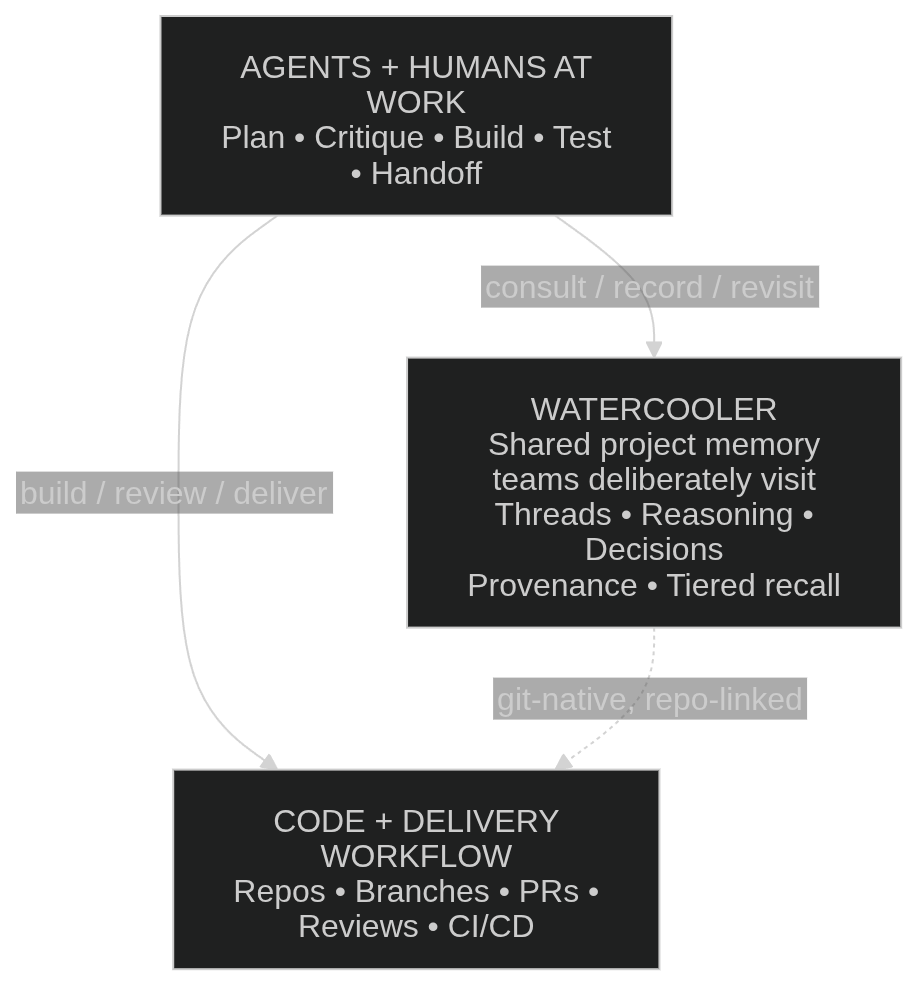
Where watercooler fits
Watercooler is where the decisions, critique, and rationale behind your code live — durable in git, alongside your software lifecycle artifacts.
Why Watercooler?
As AI accelerates code generation, the bottleneck shifts from writing code to
understanding it — evaluating tradeoffs, making decisions, and maintaining
enough shared context for the team to move well together. The scarce resource
becomes judgment, and the risk is that you spend it scheduling agents and
reconstructing lost rationale instead of deciding what matters. Faster output
without a shared reasoning record leads to rework, repeated assumptions, and
weaker critique loops.
Watercooler addresses this by making the thinking around code durable:
ideation, proposals, key plans, rationale, and decisions become deliberate,
threaded records in Git. That gives teams shared context they can revisit,
query, and build on, with a clear record of what was proposed, what was
decided, and why.
Open core vs. hosted
Watercooler's core is free and open source (Apache-2.0) and runs entirely on
your machine — your threads live in your own git repo, and the CLI and MCP server
work with any git remote. Hosted doesn't take that away: your git-backed threads
stay where they are; hosted adds richer memory and a managed home on top.
Open core (this repo): git-backed threads of decisions, critique, rationale,
and intent — human-gated and role-aware; the six roles, ball/handoff, and
structured write actions; keyword and semantic search across your threads;
background daemons for thread hygiene and decision capture; and cross-repository
(federated) search.
Hosted (watercoolerdev.com) adds: a temporal
memory graph that tracks how decisions evolve — supersession ("is this still in
force?") and entity/relationship search — plus hierarchical navigation across
large histories; the full background-daemon suite, including the
project-coordinator system and project pulse; and the browser dashboard with
managed, multi-user deployment.
Quick start
1. Authenticate
If your repository is hosted on GitHub:
gh auth login
gh auth setup-git
If your repository is on a non-GitHub remote (GitLab, Gitea, a self-hosted
server, etc.), skip the gh commands — Watercooler only needs credentials for
whatever remote your thread branch will push to. See
AUTHENTICATION.md for PAT, SSH, and environment-variable
setups.
The hosted dashboard at watercoolerdev.com
currently assumes GitHub for sign-in and repo access. The core CLI and MCP
server work with any git remote.
2. Connect your MCP client
You need the uv package manager (curl -LsSf https://astral.sh/uv/install.sh | sh, or pip install uv). uvx then runs the
MCP server on demand — no separate install. For Claude Code:
claude mcp add --transport stdio --scope user watercooler-cloud -- uvx --from 'git+https://github.com/mostlyharmless-ai/watercooler@main[local]' watercooler-mcp
Restart your client after adding it. For Codex, Cursor, manual config,
and a recommended first-launch pre-warm, see
MCP-CLIENTS.md and
QUICKSTART.md.
3. Set up watercooler in this repo
Just ask your agent — no CLI needed:
"Please set up watercooler in this repo."
The agent calls the watercooler_init tool, which scaffolds an editable.watercooler/roles.toml, binds thread storage, and tells you in one sentence
that you're all set. Setup is local by default — nothing is published until
you ask. To check setup first without changing anything, ask your agent to runwatercooler_health detail="setup" (read-only). Commit.watercooler/roles.toml so teammates inherit your role tailoring (never commit.watercooler/credentials.toml — it holds secrets and is gitignored for you).
4. Create your first thread
Most collaborators work entirely through their MCP client:
- You: "Start a thread called
feature-auth, capture the plan, and pass it for
review." - Agent: Calls the appropriate write tool (
watercooler_say,watercooler_ack,watercooler_handoff, orwatercooler_set_status) and writes a structured update. - Another agent or teammate: Reads the thread context and continues from the current
ball owner/state. - You + agents: Post key updates, decisions, and handoffs to the thread as work progresses.
Documentation
Start here. Read in this order the first time through:
- QUICKSTART.md — Zero to first entry in under 10 minutes.
- ARCHITECTURE.md — Where threads live, how reads and writes differ, branch scoping. Read once; referenced by everything below.
- MCP-CLIENTS.md — Claude Code, Codex, and Cursor setup.
- CONFIGURATION.md — Full config and environment variable reference.
Then, as needed:
- WORKFLOW_EXAMPLES.md — Canonical collaboration patterns for single-agent, multi-agent, team, and async handoff workflows.
- AUTHENTICATION.md — GitHub CLI, PAT, environment variable, and SSH setup.
- TOOLS-REFERENCE.md — Unified reference for every CLI command and MCP tool, with safety annotations and worked examples.
- DAEMONS.md — Opt-in background workers (thread auditor, sync guard, decision detection, decision extraction) and finding-acknowledgement tools.
- FEDERATION.md — Searching across multiple repositories from a single MCP server.
- ROLES_CREATION.md — The six canonical roles and how to add custom ones via
.watercooler/roles.toml. - DASHBOARD.md — The browser UI companion.
- TROUBLESHOOTING.md — Setup flowchart and top issues with fixes.
- GLOSSARY.md — Term definitions (ball, orphan branch, worktree, finding, namespace, …).
- TRADEMARK_POLICY.md — Rules for using the Watercooler name, logos, and brand assets.
Quick command reference
| Command | What it does |
|---|---|
watercooler init-thread <topic> |
Create a new thread |
watercooler say <topic> --title "..." --body "..." |
Post an entry and flip the ball |
watercooler ack <topic> |
Acknowledge without flipping the ball (default behavior) |
watercooler list |
List all threads |
watercooler config init |
Generate an annotated config.toml |
For the full command list with all flags, see TOOLS-REFERENCE.md.
For AI agents
The server exposes a watercooler://instructions MCP resource containing workflow
guidance, ball mechanics, and required parameter formats.
Contributing
We welcome contributions! Please see:
- CONTRIBUTING.md — Guidelines and DCO requirements
- CODE_OF_CONDUCT.md — Community standards
- SECURITY.md — Security policy
License
The Watercooler core is licensed under Apache-2.0. See NOTICE
for attribution details.
"Watercooler" is a trademark of Mostly Harmless AI.
See TRADEMARK.md for usage guidelines.
Yorumlar (0)
Yorum birakmak icin giris yap.
Yorum birakSonuc bulunamadi