claudette
Health Uyari
- License — License: Apache-2.0
- Description — Repository has a description
- Active repo — Last push 0 days ago
- Low visibility — Only 5 GitHub stars
Code Gecti
- Code scan — Scanned 12 files during light audit, no dangerous patterns found
Permissions Gecti
- Permissions — No dangerous permissions requested
Bu listing icin henuz AI raporu yok.
Your AI never leaves your laptop. Claudette is a personal AI assistant and coding agent that runs entirely on local hardware - REPL, fullscreen TUI, one-shot CLI, and a Telegram bot, all driving one local model through Ollama or LM Studio. No cloud brain. No API key. No subscription. No telemetry. One Rust binary.
Claudette
Your AI never leaves your laptop. Claudette is a personal AI assistant and coding agent that runs entirely on local hardware — REPL, fullscreen TUI, one-shot CLI, and a Telegram bot, all driving one local model through Ollama or LM Studio. No cloud brain. No API key. No subscription. No telemetry. One Rust binary.
Pull a model, unplug the network, and she still works. The whole core — chat, notes, todos, file editing, code search, repo work, even the autonomous code-change pipeline — runs with zero internet. See Air-gapped by design.





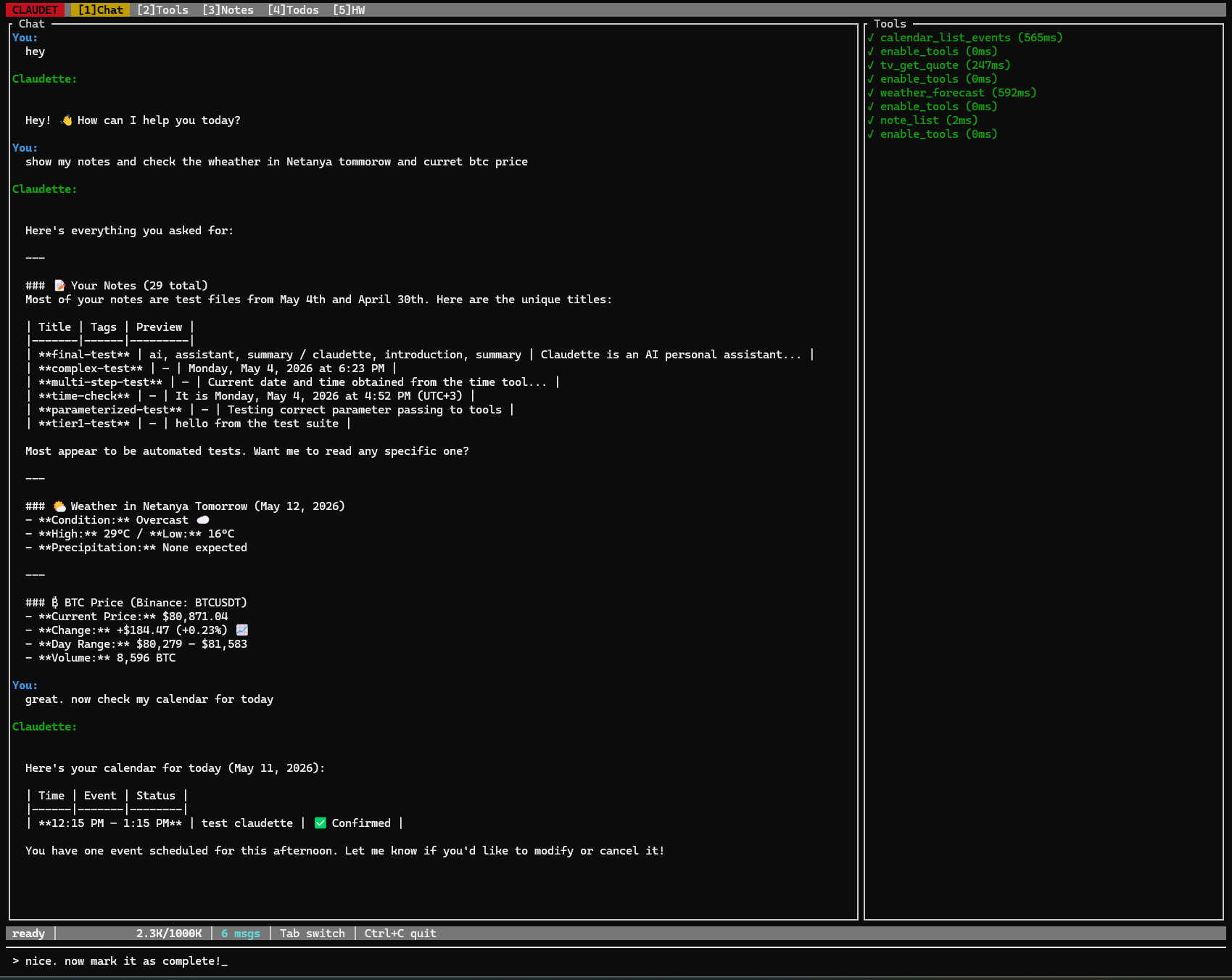
One turn driving four tool groups (
note_list,weather,tv_get_quote,calendar_list_events) — the model enables groups on demand and dispatches the calls. TUI tabs:[1]Chat [2]Tools [3]Notes [4]Todos [5]HW.
Install in 30 seconds
Linux / macOS:
curl -fsSL https://raw.githubusercontent.com/mrdushidush/claudette/main/install.sh | sh
Windows (PowerShell):
iwr -useb https://raw.githubusercontent.com/mrdushidush/claudette/main/install.ps1 | iex
Then pull a brain and talk:
ollama pull qwen3.5:4b           # 3.4 GB brain — one-time download
claudette "what time is it?"
Prefer not to pipe the network into a shell? Grab a prebuilt archive from Releases and drop
claudette(orclaudette.exe) onto yourPATH. Every artifact ships a SHA256 sidecar so you can verify the download wasn't corrupted in transit.Rust user?
cargo install claudette.
No GPU? The 4B brain runs on plain CPU — slower, but it works. See CPU-only mode.
First time?docs/show-me.mdis plain-English examples — calendar, notes, weather, screenshots, voice from your phone.
🔒 Air-gapped by design
Most "local AI" tools quietly phone home — telemetry, model downloads, a cloud fallback when the local model struggles. Claudette has no such path. There is no cloud-brain code in the binary to begin with.
- One required dependency: a model server (Ollama or LM Studio) on
localhost. That's it. - Every outbound call is opt-in and feature-gated — voice TTS, Telegram, web search, GitHub, Google Calendar/Gmail. Each one only exists if you turn it on with a token. The full inventory of every place a byte could leave your machine is in
PRIVACY.md. - Truly offline:
CLAUDETTE_SKIP_OLLAMA_PROBE=1skips even the localhost startup check. Pull your model, disconnect the network, and the entire core works — chat, notes, todos, files, code search, repo editing, and the Forge autonomous code-change pipeline. - Nothing is written outside
~/.claudette/without an explicit permission prompt.
If you work on a regulated, classified, or simply trust-no-cloud machine, this is the headline feature — not an afterthought. Your code and your conversations never touch someone else's servers.
Why Claudette
The open-source agent space is crowded with cloud-API coding tools. Claudette aims at a different slot: a general-purpose assistant and a capable coding agent that run entirely on your own hardware, with no cloud brain in the loop.
- Private by construction. Not "private mode" — there is no other mode. See above.
- Fits real hardware. The default
qwen3.5:4bbrain uses ~3.4 GB VRAM and runs on an 8 GB GPU or plain CPU. Step up toqwen3.6-35b-a3bon a 16 GB GPU for near-frontier quality. No hidden 32 GB-VRAM requirement. - Personal, not just code. Calendar, Gmail, scheduler/briefings, notes, todos, markets, weather, web search — code generation is one capability, not the whole product.
- Messaging-first. A first-class Telegram bot with voice in (Whisper) and voice out (edge-tts) — drive the whole agent from your phone at a bus stop.
- Honest about itself. Side-by-side vs. OpenHands, Aider, opencode, Cline, Continue:
docs/comparison.md. Claudette doesn't win every column — it's the only one built for this slot.
What she can do
Four interfaces, one local brain
| Mode | Command | What it's for |
|---|---|---|
| REPL | claudette |
Conversational shell. Autosaves every turn. |
| One-shot | claudette "your question" |
Print a reply and exit. Pipe-friendly. |
| TUI | claudette --tui |
Ratatui fullscreen UI, 5 tabs, live tool panel. |
| Telegram bot | claudette --telegram |
Voice-capable remote chat from your phone. |
80+ tools, ~200-token base schema
Almost every tool lives in a group the model opts into via enable_tools(group), so the prompt stays tiny until the surface is actually needed. 22 groups: notes, todos, files, code, meta, git, ide, search, advanced, facts, registry, github, markets, telegram, calendar, schedule, gmail, recall, quality (run_tests / diagnostics / apply_patch), semantic (semantic_grep), vision (screenshot_capture / image_describe), and clipboard. Point Claudette at a repo (CLAUDETTE_WORKSPACE) and the lean coding core (Files + Search + Advanced + Quality) is pre-enabled so she can read, edit, search, and run tests immediately.
🛠️ Forge-mode: an autonomous code-change pipeline
claudette --forge "<prompt>" runs a Planner → Coder → Verifier loop against a git repo, with a configurable fix-loop (default 2 rounds) and an optional deterministic security-review stage, before it opens a PR. Inside an existing repo it auto-bootstraps an ephemeral mission at the repo root — no clone needed. Roles are independently routable, so you can pin a stronger model to the Verifier and a cheap one to the Coder. Full walkthrough: docs/forge.md.
🌿 Brownfield missions: clone, edit, ship a PR in one chain
mission_start("owner/repo") clones into ~/.claudette/missions/<slug>/ and transparently re-routes git_status / glob_search / grep_search / write_file / bash into the mission tree. mission_submit auto-branches, commits, pushes, and opens the PR. Resumable across sessions with mission_state(action="attach").
🧠 Tiered-brain auto-fallback
Three presets — Fast / Auto / Smart. Auto runs qwen3.5:4b and escalates to qwen3.5:9b only on real stuck signals (empty response after retry, max-iterations with no text, ≥3 consecutive tool errors), reverting per-turn rather than sticking. On a 16 GB GPU, pin qwen3.6-35b-a3b instead — see Claudette Certified.
🎙️ Voice in, voice out, vision in
Whisper transcription for Telegram voice notes, edge-tts replies (English or Hebrew), and image attachments in TUI/REPL via Alt+V (clipboard), drag-drop, or @/path/to/img.png — when the loaded brain is multimodal.
⚙️ Codet sidecar for code generation
generate_code routes through a dedicated coder model (default qwen3-coder:30b), runs a real syntax check across 4 languages (Python py_compile, rustc --emit=metadata, JavaScript + TypeScript via tsc --noEmit), then an Aider-style SEARCH/REPLACE fix loop on failure, then optional pytest / cargo-test / jest. Hot-swaps into VRAM on demand on memory-constrained boxes.
🔎 Cross-session semantic recall
/recall <query> searches every past conversation turn across sessions via a local embedding index, dropping the relevant fragments straight into the current context.
🤝 Sub-agents
spawn_agent delegates to a Researcher (web + file + code search), GitOps (rebase/squash/push), or Code Reviewer (read-only). Only the final answer comes back — sub-agent chatter never pollutes the main context.
🛡️ Per-tool permission gating
ReadOnly and WorkspaceWrite tools auto-allow; DangerFullAccess (bash, edit_file, git add/commit/push, cross-org PRs) prompts [y/N] every time. Telegram default-denies DangerFullAccess (no TTY to confirm at).
🏅 Claudette Certified — the local-model benchmark
A local agent is only as good as the model behind it, and "which model should I run?" is the question every new user asks. So we answer it with data, not vibes.
Every candidate brain runs the same objective 50-task battery — 11 languages/surfaces (Rust, Python, JS, TS, Go, shell, HTML, CSS, SQL, a large real repo, git) × 12 task types (bugfix, add-feature, multi-file, refactor, create-file, explain, locate, enumerate, run-tests, debug-error, git-workflow, answer-from-codebase) — through Claudette's real tool loop, then an automated verifier checks the result (build/test passes, the file is correct, or ground-truth tokens appear in the transcript). No model grades itself. All runs below: 24k context, --parallel 1, RTX 5060 Ti 16 GB (2026-05-30). The harness is reusable and lives at runs/eval-2026-05-29/battery/ — bring your own model.
| Brain | Quant | VRAM | Pass @ 50 | Wall | Best for |
|---|---|---|---|---|---|
qwen3.6-35b-a3b |
q3_k_xl |
16 GB (MoE offload) | 92% | 38 min | Best accuracy — the daily-driver default |
qwen3.5-4b |
Q4–Q8 | 8 GB | 90% | 8 min | Best value — runs on almost any GPU |
qwen3.5-9b |
Q4 | 11 GB | 88% | 16 min | Solid mid-tier |
qwen3.6-35b-a3b |
q4_k_xl |
24 GB (spills at 16) | 88% | 48 min | More precision, but RAM-bound on 16 GB → timeouts |
gpt-oss-20b |
MXFP4 | 13 GB (resident) | 86% | 5 min | Fastest — fully in-VRAM, coolest |
granite-4.1-8b |
Q4–Q6 | 9 GB | 78% | 17 min | Reliable tool-calling, weaker raw coder |
Not ranked —
qwen3.6-27b(dense), incomplete run. Its sweep was cut short when the model unloaded partway through (the dense 27b runs hot, ~72 °C, and got evicted): the 12 hardest tasks — all 8 large-repo + 4 git-workflow — never actually executed (they log a 0-secondHTTP 400 "No models loaded", i.e. an infrastructure halt, not a real attempt). So there is no comparable/50to rank it by — a score over only the ~38 tasks that ran isn't apples-to-apples with the full-50 numbers above, so we leave it out rather than flatter it. It held up fine on what it did run, but it's the slow dense "precision" tier regardless (~67 s/task — accurate, not interactive). Raw per-task rows:SCORES-qwen36-27b.tsv.
The lessons that shaped the recommendations:
- Fitting in VRAM beats parameter count.
q3_k_xl(fits 16 GB) beatsq4_k_xl(spills to RAM → ~20% slower → loses tasks to timeouts) despite lower precision. On 16 GB, pickq3_k_xl. - Small models punch up. A 4B model hits 90% in 8 minutes and runs on an 8 GB GPU — the value/accessibility star.
- Chat-template compatibility is the #1 local-model failure mode.
gemma-4-26bandqwen3-coder-30bstock GGUFs return HTTP 400 on tool calls in LM Studio's template engine;glm-4.7-flashnarrated prose instead of emitting tool calls. Always pull almstudio-community/unslothrepack and validate one real tool call before trusting a model. - Thermals follow architecture, not size. MoE brains keep the GPU ~55 °C at any size; the dense
qwen3.6-27bruns hot (72 °C) — it's the slow precision tier, not for sustained interactive use.
Full per-task data and reasoning notes: runs/eval-2026-05-29/battery/MODEL-COMPARISON.md. The next batch of candidates queued for certification (GLM-4.7-Flash, Qwen3-Coder-30B, Granite-4.1-8B, Mistral/Ministral, and more) is in CANDIDATES.md — this is one of the best ways to contribute (see Roadmap).
qwen3.6-35b-a3bis distributed via LM Studio (Unsloth GGUF) rather than packaged on Ollama. Flip the backend withCLAUDETTE_OPENAI_COMPAT=1and pin the quant explicitly (CLAUDETTE_MODEL=qwen3.6-35b-a3b@q3_k_xl) — LM Studio picks the smallest match otherwise. Recipe indocs/power-user.md.
Hardware
The numbers describe the comfortable setup. You don't need a GPU — Ollama runs on plain CPU (slower, but viable for a 1B/3B/4B brain). See docs/hardware.md#no-gpu-cpu-only-mode.
| Component | Comfortable minimum | Recommended | Tested on |
|---|---|---|---|
| GPU | 6 GB VRAM (or CPU-only with a smaller brain) | 8 GB VRAM (16 GB for the 35b brain) | RTX 5060 Ti 16 GB |
| RAM | 16 GB | 32 GB | 32 GB DDR4 |
| Disk | ~3 GB (brain only) | ~27 GB (brain + fallback + 30b coder) | NVMe SSD |
| OS | Windows 10+, Linux, macOS | Windows 11 / Ubuntu 24.04 / macOS 14+ | Windows 11 Pro |
Full model-footprint table, CPU-only recipes, and the 30b-coder-on-8GB-VRAM env recipe: docs/hardware.md.
Quick start (full setup)
# 1a. Default path — Ollama with the 3.5 family (works on 8 GB VRAM, or CPU).
ollama pull qwen3.5:4b           # brain (default Auto preset)
ollama pull qwen3.5:9b           # fallback brain (optional)
ollama pull qwen3-coder:30b      # Codet coder — only if you'll use generate_code

# 1b. Recommended path — LM Studio with qwen3.6 (best on 16 GB+ VRAM).
# Pull `qwen3.6-35b-a3b` inside LM Studio, then in ~/.claudette/.env:
#   CLAUDETTE_OPENAI_COMPAT=1
#   OLLAMA_HOST=http://localhost:1234
#   CLAUDETTE_MODEL=qwen3.6-35b-a3b@q3_k_xl
#   CLAUDETTE_CODER_MODEL=qwen3.6-35b-a3b@q3_k_xl
# Full LM Studio recipe: docs/power-user.md

# 2. Install Claudette — pick one.
curl -fsSL https://raw.githubusercontent.com/mrdushidush/claudette/main/install.sh | sh   # Linux/macOS
iwr -useb https://raw.githubusercontent.com/mrdushidush/claudette/main/install.ps1 | iex  # Windows
cargo install claudette                                                                    # Rust users

# 3. (Optional) Tokens for opt-in tools that reach the network.
export BRAVE_API_KEY=...         # web_search
export GITHUB_TOKEN=ghp_...      # github group
export TELEGRAM_BOT_TOKEN=...    # --telegram mode

# 4. Run.
claudette                        # REPL
claudette --tui                  # TUI
claudette "what time is it?"     # one-shot
claudette --forge "fix the failing test in src/parser.rs"   # autonomous pipeline
claudette --resume               # resume last session
claudette --telegram             # Telegram bot
claudette --doctor               # diagnose model server, models, tokens, permissions
First launch auto-creates ~/.claudette/ and probes http://localhost:11434. Going fully offline? CLAUDETTE_SKIP_OLLAMA_PROBE=1.
Out of the box (no tokens, no network): notes, todos, files, time, code search, repo editing, forge. Brave / GitHub / Google Calendar / Gmail tools light up when you set the relevant token — full table in docs/configuration.md.
🚀 Roadmap
Claudette has a clear north star: be the most private, most universally-runnable local code assistant in the world. Here's where she's headed — and these are exactly the places a new contributor can leave a mark.
The vision
- 🔒 Hardened air-gap mode. A first-class, audited offline profile: a
--air-gappedflag that hard-disables every network-capable tool, a reproducible offline install bundle (binary + model + Whisper weights), and a documented "regulated-machine" deployment story. - 🧠 A model-agnostic, curated brain menu. Not one blessed model — a recommendation for every hardware tier, from a 4 GB laptop GPU to a 24 GB workstation, so anyone can run her well on what they already own.
- 🏅 The Claudette Certified program, expanded. Keep running the objective 50-task battery on every promising new local model and publish a living, badged recommendation table. The candidate queue is already scouted — GLM-4.7-Flash, Qwen3-Coder-30B, Granite-4.1-8B, the Mistral/Ministral family, and more.
Where you come in 🙌
New contributors welcome — these are real, scoped, high-impact ways to help:
- 🏅 Certify a model. Have a GPU and a model we haven't benched? Run the reusable battery at
runs/eval-2026-05-29/battery/and open a PR with the scores. This is the single most valuable contribution right now and needs no Rust. - 📦 Rescue a template.
gemma-4-26b,qwen3-coder-30b, andglm-4.7-flashare strong models gated only by broken stock chat templates. Find/build a workinglmstudio-community/unslothGGUF, validate one tool call, and document the fix. - ⚙️ Sharpen the coder. Route trivial create-file requests straight to
write_fileso they don't race thegenerate_codetimeout; widen the syntax-check language set; improve the SEARCH/REPLACE fix loop. - 🛡️ Grow the security-review stage. The Forge security scanner is line-based on diff additions — extend its rule coverage (multi-line sinks, SSRF, path traversal, prototype pollution) and shrink false positives.
- 🎙️ Extend voice & vision. More TTS languages, better multimodal image handling, richer Telegram voice flows.
- 📚 Tell the story. Tutorials, a homelab/Pi deploy guide, screencasts —
docs/show-me.mdis where the new-user journey lives.
Known open items live on the issue tracker, including the current Dependabot advisories. Start at CONTRIBUTING.md, grab a thread above, and say hi in an issue.
Docs
docs/show-me.md— start here: plain-English example prompts (notes, calendar, vision, voice, code)docs/quickstart.md— 30-second start, common flowsdocs/configuration.md— every env var, token file fallbacks, recall settingsdocs/power-user.md— LM Studio recipe, brain pinning, forge knobs, context tuningdocs/hardware.md— VRAM/RAM/disk by preset, CPU-only mode, 30b-on-8GB env recipedocs/usage.md— CLI flags, slash commands, Telegram-only commandsdocs/architecture.md— module layout, tool-group contract, Codet sidecar contractdocs/forge.md— forge-mode pipeline, Submitter contract,models.tomlschema, auto-bootstrapdocs/comparison.md— honest side-by-side vs. opencode / Aider / OpenHands / Cline / Continuedocs/google_setup.md— Calendar + Gmail OAuth walkthroughdocs/deploy.md— Pi / VPS / home-server deploy via docker-composeeditor/vscode/— VS Code extension (REPL / TUI / forge / "ask about selection")PRIVACY.md— every place data can leave your machine, and the conditions for each
Storage layout
~/.claudette/
├── notes/            # Markdown notes (ISO-timestamped, optional tags)
├── files/            # Sandboxed scratch dir for write_file/generate_code
├── sessions/         # Auto-saved + named sessions
├── secrets/          # Token files (github.token, telegram.token, brave.token, …)
├── missions/         # Brownfield mission clones
├── models/           # Whisper model (download separately)
├── recall.sqlite     # Cross-session semantic-recall index
├── todos.json        # Task list
├── models.toml       # Optional model-config overlay
├── fallback.jsonl    # Auto-fallback event log
├── .env              # Persistent env-var overrides
└── CLAUDETTE.MD      # Optional user memory (800-char cap)
Nothing outside ~/.claudette/ is written without an explicit permission prompt.
Build from source
git clone https://github.com/mrdushidush/claudette
cd claudette
cargo build --release -p claudette
./target/release/claudette --help
1,000+ tests passing. Before committing: cargo fmt --all && cargo clippy --all-targets --no-deps -- -D warnings && cargo test --lib.
Contributing
See CONTRIBUTING.md, and the Roadmap above for high-impact starting points. Quick version:
- File bugs at https://github.com/mrdushidush/claudette/issues.
- Conventional Commits:
feat:,fix:,docs:,refactor:,test:,chore:,style:,ci:. - By contributing, you agree your work is dual-licensed under MIT OR Apache-2.0.
Security issues: please use the private advisory flow in SECURITY.md — don't open a public issue.
Be kind — CODE_OF_CONDUCT.md has the short version.
License
Dual-licensed under either of:
- MIT — see
LICENSE-MIT - Apache License 2.0 — see
LICENSE-APACHE
at your option. Use, modify, redistribute commercially or personally. The Apache option adds an explicit patent grant; neither grants a trademark — don't imply endorsement.
Unless you explicitly state otherwise, any contribution intentionally submitted for inclusion in the work by you, as defined in the Apache-2.0 license, shall be dual-licensed as above, without any additional terms or conditions.
Copyright © 2026 mrdushidush.
Yorumlar (0)
Yorum birakmak icin giris yap.
Yorum birakSonuc bulunamadi