zuey-pi-setup
Health Uyari
- No license — Repository has no license file
- Description — Repository has a description
- Active repo — Last push 0 days ago
- Community trust — 25 GitHub stars
Code Basarisiz
- process.env — Environment variable access in config/extensions/pi-footer-cache-tps.ts
- fs.rmSync — Destructive file system operation in scripts/pi-lens-compact-lsp-status.mjs
- os.homedir — User home directory access in scripts/pi-lens-compact-lsp-status.mjs
- process.env — Environment variable access in scripts/pi-lens-compact-lsp-status.mjs
- rm -rf — Recursive force deletion command in scripts/pi-setup-backup.sh
- fs module — File system access in scripts/pi-setup-backup.sh
- Hardcoded secret — Potential hardcoded credential in scripts/pi-setup-backup.sh
- os.homedir — User home directory access in scripts/pi-setup-patch-extensions.mjs
- process.env — Environment variable access in scripts/pi-setup-patch-extensions.mjs
- rm -rf — Recursive force deletion command in scripts/pi-setup-restore.sh
- fs module — File system access in scripts/pi-setup-restore.sh
Permissions Gecti
- Permissions — No dangerous permissions requested
Bu listing icin henuz AI raporu yok.
Portable snapshot of a pi coding-agent setup + backup/restore tooling. Clone to rebuild 22 extensions on another machine. Excludes secrets, cache, and machine state.
zuey-pi-setup
A portable snapshot of my pi setup — clone it and rebuild the full set of 24 extensions on a new machine.
pi 0.85.1 · Node 24 · macOS · Linux · Windows (Git Bash) · updated 2026-09-16
English · Tiếng Việt
Why this repo exists
pi has no config export/import. This repo is a deterministic way to carry the entire setup to another machine without copying caches:
~/.pi/agent/npm/(~250 MB) — not needed, pi reinstalls it fromsettings.json~/.pi/agent/auth.json— not committed (API keys + OAuth tokens), log in again on the new machine~/.pi/agent/sessions/(~56 MB) andmissions/— not committed (history/state, may contain internal data)
The mechanism: settings.json holds a packages array; pi reads it on startup and npm installs anything missing. So if you can carry the manifest, you carry the whole extension set.
Quickstart (new machine)
# 1) install pi, exact version
npm i -g @earendil-works/[email protected]

# 2) clone
git clone https://github.com/mrgoonie/zuey-pi-setup.git
cd zuey-pi-setup

# 3) safe rehearsal into a temp dir (touches nothing real)
./scripts/pi-setup-restore.sh --from-config config --scratch --install --verify

# 4) the real thing
./scripts/pi-setup-restore.sh --install --verify
Then log the providers back in (auth is not in the repo):
pi auth check --provider opencode-go # and /login inside pi for each provider
One more manual step: @injaneity/pi-computer-use needs macOS Accessibility and Screen Recording granted to ~/Applications/pi-computer-use.app (it installs the helper itself). Run pi interactively once and finish the setup prompt — in print mode the extension stays inert.
Full details, copy/do-not-copy table, troubleshooting: docs/pi-setup-migration.md (Vietnamese only).
Windows: the scripts are bash → run them in Git Bash (or WSL), not PowerShell/cmd. See Windows (Git Bash).
Windows (Git Bash)
Verified end-to-end on Windows 11 + Git Bash (MSYS2, bash 5.3): restore → --install → --verify → backup → bundle rebuild. No extra steps beyond the Quickstart commands.
| Windows difference | Status |
|---|---|
| Shell | Git Bash (or WSL) is required. The scripts use POSIX bash plus MSYS tar/gzip/find/awk |
| Installing Node | Usually via fnm instead of nvm. pi installs globally per Node version → pi only exists in a shell that ran fnm use (path looks like .../fnm_multishells/<id>/pi) |
Counting packages (--verify) |
Uses node (as of this revision), not python3 — Windows often lacks python3, or hits the Microsoft Store stub |
shasum |
Absent in Git Bash → the script falls back to sha256sum |
Paths passed to the child pi |
MSYS converts PI_CODING_AGENT_DIR automatically (/c/Users/..., /tmp/... → C:/Users/...) — verified |
--scratch |
Works: mktemp -d plus path conversion for the child pi process |
| CRLF | Git Bash's bash tolerates CRLF (tested with a CRLF copy). .gitattributes still pins *.sh text eol=lf for safety |
| Symlinks | Creating them needs Developer Mode, but the repo only reads/backs up existing symlinks, so it does not matter |
tar |
Inside Git Bash this is GNU tar (/usr/bin/tar), not C:\Windows\System32\tar.exe |
| Terminal font | A Nerd Font is required while iconMode: "nerd" — see Terminal font |
The full Windows sequence:
# inside Git Bash
fnm use 24
npm i -g @earendil-works/[email protected]
git clone https://github.com/mrgoonie/zuey-pi-setup.git && cd zuey-pi-setup
./scripts/pi-setup-restore.sh --from-config config --scratch --install --verify   # rehearsal
./scripts/pi-setup-restore.sh --install --verify                                 # for real
Screenshots
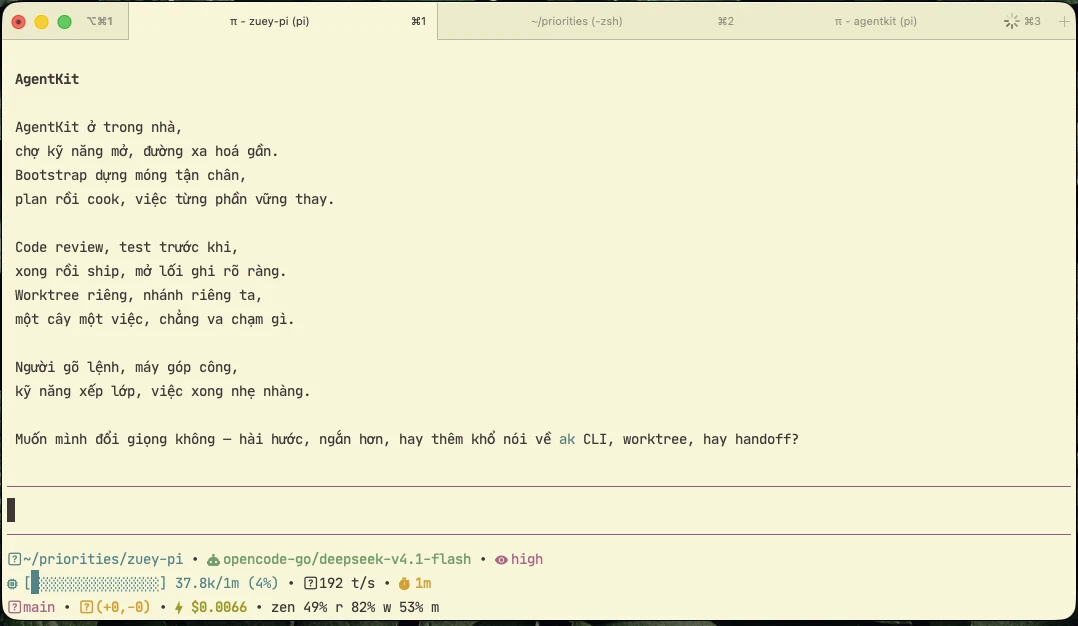
The statusline is laid out in exactly three rows — context bar scaled to the model's context window, token speed, git, cost, and other extensions' statuses pulled onto the same rows:
Light theme (thinking high) — cache-hit-rate and cache_ttl are 0 here, so they hide themselves:
Dark theme (thinking off) — all five widgets on row 2, including cache-hit-rate 79.8% and cache_ttl ~1s:
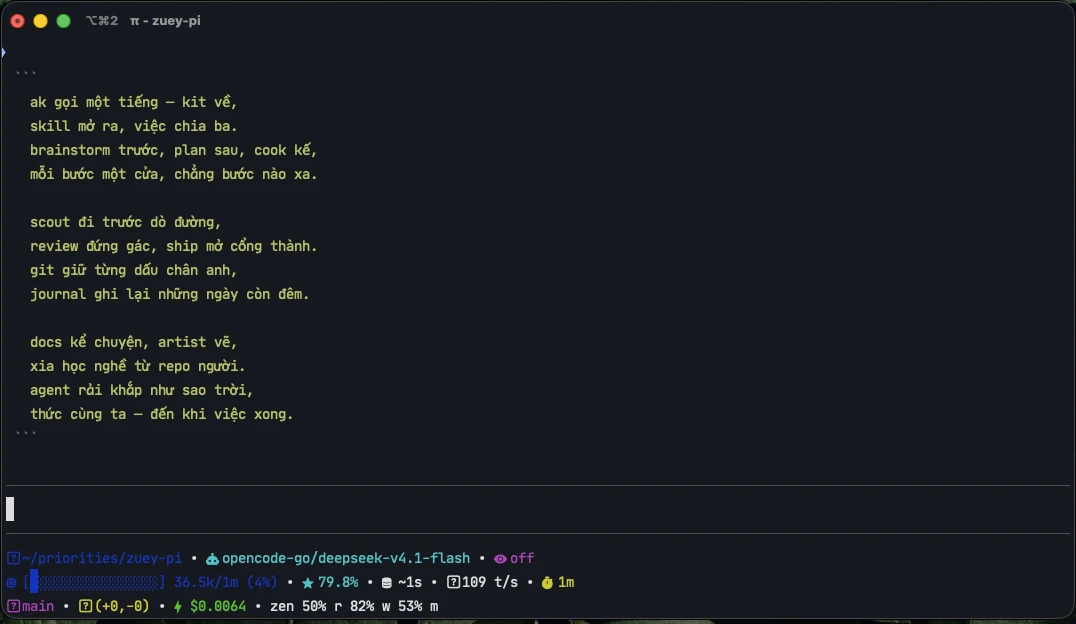
Cropped from CleanShot and compressed as WebP q90: 1078×626 / 40 KB and 1076×624 / 38 KB — 94% smaller than the original PNGs (696 KB). Unprocessed originals live in screenshots/originals/ (gitignored).
What's in the repo
zuey-pi-setup/
├── README.md                        ← you are reading this
├── README.vi.md                     Vietnamese README
├── .gitattributes                   keeps *.sh at LF (Windows-friendly)
├── docs/
│   └── pi-setup-migration.md        detailed guide + verification data (Vietnamese)
├── fonts/                           JetBrains Mono 1.0.2 (terminal font, OFL-1.1)
│   ├── README.md                    provenance, install steps, Nerd Font warning
│   ├── LICENSE.txt                  SIL Open Font License 1.1
│   └── JetBrainsMono-1.0.2/         ttf/ (1 MB, for terminals) + web/ (2 MB, for the web)
├── screenshots/                     statusline images used in the README (WebP, ~40 KB each)
│   └── originals/                   unprocessed CleanShot originals (gitignored)
├── scripts/
│   ├── pi-setup-backup.sh           packages the current machine's setup
│   ├── pi-setup-restore.sh          rebuilds that setup on a new machine
│   ├── pi-setup-verify-advisor.mjs  validates advisor.json against pi-advisor-flow's real schema
│   ├── pi-lens-compact-lsp-status.mjs  patches pi-lens so the LSP status line is compact (`LSP ✓` / `LSP ✗`)
│   └── pi-setup-patch-extensions.mjs   patches the stale-ctx crashes in pi-footer + pi-goal-x (both live in node_modules)
├── backups/
│   └── pi-setup-portable.tar.gz     ready-to-download bundle (filtered — see below)
└── config/                          setup snapshot (plain files, git-diffable)
    ├── .pi-setup-exclude           exclusion globs — backup honours this file
    ├── settings.json               manifest of 24 packages + model/theme/compaction
    ├── advisor.json                pi-advisor-flow config (at the config-dir root)
    ├── 99extensions.json           99percentpeople family config (todo namespace)
    ├── pi-lens-config.json          pi-lens config — lives in ~/.pi-lens/, OUTSIDE the config dir
    ├── external-configs.txt        manifest: which file goes where on restore
    ├── APPEND_SYSTEM.md            extra system prompt
    ├── models-store.json           model catalog (saves the 4h refresh wait)
    ├── model-fallback/
    │   └── config.json            pi-model-fallback rules (state.json is not taken)
    └── extensions/                 locally written extensions, not on npm
        ├── compaction-policy.ts    the only compaction trigger in this setup (thresholds + failure backoff)
        ├── pi-footer-cache-tps.ts  pushes cache-TTL + token speed (t/s) into pi-footer
        └── pi-footer.json          statusline layout (includes the context bar)
config/ is a mirror of the setup portion of ~/.pi/agent. Everything else (cache, secrets, history) is not included.
Not in the repo (generated by other tools, reinstallable)
| Excluded | Generated by | Why |
|---|---|---|
extensions/orca-*.ts (3 files, 1,239 lines) |
Orca (@orca-managed-pi-extension) |
Orca integration glue; Orca regenerates it when it manages pi |
extensions/agentkit-agent/, extensions/agentkit-hooks-engineer/ |
AgentKit (ak) |
1.2 MB of generated hooks plus caches holding absolute paths (native-skill-paths.json, 157 KB); ak reinstalls them |
missions/, memory/, skills/ |
pi / AgentKit | machine-specific state, not setup |
.pi-setup-exclude
scripts/pi-setup-backup.sh --config-dir config reads this file (one glob per line, # for comments) and deletes every match after mirroring. That is why re-running the backup never drags orca-*/agentkit-* back into the repo:
./scripts/pi-setup-backup.sh --config-dir config # → "excluded: 84 files matched .pi-setup-exclude"
Besides the two generated families it drops advisor-outcomes.jsonl, advisor-outcomes-salt (machine-local advisor logs) and extensions/*.bak* — the latter keeps the patch scripts' own backups (*.bak-pi-setup-patch) out of the repo.
The same file also works for tarball mode via --exclude-file:
./scripts/pi-setup-backup.sh -o backups/pi-setup-portable.tar.gz \
  --exclude-file config/.pi-setup-exclude
A config that cannot be backed up: @pi-unipi/notify
~/.unipi/config/notify/config.json contains a Gotify token and Telegram botToken + chatId, so it is deliberately absent from EXTERNAL_CONFIGS — committing it would leak credentials to a public repo. Set it up again on the new machine:
/unipi:notify-set-gotify     # configure the Gotify server
/unipi:notify-set-tg         # configure the Telegram bot
/unipi:notify-settings       # everything else
The same warning is written directly in scripts/pi-setup-backup.sh so it is not accidentally added later.
Config that lives outside the config dir
A few extensions keep config outside ~/.pi/agent/, so it cannot be collected by relative path. The script has a separate list for them:
# in scripts/pi-setup-backup.sh
EXTERNAL_CONFIGS=(
	"~/.pi-lens/config.json:pi-lens-config.json"
)
- Backup copies each existing file into the artifact under
<name>(pi-lens-config.json), plusexternal-configs.txt— a manifest of<name>=<~-style path>. - Restore reads that manifest and puts the file back where it belongs (
mkdir -pas needed, snapshotting the old file as*.bak.<timestamp>). - The manifest uses
~rather than/Users/..., so the artifact never leaks machine paths. - Adding another external config means adding one line to
EXTERNAL_CONFIGS; restore needs no change.
pi-multixkeeps credentials outside the config dir too (~/.multix/.env) — that one is deliberately not inEXTERNAL_CONFIGS, because it is a secret. Recreate it on the new machine.
⚠️ Artifact names must not collide with pi-lens' config basenames:
pi-lens.json,pi-lsp.json,.pi-lens.json. pi-lens walks upward from every directory it resolves
config for and matches the exact basename, so an artifact namedconfig/pi-lens.json
used to be read as a deprecated project config → 4PILENS_CFG_0003warnings plus
2PILENS_CFG_0001on every session inside this repo (and itsformat/autofixwere
applied as project settings). Renaming it topi-lens-config.jsonfixed that; the script
now has api_lens_reserved_nameguard that warns if the old name ever comes back.
backups/pi-setup-portable.tar.gz
A ready-made bundle so you don't have to clone and run the backup yourself: 10 files — settings.json (24 packages), APPEND_SYSTEM.md, models-store.json, advisor.json, pi-lens-config.json, external-configs.txt, model-fallback/config.json, extensions/compaction-policy.ts, extensions/pi-footer.json, and extensions/pi-footer-cache-tps.ts.
It is the script's full default bundle, filtered through .pi-setup-exclude so machine-only material never reaches this public repo:
| Excluded | Why |
|---|---|
extensions/orca-*.ts (3 files, 1,239 lines) |
Orca-generated code — deliberately kept out of the public repo |
extensions/agentkit-* (95 files) |
Contains native-skill-paths.json + native-skill-hashes.json (absolute paths, a list of 107 skills) and hooks/.logs/hook-log.jsonl (activity log) |
Restoring this bundle yields the same file set as config/ — all 24 extensions plus the statusline. It is a snapshot of this machine, so its settings.json can differ from config/settings.json in keys changed afterwards (e.g. default model, TUI mode). For an unfiltered bundle (keeping machine state) drop --exclude-file.
The 24 extensions in this snapshot
| # | Package | Version | What it does |
|---|---|---|---|
| 1 | pi-web-access |
0.29.0 | web search, URL fetch, GitHub repo cloning, PDF reading, YouTube + local video understanding |
| 2 | pi-mcp-adapter |
2.34.0 | MCP (Model Context Protocol) adapter |
| 3 | pi-subagents |
0.68.0 | subagent delegation + scripted multi-agent workflows |
| 4 | pi-goal-x |
0.31.4 | /goal: goal planning, durable progress, an auditor that checks completion |
| 5 | pi-background-tasks |
2.5.0 | background shell tasks, read-only delegated agents, attested runs, Fusion workflows |
| 6 | pi-model-fallback |
0.4.0 | switches to a fallback model by rule (provider/model + HTTP status 429/5xx) on provider failure; durable state with cooldowns; configured through the model_fallback_config tool |
| 7 | @narumitw/pi-usage |
0.60.8 | account usage display + DeepSeek API balance |
| 8 | pi-simplify |
0.2.3 | reviews just-changed code for clarity, consistency, maintainability |
| 9 | pi-footer |
0.5.1 | multi-row, customisable statusline (used by this repo) |
| 10 | pi-powerline-footer |
0.17.1 | powerline-style status bar (currently off via "extensions": []) |
| 11 | pi-memory |
0.4.2 | memory + semantic search (qmd) over daily log / long-term / scratchpad |
| 12 | pi-worktree |
1.3.3 | git worktree management, isolated workspaces in one command |
| 13 | @99percentpeople/pi-todo |
1.2.7 | minimal atomic todo: removal by omission, state survives compaction, dependencies, read-only widget |
| 14 | @juicesharp/rpiv-ask-user-question |
2.10.1 | asks you through multiple-choice questionnaires instead of guessing |
| 15 | @juicesharp/rpiv-btw |
2.10.1 | /btw: quick one-off question answered by the main model without polluting the conversation |
| 16 | @pi-unipi/notify |
2.17.0 | notifications when an agent finishes or fails: native OS, Gotify, Telegram, ntfy, routed per event type (⚠ config holds credentials — never backed up) |
| 17 | pi-smart-fetch |
0.3.17 (pinned) | web_fetch with a desktop-browser TLS fingerprint + defuddle content extraction |
| 18 | pi-advisor-flow |
0.6.0 | Executor/Advisor flow: a second opinion from a stronger model, with review gates before planning / after repeated failures / before declaring done |
| 19 | @tmustier/pi-session-recap |
0.5.0 | "while you were away" recap: drafts a short summary when you leave a session and shows it at the end of the transcript / above the editor when you return. Built for many parallel agents |
| 20 | pi-lens |
4.1.6 | LSP diagnostics + navigation, linters/type-checkers, formatter, ast-grep/tree-sitter, symbol_search, read-guard, /lens-map. In this setup the widget, autoformat and autofix are disabled (see its section) |
| 21 | pi-browser-use |
0.11.7 | agent browser via chrome-devtools-mcp (not Playwright): Pi's own headless Chrome on a dedicated ~/.pi/browser-profile (log in once with browser_setup), isolated fresh mode, browser_* tools plus the bundled browser-policy skill. Needs Node ≥ 24 and Chrome stable. Run browser_doctor for self-diagnostics |
| 22 | @injaneity/pi-computer-use |
0.5.1 | lets an agent drive desktop apps on macOS, Windows and Linux through the platform accessibility APIs: find_roots, observe_ui, search_ui, expand_ui, inspect_ui, act_ui, read_text, wait_for. Ships a per-user helper at ~/Applications/pi-computer-use.app; macOS needs Accessibility + Screen Recording granted to it, and the one-time setup flow requires an interactive Pi session, so nothing works in -p print mode until you grant them |
| 23 | @pinet/model-aware-compaction |
0.2.21 | model-aware compaction trigger: compacts on a share of the active model's window instead of a fixed token count. Installed but disabled here — config/extensions/compaction-policy.ts already implements the same thresholds and does not re-arm after a failed summary (see the compaction section) |
| 24 | pi-multix |
0.1.5 | multimodal generation and media processing through the multix CLI: images, video, speech, music, 3D, document conversion, ffmpeg/ImageMagick optimization. Its credentials live in ~/.multix/.env, deliberately outside this repo |
Versions are for reference at snapshot time; the source of truth is
config/settings.json. Onlypi-smart-fetchis hard-pinned, the rest float → a new machine pulls the latest. Pin them inconfig/settings.jsonif you need an exact match.
Default provider: opencode-go/deepseek-v4.1-flash (thinking high). Enabled models: see enabledModels in config/settings.json.
Statusline: context bar (0–100%)
The statusline is pi-footer, configured in config/extensions/pi-footer.json. This repo enables the context-bar widget — a progress bar scaled to each model's own context window (not a fixed number):
{
  "type": "context-bar",
  "options": {
    "contextBarMode": "medium",
    "contextConditionalColors": true,
    "hideWhenZero": true
  }
}
Real output (calling the widget's render() directly, 200k context window):
   0%  [░░░░░░░░░░░░░░░░] 0/200k (0%)        fg=blue
  25%  [████░░░░░░░░░░░░] 50k/200k (25%)      fg=blue
  71%  [███████████░░░░░] 142k/200k (71%)     fg=yellow   ← ≥ 70%
  92%  [███████████████░] 184k/200k (92%)     fg=red      ← ≥ 90%
Other models scale differently — a 1M context at 25% renders [████░░░░░░░░░░░░] 250k/1m (25%). When the context length is unknown it prints ?.
| Want to change | Edit in pi-footer.json |
|---|---|
| Bar width / style | contextBarMode: default (32 cells, bracketed) · medium (16 cells, used here) · short (10 cells) · short-only (10 cells, no numbers) |
| Percentage-based colours | contextConditionalColors (thresholds contextWarningPercent 70, contextDangerPercent 90) |
| Raw tokens instead of a bar | change "type": "context-bar" → "context-length", or use "context-remaining" / "context-window" |
Today's row 2: context-bar → cache-hit-rate → 2 event widgets (cache_ttl, tps, pushed in by pi-footer-cache-tps.ts).
3-row layout
The statusline is arranged in exactly three rows, dropping no widget:
| Row | Content | Width |
|---|---|---|
| 1 | cwd · model-provider · thinking-level |
71 |
| 2 | context-bar · cache-hit-rate · cache_ttl · tps · total-time |
80 |
| 3 | git-branch · git-diff · cost · mcp · background-tasks · goal · usage |
84 |
Why it used to be four rows: pi-footer renders the lines you configured plus one extra row (extensionStatusRow) holding statuses published by other extensions through ctx.ui.setStatus (mcp, goal, background-tasks, usage). That row is hidden with extensionStatusRow.hiddenKeys and the statuses move onto row 3 as external-status widgets.
⚠️
hiddenKeysis an exact key list, no wildcards. If another extension publishes a new status later, the fourth row comes back — add that key tohiddenKeys(or use/footer). Keys currently covered (13):advisor-scout,advisor-usage,background-tasks,goal,mcp,mcp-auth,pi-lens-lsp,session-recap,stash,subagent-slash,subagent-slash-text,usage,worktree.
Width budget: total content is 243 characters (201 of widgets + 42 of separators) → across 3 rows the longest row must be ≥ 81. The current layout needs a terminal ≥ 85 columns; narrower and the tail is truncated with …. To fit an 80-column terminal, shrink it: cwd → segments: 2 (−8) and model-provider → model (−11) ⇒ longest row drops to ~65.
⚠️ The config uses
"iconMode": "nerd", so the terminal needs a Nerd Font (patched build) for the icons to render.fonts/ships unpatched JetBrains Mono — installing that one and pointing your terminal at it is exactly how you get broken icons: see Terminal font.
Real screenshot of this layout: see Screenshots.
Terminal font: Nerd Font required
This is not a minor detail. Every statusline icon is a Nerd Fonts Private Use Area codepoint:
| Widget | Codepoint | JetBrains Mono (unpatched) | DankMono Nerd Font Mono | FantasqueSansMono NF Mono |
|---|---|---|---|---|
cwd |
U+F07C | ❌ missing | ✅ | ✅ |
model-provider |
U+F06A9 | ❌ missing | ✅ | ❌ missing |
thinking-level |
U+F0208 | ❌ missing | ✅ | ❌ missing |
context-bar |
U+F035B | ❌ missing | ✅ | ❌ missing |
cache-hit-rate |
U+F04CE | ❌ missing | ✅ | ❌ missing |
total-time |
U+F13AB | ❌ missing | ✅ | ❌ missing |
git-branch |
U+E725 | ❌ missing | ✅ | ✅ |
git-diff |
U+E702 | ❌ missing | ✅ | ✅ |
cost |
U+F04A3 | ❌ missing | ✅ | ❌ missing |
cache_ttl, tps (events) |
U+F01BC, U+EAF3 | ❌ missing | ✅ | ❌ missing |
Unpatched JetBrains Mono (the build in fonts/) is missing 11/11. When a glyph is missing the terminal does not leave the cell blank — it falls back to another font that has that codepoint, so icons render as meaningless shapes (a diamond ◆, a star ✦, or a ?) rather than a config error.
Fix — pick one:
A. Give the terminal a Nerd Font (keeps the proper icons; recommended). The Mono (single-width) variant is required for TUIs — non-Mono builds draw two-cell-wide icons and break column alignment.
# macOS
brew install --cask font-jetbrains-mono-nerd-font     # or font-dank-mono-nerd-font
# Windows: install per-user (copy the file AND register it), or select the .otf/.ttf → right-click → Install
$dst = "$env:LOCALAPPDATA\Microsoft\Windows\Fonts"
Copy-Item .\DankMonoNerdFontMono-Regular.otf $dst
New-ItemProperty -Path "HKCU:\Software\Microsoft\Windows NT\CurrentVersion\Fonts" `
  -Name "DankMono Nerd Font Mono (TrueType)" -Value "$dst\DankMonoNerdFontMono-Regular.otf" -PropertyType String -Force
Then point the terminal at it. For Windows Terminal, edit %LOCALAPPDATA%\Packages\Microsoft.WindowsTerminal_8wekyb3d8bbwe\LocalState\settings.json and set it under profiles.defaults so every profile inherits it (a profile with its own font overrides defaults, so that profile must be edited too):
"profiles": {
  "defaults": {
    "font": { "face": "DankMono Nerd Font Mono", "size": 12 }
  }
}
Any profile that already defines
fontmust have its ownfacechanged. Windows Terminal hot-reloadssettings.json, so back the file up before editing.
More on the bundled font — provenance, install steps for both platforms, license: fonts/README.md.
B. Skip patched fonts entirely: change "iconMode": "nerd" → "emoji" (renders 📁… via Segoe UI Emoji on Windows / Apple Color Emoji on macOS) or "text" (plain words, no icons). Trade-off: larger icons and a less compact statusline.
pi-model-fallback
A rule-based model-fallback extension: when a provider returns an HTTP status matching a rule (by default 429, 500, 502, 503, 504), pi switches to that rule's fallback model and persists durable state so later sessions keep using the new model until the cooldown expires (429 → 72 hours, 5xx → 10 minutes; Retry-After / x-ratelimit-reset* headers override when present). Rules match in order and the first match wins — so specific matchModels rules must come before broad matchProviders rules.
/model-fallback:status   # whether it is enabled, which durable entry is active, config/state paths
/model-fallback:reset    # clear durable state and return to the pre-fallback model
autoRetry (on by default) re-queues the failed prompt as a follow-up after the model switch; the failed request itself is not replayed.
Config lives at ~/.pi/agent/model-fallback/config.json and is read/validated/written by the extension's model_fallback_config tool — there is no TUI, unlike pi-provider-fallback (removed from this snapshot). The package default is zai/* → deepseek/deepseek-v4-flash; this snapshot replaces it with a rule for the deepseek provider:
{
  "version": 1,
  "enabled": true,
  "autoRetry": true,
  "rules": [
    {
      "name": "deepseek-to-deepseek-v4-flash",
      "matchProviders": ["deepseek"],
      "statuses": [429, 500, 502, 503, 504],
      "fallback": { "provider": "deepseek", "model": "deepseek-v4-flash" }
    }
  ]
}
The notable difference from the previous extension: the config is not inside
extensions/but in the same directory asstate.json. Soscripts/pi-setup-backup.shlistsmodel-fallback/config.jsonexplicitly and takes only the config file —state.jsonis machine state and never ships; restore also writes onlyconfig.json.
pi-advisor-flow
An Executor / Advisor flow: the model doing the work (Executor) can ask a stronger model (Advisor) for a second opinion. It has automatic review gates — before planning, after repeated failures, and before declaring completion — and can halt actions according to the policy you configure. Based on the paper Steering Black-Box LLMs with Advisor Models.
/advisor            # consult the Advisor (opens a model picker if unconfigured)
/advisor-models     # choose the Executor + Advisor models
/advisor-settings   # behaviour, context, privacy, limits
Global config is ~/.pi/agent/advisor.json — at the root of the config dir, not inside extensions/, so backup has to list it separately (it does). A project can override it with <project>/.pi/advisor.json.
The extension also publishes 2 status keys (advisor-scout, advisor-usage) — both are in hiddenKeys and have inline widgets like the other 9, so the status row does not come back while the Advisor runs.
Its own state (advisor-outcomes.jsonl, advisor-outcomes-salt) is a per-machine log/salt → excluded via .pi-setup-exclude, never committed.
@tmustier/pi-session-recap
A “while you were away” recap (in the spirit of Claude Code's away-summary): when you have genuinely stepped away from a session, the extension drafts a short summary — the main thing in flight first, then the concrete next step — and places it at the end of the transcript (in the TUI, above the editor) so you can read it the moment you return. Built for workflows with many agents across many tabs.
No config or state files — a purely stateless extension that reads/writes nothing under ~/.pi/agent/, so nothing extra needs backing up.
It still publishes 1 status key (session-recap, showing ✦ drafting recap… while drafting) → included in hiddenKeys with an inline widget, so the statusline does not jump to 4 rows while a recap is being written.
With tmux you need
set -g focus-events onin~/.tmux.conffollowed bytmux source-file ~/.tmux.confso the extension knows you came back.
pi-lens (LSP)
LSP for pi. pi has no built-in LSP — no setting, no docs — so it has to be an extension. pi-lens was chosen because it has more features and is far more widely used (@narumitw/pi-lsp is LSP-only and ~9× less used), and because the thing that made me remove it earlier — it lists files on screen — can be switched off with one config line.
The annoying part is the widget (setWidget("pi-lens", …), showing per-file findings above the editor), not the statusline. It has a widget.visible setting:
// ~/.pi-lens/config.json  —  NOTE: lives in ~/.pi-lens/, NOT ~/.pi/agent/
{
  "lsp": { "enabled": true },
  "widget": { "visible": false },
  "format": { "enabled": false },
  "autofix": { "enabled": false }
}
format and autofix are set to false here because only LSP was requested — the package defaults them to true, meaning it formats and applies quickfixes to the code you edit. Set them back to true to re-enable (or use the CLI flags --no-autofix / --no-autoformat to disable, and --lens-actionable-warnings --lens-actionable-warning-autofix to enable extra warnings).
Statusline: the extension publishes the key pi-lens-lsp (values like LSP Active: ts / LSP Inactive) → in hiddenKeys with an inline widget, so you can see whether LSP is running while the statusline stays 3 rows.
By default that value lists the server names (LSP Active: typescript, jsonc, …) and pi-lens has no config for it, so this repo compacts it with a bundle patch: LSP ✓ (green) when servers are alive, LSP ✗ (red) when one failed, LSP ✗ (dim) when none — with both alive and failed servers it shows LSP ✓ · LSP ✗, keeping the original two-state semantics. Re-run after every pi update:
node scripts/pi-lens-compact-lsp-status.mjs           # patch (no-op if already patched)
node scripts/pi-lens-compact-lsp-status.mjs --check   # report state only
node scripts/pi-lens-compact-lsp-status.mjs --revert  # restore the original bundle
Its config lives outside pi's config dir, which is why scripts/pi-setup-backup.sh has a dedicated mechanism for that group: see Config that lives outside the config dir above.
Compaction: when to compact vs how long the summary may be
These are two independent knobs, and treating them as one is how a session dies with Compaction failed: Summarization failed: generation hit the token cap and the summary is incomplete:
- When to compact is the local extension
config/extensions/compaction-policy.ts: at 40% of the window for models with a ≥500K window, 75% below that, with 60 s between requests and a 10-minute backoff after a failed compaction — so one failure does not re-arm a ~530K-token summarization on the very next turn. - How long the summary may be is pi core:
min(floor(0.8 × compaction.reserveTokens), model.maxTokens)for the summary pass (0.5×for the turn-prefix pass). The defaultreserveTokens: 16384caps the summary at 13,107 tokens. - That cap is what breaks long sessions: pi's UPDATE summarization grows monotonically. Measured growth on one real session: 6,012 → 11,286 → 10,283 → 12,659 tokens, i.e. it crosses the default cap.
- This setup ships
compaction.modelOverrideswithreserveTokens: 60000(→ a 48,000-token summary cap) for the five ≥500K-window models inenabledModels:opencode-go/deepseek-v4.1-flash,opencode-go/kimi-k3,opencode-go/qwen3.8-max,opencode-go/glm-5.3,deepseek/deepseek-flash. The globalreserveTokensstays 16384, because it is also the native trigger reserve and must stay small for small windows. @pinet/model-aware-compactionis installed but disabled (enabled: falseunderextensionsinconfig/settings.json): its rules duplicate the two thresholds above, and on failure it re-arms immediately (onErrorclearstriggeredModelKey), i.e. it would retry the expensive summarization every turn.
Scripts
The two setup scripts never ask for confirmation — they are safe to run from scripts/CI. Risk is handled with snapshots plus warnings on stderr. Of the three remaining scripts, one only reads (pi-setup-verify-advisor.mjs); the other two patch files inside installed third-party packages (pi-lens, pi-footer, pi-goal-x) and each stops with exit 2 instead of guessing when the code changes shape.
pi-setup-verify-advisor.mjs
pi-advisor-flow does not error on an unknown key in advisor.json: it keeps the key and only notifies contains unrecognized key(s) ... They were preserved but ignored — and that key has no effect. A misspelled key therefore looks configured while doing nothing.
This script extracts CONFIG_SCHEMA from the installed bundle and replays the two checks the extension runs while loading: unknownConfigKeys() (unknown key → ignored) and validate*Values() (wrong type / outside an enum).
node scripts/pi-setup-verify-advisor.mjs            # the file in this repo (config/advisor.json)
node scripts/pi-setup-verify-advisor.mjs --live     # + the live ~/.pi/agent/advisor.json, and compares the two
node scripts/pi-setup-verify-advisor.mjs --file <path>
| Exit | Meaning |
|---|---|
0 |
clean |
1 |
bad config: unknown key, wrong type, outside enum, unparsable JSON, missing file, repo snapshot diverged from the live file |
2 |
environment problem: no pi-advisor-flow bundle, bundle changed format, bad arguments |
Why it exists: I once wrote
advisorFailureMode(taken from an internal variable name in the bundle) when the real key isgateFailureMode— the file looked right, did nothing, and the warning showed up much later. This script catches exactly that class of mistake.
pi-lens-compact-lsp-status.mjs
pi-lens hardcodes the LSP status line in its bundle (updateLspStatus): `LSP Active: ${activeIds.join(", ")}`, `LSP Failed: ${failedIds.join(", ")}`, "LSP Inactive". There is no config key for it (~/.pi-lens/config.json only has lsp.enabled, widget.visible, format.enabled, autofix.enabled, ui.compactToolLine, actionableWarnings.*), and no other extension can fix it either: ctx.ui only exposes setStatus (write-only), while footerData.getExtensionStatuses() exists only inside a footer renderer — and pi-footer owns the footer (setFooter is last-wins), so its Pi Extension Status widget just renders the raw value (its trimValue option trims the leading part, so it cannot touch the trailing server list).
The script replaces exactly those three strings, and each one must match exactly once:
node scripts/pi-lens-compact-lsp-status.mjs           # patch (no-op if already patched)
node scripts/pi-lens-compact-lsp-status.mjs --check   # report state only, no write
node scripts/pi-lens-compact-lsp-status.mjs --revert  # restore the original bundle
| Exit | Meaning |
|---|---|
0 |
patched / just patched / just reverted |
1 |
not patched (with --check) or an unrecognised bundle → it does not guess |
2 |
environment problem (pi-lens bundle not found, bad arguments) |
⚠ npm overwrites
pi-lens/dist/index.json everypi updateor pi-lens reinstall → re-run this script. That is why a patch script lives in this snapshot repo. An upstream request for a first-class option is filed.
pi-setup-patch-extensions.mjs
Two third-party packages keep an ExtensionContext inside a function that runs later: pi-footer's render() (→ collectStatuslineData → ctx.getContextUsage()) and pi-goal-x's goal widget, whose two getters (getSettings → loadGoalSettings(ctx.cwd), getLedgerEvents → goalActivityEvents(ctx, …)) run on every render frame. /reload invalidates the old runner, and pi treats any use of an invalidated ctx as fatal, so the process dies with:
Error: This extension ctx is stale after session replacement or reload.
  at ExtensionRunner.assertActive
| Patch | Fix |
|---|---|
pi-footer |
wraps that one ctx use inside render() in a try/catch and returns [] for that frame; the footer is re-applied with a fresh ctx on the next session_start |
pi-goal-x |
captures cwd (a plain string — all GoalLedgerContext needs) when the widget is registered, so both getters read that value and the render path never touches ctx |
node scripts/pi-setup-patch-extensions.mjs           # patch both (idempotent, backs up first)
node scripts/pi-setup-patch-extensions.mjs --check   # report only: 0 = all patched, 1 = something missing
| Exit | Meaning |
|---|---|
0 |
everything patched (or just patched) |
1 |
something unpatched under --check, or a write produced no guard → the original is restored from the backup |
2 |
environment problem: package not found, or the code changed shape so an anchor no longer matches (it does not guess) |
⚠ Both patches live in
node_modules→ re-run after everypi updateor package reinstall (and once after a restore). As of this snapshot neither bug is fixed upstream:[email protected]and[email protected]are the latest releases.pi-goal-xalso has an unrelated open issue (#77) about itspeerDependenciesrange.
pi-setup-backup.sh
By default it takes only setup: settings.json, APPEND_SYSTEM.md, models-store.json, model-fallback/config.json, extensions/ — and it always includes the statusline (extensions/pi-footer.json lives inside extensions/).
./scripts/pi-setup-backup.sh                       # → ./pi-setup-portable.tar.gz (setup only)
./scripts/pi-setup-backup.sh --config-dir config    # → update config/ inside this repo
./scripts/pi-setup-backup.sh --skills --hooks       # add skills + hooks
./scripts/pi-setup-backup.sh -o ~/Desktop/pi.tar.gz
./scripts/pi-setup-backup.sh --dry-run
| Opt-in (NOT included by default) | What it takes | Notes |
|---|---|---|
--auth |
auth.json |
⚠ contains credentials → never publish the artifact |
--skills |
skills/ |
dereferences symlinks → self-contained backup (~24 MB, 108 skills) |
--hooks |
hooks/ dirs under ~/.pi/agent |
currently 544 KB. Does not touch ~/.claude/hooks (that one holds .env). Overrides .pi-setup-exclude for hook paths |
--memory |
memory/ |
|
--missions |
missions/ |
⚠ pi-goal-x state, may contain project/customer names |
--sessions |
sessions/ |
chat history (~56 MB) |
--with-state |
--skills --memory --missions |
| Opt-out | Effect |
|---|---|
--no-statusline |
Does not back up the statusline config (pi-footer.json, powerline-footer/theme.json) — a new machine keeps the default layout |
The script also: writes to a temp file then mvs it (no corrupt artifact on interruption) · scans for secrets (sk-*, ghp_*, xox*, BEGIN PRIVATE KEY with a base64 body, api_key=…) · warns about symlinks pointing outside · reports extension config (whether statusline / model-fallback were backed up) · compresses deterministically (gzip -n → same content, same SHA-256) · refuses to write --config-dir into $HOME, /, or pi's own config dir.
On secret scanning: the script ignores common placeholders (word-only values like
currentPassword,{CLIENT_SECRET}forms, bare PEM headers, low-entropy strings likeghp_aaaa…). It can still flag fixtures inside third-party package tests (e.g. a Slack-token-shaped string in AgentKit's own tests) and test strings you once pasted into chat (with--sessions, since transcripts live undersessions/) — read the filenames before concluding.
pi-setup-restore.sh
| Option | Effect |
|---|---|
--from-config DIR |
restore from config/ (plain files) |
--bundle FILE |
restore from a .tar.gz |
--target DIR |
a target other than ~/.pi/agent |
--scratch |
target a temp dir — safe to rehearse |
--install |
run pi headless once so it installs the extensions (~150–190 s) |
--verify |
compare installed extension count against settings.json |
--with-trust |
also copy trust.json |
--dry-run |
print only, write nothing |
Before overwriting, settings.json and auth.json (when present in the source) are snapshotted to *.bak.<timestamp>. The script sets trap ERR, so it never exits silently — it always prints the line number on unexpected errors. After a restore it also prints step 4: whether the pi-lens LSP status patch is in place in the restored target (informational only — it never mutates a third-party package).
Verification
Tested by restoring into a brand-new config dir via PI_CODING_AGENT_DIR, never touching the real setup.
⚠️ The tables below are historical, one row per snapshot. The current 24-package snapshot was re-measured on Windows 11 + Git Bash (2026-09-21): install 123 s, module dirs
0 → 281,--verify24/24,pi list24 — details in the Windows table below.
| Check | Result |
|---|---|
| First install time | 136–246 s across real runs (npm-speed dependent; 335 s with a cold npm cache) |
Module dirs in npm/node_modules |
0 → 203 (20-package snapshot) |
--verify |
20/20 on the latest run (pi-lens + pi-todo + notify), 19/19 · 18/18 · 17/17 · 16/16 on earlier snapshots |
| Extensions actually running (not just installed) | ✅ 18 extension_ui_request, 0 load errors, surfaces for subagent-async, mcp, goal, background-tasks, usage, pi-footer, advisor-scout, advisor-usage, pi-lens-lsp |
| Config outside the config dir restored | ✅ written to ~/.pi-lens/config.json (old file snapshotted first) |
Restore from the new bundle into a fake HOME |
✅ 9 files, external config written to the right place, contents match config/pi-lens-config.json |
| pi-lens legacy-basename collision | ✅ config/pi-lens.json → pi-lens-config.json: repro with cwd=config/ went 6 → 12 PILENS_CFG_0003/0001 warnings before the fix, delta 0 after, resolution documents=1 legacy=0 records=0 |
| Clone the public repo and restore | ✅ 11 files, 0 excluded, 153 s, verify matched, 0 errors |
auth.json in the new dir |
{} → no secret leakage |
| Second run | empty log → idempotent |
| Two consecutive backups | byte-identical (deterministic) |
context-bar rendering |
✅ direct render() call: 0/25/71%→yellow/92%→red/100%, correctly scaled for 200k and 1M |
--no-statusline |
✅ pi-footer.json disappears from the bundle (different SHA than the default) |
--hooks + .pi-setup-exclude |
✅ hooks survive, "override" warning printed, 54 files remain |
--auth on restore |
✅ auth.json.bak.<ts> preserves the old credentials before overwriting |
Windows 11 + Git Bash (MSYS2, bash 5.3) — re-measured on the 24-package payload (2026-09-21)
| Check | Result |
|---|---|
Real restore (--from-config config --scratch --install --verify) |
✅ 24/24, install 123 s, module dirs 0 → 281 (the 20-package payload was 20/20 · 88 s · 0 → 203) |
pi list in the restored dir |
✅ 24 packages |
settings.json after restore |
✅ byte-identical to config/settings.json |
| Extensions actually running in the restored dir | ✅ 26 extension_ui_request, 0 load errors; the single error notification is Advisor models are not configured or available — expected in a fresh dir where /advisor has not run yet |
| Config outside the config dir | ✅ written to %USERPROFILE%\.pi-lens\config.json, matching config/pi-lens-config.json |
Restore from a bundle into a fake HOME |
✅ 10 files, external config written correctly |
MSYS path conversion for child pi |
✅ PI_CODING_AGENT_DIR=/tmp/... → C:/Users/.../Temp/... |
| Bundle rebuilt on Windows | ✅ 10 files, 11.2 KB, clean (no ._* AppleDouble junk like the macOS-built one), sha256 280de9d0… |
Package counting without python3 |
✅ node -e → 20 |
| CRLF in scripts | ✅ bash 5.3.15 tolerates CRLF (tested with a CRLF copy, exit 0) |
Verify script (advisor.json)
| Check | Result |
|---|---|
| Config matrix (real runs, exit codes compared) | ✅ 6/6: clean config 0 · unknown key 1 · outside enum 1 · wrong type 1 · ref missing provider/model 1 · missing gateFailureMode still 0 |
| Environment branches | ✅ 7/7: --live compares both files 0 · missing --pkg 2 · bundle without CONFIG_SCHEMA 2 · --help 0 · bad argument 2 · unparsable JSON 1 · missing file 1 |
| Schema extraction | ✅ 31 keys from the 0.6.0 bundle's CONFIG_SCHEMA; reproduces the exact advisorFailureMode notice the extension emitted (harness matched real output) |
Known limitations
auth.jsonis not in the repo (secret) →/loginagain on the new machine.sessions/andmissions/are not in the repo → chat/mission history is not migrated. Use--sessions/--missionsto back them up yourself.- 2 skills are symlinks into AgentKit (
skills/orchestration,skills/orca-per-workspace-env) → they only work if the new machine has AgentKit installed. Broken symlinks there affect no other extension (tested). Use--skillsto back up the real content. - 3
orca-*.tsextensions and 2agentkit-*directories are not in the repo → Orca/AgentKit regenerate them. pi-model-fallbackconfig lives at~/.pi/agent/model-fallback/config.json— the same directory asstate.json, andstate.jsonis machine state (entries + cooldown deadlines) so it is not backed up. The script lists the config file explicitly. Without that file the extension runs on the package default (zai→deepseek/deepseek-v4-flash).pi-advisor-flowconfig (~/.pi/agent/advisor.json, at the config-dir root rather than insideextensions/) only exists after running/advisoror/advisor-settings. Backup lists that file explicitly, so it is included automatically once it appears.- The scripts need a POSIX shell → on Windows run them in Git Bash or WSL; PowerShell/cmd cannot run them.
- Statusline icons need a Nerd Font → using the unpatched JetBrains Mono from
fonts/breaks icons into ◆/✦/?; see Terminal font. piinstalls globally per Node version →nvm use/fnm useto a different version can make thepicommand disappear; reinstall it globally for that version./reloadkills pi unlesspi-footerandpi-goal-xare patched (Error: This extension ctx is stale after session replacement or reload) → runnode scripts/pi-setup-patch-extensions.mjs, and re-run after everypi updatebecause both patches live innode_modules. Neither bug is fixed upstream ([email protected],[email protected]are the latest).- The
pi-lensLSP status line is a bundle patch, not config →pi updateoverwrites it; re-runnode scripts/pi-lens-compact-lsp-status.mjs(the script stops with exit1if pi-lens changes the shape of that function instead of guessing).
Personal repo
This is a snapshot of one person's setup at a point in time — not an official product of pi or of any package listed here. No license is included: all rights belong to the author; third-party extensions remain under their own licenses.
Yorumlar (0)
Yorum birakmak icin giris yap.
Yorum birakSonuc bulunamadi