deadweight
Health Uyari
- License — License: MIT
- Description — Repository has a description
- Active repo — Last push 0 days ago
- Low visibility — Only 8 GitHub stars
Code Gecti
- Code scan — Scanned 8 files during light audit, no dangerous patterns found
Permissions Gecti
- Permissions — No dangerous permissions requested
Bu listing icin henuz AI raporu yok.
Find the dead weight in your Claude Code setup: what every request carries before you type, and what you never use. Single Rust binary.
deadweight
Find the dead weight in your Claude Code setup.
Every plugin, skill, MCP server and hook you install adds text to every single request Claude Code sends, before you type a word. deadweight measures that overhead from your own session history, tells you exactly where it comes from, shows what you never actually use, and removes it with one undoable command.




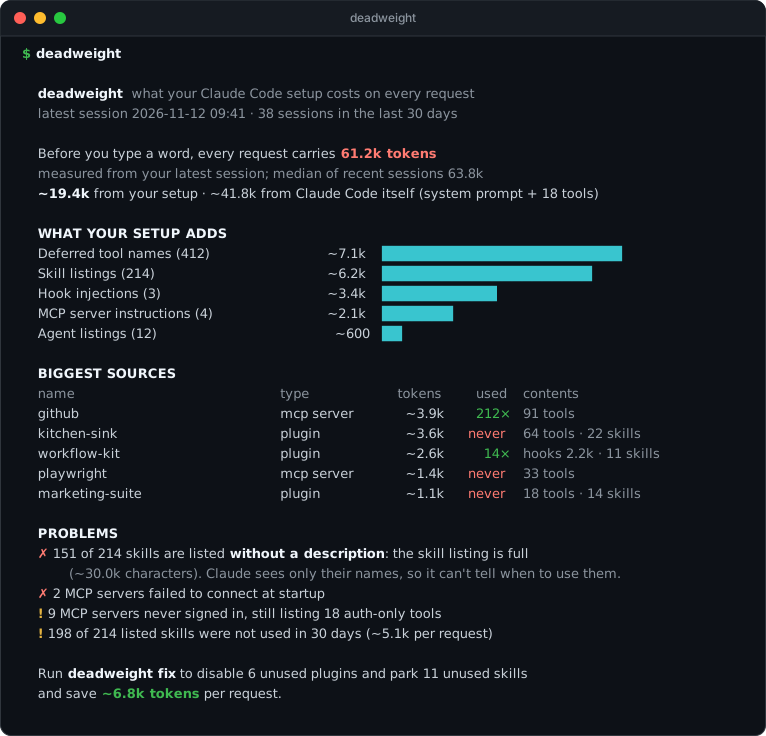
An example run. Yours will look different, and that's the point.
Same output as text$ deadweight
Before you type a word, every request carries 61.2k tokens
measured from your latest session; median of recent sessions 63.8k
~19.4k from your setup · ~41.8k from Claude Code itself (system prompt + 18 tools)
WHAT YOUR SETUP ADDS
Deferred tool names (412) ~7.1k ████████████████████████
Skill listings (214) ~6.2k █████████████████████
Hook injections (3) ~3.4k ███████████▌
MCP server instructions (4) ~2.1k ███████▏
Agent listings (12) ~600 ██
BIGGEST SOURCES
name type tokens used contents
github mcp server ~3.9k 212× 91 tools
kitchen-sink plugin ~3.6k never 64 tools · 22 skills
workflow-kit plugin ~2.6k 14× hooks 2.2k · 11 skills
playwright mcp server ~1.4k never 33 tools
devops-pack plugin ~1.3k 3× hooks 1.2k · 6 skills
marketing-suite plugin ~1.1k never 18 tools · 14 skills
linear mcp server ~810 37× 41 tools
PROBLEMS
✗ 151 of 214 skills are listed without a description: the skill listing is full
(~30.0k characters). Claude sees only their names, so it can't tell when to use them.
Including 4 you actually use: pdf-tools:extract, review-pr, workflow-kit:plan, +1 more
✗ 2 MCP servers failed to connect at startup
! 9 MCP servers never signed in, still listing 18 auth-only tools
! 3 skill names are listed more than once
! 198 of 214 listed skills were not used in 30 days (~5.1k per request)
Run deadweight fix to disable 6 unused plugins and park 11 unused skills and save ~6.8k tokens per request.
UNUSED, BUT YOURS TO REMOVE
mcp server playwright ~1.4k claude mcp remove "playwright"
LOADED IN EVERY PROJECT, USED IN ONE OR TWO
mcp server linear ~810 37× in /home/you/code/app (of 9 projects)
in .claude.json, move "linear" from the top-level mcpServers into projects > "/home/you/code/app" > mcpServers
Why this matters
- Your usage limit drains faster. The overhead is resent on every turn of every session.
- Your context window fills sooner, so sessions compact earlier and Claude loses track of your actual work.
- Claude gets worse at picking the right skill. This one surprised us: Claude Code caps the skill listing at roughly 30,000 characters. Once you go past it, skills are listed by name only, without their descriptions. With a few hundred skills installed, most of them end up as bare names, and Claude has no way to tell when to use them. Unused skills crowd out the ones you rely on.
None of this shows up anywhere in the UI. Plugins get installed one at a time and the total is never visible.
Install
cargo install deadweight
Or grab a prebuilt binary for macOS, Linux or Windows from Releases. It's a single binary with no runtime dependencies.
Usage
deadweight                 # audit: what every request carries and where it comes from
deadweight --all           # list every source, not just the biggest
deadweight --days 60       # count anything used in the last 60 days as "used"
deadweight --json          # machine-readable output

deadweight fix --dry-run   # show what would change
deadweight fix             # disable unused plugins, park unused skills (asks first)
deadweight undo            # put everything back
fix options:
| flag | effect |
|---|---|
--keep NAME |
never touch this plugin or skill (repeatable) |
--include-hooked |
also disable unused plugins that run hooks |
--yes |
don't ask for confirmation |
--force |
run even with fewer than 5 sessions of history |
Restart Claude Code after fix or undo to load the new setup.
Use it from inside Claude Code
deadweight ships as a Claude Code plugin too, so you can ask Claude to audit its own setup:
/plugin marketplace add msertdev/deadweight
/plugin install deadweight@deadweight
/deadweight
The plugin needs the deadweight binary on your PATH (see Install). It adds a single short line to the skill listing, about 18 tokens.
How it works
Claude Code keeps a transcript of every session in ~/.claude/projects/. Alongside the conversation it records what was loaded at startup: the skill listing, the deferred tool names, MCP server instructions, the agent listing, hook output, and the token usage the API billed for each request.
deadweight reads those records:
- Measure. The total comes from the API usage of the first request of your latest session (input + cache write + cache read tokens). This number is measured, not estimated.
- Attribute. Each skill line, tool name, instruction block, agent and hook injection is traced to the plugin, skill, MCP server or connector that added it. Hook commands are matched against each plugin's
hooks.json. Sizes are converted to tokens from text length; whatever your setup doesn't explain is Claude Code's own system prompt and tools. - Check usage. Every transcript from the last 30 days (including subagents) is scanned for
Skillcalls, MCP tool calls, agent launches and slash commands. - Diagnose. Failed and never-authenticated MCP servers, duplicate skill names, skills that lost their description, and single skills with very large descriptions.
- Scope. A user-scope MCP server loads in every project. If its tools were only ever called from one or two projects, deadweight says which ones, so you can move it to those projects and stop paying for it everywhere else. (A project's
.mcp.jsonworks too, if the team should share it.)
On the author's machine, 1.4 GB of transcripts (41 sessions, 400+ subagent runs) are scanned in about a second, in parallel.
Safety
- Read-only by default. Only
fixandundowrite anything, and both ask first. - No secrets are read. From
.claude.jsondeadweight takes only MCP server names, never commands, environment variables or headers. A test checks that secret values never reach the output. - Nothing is deleted. Plugins are disabled in
settings.json(enabledPlugins: false), not uninstalled. User skills are moved into the backup folder. - Everything is backed up. Each
fixwrites a manifest and a copy ofsettings.jsonto~/.claude/deadweight/backups/<timestamp>/.undoreverts the latest one. - Conservative. Plugins that run hooks may be doing useful work deadweight can't see (memory, safety checks), so they are skipped unless you pass
--include-hooked.fixrefuses to run with fewer than 5 sessions of history. - No network. deadweight never makes a network request.
MCP servers in .claude.json and claude.ai connectors are never edited; deadweight prints the command that removes them, or where to move them, instead.
FAQ
Does it work with CLAUDE_CONFIG_DIR? Yes, and you can also pass --config-dir.
Why does fix skip a plugin I never use? It runs hooks. Review it, then run deadweight fix --include-hooked, or disable it yourself with /plugin.
My usage looks wrong. Claude Code deletes transcripts older than cleanupPeriodDays (30 by default), so deadweight can't see further back than that. Use --keep for anything you use rarely but want to keep.
Is it affiliated with Anthropic? No. It's an independent open-source tool that reads files Claude Code writes on your machine.
Contributing
Issues and pull requests are welcome. Start with CONTRIBUTING.md and the good first issues; the whole codebase is about 2,600 lines of Rust.
If deadweight misattributes something in your setup, run deadweight --json, remove anything private, and open an issue with the relevant part.
License
MIT © Murat Sert
Yorumlar (0)
Yorum birakmak icin giris yap.
Yorum birakSonuc bulunamadi