tare
Health Warn
- License — License: MIT
- Description — Repository has a description
- Active repo — Last push 0 days ago
- Low visibility — Only 5 GitHub stars
Code Pass
- Code scan — Scanned 12 files during light audit, no dangerous patterns found
Permissions Pass
- Permissions — No dangerous permissions requested
No AI report is available for this listing yet.
Lossless-by-default context compression for LLM coding agents — proxy, library, CLI, and MCP server. Local-first, cache-correct, reversible.

Cut your coding agent's context 44–73% — lossless by default, cache-safe, output-aware.



Install · Proof · Compared to · Claude / MCP · Integrations · Status
tare sits between your agent and the model API and shrinks the context window. Three properties make
it different:
- Lossless by default — tool output, logs, and JSON are re-encoded into a denser equivalent
form. Information is dropped only when you opt in (row-caps, telegraphic NL, AST code
skeletonization). - Cache-correct — provider prefix caches discount cached tokens ~10×, and one rewritten byte in
the prefix forfeits it. tare detects the cache breakpoint and compresses only the dynamic suffix. - Output-aware — over-compression makes models compensate with verbose output, so total cost can
rise as input falls. tare watches output tokens per turn and backs off when they spike.
What you get
tare-proxy— point your agent's base URL at it; zero code changes. Speaks Anthropic
(/v1/messages) and OpenAI (/v1/chat/completions).tareCLI —compress,skeletonize,compact-lossy, and 12 more subcommands
(full reference).tare-mcp— compression + persistent cross-session memory as MCP tools, for any MCP client.- Libraries —
tare-core(Rust),tare-compress(Python),tare-ai(JS/TS).
Proof
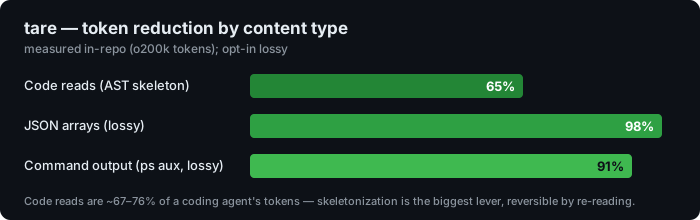
All numbers are measured by running target/release/tare on the committed corpus with tiktoken
o200k_base (v0.13.0). Results live in crates/tare-bench/results/; reproduce withpython3 crates/tare-bench/run_proof.py.
| Name | Content type | Command | Input tokens | Output tokens | Reduction |
|---|---|---|---|---|---|
| cargo_packages | json_array | tare compact-lossy |
6,906 | 3,625 | 47.5% |
| ps_aux | tabular | tare compact-lossy |
1,545 | 802 | 48.1% |
| app_log | logs | tare compact-lossy |
13,217 | 6,551 | 50.4% |
| agent_context | agent_context | tare compress |
15,130 | 8,499 | 43.8% |
| server_rs | code | tare skeletonize --path server.rs |
5,930 | 1,582 | 73.3% |
| json_crush_rs | code | tare skeletonize --path json_crush.rs |
3,937 | 1,607 | 59.2% |
| readme_prose | prose | tare compact-lossy |
5,732 | 2,727 | 52.4% |
Code reads are ~67–76% of a coding agent's tokens (SWE-Pruner, ACL 2026),
so skeletonization is the biggest lever. Head-to-head harnesses against Headroom, LLMLingua-2,
lean-ctx, and RTK live in crates/tare-bench/benchmarks/.
Compared to
| Scope | Deploy | Local | Lossless default | Output-aware¹ | |
|---|---|---|---|---|---|
| tare | tools · logs · files · JSON · history | proxy · library · CLI · MCP | ✅ | ✅ | ✅ |
| Headroom | all context | proxy · lib · MCP | ✅ | ❌ (reversible via cache) | ❌ |
| RTK | CLI command outputs | CLI wrapper | ✅ | ❌ | ❌ |
| lean-ctx | CLI commands, MCP tools | CLI · MCP | ✅ | ❌ | ❌ |
| LLMLingua-2 | prose / RAG | library (ML model) | ✅ | ❌ | ❌ |
| OpenAI / Anthropic native compaction | conversation history | provider-native | ❌ | ❌ | ❌ |
¹ Output-aware = reads the model's output token count each turn and reduces compression aggression
when verbosity spikes (the x-tare-verbosity-spike signal incrates/tare-proxy/src/server.rs).
When to use · When to skip
Great fit if you…
- run coding agents and want savings without losing information by default
- care about the provider cache staying warm (tare won't break the prefix)
- want code reads compressed structurally (signatures kept, bodies elidable on demand)
Skip it if you…
- only use a single provider's native compaction and don't need a cross-provider proxy
- run in a sandbox where a local proxy process can't run
Get started (60 seconds)
# 1 — install (no Rust toolchain needed)
curl -fsSL https://raw.githubusercontent.com/mstuart/tare/main/install.sh | sh   # → ~/.local/bin
# or:  npm install -g tare-ai
# or:  docker pull ghcr.io/mstuart/tare
# or:  cargo install tare-cli
# or:  git clone https://github.com/mstuart/tare && cd tare && cargo build --release

# 2 — run as a proxy (point your agent's base URL at http://localhost:8787)
TARE_UPSTREAM=https://api.anthropic.com tare-proxy

# 3 — or use the CLI on any stdin
cat big.rs | tare skeletonize --path big.rs    # drop fn bodies, keep structure
ps aux     | tare compact-lossy --max-rows 30 --max-field 110
| Env var | Default | Meaning |
|---|---|---|
TARE_UPSTREAM |
https://api.anthropic.com |
upstream API base URL |
TARE_PORT |
8787 |
listen port |
TARE_RECENCY |
4 |
recent tool outputs always kept |
TARE_ENABLED |
true |
set 0/false for byte-exact passthrough |
TARE_CONTEXT_LIMIT |
200000 |
model context window (drives the fill dial) |
TARE_OUTPUT_HOLDOUT |
0 |
fraction of sessions left uncompressed (A/B for tare output-savings) |
TARE_ADMIN_TOKEN |
unset | secret required by admin endpoints and CLI admin commands; unset disables the admin API |
TARE_LOG |
unset | set it to log one line per turn with the compression report |
Response headers (x-tare-input-tokens, x-tare-net-tokens, x-tare-dropped, x-tare-aggression,x-tare-verbosity-spike, x-tare-halted) report what each turn did; GET /admin/stats andPOST /admin/runtime-env expose live stats and hot config when TARE_ADMIN_TOKEN is set; clients
must send the token in x-tare-admin-token. Details: getting started.
Integrations
# pip install tare-compress
import tare
out = tare.compress(blocks_json, task="fix the login bug")   # in-process, no proxy needed
// npm install tare-ai
import { withTare } from "tare-ai";
const client = new Anthropic(withTare({ apiKey: "..." }));   // routes through the local proxy
Python ships all core transforms in-process plus adapters for litellm, ASGI, LangChain, Agno, and
Strands; JS/TS ships proxy helpers for the Anthropic/OpenAI SDKs and the Vercel AI SDK.
Full adapter reference: docs/integrations.md.
Use with your Claude subscription — MCP, no API key
The proxy forwards whatever auth the client sends — a billable x-api-key, or your Claude Pro/Max
subscription OAuth token when you point Claude Code's ANTHROPIC_BASE_URL at it
(scripts/live-smoke-sub.sh runs exactly this round-trip). Prefer no base-URL change at all? Runtare-mcp: a local stdio server your agent calls as tools — it never calls the model itself, so it
needs no API key.
# easiest — no build; npx fetches the prebuilt binary on first run:
claude mcp add tare -s user -- npx -y -p tare-ai tare-mcp
{
  "mcpServers": {
    "tare": { "command": "npx", "args": ["-y", "-p", "tare-ai", "tare-mcp"] }
  }
}
Paste the same block into any MCP client (Cursor, Codex, Claude Desktop'sclaude_desktop_config.json, …). It exposes 10 tools: compression (tare_compress,tare_skeletonize, tare_compact_lossy, tare_deref_images), a reversible tare_expand,tare_stats, and cross-session memory — full list.
Wrap your agent
One command starts the proxy and launches your CLI agent through it — ENV-based and ephemeral:
tare wrap claude               # start proxy + launch Claude Code through it
tare wrap codex --port 9000    # 12 agents supported: claude, codex, aider, goose, …
tare wrap claude --print       # dry-run: show what would run
Full agent matrix and modes: docs/cli.md.
Status & limitations
- Tested — verified end-to-end against the live Anthropic API (a full proxy round-trip on a
Claude subscription, plus the MCP server over real stdio JSON-RPC), on top of 228 unit,
integration, and property tests;fmt/clippy -D warnings/cargo denygate every commit. - Deploy it as a local sidecar — tare runs next to your agent and forwards your credentials
upstream without logging or persisting them; treat it as a trusted component on your own machine,
not shared multi-tenant infrastructure (SECURITY.md). Startup failures exit with a
clear[tare-proxy] fatal: …message, never a panic backtrace.
Known edges
- Proxy and CLI token counts are approximate (
tare-tokenize, chars/4); the benchmark numbers above
are measured with tiktoken. - The context-fill signal counts the serialized request (incl. JSON envelope), so it slightly
over-estimates fill — conservative, errs toward compressing sooner. - A
>2 MBstreaming response whose final usage event straddles the 64 KB tail buffer may skip
one verbosity sample (non-fatal).
Non-goals — no trained ML text-compressor (no weights to download, no inference latency) and no
audio: transcribe externally and feed the transcript through tare compress.
Architecture
Nine crates: engine (tare-core), proxy + closed-loop controller (tare-proxy), CLI, MCP server,
SQLite memory, tokenizer, cache models, Python bindings, bench harness. Optional neural-embed
feature swaps keyword relevance for exact-cosine neural embeddings.
Diagram and crate guide: docs/architecture.md.
Contributing
See CONTRIBUTING.md. CI runs cargo fmt --check, cargo clippy -D warnings,cargo test, and a release build — please make sure those pass locally.
License
MIT — see LICENSE.
Reviews (0)
Sign in to leave a review.
Leave a reviewNo results found