cheap-ag
Health Pass
- License — License: MIT
- Description — Repository has a description
- Active repo — Last push 0 days ago
- Community trust — 196 GitHub stars
Code Fail
- fs module — File system access in bench/compare.sh
- spawnSync — Synchronous process spawning in bench/lib.mjs
- process.env — Environment variable access in bench/lib.mjs
Permissions Pass
- Permissions — No dangerous permissions requested
No AI report is available for this listing yet.
50x your Claude usage with cheap-ag. Opus plans, a dirt-cheap model writes every line, and tests decide what ships. Your $20 plan stops hitting limits. One MCP server for Claude Code.
Cheap Agent
Your Opus is a principal engineer. Stop paying it to type.





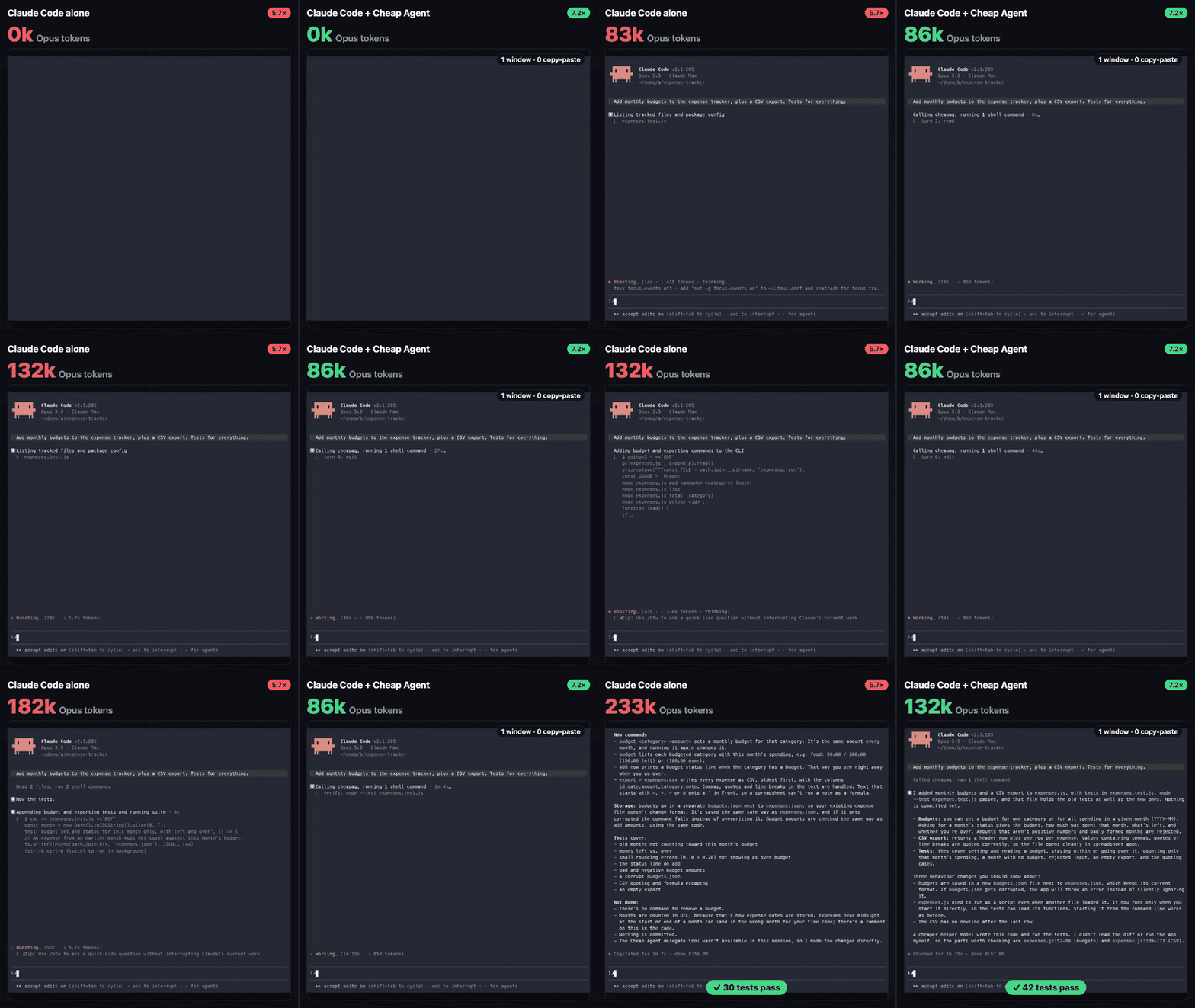
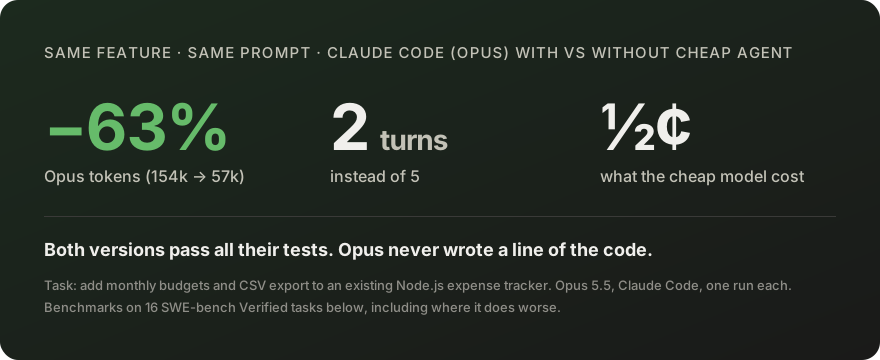
Same feature. Same prompt. 63% fewer Opus tokens.
Your Claude plan lasts longer. Your code still ships with tests.
⭐ Star it, and click Watch → Custom → Releases to hear when new versions ship.
You know the principal engineer. Twenty years in. Sees the whole system at once. Costs a fortune per hour.
You would never pay them to type out a CSV exporter.
But that's exactly what happens every time Opus writes your code: the most expensive model you have, reading files, typing boilerplate, re-running tests, burning through your plan.
Cheap Agent fixes the org chart. Opus plans and decides. A model that costs half a cent per task does the typing, in its own copy of your project, and has to prove its work with a test before anything reaches you.
Why I built this
The idea: get $200-plan usage out of the $100 Claude plan, and $50–70 worth out of the $20 plan, with a few dollars of DeepSeek doing the typing.
I've met a lot of students, mostly in developing countries, who really want Opus for the hard problems and simply can't afford $100 a month. I wanted to find something that helps them.
This is a small effort from my side. It won't make Opus ten times cheaper. But stretching the plan you already pay for is something, and something is better than nothing.
📖 The full story (why I built it, how it works step by step, and the SWE-bench numbers): Cheap Agent: how I made my Claude plan last 2.2–2.7x longer
Install
Easiest: paste this into Claude Code. It asks what you want, then gives you one command to run.
Set up Cheap Agent (npm: cheap-agent) for me.
1. Ask me: which provider (OpenRouter recommended, DeepSeek, OpenCode Go or Command Code), and which
   models (balanced is the default; cheapest, strongest, or my own provider/model).
2. Check that node is 20+ and the claude CLI is installed.
3. If I picked my own model, save {"models":{"implement":"<model>"}} in
   ~/.config/cheapag/config.json, keeping what else is there.
4. Give me the command to run in my terminal: npx cheap-agent login --preset <my choice,
   or custom>, and which number to pick for my provider (1 OpenCode Go, 2 OpenRouter,
   3 DeepSeek, 4 Command Code). I run it and type my API key there. Never ask for my key.
5. When I say done, check `claude mcp list` shows cheapag, then tell me to run
   /cheapag:allow in a new Claude Code session in my project.
Or do it yourself:
npx cheap-agent
Pick a provider (OpenRouter if unsure), press Enter for the recommended models, paste your API key. It checks the key works, then adds itself to Claude Code for every project.
Then, in each project, once:
/cheapag:allow
That's it. Ask Claude for changes like you always do.
You need:
- Claude Code
- Node.js 20+
- An API key with a few dollars on it from OpenRouter, DeepSeek, OpenCode Go or Command Code (needs a plan with API access)
A few dollars lasts hundreds of tasks. It runs on macOS and Linux.
Windows (beta): tested in CI, not yet by a Windows user. You also need Git for Windows (Git Bash). Known so far:
- The very first job can take about 2 minutes while the cheap model's engine (OpenCode) sets itself up. Later jobs start in seconds.
- If that engine crashes mid-session, Cheap Agent starts a new one, but the crashed copy can stay running (
opencode.exein Task Manager) until you end it or restart. - The cheap model can't read your dependency folders (like
node_modules) inside its copy of the project. Your tests still run normally.
The numbers
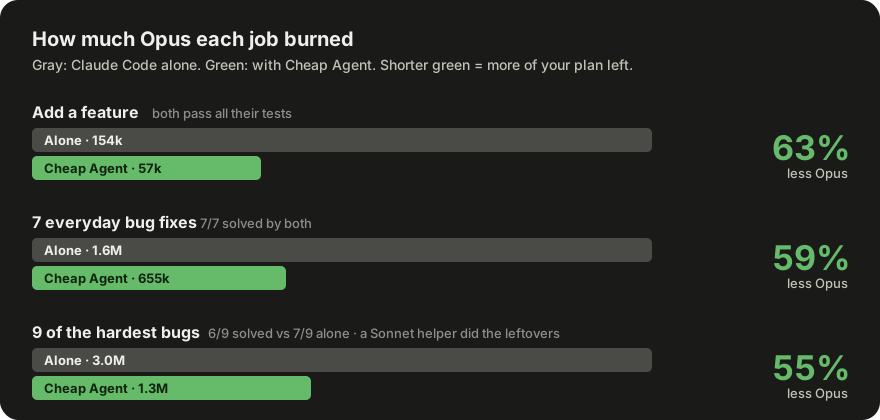
Tested on SWE-bench Verified: real bugs from real open-source projects, graded by the official harness. Same prompts in Claude Code with Opus 5.5, with and without Cheap Agent.
What I won't hide:
- On the very hardest bugs it solved 6 of 9 where plain Opus solved 7 (on a single run plain Opus averages about 6 too).
- On tiny jobs (a few lines, or a whole small app from nothing), Opus is already quick, so there's nothing to save.
Cheap Agent shines on the work in between: real features and real fixes in real code. That's most of your day.
Before / after
The ask: "Add monthly budgets to the expense tracker, plus a CSV export. Tests for everything."
| Claude Code alone | Claude Code + Cheap Agent | |
|---|---|---|
| Opus tokens | 154k | 57k |
| Opus turns | 5 | 2 |
| Who wrote the code | Opus | a cheap model, for $0.005 |
| Tests | 33 passing | 38 passing |
Opus wrote one task. The cheap model did the rest, tests included.
Built with itself
Native Windows support (36 files, +753/−278 lines) was built with Cheap Agent. Claude found the problems and wrote the plans. The cheap model wrote the code in 30 jobs for $0.29 in total, Sonnet helpers finished what it couldn't and read OpenCode's source to find the two Windows-only bugs, and the full test suite now passes on Linux and Windows.
How it works
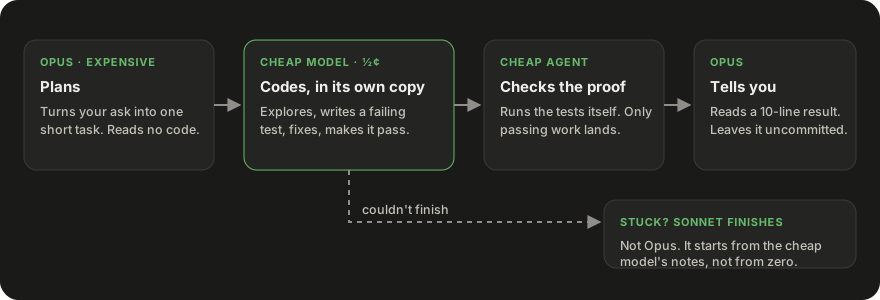
- Every change is proven. The cheap model must write a test that fails before its fix and passes after. Cheap Agent runs the tests itself; it doesn't take the model's word for it.
- Your project stays clean. Work happens in a private copy (a git worktree). Only passing work lands, uncommitted, so you review the diff like any other.
- Opus stays in charge, but it's held to it: Cheap Agent's hooks stop Opus from quietly redoing work that already passed, or doing a failed step itself when Sonnet can.
Commands
| Command | What it does |
|---|---|
/cheapag:allow |
Your OK to send this project's code to the cheap model. Once per project. |
/cheapag:status |
Recent jobs, and what the cheap model has cost you. |
/cheapag:hook on |
No more "I'll just do it myself": Claude must hand code changes to the cheap model. |
/cheapag:clean |
Tidy up old job folders. |
Settings
Optional. Put a cheapag.json in a project:
| Setting | Default | What it does |
|---|---|---|
takeover |
"sonnet" |
Who finishes a step the cheap model couldn't: a Sonnet helper, or "self" (Opus, capped at 15 tool calls). |
limits.max_turns |
25 |
The most turns the cheap model gets per step. |
models |
from setup | Which cheap models to use. Switch with npx cheap-agent login --preset strongest. |
FAQ
Is a half-cent model actually any good?
On its own, no. With a written task from Opus, a test it has to pass, and a referee that runs that test, yes, most of the time. When it isn't, it says so and Sonnet takes over.
Does Claude check the work?
The tests check the work, and Cheap Agent runs them. Opus checking every passing change cost three times the tokens and caught nothing in my runs, so it trusts a pass. You still review the diff before you commit.
Where does my code go?
To the provider you picked, only after you run /cheapag:allow in that project, which also shows exactly which models will see it. Your API key stays on your machine, in a hidden prompt and a local credential store, never in chat.
Will it commit or push anything?
Never. Changes land uncommitted. Your git, your call.
Why not just use Sonnet for everything?
Sonnet still costs real usage on every line it types. The cheap model types for half a cent. Sonnet only gets called when the cheap model is stuck.
Can I use it at work, or build on it?
Yes. It's MIT licensed: use it, change it, share it, at any company, for free (MIT License).
Why "Cheap Agent"?
Because your plan isn't.
Contributing
PRs are welcome, and I'm more than happy to merge them. Setup, where things live, and how to add a provider are in CONTRIBUTING.md.
Update or remove
New versions are announced on the Releases page. Cheap Agent also tells you when a session starts if a new minor or major version is out; set CHEAPAG_NO_UPDATE_CHECK=1 to turn that off.
Update:
npx cheap-agent@latest
Remove (two commands):
claude plugin uninstall cheapag@cheapag
claude mcp remove -s user cheapag
Reviews (0)
Sign in to leave a review.
Leave a reviewNo results found