SemanticDrift
Health Warn
- License — License: CC-BY-4.0
- Description — Repository has a description
- Active repo — Last push 0 days ago
- Low visibility — Only 7 GitHub stars
Code Pass
- Code scan — Scanned 12 files during light audit, no dangerous patterns found
Permissions Pass
- Permissions — No dangerous permissions requested
No AI report is available for this listing yet.
Small wording changes in MCP tool descriptions can reorder LLM agent leaderboards. Pre-registered study on IBM AssetOpsBench: 10 models, 38,304 tool-selection decisions, open data and code.
SemanticDrift
Does rewording an agent's tool descriptions change which model looks best?
A pre-registered study on the MCP tools of IBM AssetOpsBench,
using wording changes that the benchmark's own developers made over 2026.


Key findings
We gave 10 models from 6 providers the same 36 AssetOpsBench tools and 152 requests, and changed
only the tool descriptions. That makes 38,304 tool-selection decisions in total.
- Aggregate accuracy hardly moves. No accuracy difference between the original catalog and any
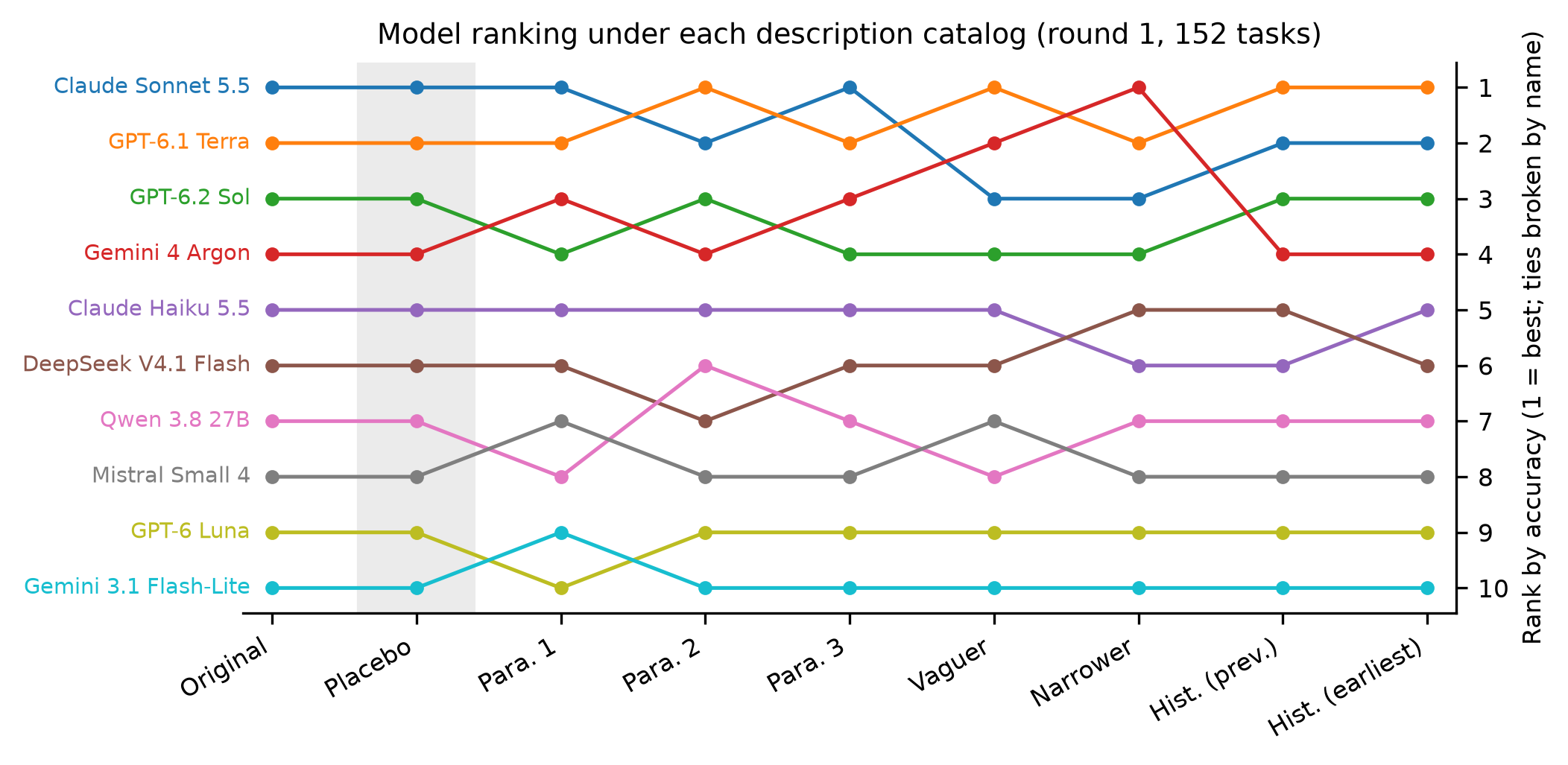
rewritten catalog survives correction for multiple comparisons. - The leaderboard does move. Under an identical copy of the catalog (our placebo), the top
model stays the same. Under 6 of the 7 rewritten catalogs, the top model changes or becomes tied
(mostly between Claude Sonnet 5.5 and GPT-6.1 Terra, which differ by 3 of 152 tasks on the
original catalog). - Individual decisions move beyond run-to-run noise, mainly when the content changes. For 24
of 70 model × catalog pairs, more decisions change than under the placebo (95% CI above zero).
Two independent LLM judges classify 30 of the 32 real AssetOpsBench edits as changing meaning,
and these edits move decisions (for example, +4.8 points for Mistral Small 4 on the tasks whose
tools were edited). Restricted to paraphrases that both judges confirm are equivalent, the
effect shrinks to about run-to-run noise. - Some small models act when they should ask. On 24 requests that need a human decision,
GPT-6 Luna chose a write tool (create, close or cancel a work order) 18–25% of the time; frontier
models stayed near 0–4%.
The full results, with sources for every number, are in research/FINDINGS.md.
For a concrete case, see one request under all nine catalogs.
What's in this repository
| Path | Contents |
|---|---|
datasets/tools/ |
The 36 tools (29 read, 7 write) and the 9 description catalogs |
datasets/history/ |
42 earlier, developer-written descriptions recovered from AssetOpsBench's git history |
datasets/tasks/ |
152 requests with gold labels (103 single-tool, 49 that need no tool) |
src/semdrift/ |
Extraction, request building, the experiment runner, scoring, analysis and figures |
configs/ |
Models, prices, reasoning settings and run configuration |
results/ |
Processed scores and analysis (raw responses are archived separately) |
research/ |
Pre-registration, design, findings notebook, decision log |
docs/ |
A worked example, and the original June 2026 proposal in docs/history/ |
Quick start
Requires Python 3.11 or newer. The harness uses only the standard library.
git clone https://github.com/Mukkandi-Sridhar/SemanticDrift && cd SemanticDrift
git clone https://github.com/IBM/AssetOpsBench vendor/AssetOpsBench
git -C vendor/AssetOpsBench checkout 0d044061ab3ffd4b213ddf6a0868c360d7e9667c

make check     # validate the dataset and run the tests
make figures   # redraw the figures (needs matplotlib: pip install -r requirements.txt)
The dataset
Tools. Names, descriptions and input schemas are extracted statically from four AssetOpsBench
MCP servers (iot, utilities, fmsr, wo) at commit 0d04406. Nothing from upstream is
imported or executed.
Catalogs. Every catalog keeps the same tool names, order and schemas; only description text
differs.
| ID | Catalog | How it was made |
|---|---|---|
| V0 | Original | Upstream, verbatim |
| V0R | Placebo | Byte-identical copy of V0 (measures run-to-run noise) |
| P1–P3 | Paraphrases | Meaning-preserving rewrites; the 15 riskiest were checked by hand |
| MG | Vaguer | Scope widened, parameter docs unchanged |
| MS | Narrower | One plausible narrowing per tool |
| H1 | Historical, earliest | Each tool's oldest description in the git history with an identical schema |
| H3 | Historical, previous | Each tool's last description before V0 |
Tasks. 103 requests have exactly one correct tool; 49 should get a text reply instead
(20 easy, 24 "tempting" requests that resemble a write action but need a human decision, and
5 out of scope). Provenance and checks are described in datasets/tasks/SOURCES.md andresearch/03-dataset/.
How the study was run
The hypotheses, metrics and analysis were fixed before any data was collected
(research/PREREG.md). Every later change is listed there with its date and
reason.
- Each request goes to each model once per catalog and repeat. The first action counts: a tool
call or a text reply. No tool is ever executed. - Models use their lowest available reasoning setting, the provider's default temperature, and a
fixed system prompt. Each OpenRouter model is pinned to one host. - Tool order is shuffled per repeat and shared by all models and catalogs.
- Nine models ran three repeats; Gemini 4 Argon ran one (budget).
| Models | GPT-6 Luna, GPT-6.1 Terra, GPT-6.2 Sol, Claude Haiku 5.5, Claude Sonnet 5.5, Gemini 3.1 Flash-Lite, Gemini 4 Argon, DeepSeek V4.1 Flash, Qwen 3.8 27B, Mistral Small 4 |
| Decisions | 38,304, run on 2026-11-25 |
| API cost | ≈ $36 (OpenRouter $29.93, OpenAI ≈ $6.25) |
To rerun the experiment you need OpenAI and OpenRouter API keys in a .env file
(see .env.example) and the steps in research/RUNBOOK.md.
Limitations
- Each trial is a single first action, not a full multi-step agent run.
- The tools come from one benchmark and one domain (industrial maintenance).
- The paraphrases were written by a language model. Two LLM judges agree that 15–19 of 36 per
catalog are fully equivalent; the rest are borderline or, rarely, changed. The historical
catalogs are human-written. - The effects are small per decision. Their importance lies in how they change rankings and
safety-relevant actions, not in average accuracy. - Several ranking changes involve models whose accuracy differs by only a few tasks.
Citation
If you use this work, please cite it as described in CITATION.cff.
Acknowledgements
The tools, descriptions and historical versions come from
IBM AssetOpsBench (Apache-2.0); seedatasets/tools/LICENSE.AssetOpsBench and datasets/tools/SOURCE.md.
License
CC BY 4.0. Material derived from AssetOpsBench keeps its Apache-2.0 license.
Reviews (0)
Sign in to leave a review.
Leave a reviewNo results found