design-distill
Health Warn
- License — License: MIT
- Description — Repository has a description
- Active repo — Last push 0 days ago
- Low visibility — Only 7 GitHub stars
Code Pass
- Code scan — Scanned 12 files during light audit, no dangerous patterns found
Permissions Pass
- Permissions — No dangerous permissions requested
No AI report is available for this listing yet.
Distill any website's design system into a reusable, Stitch-compatible DESIGN.md. Works with Claude Code, Codex, and any AI agent.
Design Distill
Stop generating generic-looking UIs. Distill any website's real design system into a structured DESIGN.md, then generate code that actually matches.
You:    "Distill linear.app, then make me a settings page"
Agent:  → extracts colors, fonts, spacing, components from linear.app
        → saves as DESIGN.md (Stitch-compatible)
        → generates a settings page that looks like Linear, not like every other AI output
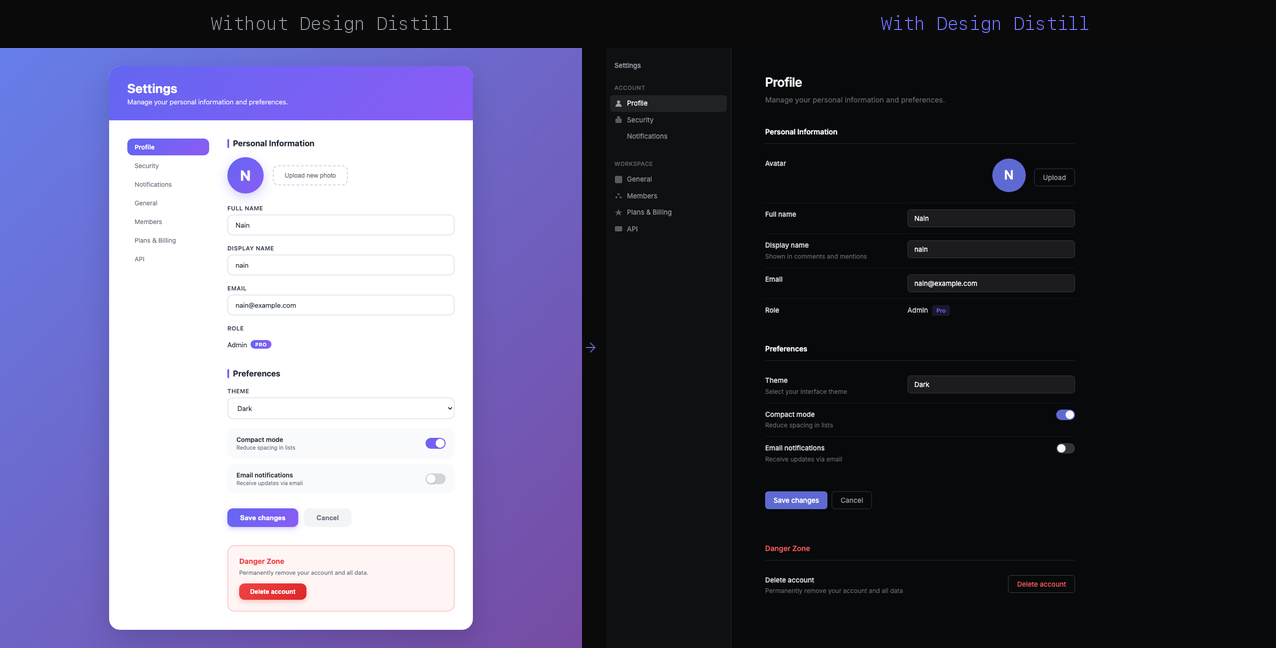
Same prompt: "Make a settings page like Linear." Left: generic AI output. Right: with Design Distill.
The Problem
Every AI-generated UI looks the same. Same gradients, same rounded cards, same blue buttons. You ask for "a settings page like Linear" and get generic Material Design.
Design Distill solves this by extracting the real design tokens from a live site and constraining generation to that palette.
Install
# Install skills (design-distill + design-apply)
npx skills add Muluk-m/design-distill

# One-time bootstrap: ensures a browser + seeds the bundled styles
node scripts/setup.mjs
The skill is self-contained — there's no global CLI to install. setup.mjs
reuses a browser you already have (system Chrome/Edge, or a CDP endpoint viaDESIGN_DISTILL_CDP) and only downloads Chromium when none is found. 5 bundled
design systems (GitHub, Linear, Notion, Stripe, Vercel) are seeded into the
library (~/.config/design-distill/, overridable via DESIGN_DISTILL_HOME).
Two Skills, One Library
  design-distill                    design-apply
  ──────────────                    ────────────
  "Distill linear.app"              "用 linear 做个博客主页"
        │                                 │
        ▼                                 ▼
  ┌──────────────┐               ┌──────────────────┐
  │  dembrandt   │               │  Load DESIGN.md   │
  │  (tokens)    │               │       +           │
  │      +       │── global ──▶  │  Re-screenshot    │
  │  screenshots │    library    │  source site      │
  │  (visual)    │               └──────────────────┘
  └──────────────┘                       │
                                         ▼
                                   Code that looks
                                   like the original
design-distill — Extract Design Systems
Extracts design tokens via dembrandt + screenshots for visual ground truth. Outputs a Stitch-compatible DESIGN.md to the global library.
design-distill https://linear.app     # extract from URL → save to library
design-distill ./my-app               # extract from local project
design-apply — Generate with Style Consistency
Loads a design system, re-screenshots the source site for visual calibration, generates code strictly constrained to the original palette, fonts, and component patterns.
design-apply 用 linear 做个博客主页    # load from library by name
design-apply 做个登录页                # auto-loads local ./DESIGN.md
Library & primitives
The library is plain files under ~/.config/design-distill/<name>/
(tokens.json is canonical, DESIGN.md is the rendered view) — list/show/remove
with ordinary file commands (ls, cat, rm). The skill ships bundled
primitives instead of a global CLI:
node scripts/setup.mjs --probe        # report capability tier + browser source
node scripts/extract.mjs <url>        # extract a token set (MCP → dembrandt → native)
node scripts/build-design.mjs --out <dir>   # normalize → tokens.json + DESIGN.md
node scripts/screenshot.mjs <url> --out <dir>
node scripts/compare.mjs <ref.json> <cand.json>
node scripts/diff.mjs <name>          # drift: saved vs. live source
node scripts/verify.mjs <tokens.json> <output>   # visual-verification loop round
Architecture
No global CLI — the skills are self-contained and call zero-build .mjs
primitives directly. One browser dependency (reused from the system or
downloaded once).
design-distill/
├── scripts/                   ← bundled primitives (run via `node`, no build step)
│   ├── setup.mjs              ← bootstrap: reuse/ensure a browser + seed styles
│   ├── extract.mjs            ← tokens (MCP → pinned dembrandt → native fallback)
│   ├── build-design.mjs       ← normalize → tokens.json (canonical) + DESIGN.md
│   ├── screenshot.mjs         ← full-page / multi-viewport / light-dark capture
│   ├── compare.mjs            ← per-category thresholded fidelity diff
│   ├── verify.mjs             ← closed visual-verification loop (one round)
│   ├── diff.mjs · preview.mjs ← drift detection · HTML preview
│   └── lib/                   ← target, color, tokenset, semantic, wcag, merge, probe …
├── skills/
│   ├── design-distill/        ← extraction skill (+ references/template.md)
│   └── design-apply/          ← generation skill (closed visual loop)
├── tests/                     ← vitest (unit + browser integration)
├── bundled/                   ← snapshots (github, linear, notion, stripe, vercel)
└── package.json
Skills handle AI behavior; bundled scripts handle deterministic work
(extraction, capture, comparison); tokens.json is canonical and DESIGN.md
is its rendered view.
Development
npm test               # vitest (unit + browser integration via system Chrome/Playwright)
node scripts/setup.mjs --probe   # show capability tier + browser source
Compatibility
Works with Claude Code, Codex, Openclaw, and any agent that supports skills.
Output follows the Google Stitch DESIGN.md specification.
License
MIT
Reviews (0)
Sign in to leave a review.
Leave a reviewNo results found