agentdream
Health Gecti
- License — License: MIT
- Description — Repository has a description
- Active repo — Last push 0 days ago
- Community trust — 18 GitHub stars
Code Gecti
- Code scan — Scanned 12 files during light audit, no dangerous patterns found
Permissions Gecti
- Permissions — No dangerous permissions requested
Bu listing icin henuz AI raporu yok.
Open-source 'dreaming' for any AI agent: sleep-time memory consolidation that merges duplicates, fixes stale or wrong notes with transcript evidence, and surfaces insights. Any model, local-first.
agentdream


Sleep-time memory consolidation ("dreaming") for any agent and any model — local-first, reviewable, zero dependencies.
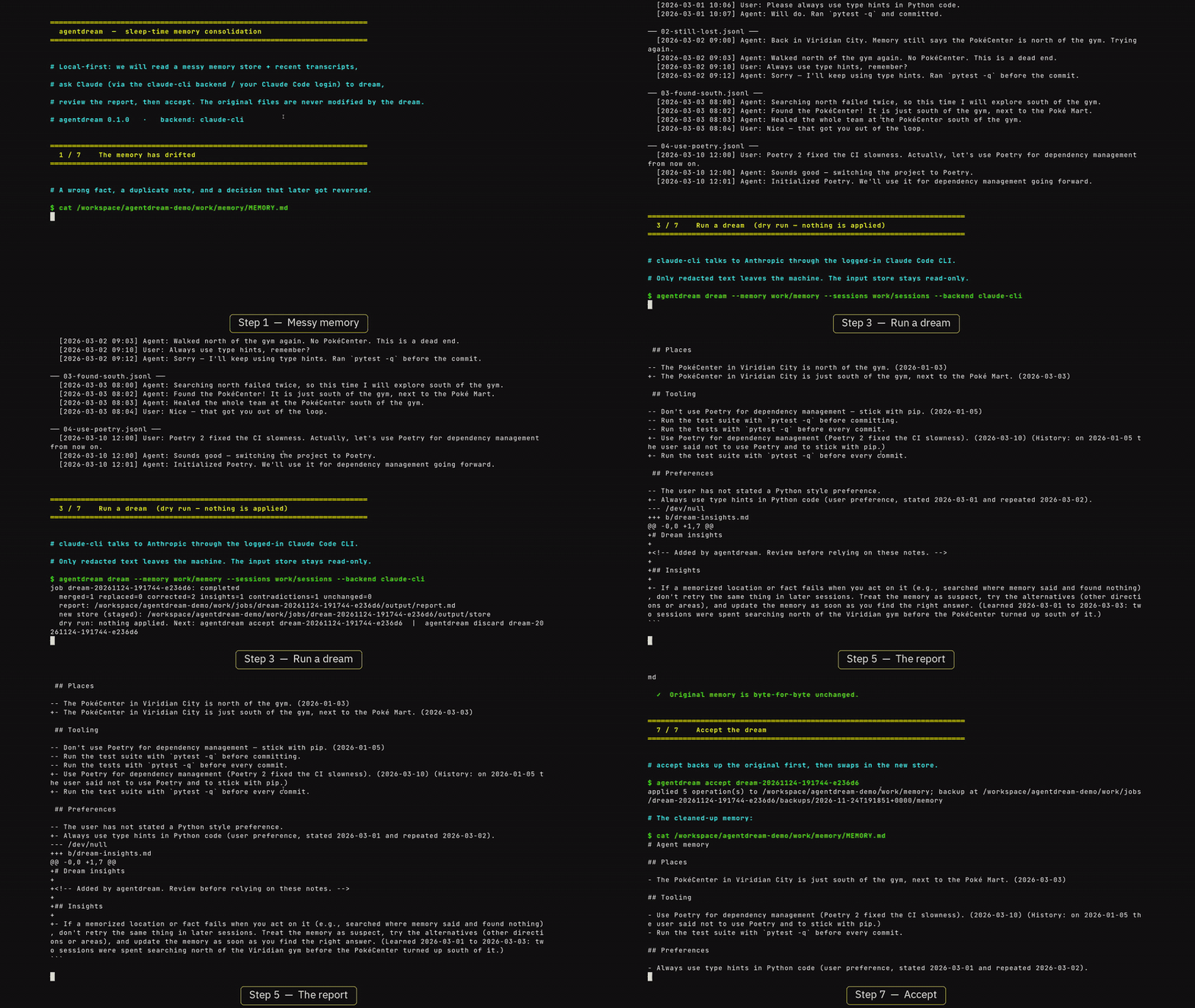
The GIF is a highlight of a real terminal run with the claude-cli backend (your Claude Code login, no API key). The quickstart below uses the bundled example and the deterministic backend, so it works offline with no model.
Agents accumulate memory notes that drift: duplicates pile up, old values go stale, and some notes are
simply wrong — the agent keeps acting on them and failing. agentdream reads your agent's memory store
plus recent session transcripts and produces a new, reorganized store and a report: duplicates merged,
stale values replaced, notes corrected with citations to the transcript lines that prove it, and new
insights (recurring mistakes, repeated preferences, converged workflows). Your input store is never
modified; you review the diff and accept all, some, or none of it.
It is an open-source take on the idea behind Anthropic's
Dreams for Claude Managed Agents and the
Letta / UC Berkeley sleep-time compute paper — but it runs on your
machine, works with markdown folders (Claude Code's CLAUDE.md / memory dirs), JSON, SQLite and
stancelog stores, and with no model at all
(deterministic heuristics), a local model (Ollama, LM Studio, vLLM), the Anthropic or OpenAI APIs, or
your Claude Code login.
60-second quickstart
pip install agentdream               # Python >= 3.10, no dependencies
git clone https://github.com/mvplab-ai/agentdream && cd agentdream     # only for the bundled example below

agentdream dream --memory examples/memory --sessions examples/sessions     # dry run: nothing is changed
agentdream show <job-id>                 # the report: what changed, why, with transcript citations
agentdream accept <job-id>               # apply it (the original is backed up first)
agentdream accept <job-id> --only correct-2ec6281c,merge-a91fbf3a     # ...or just some operations
agentdream discard <job-id>              # ...or throw it away
agentdream restore <job-id>              # undo an accept: put the backup back
Point it at your own agent: --memory takes a markdown folder or file, a JSON/JSONL file or folder, a
SQLite database or stancelog:<path>; --sessions takes transcript files, folders or globs (generic{"role", "content"} JSONL, Claude Code session files, OpenAI-style message JSON, or plainUser: / Assistant: text — auto-detected).
Architecture
Entry points share one config and one pipeline. Memory and transcripts are read-only — the input
store is never modified. The pipeline writes a staged store and a report; nothing is applied until
you accept, which takes a backup first so you can restore. Full diagrams and the module map:
docs/ARCHITECTURE.md. Static images of the figure below:
SVG · PNG.
flowchart TB
  subgraph entry["Entry points"]
    direction LR
    cli["CLI"]
    py["Python API"]
    mcp["MCP server"]
    sched["Scheduler"]
    hook["Claude Code hook"]
    cli ~~~ py ~~~ mcp ~~~ sched ~~~ hook
  end

  cfg["Config"]

  subgraph sources["Read-only inputs"]
    direction LR
    mem["Memory adapters"]
    original[("Input store never modified")]
    tx["Transcript loaders"]
    mem ~~~ original ~~~ tx
  end

  subgraph pipe["Dream pipeline"]
    direction TB
    subgraph prep["Prepare"]
      direction LR
      load["load"] --> redact["redact"] --> limits["limits"]
    end
    subgraph analyze["Consolidate, verify, insights"]
      direction LR
      cons["consolidate"] --> verify["verify"] --> insights["insights"]
    end
    write["write"]
    limits --> cons
    insights --> write
  end

  subgraph engines["Engines"]
    direction LR
    det["Deterministic"]
    llm["LLM backends"]
    det ~~~ llm
  end

  staged["Staged store and report"] --> review["Accept, discard, or restore"] --> backup["Backup of the target"]

  entry --> cfg
  cfg --> load
  sources --> load
  analyze --> engines
  write --> staged
How it works
A dream is a pipeline of small, replaceable phases:
load (read-only) → redact secrets → enforce size limits → consolidate → verify → insights → write new store + report
- consolidate merges duplicates / near-duplicates, replaces stale values with the latest one, and
resolves stance reversals ("don't use A" … later "use A") keeping a one-line history; - verify checks each note against what actually happened in the transcripts and corrects notes the
evidence contradicts, citingfile:lineand quoting the lines; - insights surfaces patterns that recur across sessions.
Each change is an operation with a stable id, so you can accept them selectively. With an LLM backend
each phase is a structured-JSON prompt whose output is validated (unknown ids and unverifiable citations
are dropped); large inputs are split into token-budgeted chunks and the per-chunk results are merged
deterministically. If the model fails, the deterministic heuristics take over.
Details, diagrams and extension points: docs/ARCHITECTURE.md.
A real run on examples/
Generated by python examples/run_example.py with the deterministic backend (no model, no network).
Before — examples/memory/MEMORY.md:
## Navigation (Viridian City)

- The PokéCenter in Viridian City is north of the gym. (2026-01-03)
- The Poké Mart in Viridian City sells Potions and Poké Balls.

## Tooling

- Don't use Poetry for dependency management — it was too slow on CI. (2026-01-05)
- Run the test suite with `pytest -q` before committing.
- Run the tests with `pytest -q` before every commit.

## Project facts

- The API server listens on port 8080. (2025-12-01)
- Production deploys go through the `release` branch.
(notes/project.md also says "The API server listens on port 9090. (2026-02-10)"; the five sessions
show the agent walking north of the gym and failing, then finding the PokéCenter south of it, and the
user switching to Poetry.)
After — the staged store (nothing applied until you accept):
## Navigation (Viridian City)

- The PokéCenter in Viridian City is south of the gym. (2026-03-03)
- The Poké Mart in Viridian City sells Potions and Poké Balls.

## Tooling

- Use Poetry for dependency management. (History: earlier said "Don't use Poetry for dependency management — it was too slow on CI" (2026-01-05); reversed later (examples/sessions/session-04-claude-code.jsonl:2).)
- Run the tests with `pytest -q` before every commit.

## Project facts

- Production deploys go through the `release` branch.
plus a new dream-insights.md with "Preference (stated in 2 sessions): Always use type hints in Python
code.", a recurring-mistake note and a converged pytest -q → git commit -m workflow.
Report excerpt (report.md):
| Merged | Replaced | Corrected | New insights | Contradictions (temporal) | Unchanged |
|---|---|---|---|---|---|
| 1 | 1 | 1 | 3 | 2 (2) | 3 |

### `correct-2ec6281c` — Corrected from transcript evidence: "The PokéCenter in Viridian City is south of the gym. (2026-03-03)"

- Entries: `MEMORY.md#1`
- Before: The PokéCenter in Viridian City is north of the gym. (2026-01-03)
- After: The PokéCenter in Viridian City is south of the gym. (2026-03-03)
- Why: Transcripts show 'south', not 'north' (3 supporting, 4 refuting observation(s)).
- Evidence:
  - `examples/sessions/session-01.jsonl:3` (refutes, assistant): "Walked north of the gym for 20 steps. No PokéCenter here, only tall grass."
  - `examples/sessions/session-01.jsonl:4` (refutes, assistant): "Still can't find the PokéCenter north of the gym."
  - `examples/sessions/session-02.jsonl:2` (refutes, assistant): "Walked north of the gym again. No PokéCenter here, this is a dead end."
  - `examples/sessions/session-02.jsonl:3` (refutes, assistant): "Still can't find the PokéCenter north of the gym."
  - `examples/sessions/session-03.jsonl:2` (supports, assistant): "It is just south of the gym, next to the Poké Mart."
  - `examples/sessions/session-03.jsonl:3` (supports, assistant): "Healed the whole team at the PokéCenter south of the gym."
- Confidence: 0.80 · origin: deterministic

### `replace-ef9c48dc` — Stale value replaced by the latest: "The API server listens on port 9090. (2026-02-10)"

- Entries: `MEMORY.md#6`, `notes/project.md#1`
- Before: The API server listens on port 8080. (2025-12-01)
- After: The API server listens on port 9090. (2026-02-10)
- Why: Notes give different values for the same subject; the most recent (by timestamp) wins.
The report also contains a unified diff of old vs. new store, and report.json has the same data for
machines. Operation ids are content hashes, so they are stable across re-runs of the same inputs.
How it compares
agentdream is a maintenance pass over a memory store you already have. It is not a new memory
database, and it is not an agent framework. The tools below are complementary more often than they are
alternatives.
| What it is | Where it runs | What it does with memory | Review before write | |
|---|---|---|---|---|
| agentdream | Sleep-time consolidation CLI / library / MCP server | Your machine (stdlib-only; optional local or API model) | Merges duplicates, replaces stale values, corrects notes from transcript evidence with citations, surfaces insights. Never mutates the input store. | Yes: dry-run default, accept / partial accept / discard / restore |
| Anthropic Dreams | Managed sleep-time workflow for Claude Managed Agents | Anthropic's platform | Same shape of workflow (memory + transcripts in, new store + report out) | Managed on the platform |
| Letta (formerly MemGPT) | Agent framework whose agents edit their own memory | Self-hosted or Letta Cloud | The agent gets tools to manage memory during a run, not a batch consolidation of an existing markdown/JSON/SQLite store | In-agent |
| Mem0 | Memory layer (extract, store, retrieve) | Open-source and hosted | Adds and retrieves memories for an app; not a cited, reviewable rewrite of a store you already keep | Different model |
| Zep / Graphiti | Temporal knowledge-graph memory service | Self-hosted or hosted | Builds a graph of facts over interactions | Service-side |
agentdream is an independent open-source project, not affiliated with Anthropic, Letta, Mem0, or Zep.
Configuration
Every option can come from a CLI flag, an AGENTDREAM_* environment variable, a project config file
(.agentdream.toml, or [tool.agentdream] in pyproject.toml, found by walking up from the current
directory) or a user config file (~/.config/agentdream/config.toml). Precedence:
CLI > env > project file > user file > defaults. agentdream config prints every effective value and
where it came from.
# .agentdream.toml — relative paths are relative to this file
backend = "ollama"
model = "llama3.1:8b"
memory = "memory"
sessions = ["~/.claude/projects/-home-me-myrepo/*.jsonl"]

[limits]
max_sessions = 20
max_chunk_tokens = 8000        # small local context window -> more, smaller chunks

[redaction]
emails = true

[hook]
every = 3                      # Claude Code hook: dream every 3 sessions
With that file, agentdream dream needs no flags at all; AGENTDREAM_MODEL=qwen2.5:14b agentdream dream
overrides one value. All keys, env vars and defaults: docs/CONFIG.md.
Backends
| Backend | --backend |
Needs | Notes |
|---|---|---|---|
| Deterministic heuristics | deterministic (default) |
nothing | Offline, free, reproducible. Rule-based duplicate / contradiction / evidence matching. Handles 5k-entry stores in seconds. |
| Anthropic Messages API | anthropic |
ANTHROPIC_API_KEY |
Default model claude-sonnet-5-5; --model to change. stdlib HTTP, no SDK. |
| OpenAI-compatible | openai, ollama, lmstudio, vllm |
OPENAI_API_KEY for api.openai.com; nothing for local servers |
--base-url for any compatible server. ollama → http://localhost:11434/v1, lmstudio → :1234. |
| Claude Code CLI | claude-cli |
claude on PATH, logged in |
Runs claude -p --output-format json — uses your Claude Code login, no API key. |
agentdream dream -m ./memory -s ./logs --backend anthropic --model claude-sonnet-5-5
agentdream dream -m ./memory -s ./logs --backend ollama --model llama3.1:8b --max-chunk-tokens 6000
agentdream dream -m ./memory -s ./logs --backend openai --base-url http://localhost:8000/v1 --model my-vllm-model
agentdream dream -m ./memory -s ./logs --backend claude-cli
Every LLM backend falls back to the heuristics if the model is unreachable or returns unusable output (a
warning is recorded in the report). Setup details, custom backends: docs/BACKENDS.md.
Claude Code integration
MCP server — let Claude run dreams on request:
claude mcp add agentdream -- agentdream serve-mcp # or: -- python -m agentdream serve-mcp
Tools: dream, dream_status, show_report, accept, discard, list_dreams. Ask "dream over my
memory using the last sessions and show me the report"; Claude calls dream and show_report, andaccept only once you approve.
Auto-dream after sessions — an opt-in Claude Code hook:
cd ~/code/myrepo
agentdream install-claude-hook --every 3          # .claude/settings.json; --local or --user for other scopes
After every third session (SessionEnd), a background dream runs over those sessions against the
project's Claude memory (~/.claude/projects/<project>/memory/, else CLAUDE.md). It is a dry run
unless you pass --apply: results land in .agentdream/jobs/ for agentdream list / show / accept.
The hook returns in ~0.1 s, never blocks or fails your session, logs to .agentdream/hook.log, and a lock
prevents concurrent dreams. Remove it with agentdream uninstall-claude-hook.
Full setup: docs/CLAUDE_CODE.md.
Cursor integration
Add to .cursor/mcp.json (project) or ~/.cursor/mcp.json (global):
{
  "mcpServers": {
    "agentdream": { "command": "agentdream", "args": ["serve-mcp"] }
  }
}
The same six tools become available in Cursor's agent. A copy lives inexamples/integrations/cursor-mcp.json.
Python API
from agentdream import accept, dream

job = dream(memory="examples/memory", sessions=["examples/sessions"])  # dry run, deterministic
print(job.status, job.counts["corrected"], job.counts["merged"])         # completed 1 1
for op in job.operations:
    print(f"{op.id:28} {op.type:13} {op.summary[:60]}")

corrections = [op.id for op in job.operations if op.type == "correct"]
result = accept(job, only=corrections, to="reviewed-memory")  # write to a new place, not over the input
print(result.applied_ops, result.target)
Background jobs, status and cancellation (state survives restarts in .agentdream/jobs/<id>/job.json):
from agentdream import DreamJob, dream_async

job = dream_async("examples/memory", ["examples/sessions"], instructions="focus on navigation notes")
job.wait(timeout=60)
print(job.status, job.progress)                       # completed 1.0
print(DreamJob.load(job.id).report["counts"]["insights"])
dream() accepts every config field as a keyword (backend=, model=, max_chunk_tokens=,redact_emails=...); pass an LLMBackend instance as backend to use a custom model client, andpipeline= to add or replace phases (extension points).
Scheduler
agentdream schedule -m ./memory -s "./logs/*.jsonl" --idle 30m          # after 30 min without new transcript activity
agentdream schedule -m ./memory -s ./logs --every 6h                     # on an interval (when there are new sessions)
agentdream schedule -m ./memory -s ./logs --new-sessions 5 --once        # check once (cron-friendly) and exit
The scheduler remembers which sessions it has already dreamed over (.agentdream/scheduler-state.json),
so restarts don't re-dream old sessions. Defaults can live in a [schedule] config table.
Safety guarantees
- The input store is never modified by a dream. Adapters load read-only (SQLite in
mode=ro,
stancelog from a private temp copy), outputs go to a separate staging directory, and adapters refuse to
write onto their input path. The test suite hashes every input file before and after, for every adapter. - Dry run by default. Nothing is applied until
accept(or an explicit--apply);acceptbacks up
the target first, refuses if the store changed since the dream (unless--force), and swaps the new
store in by rename; a failure mid-accept puts the original back, andagentdream restore JOBundoes a
completed accept from its backup. - Secrets are redacted before analysis and again over every prompt sent to a model and every report
quote: 30+ patterns covering provider keys (Anthropic, OpenAI, GitHub, AWS, Slack, Stripe, Google,
Azure, …), JWTs, private keys,password=-style assignments, URL credentials and card numbers, base64
blobs that decode to a secret, keys wrapped onto the next line, plus a check for long high-entropy tokens.
Job state (job.json),error.logand the hook log are redacted too.
Reports list counts per kind, never the secret. - Size limits (sessions, bytes per transcript, total tokens, chunks per phase) truncate with a notice or
fail clearly (--on-limit fail). - Model output is untrusted: entry ids are normalised (
id='MEMORY.md#1', quotes, brackets, comma-joined
lists, as small local models return them) and resolved only on a unique match; operations naming unknown or
unseen entry ids are dropped, citations must
name a real transcript line (a quote that doesn't match it is replaced by the real text and flagged), and
corrections without verifiable evidence are downgraded to flags. - Atomic writes for job state, reports and stores; job status survives crashes (a job whose worker died
is marked failed).
How each guarantee is enforced and tested: docs/ARCHITECTURE.md#safety-guarantees.
Edge cases (empty / huge / malformed / hostile inputs, crashes, concurrency, model misbehaviour) and the
behaviour for each: docs/EDGE_CASES.md. How the suite is run, the pass/fail
table, and what was verified live vs mocked: docs/TESTING.md.
FAQ
How is this different from Anthropic's Dreams? Dreams is a managed research-preview feature of Claude
Managed Agents: it runs on Anthropic's platform over memory stores that live there. agentdream is a
local, open-source tool with the same shape of workflow (memory + transcripts in, a new store + report
out, review before accepting) for memory that lives on your disk, any agent framework, and any model —
including none. It is an independent implementation, not affiliated with Anthropic.
How does it compare to Mem0 or Letta? Those are memory systems: they decide what to store while the
agent runs and serve it back (Letta also runs "sleep-time" agents inside its framework). agentdream is a
batch maintenance step for a store you already have — files, a JSON blob, a SQLite table — that turns
its output into a reviewable diff. They are complementary; an adapter for another store is ~40 lines.
Will it modify my memory? Not unless you accept. dream writes a new store into a staging
directory; accept applies it with a backup; discard deletes the staged copy.
Does my data leave my machine? Only if you choose a remote backend (anthropic, openai, orclaude-cli, which talks to Anthropic through your Claude Code login), and then only redacted text. The
default deterministic backend and local OpenAI-compatible servers make no network calls.
What does it cost? The deterministic backend is free. With an LLM, a dream makes three calls (one per
phase) when everything fits in max_chunk_tokens, more when it is chunked; input is roughly
3 × memory + 2 × transcripts tokens (consolidate sees the memory, verify and insights see both). --max-sessions, --max-total-tokens and --max-chunks
bound it.
Which model should I use? Start with deterministic to see what the heuristics find. For semantic
merges and subtler corrections use a strong instruction-following model that produces reliable JSON —claude-sonnet-5-5 is the Anthropic default; on local hardware, a 7–14B instruct model with--max-chunk-tokens set to its context window works for small stores.
What if the model hallucinates? Proposals are validated against the real store and transcripts:
unknown entry ids and made-up citations are dropped, a quote that isn't in the cited message is replaced
by the real message text (and flagged), corrections without verifiable evidence become flags, and you still
review everything before it is applied.
Can it run automatically? Yes: agentdream schedule (idle / interval / every N sessions) or the
Claude Code hook (install-claude-hook). Both are dry runs unless you opt in to --apply.
Limitations
- The deterministic engine is heuristic English-language pattern matching (subjects, polarity, typed
values like directions, numbers and on/off states). It is precise on clear-cut cases but misses
paraphrases an LLM would catch, and it does not understand other languages. - LLM results depend on the model; small local models can produce shallow or inconsistent proposals
(they are validated, but may be few). Chunked runs see one part of the input per call: duplicates or
evidence split across chunks are reconciled by the reduce step only if each chunk proposes them. - Token counts are estimated (~4 characters per token), not computed with the model's tokenizer.
- When an operation rewrites a note that contained a redacted secret, the new note carries the
[REDACTED:…]placeholder; the report warns about it. - Markdown stores are parsed as one entry per bullet / paragraph (or per file with front matter); exotic
layouts may be re-rendered more coarsely than you wrote them (only changed blocks are re-rendered). - Windows is not covered by CI (the code avoids POSIX-only APIs where possible; file locking uses
msvcrtthere). macOS is in CI as a best-effort job (continue-on-error) because hosted macOS
runners are often unavailable.
Contributing
Issues and PRs welcome — see CONTRIBUTING.md and the
Code of Conduct. Security reports: SECURITY.md.
The core stays stdlib-only; pip install -e ".[dev]", then python -m pytest -q,ruff check src tests examples and mypy.
Credits
- Anthropic, Dreams (Claude Managed Agents)
— the workflow this project reimplements in the open, and
The components of agent memory.
The PokéCenter example is a nod to the Claude Plays Pokémon story of a wrong note corrected from logs. - Lin, Snell, Wang, Packer, Wooders, Stoica, Gonzalez — Sleep-time Compute: Beyond Inference Scaling at
Test-time, Letta / UC Berkeley, arXiv:2504.13171. - stancelog for the contradiction-aware belief-log adapter.
MIT licensed. © 2026 systemagents-ai.
Yorumlar (0)
Yorum birakmak icin giris yap.
Yorum birakSonuc bulunamadi