agentloom
Health Warn
- License — License: AGPL-3.0
- Description — Repository has a description
- Active repo — Last push 0 days ago
- Low visibility — Only 5 GitHub stars
Code Fail
- exec() — Shell command execution in app/scripts/build-store-msix.mjs
- process.env — Environment variable access in app/scripts/build-store-msix.mjs
Permissions Pass
- Permissions — No dangerous permissions requested
No AI report is available for this listing yet.
Many models. One workbench. Your machine. Run Claude, Codex, DeepSeek, GLM and more — side by side, or as a team. The open-source desktop workbench that turns many LLMs into one workforce you control.
AgentLoom
Many models. One workbench. Your machine.
Run Claude, Codex, DeepSeek, GLM and more — side by side, or as a team.
The open-source desktop workbench that turns many LLMs into one workforce you control.
Website · Download · Report an issue


English · 简体中文
Why AgentLoom
Most AI coding tools hand you one agent, in one editor, on one folder, from one vendor.
That's fine — until the job is bigger than one agent, the quota runs out mid-afternoon, or
you need to know exactly what it changed before you keep it.
AgentLoom starts from the opposite assumption: many projects, many models, several agents
working at once — on your machine, under your control.
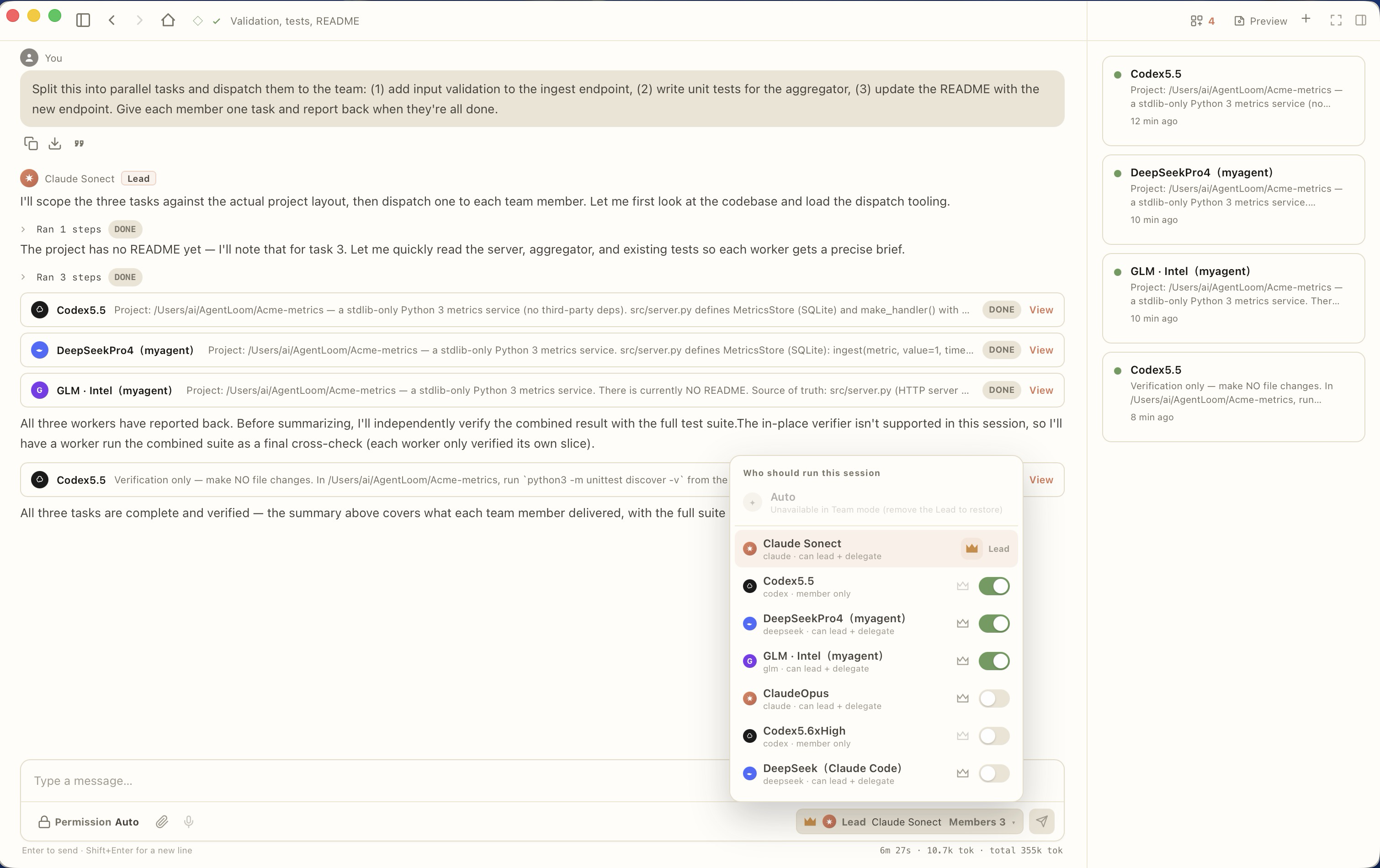
One agent is a bottleneck. Run a team. Crown a lead — Claude or Codex, the models that
are good at planning — and give it a bench of cheaper models. The lead splits the goal,
hands out tasks in parallel, reviews what comes back and fixes what doesn't fit. Several
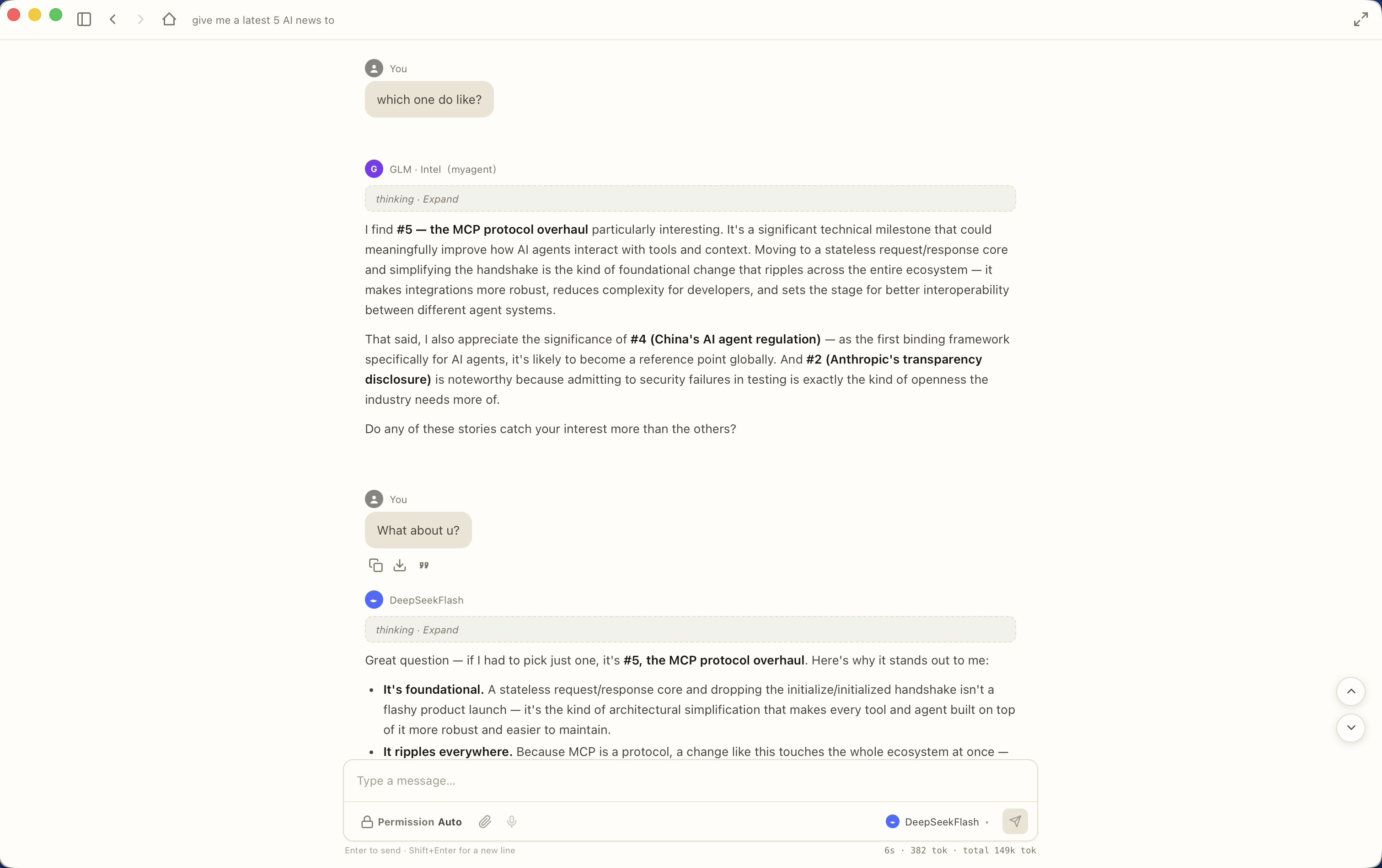
files move at once instead of one, and you pay top-tier prices only for the thinking.Never stuck behind one vendor. Out of Claude quota at 4pm? Point the same session at
GLM, DeepSeek or a local model and keep going — same thread, same context, nothing to
copy-paste. Switching vendors is a dropdown, not a migration. And when a session gets long,
AgentLoom writes the hand-off brief so the next one starts warm.Cheap models that actually finish the job. AgentLoom ships its own agent engine,
myagent, written in Rust — no Claude Code, no Codex, no vendor CLI required. Providers you
connect through that engine get the same tool loop, plan mode and checkpoints that the
expensive CLIs have, so a pay-as-you-go key gets a real shot at real work.
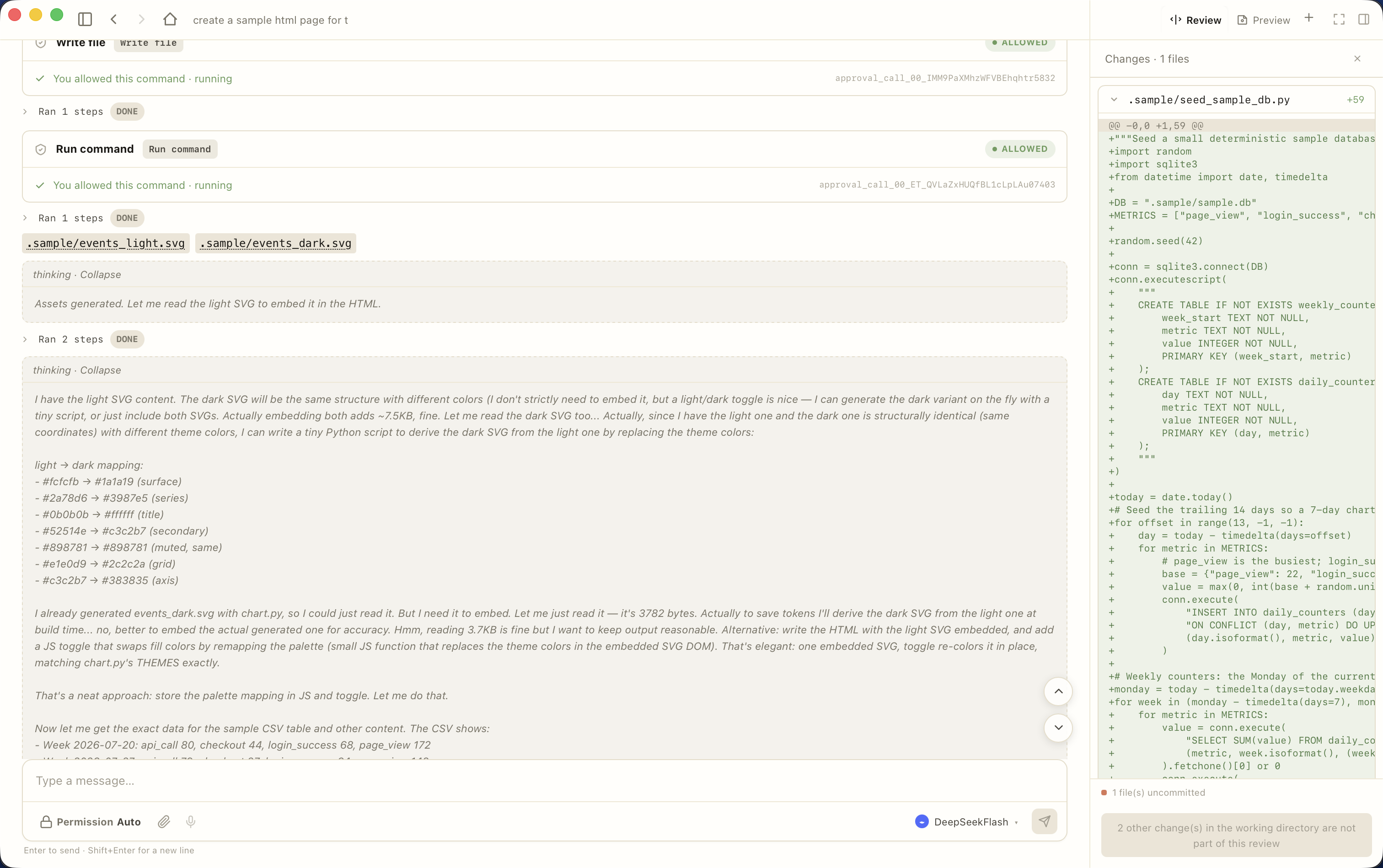
We measured that claim rather than asserting it — see Benchmarks below.See every move. Undo any of them. Every command and every file write lands as a card you
can open, plus a Review panel with a file-level ledger. Keep what you like, roll back the
rest, file by file. You don't have to be a terminal expert to tell whether the agent did the
right thing — and you don't have to trust it blind to let it work.Yours, truly. Open source and local-first. Your API keys live in your OS keychain, your
conversations in a database on your own disk, and agents work directly in your own
repositories. AgentLoom runs no server on the internet; the only listeners it starts are
loopback-only helpers — the only things that ever leave your machine are the requests you
send to the model provider you chose, and, if you turn on web search, your queries to the
search backend you configured.
Its own bookkeeping never touches your working tree.
Benchmarks — cheap models, real work
17 / 30 · 56.7%
Median resolved on a 30-instance subset of SWE-bench Verified.
myagentdrivingdeepseek-v4-pro, graded by the official SWE-bench Docker harness. Eight runs, range 16–19.
We quote the median, not our best run — a single run of this subset carries ±3 instances of
noise, so any one number (including our 19/30) would overstate what you should expect.
| Engine · model | myagent (this repository, Rust) · deepseek-v4-pro, temperature 0 |
| Grading | Official swebench.harness.run_evaluation in Docker |
| Test leakage | None. The engine got a working test environment, but never saw the FAIL_TO_PASS grading test, and test.patch was never applied during a run |
| Runs | 8 graded runs · median 17 · mean 17.1 · range 16–19 (53.3%–63.3%) |
| Caveat on those runs | They span four days of engine iteration — replicates of a moving target, not eight repeats of one frozen build |
| Cost | roughly $3–6 in model spend for all 30 instances |
Read this before comparing: this is a hand-picked 30-instance subset, not the full
500 — it is not comparable to the public SWE-bench Verified leaderboard, and it
deliberately excludes repositories with heavy C extensions our host could not build
reliably. Frontier-model agents score 60–70%+ on the full set. The point of this number is
"a mid-tier, pay-as-you-go model is enough for everyday work" — not "we beat frontier
agents."
We publish the exact instance IDs and the full method, limitations included:
docs/benchmarks.md · evals/swebench/fair30_ids.json.
If you run the same 30 instances and get something materially different, please open an issue.
What it looks like
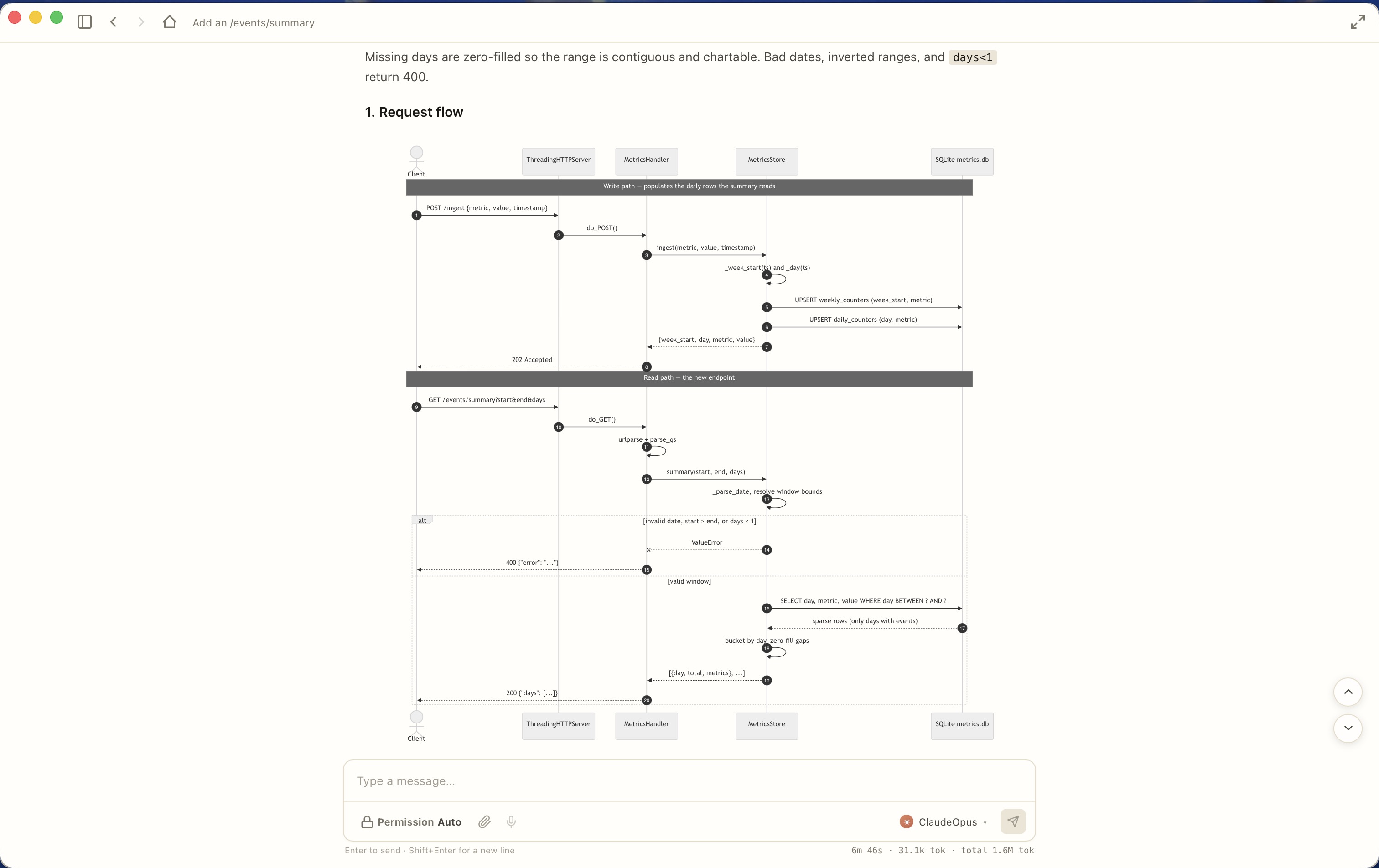
| Switch models mid-conversation | Diagrams and charts, rendered inline | Cards, review & undo, file by file |
|---|---|---|
 |
 |
 |
A session is the unit of work: one focused conversation that ships code, with checkpoints
and undo. The sidebar holds every project you work on and every session inside it — no tab soup.
Features
- Agent teams — configure any number of agents across providers (native CLIs like Claude
Code and Codex, plus engine-driven providers like DeepSeek, GLM and Kimi); crown a lead,
toggle members, dispatch work, watch results land. - Session-centric workbench — all your projects in one window (GitHub repos and plain
local folders alike), each with its own session list, groups, ⌘K search and hand-offs. - Checkpoints & undo — a file-level write ledger with reviewable, selective undo. See
exactly what an agent touched before you decide to keep it. - Rich transcript rendering — mermaid diagrams, inline images, diffs, collapsible
thinking, tool-call cards; long output folds by default so the conversation stays readable. - Built-in agent engine (
myagent) — a Rust harness that runs provider-agnostic agent
loops with tool use, plan mode, checkpoints and event streaming. Use it standalone on the
command line, or let AgentLoom drive it. - Web search for every model — not every model ships with search; AgentLoom wires up
third-party backends (DuckDuckGo with zero config, Brave/Exa with your key) so any agent
can look things up. - Bring your own everything — OpenAI-compatible and Anthropic-compatible endpoints,
custom base URLs, local models. - i18n — English and 简体中文 in the UI today, more on the way.
- Cross-platform — macOS (Apple silicon and Intel), signed and notarized. Windows is
available as an unsigned preview until we can sign it. Linux is not started.
Install
- macOS — grab the
.dmgfor your Mac (Apple silicon or Intel) from
myagenthubs.com/agentloom or the
Releases page, and drag it to
Applications. Signed and notarized by Apple; it opens with no warnings. The website also
serves a mirror, which helps if GitHub is slow where you are. - Windows — an unsigned preview is available:
v0.1.0-windows-preview.
It is a pre-release on purpose. We have no code-signing certificate, so SmartScreen will
warn on it, and nobody has run it on real Windows hardware yet — CI compiles, packages and
smoke-tests it, and that is all. Try it if a warning dialog does not put you off, and tell
us what breaks.
Build from source
Prerequisites: Rust (stable), Node.js ≥ 20, npm.
Install the Tauri system prerequisites for your platform: https://tauri.app/start/prerequisites/
# 1. Build the myagent engine sidecar
cd harness-agent
cargo build --release

# 2. Place the sidecar where the app expects it (the command detects your platform's
#    target triple)
mkdir -p ../app/src-tauri/binaries
cp target/release/myagent ../app/src-tauri/binaries/myagent-$(rustc -vV | sed -n 's/^host: //p')

# 3. Build / run the app
cd ../app
npm install
npm run tauri dev      # development
npm run tauri build    # release bundle
Repository layout
app/            Tauri desktop app (React + TypeScript front end, Rust back end)
harness-agent/  myagent — the provider-agnostic agent engine CLI (Rust)
docs/           Benchmarks, screenshots
evals/          Public benchmark instance lists
.github/        Issue and pull request templates, CI workflows
AGENTS.md       Contribution rules for AI agents
Roadmap (short version)
- A signed Windows installer (the build already works; the certificate does not exist yet)
- More providers and deeper local-model support
- Richer agent-team workflows (discussion / round-table modes)
- GitLab support through the existing adapter seam
Contributing
Issues, bug reports and pull requests are welcome — see CONTRIBUTING.md
for how to build, test and submit. Contributors sign a lightweight CLA (one click in the PR)
the first time they contribute.
License
AGPL-3.0. In short: use it freely, self-host it, fork it — but if you distribute a
modified version or run one as a service, your changes have to be open too. That keeps the
workbench honest for everyone.
The AgentLoom and MyAgentHubs names and logos are trademarks of MyAgentHubs and are
not covered by the code license — see TRADEMARK.md.
Contact
© 2026 MyAgentHubs
Reviews (0)
Sign in to leave a review.
Leave a reviewNo results found