Yummi
Health Gecti
- License — License: Apache-2.0
- Description — Repository has a description
- Active repo — Last push 0 days ago
- Community trust — 12 GitHub stars
Code Basarisiz
- eval() — Dynamic code execution via eval() in .github/workflows/weekly-agent-eval.yml
- network request — Outbound network request in brain/src/yummi_brain/rest_client.py
Permissions Gecti
- Permissions — No dangerous permissions requested
Bu listing icin henuz AI raporu yok.
A privacy-first, fail-closed AI pentest conductor and autonomous Red Team platform
A privacy-first, fail-closed AI pentest conductor and autonomous Red Team platform.





Full Documentation · Installation · Architecture · Security Model · Usage Guide · API Reference
Yummi translates natural language into verified security workflows while enforcing strict operator authority and fail-closed network control. An autonomous agent drives a hardened Kali Linux workbench equipped with 58 native MCP tools, 99 battle-tested offensive skills, and 52 specialist sub-agents, while an independent Rust gateway enforces packet-level policy outside the model's reach.
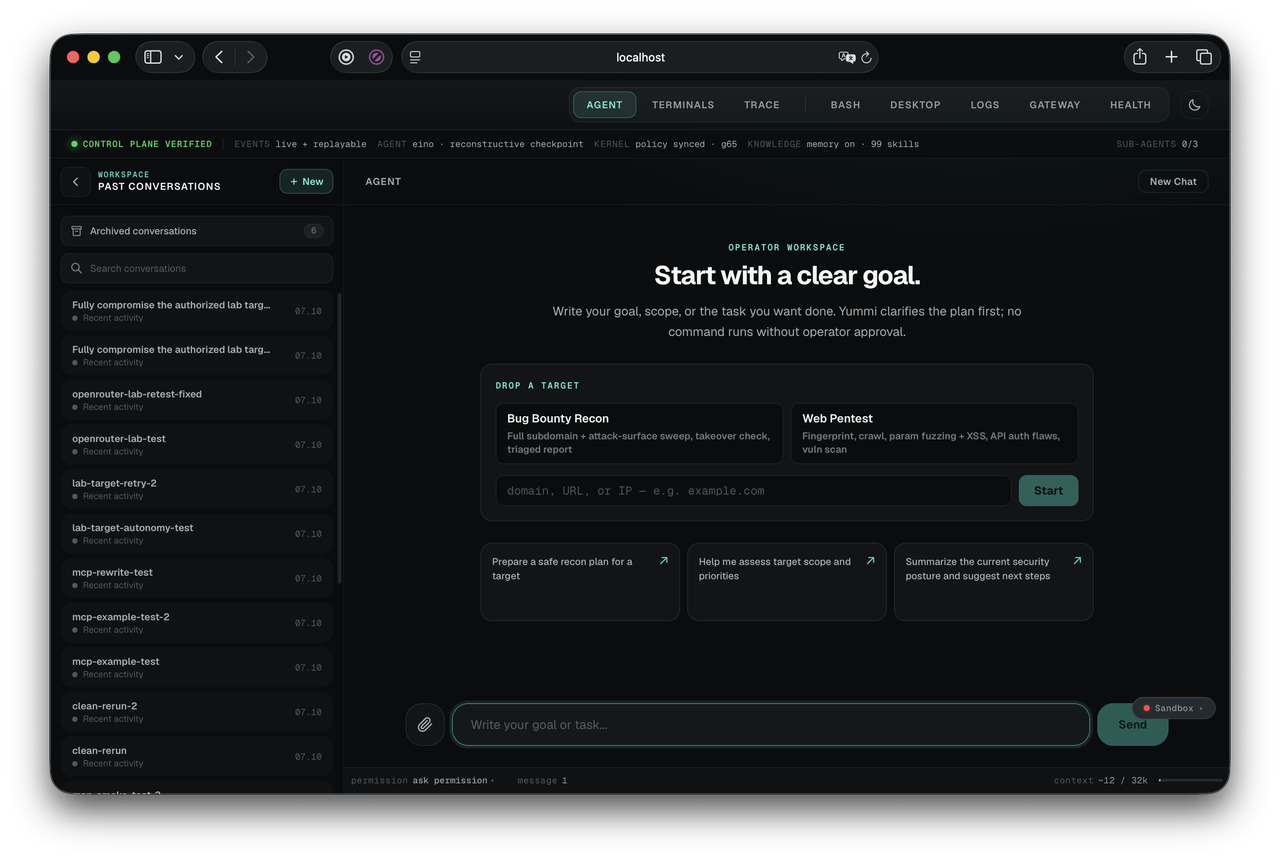
Drop a target, state a goal in one sentence, and Yummi plans before it acts. See the Usage Guide for every tab, including a real completed run.
Key Capabilities
Security Boundary & Traffic Governance
- Fail-Closed Rust Gateway — Packet filtering is enforced by an independent Rust daemon (
yummi-gateway) via Linux kernelnftablesrules. Default-deny policies install at startup and persist even if the daemon terminates. The AI agent never manages firewall rules. - Runtime 4-Way Egress Mode — Operator controls egress on the fly:
block_all(complete airgap, drops all outbound egress unconditionally),block_all_except_rules(strict scope, permits only explicitly authorized targets and active temporary rules),allow_all(blanket external connectivity for public destinations), orask_every_time(destination-by-destination interactive operator approval). Resets toblock_allon daemon restart. - Tamper-Evident Audit Chain — Every routing decision, temporary rule, and egress evaluation is cryptographically chained using SHA-256 in a local SQLite WAL journal.
Offensive Arsenal & Pwnbox Environment
- Unified Kali Sandbox (
yummi-pwnbox) — Single hardened container running as an unprivileged user (UID 1000). Shares operator Bash (tmux), graphical desktop (noVNC/XFCE), and agent execution. - 58 Native MCP Tools — Six-tier tool strategy: 6 typed core tools (Nmap, WhatWeb, cURL, Gobuster, ffuf, Nikto), 32 cataloged offensive utilities, 2 Go recon pipelines, 7 persistent tmux terminal tools, 9 full-capability browser automation tools, and 2 sandboxed web research tools.
- Full-Capability Browser Automation — Native Chromium automation via Rod with compact accessibility tree snapshots (
@eNrefs including semantic content elementsli,td,th,blockquote,code), multi-tab lifecycle, session cookie isolation, and in-sandbox connection proxy for HTTP/S and WS/WSS enforcing gateway hostname policy. - Controlled Sandboxed Web Research — Privacy-first research tools (
web_search,web_fetch) with OpenRouter/Exa cited sources, direct HTTPS plaintext extraction/pagination/find, RFC 1918/metadata IP rejection, operator-controlled UI toggle button (btn-web-search), and prompt-injection defense (UNTRUSTED_WEB_CONTENT). - Persistent Tmux Terminal Verbs — Full session lifecycle (
term_open,term_run,term_read,term_wait,term_keys,term_list,term_close) for long-running listeners, background tunnels, reverse shells, and interactive prompts. - Active Directory & Network Pivoting — Pre-staged Kerberos (
krb5-user,kerbrute), Impacket, NetExec, Nishang, Metasploit Framework, OpenVPN lab profiles (/dev/net/tun), and an automatic reverse shell generator (revshell).
Autonomous Reasoning & Specialized Agents
- Dual Agent Backends — A deterministic 11-node Graph State Machine (closed tag protocol) or CloudWeGo's Eino ADK (native tool-calling). Both architectures scale down to small local models, but live-tested autonomous reliability needs a 120B+ local model or a cloud model — see Agent Overview for the tested floor and a specific recommendation.
- 99 Offensive Skills & 52 Specialist Sub-Agents — Declarative offensive methodologies and bounded depth-1 specialist roles spanning Active Directory, Web/APIs, Cloud/K8s, Binary RE, Hardware/RF, and Adversary Emulation.
- Active Exploit Verification Oracles — Findings require deterministic proof (
OracleActivePoC,OracleDOMExecution,OracleOOBInteraction,OracleDifferential) before acceptance, eliminating hallucinated vulnerabilities.
Operator Surface & Attack Surface Management
- Single Web-Managed Workspace — Clean React 18 dashboard on port 3000 featuring eight dedicated tabs:
[AGENT] [TERMINALS] [TRACE]|[BASH] [DESKTOP] [LOGS] [GATEWAY] [HEALTH]. - Persistent Task Summary Cards — First-class terminal summary cards with status pills, step metrics, executive summary prose, and structured findings with automatic CTF/pentest flag extraction, copy interaction, and CVE tagging.
- On-Demand Desktop Activation — Lazy-loaded XFCE desktop session with click-to-activate protection to preserve memory/VRAM and maintain container security.
- Attack Surface Management (ASM) — Hierarchical asset graph tracking domains, subdomains, IPs, ports, endpoints, query parameters, secrets, and cloud storage buckets.
- Proxy Ingestion & Multi-Format Reporting — Live HTTP stream ingestion from Burp Suite, Caido, or Mitmproxy, with one-click report generation in HackerOne Markdown, Bugcrowd VRT, Executive Summary, or structured JSON.
Architecture Topology
                        +----------------------+
       Operator ------->|   ui (React/nginx)   |  :3000
                        +----------+-----------+
                                   | /api, /ws (proxied)
                        +----------v-----------+
       CLI ------------>|  orchestrator (Go)   |  :9080 (127.0.0.1 only)
                        |  conductor + agent   |
                        +----+------------+----+
                             |            |
                 IPC Socket  |            | Docker Exec (via docker-proxy)
        (Length-prefixed)    |            |
                        +----v-------+    |
                        | gateway    |    |
                        | (Rust)     |    |
                        | nftables   |    |
                        +----+-------+    |
                             |            |
               FORWARD Chain |            |
                (Allow/Deny) |            |
                        +----v------------v----+
                        |    sandbox (Kali)    |  No direct internet route;
                        |                      |  egress gated by gateway's
                        |                      |  FORWARD chain.
                        +----------------------+
Five runtime components collaborate in a fail-closed architecture:
- orchestrator (Go) — AI conductor, agentic state machine (Graph / Eino), execution store, and REST/WebSocket API.
- gateway (Rust) — Fail-closed
nftablespolicy engine, IP/hostname scope evaluator, and tamper-evident SHA-256 audit log. - sandbox (Yummi Pwnbox / Kali Linux) — Hardened offensive workbench running 58 pentest, browser, and terminal MCP tools, Metasploit, Nishang, tmux shell, and XFCE/noVNC desktop.
- docker-proxy — Restricts orchestrator access strictly to container exec/inspect operations; blocks host daemon mutations.
- ui (React 18 + Vite) — Modern, web-only operator surface served via nginx on port 3000.
Read the full architecture documentation ->
Documentation
Comprehensive guides and technical references live in the docs/ directory. Start at docs/README.md:
- Architecture — Runtime components, isolation boundaries, and core data flows
- Security Model — Fail-closed network design, threat scanner, and SHA-256 audit chain
- Installation — Environment prerequisites, container engines, and model setup
- Usage Guide — Target-First launcher, UI tabs, approval flows, and CLI helper
- Agent Internals — Graph state machine, Eino ADK, memory store, and verification oracles
- Skills & Sub-Agents — The 99 built-in playbooks and 52 specialist sub-agents
- API Reference — Complete REST endpoints, WebSocket streams, and wire schemas
- Development — Multi-module Go workflow, Rust builds, and test harnesses
Quick Start
1. Platform Prerequisites
- Linux (x86_64 / arm64): Native Docker Engine (reference production platform).
- macOS (Apple Silicon): Docker with OrbStack strongly recommended for native container bridge performance.
- Windows 10/11: WSL2 with Ubuntu and Docker Desktop WSL2 engine (clone repo inside
~/yummi, not/mnt/c/).
2. Bootstrap & Start
# 1. Install prerequisites (Docker, Go, Rust, Node, Ollama)
make install

# 2. Interactive setup wizard (run once to configure engine, language, and model)
make conf

# 3. Build images and start the full stack
make start
Yummi is managed entirely from the web UI at http://localhost:3000. The root CLI binary (./bin/yummi) handles container lifecycle (--start, --stop, --status, --doctor) and opens the web UI in an app-style window.
Configuration Matrix (make conf)
Running make conf writes your settings to .yummi.conf so subsequent commands never require repetitive flags:
| Setting | Options | Description |
|---|---|---|
CONTAINER_ENGINE |
docker, podman, orbstack |
Selects your container runtime. |
YUMMI_NETWORK_MODE |
secure, insecure-bridge |
Fail-closed network mode (insecure-bridge enables Docker Desktop VM workarounds). |
YUMMI_LANG |
en, tr |
UI display language (compiled into the Vite bundle at build time). |
YUMMI_AGENT_BACKEND |
graph, eino |
graph for deterministic local models; eino for native tool-calling on larger models. |
YUMMI_OLLAMA_MODEL |
gpt-oss:20b, gpt-oss:120b, qwen3 |
Local intent classification and chat model. |
YUMMI_EINO_MODEL_API_KEY |
(Secret input) | Optional OpenRouter/OpenAI API key for frontier cloud reasoning models. |
Recommended OpenRouter model:
minimax/minimax-m2.1. Live-tested
completing a full CVE-to-root chain end to end — exploit, reverse-shell
terminal, privesc, both flags — plus memory recall and a sub-agent
handoff, at a fraction of a general frontier model's cost. SetYUMMI_EINO_MODEL_NAME=minimax/minimax-m2.1(andYUMMI_EINO_PROVIDER=openrouter) in.yummi.conf, or viamake conf.
Seeorchestrator/internal/conductor/tier.go'sDefaultTierRegistrydoc
comment for the full writeup.
Development
make build   # Builds CLI + orchestrator + gateway binaries AND UI (dist)
make test    # Runs all test suites (Go root, Go orchestrator, Go sandbox-mcp, Rust gateway, UI)
make lint    # Runs golangci-lint across all three Go modules
Note: The repository consists of three separate Go modules (root CLI,
orchestrator/, andsandbox-mcp/). When running ad-hocgo testcommands, prefix with the module path (e.g.cd orchestrator && go test ./...). See docs/development.md.
License
Yorumlar (0)
Yorum birakmak icin giris yap.
Yorum birakSonuc bulunamadi