forgeline
Health Warn
- License — License: MIT
- Description — Repository has a description
- Active repo — Last push 0 days ago
- Low visibility — Only 5 GitHub stars
Code Pass
- Code scan — Scanned 12 files during light audit, no dangerous patterns found
Permissions Pass
- Permissions — No dangerous permissions requested
No AI report is available for this listing yet.
Ticket in, reviewed PR out. A Claude Code harness where agents do the work and guardrails they can't edit decide what ships.

Forgeline
Ticket in, reviewed PR out.
A Claude Code harness where agents do the work and guardrails they can't edit decide what ships.
Factory agents, a deterministic gate, merge policy in code, guard hooks and pluggable trackers.
Install
In Claude Code:
/plugin marketplace add Nabwinsaud/forgeline
/plugin install forgeline@forgeline
or in one step (Claude Code 2.1.275+): /plugin install forgeline --marketplace Nabwinsaud/forgeline
Or set everything up from a terminal in one step, inside your app repo:
npm create forgeline # or: bunx create-forgeline
It checks your repo, writes .factory/ with safe defaults, runs your gate once and installs the
plugin. See packages/create-forgeline.
Then, inside your app repo:
/forgeline:init          # detects your stack (Go, TS, Python, Rust, Java, Ruby, monorepos), writes .factory/
/forgeline:do add a health endpoint      # one sentence in, reviewed PR out
No tracker needed. From a terminal it's forgeline do "add a health endpoint". When you're ready,
point it at GitHub Issues, Jira or Linear and use /forgeline:run to work through the queue.
Requirements: Claude Code, git, Python 3.10+ (macOS/Linux ship it). Optional: gh, gitleaks, codex.
What you get
| 12 factory agents | intake, spec-writer, backend/frontend builders, unit & e2e test engineers, security engineer, code / security / UX reviewers, approver, QA validator | each with its own tools (reviewers are read-only), model and preloaded skills |
| 21 skills | 8 commands (/forgeline:do, run, init, status, approve, ticket, doctor, report) and 13 engineering skills (TDD, verification, specs, review, security, API design, migrations, Go, React, Python, Playwright, QA, git) |
|
| Engine | forgeline CLI on your PATH: a deterministic state machine with locks, retries, worktrees, a headless runner, metrics |
agents judge, code decides |
| Guard hooks | block force-push, agents pushing to main or merging, agents editing the gate/policy, edits to generated code, secrets in code; profiles minimal · standard · strict |
active only in repos with .factory/ |
| Rule packs | always-on standards for common, Go, TypeScript/React, Python, installed into your repo by init |
|
| Adapters | trackers: local · GitHub · Jira · Linear; git: local · GitHub; environments: none · URL poll · any command | add one in a single file |
Architecture
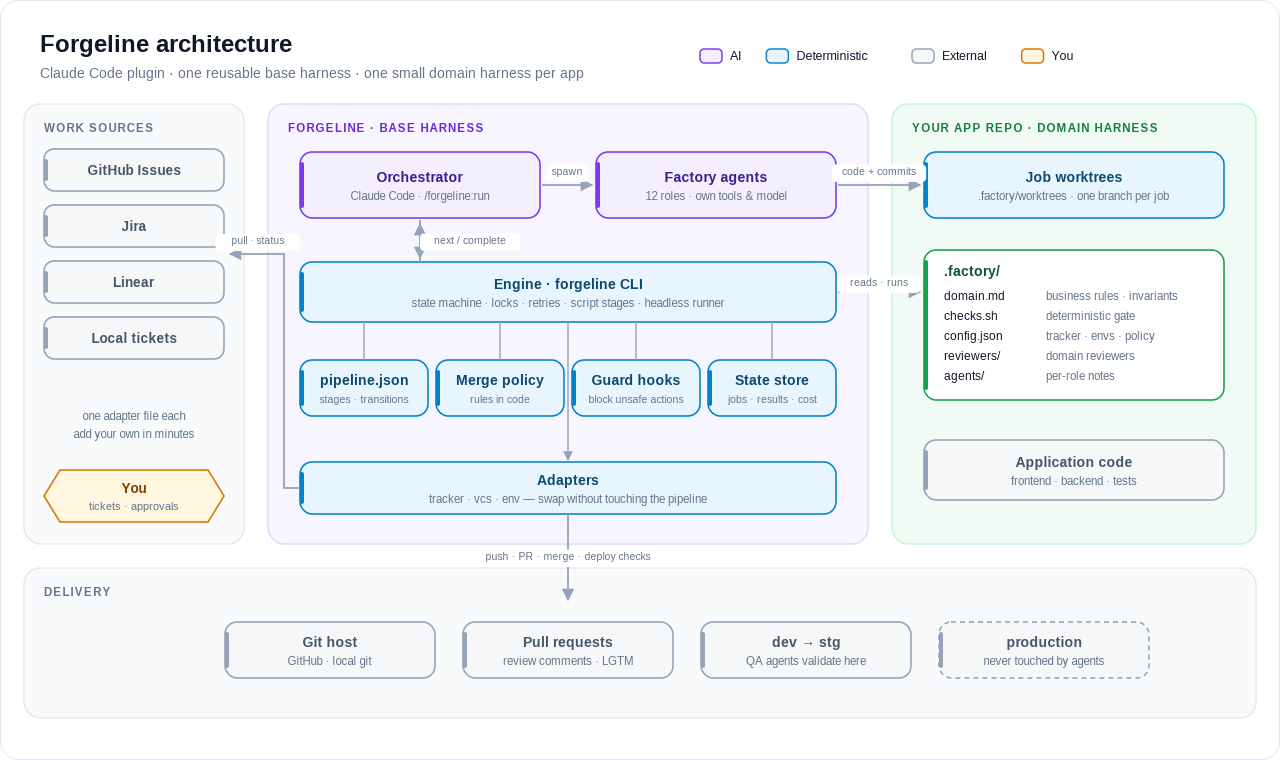
- Base harness (this plugin): the same for every app. Agents, skills, hooks, engine, policy, adapters.
- Domain harness (
.factory/in your repo): what makes it your factory.domain.md(business rules
and invariants every agent reads),checks.sh(your merge gate),config.json(tracker, environments,
policy, models),reviewers/(your own expert reviewers, e.g. privacy or finance).
Pipeline
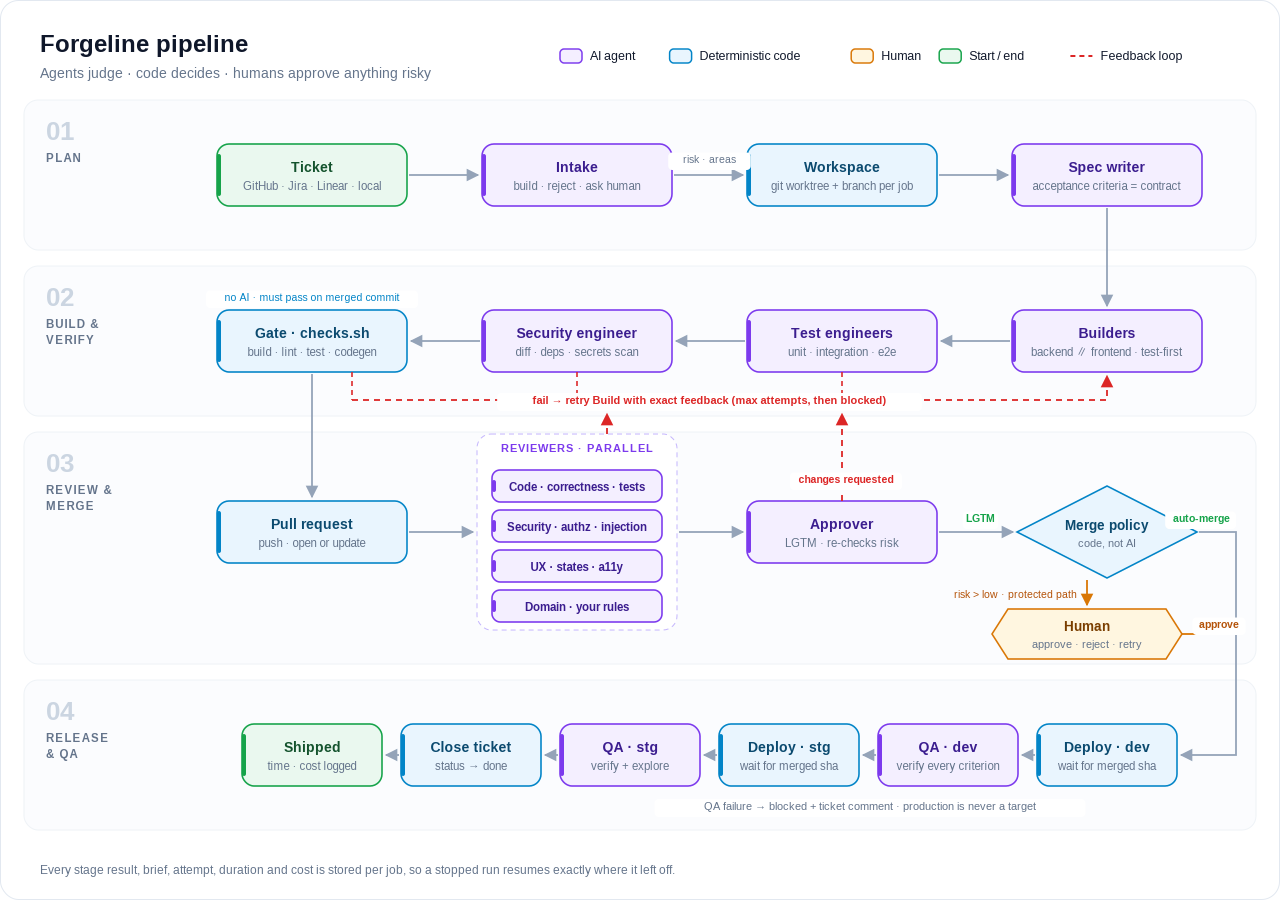
- Agents judge, code decides. Agents return
pass | fail | changes_requested | needs_human | reject | skip;pipeline.jsondecides what happens next. Agents never merge, push the base branch or touch tickets, and
the guard hooks enforce that. - Deterministic gate.
.factory/checks.shmust pass on the exact commit that gets merged. Agents cannot
edit it. - Merge policy in code. Auto-merge only up to the risk level you allow; protected paths always go to a
human. New repos start with auto-merge off. - Feedback loops. Test, security, gate and review failures are fed into the next build attempt. There
are max attempts, then the job isblocked. - Durable and parallel. All state lives in
.factory/state/, so you can stop anytime and resume. One
git worktree per job, jobs run in parallel, and reviewers run in parallel. - Observable. Time, attempts and real cost per stage:
forgeline report.
Two ways to run
| Interactive | Headless | |
|---|---|---|
| How | /forgeline:run in Claude Code |
forgeline run (cron, CI, a server) |
| Agents | Claude Code subagents (forgeline:<role>) |
claude -p per task, or --runner codex |
| Cost tracking | from agent reports | real token usage and $ from the runner |
Make it yours
.factory/
├── domain.md          what the business is, invariants, high-risk areas, glossary, test accounts
├── checks.sh          your gate: build · lint · test · codegen freshness · secrets · your own checks
├── config.json        tracker · git host · dev/stg URLs · policy · models · hook profile
├── reviewers/*.md     extra reviewers that run in parallel with code/security/UX
└── agents/<role>.md   extra notes for one role (e.g. QA test accounts)
See docs/getting-started.md, docs/configuration.md,
docs/hooks.md, docs/architecture.md.
Safety
- Hooks act only in repos that opted in (
.factory/config.json); the rest of your projects are untouched. - Credentials come from env vars or your existing
ghlogin, never from config files. - QA agents only get the dev/stg URLs and test accounts you list. Production is never a target.
- Ticket text is untrusted input: limit who can mark tickets ready for the factory.
What's next
Planned work lives in milestones. Each one is a single theme:
| Milestone | Goal |
|---|---|
| v0.4: Safe merges | rebase on latest main and re-run the gate before every merge; conflicts go back to the builder; agents never hold push credentials; hooks that fail closed |
| v0.5: The plan is the contract | tests can't be quietly weakened; plan changes need a human; every result is tied to the commit it checked |
| v0.6: Parallel without pain | file leases between jobs, automatic worktree cleanup, a fast path for tiny tickets |
| v0.7: Easier to adopt | create-forgeline drafts your domain.md from the code, plus adapter fixes |
| Later | team mode: self-hosted server, shared job state, humans only see opened PRs |
Ideas and feedback welcome in issues.
License
MIT
Reviews (0)
Sign in to leave a review.
Leave a reviewNo results found