NadirClaw
Health Gecti
- License — License: MIT
- Description — Repository has a description
- Active repo — Last push 0 days ago
- Community trust — 382 GitHub stars
Code Basarisiz
- rm -rf — Recursive force deletion command in install.sh
Permissions Gecti
- Permissions — No dangerous permissions requested
This tool acts as a local proxy that automatically routes simple AI prompts to cheaper models and complex prompts to premium ones. It helps developers reduce API costs by acting as an OpenAI-compatible intermediary for various AI coding assistants.
Security Assessment
As an LLM proxy, the tool inherently handles highly sensitive data, including your source code and all prompt inputs. Because it must forward these prompts to AI providers, it relies on making continuous external network requests, meaning your API keys are actively processed by the application. While the automated scan confirmed no dangerous system permissions are requested, it flagged a "rm -rf" recursive force deletion command inside the install script. Even though this is a common cleanup step in many bash installers, executing untrusted shell scripts always carries inherent risks. Overall risk: Medium.
Quality Assessment
The project demonstrates strong signs of active maintenance and reliability. It is licensed under the standard MIT license and appears to be actively developed, with repository updates pushed as recently as today. Additionally, it has garnered nearly 400 GitHub stars, indicating a solid baseline of community trust and adoption among developers.
Verdict
Use with caution. The project is actively maintained and community-trusted, but you should carefully inspect the install script for the "rm -rf" command and ensure you are comfortable with the tool handling your API keys and sensitive prompts.
Open-source LLM router & AI cost optimizer. Routes simple prompts to cheap/local models, complex ones to premium — automatically. Drop-in OpenAI-compatible proxy for Claude Code, Codex, Cursor, OpenClaw. Saves 40-70% on AI API costs. Self-hosted, no middleman.
NadirClaw
Your simple prompts are burning premium tokens.
NadirClaw routes them to cheaper models automatically. Save 40-70% on AI API costs.





Works with Claude Code · Cursor · Continue · Aider · Windsurf · Codex · OpenClaw · Open WebUI · Any OpenAI-compatible client
Website · Quick Start · Comparisons · GitHub Action
Why NadirClaw?
Most LLM requests don't need a premium model. In typical coding sessions, 60-70% of prompts are simple — reading files, short questions, formatting. They can be handled by models that cost 10-20x less.
$ nadirclaw serve
✓ Classifier ready — Listening on localhost:8856

SIMPLE  "What is 2+2?"              → gemini-flash    $0.0002
SIMPLE  "Format this JSON"          → haiku-4.5       $0.0004
COMPLEX "Refactor auth module..."   → claude-sonnet    $0.098
COMPLEX "Debug race condition..."   → gpt-5.2          $0.450
SIMPLE  "Write a docstring"         → gemini-flash    $0.0002

3 of 5 routed cheaper · $0.549 vs $1.37 all-premium · 60% saved
- Cut AI API costs 40-70% — real savings from day one
- ~10ms classification overhead — you won't notice it
- Drop-in proxy — works with any OpenAI-compatible tool
- Runs locally — your API keys never leave your machine
- Fallback chains — automatic failover when models are down
- Built-in cost tracking — dashboard, reports, budget alerts
Your keys. Your models. No middleman. NadirClaw runs locally and routes directly to providers. No third-party proxy, no subsidized tokens, no platform that can pull the plug on you. Why this matters.
Quick Start
pip install nadirclaw
Or install from source:
curl -fsSL https://raw.githubusercontent.com/doramirdor/NadirClaw/main/install.sh | sh
Then run the interactive setup wizard:
nadirclaw setup
This guides you through selecting providers, entering API keys, and choosing models for each routing tier. Then start the router:
nadirclaw serve --verbose
That's it. NadirClaw starts on http://localhost:8856 with sensible defaults (Gemini 3 Flash for simple, OpenAI Codex for complex). If you skip nadirclaw setup, the serve command will offer to run it on first launch.
Features
- Context Optimize — compacts bloated context (JSON, tool schemas, chat history, whitespace) before dispatch, saving 30-70% input tokens with zero semantic loss. Modes:
off(default),safe(lossless),aggressive(future). See savings analysis - Smart routing — classifies prompts in ~10ms using sentence embeddings
- Three-tier routing — simple / mid / complex tiers with configurable score thresholds (
NADIRCLAW_TIER_THRESHOLDS); setNADIRCLAW_MID_MODELfor a cost-effective middle tier - Agentic task detection — auto-detects tool use, multi-step loops, and agent system prompts; forces complex model for agentic requests
- Reasoning detection — identifies prompts needing chain-of-thought and routes to reasoning-optimized models
- Vision routing — auto-detects image content in messages and routes to vision-capable models (GPT-4o, Claude, Gemini)
- Routing profiles —
auto,eco,premium,free,reasoning— choose your cost/quality strategy per request - Model aliases — use short names like
sonnet,flash,gpt4instead of full model IDs - Session persistence — pins the model for multi-turn conversations so you don't bounce between models mid-thread
- Context-window filtering — auto-swaps to a model with a larger context window when your conversation is too long
- Fallback chains — if a model fails (429, 5xx, timeout), NadirClaw cascades through a configurable chain of fallback models until one succeeds
- Streaming support — full SSE streaming compatible with OpenClaw, Codex, and other streaming clients
- Native Gemini support — calls Gemini models directly via the Google GenAI SDK (not through LiteLLM)
- OAuth login — use your subscription with
nadirclaw auth <provider> login(OpenAI, Anthropic, Google), no API key needed - Multi-provider — supports Gemini, OpenAI, Anthropic, Ollama, and any LiteLLM-supported provider
- OpenAI-compatible API — drop-in replacement for any tool that speaks the OpenAI chat completions API
- Request reporting —
nadirclaw reportwith per-model and per-day cost breakdown (--by-model --by-day), anomaly flagging, filters, latency stats, tier breakdown, and token usage - Log export —
nadirclaw export --format csv|jsonl --since 7dfor offline analysis in spreadsheets or data tools - Raw logging — optional
--log-rawflag to capture full request/response content for debugging and replay - Prometheus metrics — built-in
/metricsendpoint with request counts, latency histograms, token/cost totals, cache hits, and fallback tracking (zero extra dependencies) - OpenTelemetry tracing — optional distributed tracing with GenAI semantic conventions (
pip install nadirclaw[telemetry]) - Cost savings calculator —
nadirclaw savingsshows exactly how much money you've saved, with monthly projections - Spend tracking and budgets — real-time per-request cost tracking with daily/monthly budget limits, alerts via
nadirclaw budget, optional webhook and stdout notifications - Prompt caching — in-memory LRU cache for identical chat completions, skipping redundant LLM calls entirely. Configurable TTL and max size via
NADIRCLAW_CACHE_TTLandNADIRCLAW_CACHE_MAX_SIZE. Monitor withnadirclaw cacheor the/v1/cacheendpoint - Live dashboard —
nadirclaw dashboardfor terminal, or visithttp://localhost:8856/dashboardfor a web UI with real-time stats, cost tracking, and model usage - GitHub Action —
doramirdor/nadirclaw-actionfor CI/CD pipelines
Dashboard
Monitor your routing in real-time with nadirclaw dashboard:
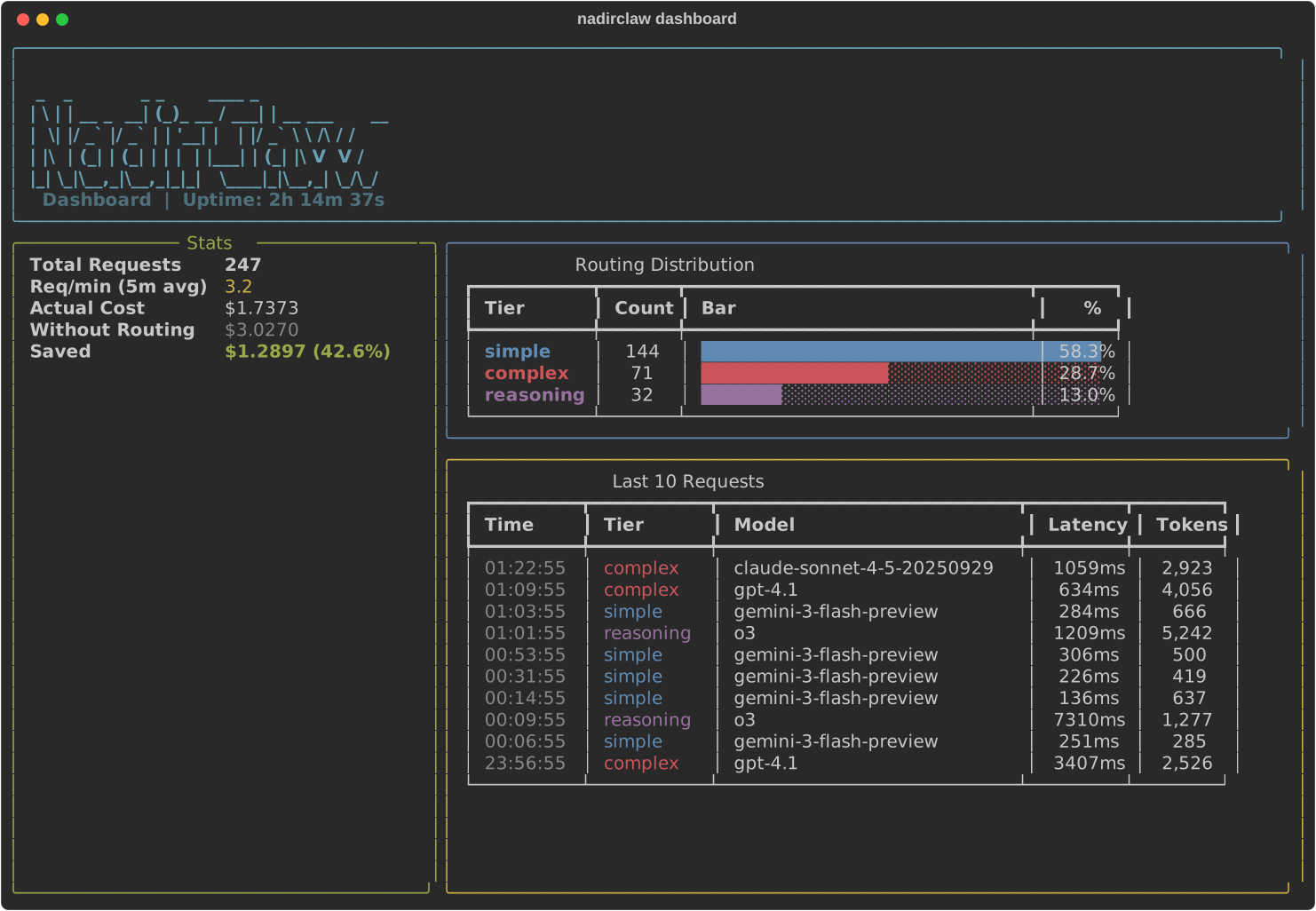
Install the dashboard extras: pip install nadirclaw[dashboard]
Prerequisites
- Python 3.10+
- git
- At least one LLM provider:
- Google Gemini API key (free tier: 20 req/day)
- Ollama running locally (free, no API key needed)
- Anthropic API key for Claude models
- OpenAI API key for GPT models
- Provider subscriptions via OAuth (
nadirclaw auth openai login,nadirclaw auth anthropic login,nadirclaw auth antigravity login,nadirclaw auth gemini login) - Or any provider supported by LiteLLM
Install
One-line install (recommended)
curl -fsSL https://raw.githubusercontent.com/doramirdor/NadirClaw/main/install.sh | sh
This clones the repo to ~/.nadirclaw, creates a virtual environment, installs dependencies, and adds nadirclaw to your PATH. Run it again to update.
Manual install
git clone https://github.com/doramirdor/NadirClaw.git
cd NadirClaw
python3 -m venv venv
source venv/bin/activate
pip install -e .
Uninstall
rm -rf ~/.nadirclaw
sudo rm -f /usr/local/bin/nadirclaw
Docker
Run NadirClaw + Ollama with zero cost, fully local:
git clone https://github.com/doramirdor/NadirClaw.git && cd NadirClaw
docker compose up
This starts Ollama and NadirClaw on port 8856. Pull a model once it's running:
docker compose exec ollama ollama pull llama3.1:8b
To use premium models alongside Ollama, create a .env file with your API keys and model config (see .env.example), then restart.
To run NadirClaw standalone (without Ollama):
docker build -t nadirclaw .
docker run -p 8856:8856 --env-file .env nadirclaw
Configure
Environment File
NadirClaw loads configuration from ~/.nadirclaw/.env. Create or edit this file to set API keys and model preferences:
# ~/.nadirclaw/.env

# API keys (set the ones you use)
GEMINI_API_KEY=AIza...
OPENAI_API_KEY=sk-...
ANTHROPIC_API_KEY=sk-ant-...

# Model routing
NADIRCLAW_SIMPLE_MODEL=gemini-3-flash-preview
NADIRCLAW_COMPLEX_MODEL=gemini-2.5-pro

# Server
NADIRCLAW_PORT=8856
If ~/.nadirclaw/.env does not exist, NadirClaw falls back to .env in the current directory.
Authentication
NadirClaw supports multiple ways to provide LLM credentials, checked in this order:
- OpenClaw stored token (
~/.openclaw/agents/main/agent/auth-profiles.json) - NadirClaw stored credential (
~/.nadirclaw/credentials.json) - Environment variable (
GEMINI_API_KEY,ANTHROPIC_API_KEY,OPENAI_API_KEY, etc.)
Using nadirclaw auth (recommended)
# Add a Gemini API key
nadirclaw auth add --provider google --key AIza...

# Add any provider API key
nadirclaw auth add --provider anthropic --key sk-ant-...
nadirclaw auth add --provider openai --key sk-...

# Login with your OpenAI/ChatGPT subscription (OAuth, no API key needed)
nadirclaw auth openai login

# Login with your Anthropic/Claude subscription (OAuth, no API key needed)
nadirclaw auth anthropic login

# Login with Google Gemini (OAuth, opens browser)
nadirclaw auth gemini login

# Login with Google Antigravity (OAuth, opens browser)
nadirclaw auth antigravity login

# Store a Claude subscription token (from 'claude setup-token') - alternative to OAuth
nadirclaw auth setup-token

# Check what's configured
nadirclaw auth status

# Remove a credential
nadirclaw auth remove google
Using environment variables
Set API keys in ~/.nadirclaw/.env:
GEMINI_API_KEY=AIza...          # or GOOGLE_API_KEY
ANTHROPIC_API_KEY=sk-ant-...
OPENAI_API_KEY=sk-...
Model Configuration
Configure which model handles each tier:
NADIRCLAW_SIMPLE_MODEL=gemini-3-flash-preview          # cheap/free model
NADIRCLAW_COMPLEX_MODEL=gemini-2.5-pro                 # premium model
NADIRCLAW_REASONING_MODEL=o3                           # reasoning tasks (optional, defaults to complex)
NADIRCLAW_FREE_MODEL=ollama/llama3.1:8b                # free fallback (optional, defaults to simple)
NADIRCLAW_FALLBACK_CHAIN=gpt-4.1,claude-sonnet-4-5-20250929,gemini-2.5-flash  # cascade order on failure (optional)
Example Setups
| Setup | Simple Model | Complex Model | API Keys Needed |
|---|---|---|---|
| Gemini + Gemini | gemini-2.5-flash |
gemini-2.5-pro |
GEMINI_API_KEY |
| Gemini + Claude | gemini-2.5-flash |
claude-sonnet-4-5-20250929 |
GEMINI_API_KEY + ANTHROPIC_API_KEY |
| Claude + Ollama | ollama/llama3.1:8b |
claude-sonnet-4-5-20250929 |
ANTHROPIC_API_KEY |
| Claude + Claude | claude-haiku-4-5-20251001 |
claude-sonnet-4-5-20250929 |
ANTHROPIC_API_KEY |
| OpenAI + Ollama | ollama/llama3.1:8b |
gpt-4.1 |
OPENAI_API_KEY |
| OpenAI + OpenAI | gpt-4.1-mini |
gpt-4.1 |
OPENAI_API_KEY |
| OpenAI Codex | gemini-2.5-flash |
openai-codex/gpt-5.3-codex |
GEMINI_API_KEY + OAuth login |
| Fully local | ollama/llama3.1:8b |
ollama/qwen3:32b |
None |
Gemini models are called natively via the Google GenAI SDK. All other models go through LiteLLM, which supports 100+ providers.
Usage with Gemini
Gemini is the default simple model. NadirClaw calls Gemini natively via the Google GenAI SDK for best performance.
# Set your Gemini API key
nadirclaw auth add --provider google --key AIza...

# Or set in ~/.nadirclaw/.env
echo "GEMINI_API_KEY=AIza..." >> ~/.nadirclaw/.env

# Start the router
nadirclaw serve --verbose
Rate Limit Fallback
If the primary model hits a 429 rate limit, NadirClaw automatically retries once, then falls back to the other tier's model. For example, if gemini-3-flash-preview is exhausted, NadirClaw will try gemini-2.5-pro (or whatever your complex model is). If both models are rate-limited, it returns a friendly error message instead of crashing.
Usage with Ollama
If you're running Ollama locally, NadirClaw works out of the box with no API keys:
# Fully local setup -- no API keys, no cost
NADIRCLAW_SIMPLE_MODEL=ollama/llama3.1:8b \
NADIRCLAW_COMPLEX_MODEL=ollama/qwen3:32b \
nadirclaw serve --verbose
Or mix local + cloud:
nadirclaw serve \
  --simple-model ollama/llama3.1:8b \
  --complex-model claude-sonnet-4-20250514 \
  --verbose
Recommended Ollama Models
| Model | Size | Good For |
|---|---|---|
llama3.1:8b |
4.7 GB | Simple tier (fast, good enough) |
qwen3:32b |
19 GB | Complex tier (local, no API cost) |
qwen3-coder |
19 GB | Code-heavy complex tier |
deepseek-r1:14b |
9 GB | Reasoning-heavy complex tier |
Auto-Discovery
NadirClaw can automatically discover Ollama instances on your local network:
# Quick scan (localhost only)
nadirclaw ollama discover

# Network scan (finds instances on your local subnet)
nadirclaw ollama discover --scan-network
The nadirclaw setup wizard offers auto-discovery when you select Ollama as a provider, so you don't need to know the URL beforehand. If Ollama is running on a different machine (like a home server or VM), auto-discovery will find it and configure the OLLAMA_API_BASE automatically.
Manual configuration is still supported via the OLLAMA_API_BASE environment variable:
# Connect to Ollama on a different host
OLLAMA_API_BASE=http://192.168.1.100:11434 nadirclaw serve
Usage with Custom OpenAI-Compatible Endpoints
NadirClaw works with any OpenAI-compatible API server — vLLM, LocalAI, LM Studio, text-generation-inference, or any custom endpoint:
# Point NadirClaw at your custom endpoint
NADIRCLAW_API_BASE=http://your-server:8000/v1 \
NADIRCLAW_SIMPLE_MODEL=openai/your-small-model \
NADIRCLAW_COMPLEX_MODEL=openai/your-large-model \
nadirclaw serve --verbose
Use the openai/ prefix on model names so LiteLLM routes them as OpenAI-compatible. NADIRCLAW_API_BASE is passed to all non-Ollama, non-Gemini LiteLLM calls.
You can also mix custom endpoints with cloud providers:
# Local model for simple, cloud for complex
NADIRCLAW_API_BASE=http://localhost:8000/v1 \
NADIRCLAW_SIMPLE_MODEL=openai/local-llama \
NADIRCLAW_COMPLEX_MODEL=claude-sonnet-4-5-20250929 \
nadirclaw serve
Usage with OpenClaw
OpenClaw is a personal AI assistant that bridges messaging services to AI coding agents. NadirClaw integrates as a model provider so OpenClaw's requests are automatically routed to the right model.
Quick Setup
# Auto-configure OpenClaw to use NadirClaw
nadirclaw openclaw onboard

# Start the router
nadirclaw serve
This writes NadirClaw as a provider in ~/.openclaw/openclaw.json with model nadirclaw/auto. If OpenClaw is already running, it will auto-reload the config -- no restart needed.
Configure Only (Without Launching)
nadirclaw openclaw onboard
# Then start NadirClaw separately when ready:
nadirclaw serve
What It Does
nadirclaw openclaw onboard adds this to your OpenClaw config:
{
  "models": {
    "providers": {
      "nadirclaw": {
        "baseUrl": "http://localhost:8856/v1",
        "apiKey": "local",
        "api": "openai-completions",
        "models": [{ "id": "auto", "name": "auto" }]
      }
    }
  },
  "agents": {
    "defaults": {
      "model": { "primary": "nadirclaw/auto" }
    }
  }
}
NadirClaw supports the SSE streaming format that OpenClaw expects (stream: true), handling multi-modal content and tool definitions in system prompts.
Usage with Codex
Codex is OpenAI's CLI coding agent. NadirClaw integrates as a custom model provider.
# Auto-configure Codex
nadirclaw codex onboard

# Start the router
nadirclaw serve
This writes ~/.codex/config.toml:
model_provider = "nadirclaw"

[model_providers.nadirclaw]
base_url = "http://localhost:8856/v1"
api_key = "local"
OpenAI Subscription (OAuth)
To use your ChatGPT subscription instead of an API key:
# Login with your OpenAI account (opens browser)
nadirclaw auth openai login

# NadirClaw will auto-refresh the token when it expires
This delegates to the Codex CLI for the OAuth flow and stores the credentials in ~/.nadirclaw/credentials.json. Tokens are automatically refreshed when they expire.
Usage with Claude Code
Claude Code is Anthropic's CLI coding agent. NadirClaw works as a drop-in proxy that intercepts Claude Code's API calls and routes simple prompts to cheaper models.
# Point Claude Code at NadirClaw
export ANTHROPIC_BASE_URL=http://localhost:8856/v1
export ANTHROPIC_API_KEY=local

# Start NadirClaw, then use Claude Code normally
nadirclaw serve --verbose
claude
You can also wrap this in a shell alias:
alias claude-routed='ANTHROPIC_BASE_URL=http://localhost:8856/v1 ANTHROPIC_API_KEY=local claude'
Authentication
Use your existing Claude subscription instead of a separate API key:
# Login with your Anthropic account (OAuth, opens browser)
nadirclaw auth anthropic login

# Or store a Claude subscription token directly
nadirclaw auth setup-token
What happens
Claude Code sends every request to Anthropic's API. With NadirClaw in front, each prompt is classified in ~10ms:
- Simple prompts (reading files, quick questions, "what does this function do?") get routed to a cheap model like Gemini Flash
- Complex prompts (refactoring, architecture, multi-file changes) stay on Claude
Streaming works as expected. In typical Claude Code usage, 40-70% of prompts are simple enough to route to a cheaper model, which translates directly to cost savings.
Usage with Open WebUI
Open WebUI is a popular self-hosted AI interface. NadirClaw works as a drop-in OpenAI-compatible provider:
# View setup instructions
nadirclaw openwebui onboard
Quick Setup
- Start NadirClaw:
nadirclaw serve - In Open WebUI, go to Admin Settings → Connections → OpenAI → Add Connection
- Enter:
- URL:
http://localhost:8856/v1 - API Key:
local
- URL:
- Select the
automodel in your chat
Open WebUI will auto-discover NadirClaw's available models (auto, eco, premium, plus your configured tier models). The auto model routes each prompt to the right model automatically — simple prompts go to cheap models, complex ones to premium.
Usage with Continue
Continue is an open-source AI coding assistant for VS Code and JetBrains. NadirClaw can be added as a model provider:
# Auto-configure Continue
nadirclaw continue onboard
This writes a ~/.continue/config.json entry with NadirClaw's auto model. Just start the server, open Continue in your editor, and select "NadirClaw Auto" from the model dropdown.
Usage with Cursor
Cursor supports OpenAI-compatible providers natively:
# View setup instructions
nadirclaw cursor onboard
In Cursor: Settings → Models → OpenAI API Key → enter local as the API key and http://localhost:8856/v1 as the base URL, with model name auto.
Usage with Any OpenAI-Compatible Tool
NadirClaw exposes a standard OpenAI-compatible API. Point any tool at it:
# Base URL
http://localhost:8856/v1

# Model
model: "auto"    # or omit -- NadirClaw picks the best model
Example: curl
curl http://localhost:8856/v1/chat/completions \
  -H "Content-Type: application/json" \
  -d '{
    "messages": [{"role": "user", "content": "What is 2+2?"}]
  }'
Example: curl (streaming)
curl http://localhost:8856/v1/chat/completions \
  -H "Content-Type: application/json" \
  -d '{
    "messages": [{"role": "user", "content": "What is 2+2?"}],
    "stream": true
  }'
Example: Python (openai SDK)
from openai import OpenAI

client = OpenAI(
    base_url="http://localhost:8856/v1",
    api_key="local",  # NadirClaw doesn't require auth by default
)

response = client.chat.completions.create(
    model="auto",
    messages=[{"role": "user", "content": "What is 2+2?"}],
)
print(response.choices[0].message.content)
Routing Profiles
Choose your routing strategy by setting the model field:
| Profile | Model Field | Strategy | Use Case |
|---|---|---|---|
| auto | auto or omit |
Smart routing (default) | Best overall balance |
| eco | eco |
Always use simple model | Maximum savings |
| premium | premium |
Always use complex model | Best quality |
| free | free |
Use free fallback model | Zero cost |
| reasoning | reasoning |
Use reasoning model | Chain-of-thought tasks |
# Use profiles via the model field
curl http://localhost:8856/v1/chat/completions \
  -H "Content-Type: application/json" \
  -d '{"model": "eco", "messages": [{"role": "user", "content": "Hello"}]}'

# Also works with nadirclaw/ prefix
# model: "nadirclaw/eco", "nadirclaw/premium", etc.
Model Aliases
Use short names instead of full model IDs:
| Alias | Resolves To |
|---|---|
sonnet |
claude-sonnet-4-5-20250929 |
opus |
claude-opus-4-6-20250918 |
haiku |
claude-haiku-4-5-20251001 |
gpt4 |
gpt-4.1 |
gpt5 |
gpt-5.2 |
flash |
gemini-2.5-flash |
gemini-pro |
gemini-2.5-pro |
deepseek |
deepseek/deepseek-chat |
deepseek-r1 |
deepseek/deepseek-reasoner |
llama |
ollama/llama3.1:8b |
# Use an alias as the model
curl http://localhost:8856/v1/chat/completions \
  -H "Content-Type: application/json" \
  -d '{"model": "sonnet", "messages": [{"role": "user", "content": "Hello"}]}'
Routing Intelligence — How NadirClaw Classifies Prompts
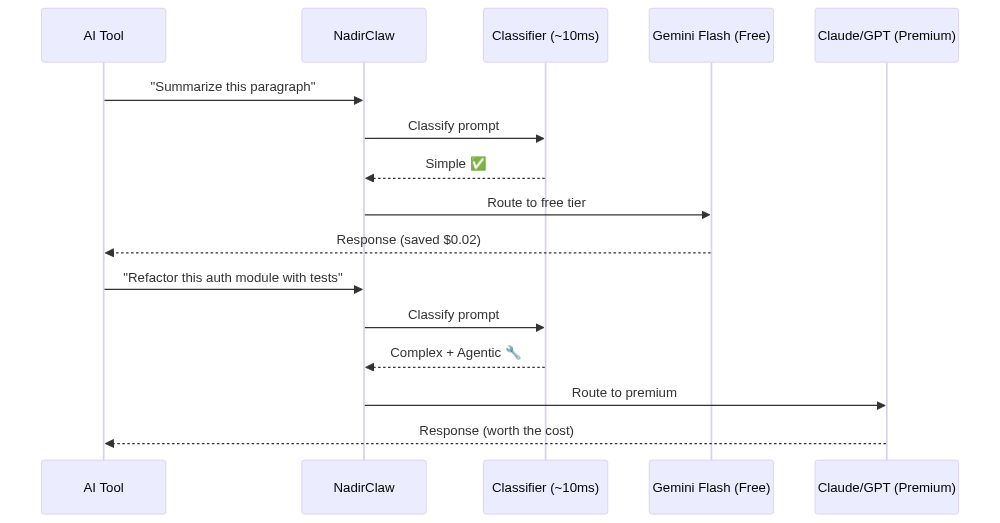
Beyond basic simple/complex classification, NadirClaw applies routing modifiers that can override the base decision:
Agentic Task Detection
NadirClaw detects agentic requests (coding agents, multi-step tool use) and forces them to the complex model, even if the individual message looks simple. Signals:
- Tool definitions in the request (
toolsarray) - Tool-role messages (active tool execution loop)
- Assistant→tool→assistant cycles (multi-step execution)
- Agent-like system prompts ("you are a coding agent", "you can execute commands")
- Long system prompts (>500 chars, typical of agent instructions)
- Deep conversations (>10 messages)
This prevents a message like "now add tests" from being routed to the cheap model when it's part of an ongoing agentic refactoring session.
Reasoning Detection
Prompts with 2+ reasoning markers are routed to the reasoning model (or complex model if no reasoning model is configured):
- "step by step", "think through", "chain of thought"
- "prove that", "derive the", "mathematically show"
- "analyze the tradeoffs", "compare and contrast"
- "critically analyze", "evaluate whether"
Vision Routing
NadirClaw detects when messages contain images (image_url content parts, including base64-encoded images) and automatically routes to a vision-capable model. If the classifier picks a text-only model (e.g., DeepSeek, Ollama), NadirClaw swaps to a vision-capable alternative from your configured tiers.
Session Persistence
Once a conversation is routed to a model, subsequent messages in the same session reuse that model. This prevents jarring mid-conversation model switches. Sessions are keyed by system prompt + first user message, with a 30-minute TTL.
Context Window Filtering
If the estimated token count of a request exceeds a model's context window, NadirClaw automatically swaps to a model with a larger context. For example, a 150k-token conversation targeting gpt-4o (128k context) will be redirected to gemini-2.5-pro (1M context).
CLI Reference
nadirclaw setup              # Interactive setup wizard (providers, keys, models)
nadirclaw serve              # Start the router server
nadirclaw serve --log-raw    # Start with full request/response logging
nadirclaw test               # Probe each configured model and verify it responds
nadirclaw optimize <file>    # Test context compaction on a file (dry-run)
nadirclaw classify <prompt>  # Classify a prompt (no server needed)
nadirclaw classify --format json <prompt>  # Machine-readable JSON output
nadirclaw report             # Show a summary report of request logs
nadirclaw report --since 24h # Report for the last 24 hours
nadirclaw report --by-model  # Per-model cost breakdown with anomaly detection
nadirclaw report --by-day    # Per-day cost breakdown
nadirclaw report --by-model --by-day  # Combined model × day breakdown
nadirclaw export --format csv --since 7d  # Export logs to CSV for offline analysis
nadirclaw export --format jsonl -o data.jsonl  # Export to JSONL file
nadirclaw savings            # Show how much money NadirClaw saved you
nadirclaw savings --since 7d # Savings for the last 7 days
nadirclaw dashboard          # Live terminal dashboard with real-time stats
nadirclaw status             # Show config, credentials, and server status
nadirclaw auth add           # Add an API key for any provider
nadirclaw auth status        # Show configured credentials (masked)
nadirclaw auth remove        # Remove a stored credential
nadirclaw auth setup-token      # Store a Claude subscription token (alternative to OAuth)
nadirclaw auth openai login     # Login with OpenAI subscription (OAuth)
nadirclaw auth openai logout    # Remove stored OpenAI OAuth credential
nadirclaw auth anthropic login     # Login with Anthropic/Claude subscription (OAuth)
nadirclaw auth anthropic logout    # Remove stored Anthropic OAuth credential
nadirclaw auth antigravity login   # Login with Google Antigravity (OAuth, opens browser)
nadirclaw auth antigravity logout  # Remove stored Antigravity OAuth credential
nadirclaw auth gemini login       # Login with Google Gemini (OAuth, opens browser)
nadirclaw auth gemini logout      # Remove stored Gemini OAuth credential
nadirclaw codex onboard         # Configure Codex integration
nadirclaw openclaw onboard   # Configure OpenClaw integration
nadirclaw openwebui onboard  # Show Open WebUI setup instructions
nadirclaw continue onboard   # Configure Continue (continue.dev) integration
nadirclaw cursor onboard     # Show Cursor editor setup instructions
nadirclaw build-centroids    # Regenerate centroid vectors from prototypes
nadirclaw serve
nadirclaw serve [OPTIONS]

Options:
  --port INTEGER          Port to listen on (default: 8856)
  --simple-model TEXT     Model for simple prompts
  --complex-model TEXT    Model for complex prompts
  --models TEXT           Comma-separated model list (legacy)
  --token TEXT            Auth token
  --optimize [off|safe|aggressive]  Context optimization mode (default: off)
  --verbose               Enable debug logging
  --log-raw               Log full raw requests and responses to JSONL
nadirclaw optimize
Test context compaction on a file or stdin without running the server:
nadirclaw optimize payload.json                    # dry-run with safe mode
nadirclaw optimize payload.json --format json      # machine-readable output
nadirclaw optimize payload.json --mode aggressive   # aggressive mode (future)
cat messages.json | nadirclaw optimize             # pipe from stdin
Input can be a JSON file with a messages array (OpenAI format), a raw JSON array of messages, or plain text (wrapped as a single user message).
Example output:
Mode:          safe
Original:      ~3,657 tokens
Optimized:     ~1,573 tokens
Saved:         ~2,084 tokens (57.0%)
Transforms:    tool_schema_dedup, json_minify, whitespace_normalize
nadirclaw report
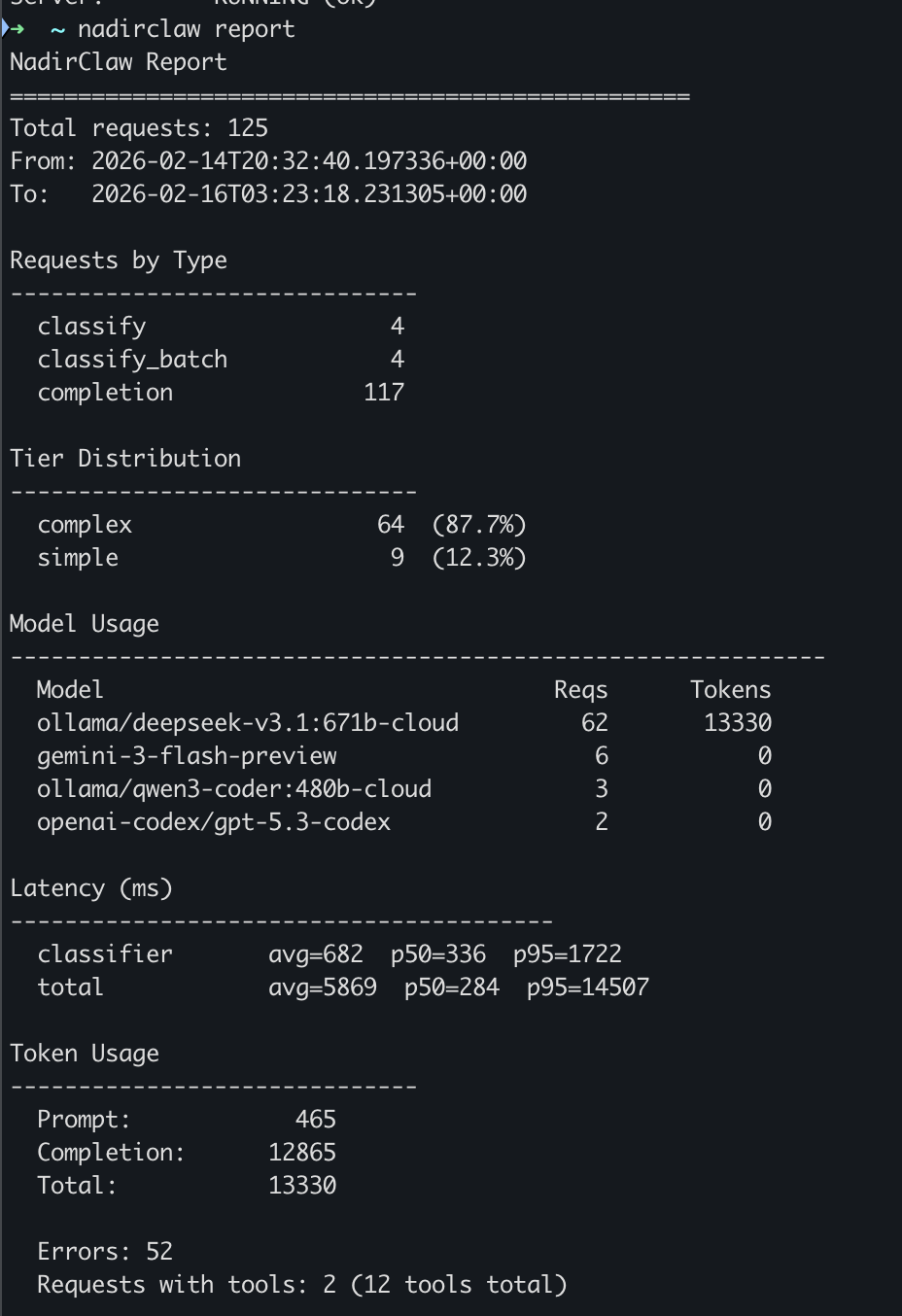
Analyze request logs and print a summary report:
nadirclaw report                     # full report
nadirclaw report --since 24h         # last 24 hours
nadirclaw report --since 7d          # last 7 days
nadirclaw report --since 2025-02-01  # since a specific date
nadirclaw report --model gemini      # filter by model name
nadirclaw report --by-model          # per-model cost breakdown
nadirclaw report --by-day            # per-day cost breakdown
nadirclaw report --by-model --by-day # combined breakdown with anomaly detection
nadirclaw report --format json       # machine-readable JSON output
nadirclaw report --export report.txt # save to file
Example output:
NadirClaw Report
==================================================
Total requests: 147
From: 2026-02-14T08:12:03+00:00
To:   2026-02-14T22:47:19+00:00

Requests by Type
------------------------------
  classify                    12
  completion                 135

Tier Distribution
------------------------------
  complex                    41  (31.1%)
  direct                      8  (6.1%)
  simple                     83  (62.9%)

Model Usage
------------------------------------------------------------
  Model                               Reqs      Tokens
  gemini-3-flash-preview                83       48210
  openai-codex/gpt-5.3-codex           41      127840
  claude-sonnet-4-20250514               8       31500

Latency (ms)
----------------------------------------
  classifier       avg=12  p50=11  p95=24
  total             avg=847  p50=620  p95=2340

Token Usage
------------------------------
  Prompt:         138420
  Completion:      69130
  Total:          207550

  Fallbacks: 3
  Errors: 2
  Streaming requests: 47
  Requests with tools: 18 (54 tools total)
nadirclaw classify
Classify a prompt locally without running the server. Useful for testing your setup. Quotes are optional — multi-word prompts work directly:
$ nadirclaw classify What is 2+2?
Tier:       simple
Confidence: 0.2848
Score:      0.0000
Model:      gemini-3-flash-preview

$ nadirclaw classify Design a distributed system for real-time trading
Tier:       complex
Confidence: 0.1843
Score:      1.0000
Model:      gemini-2.5-pro

# Machine-readable output for scripting
$ nadirclaw classify --format json Refactor this module to use dependency injection
{"tier": "complex", "is_complex": true, "confidence": 0.1612, "score": 0.9056, "model": "gemini-2.5-pro", "prompt": "Refactor this module to use dependency injection"}
nadirclaw status
$ nadirclaw status
NadirClaw Status
----------------------------------------
Simple model:  gemini-3-flash-preview
Complex model: gemini-2.5-pro
Tier config:   explicit (env vars)
Port:          8856
Threshold:     0.06
Log dir:       /Users/you/.nadirclaw/logs
Token:         nadir-***

Server:        RUNNING (ok)
nadirclaw test
Verify your credentials and model names before starting the server. Sends a short probe request to each configured tier and reports latency and the model's reply:
$ nadirclaw test
NadirClaw Model Test
==================================================

  [simple] gemini-2.5-flash
  ──────────────────────────────────────────────
  Status:   OK
  Latency:  312ms
  Reply:    'ok'

  [complex] claude-sonnet-4-5-20250929
  ──────────────────────────────────────────────
  Status:   OK
  Latency:  891ms
  Reply:    'ok'

All models OK. Start the router with: nadirclaw serve
Exits with code 1 if any model fails, so it works in CI. Override models inline:
nadirclaw test --simple-model gemini-2.5-flash --complex-model gpt-4.1
nadirclaw test --timeout 10
How It Works
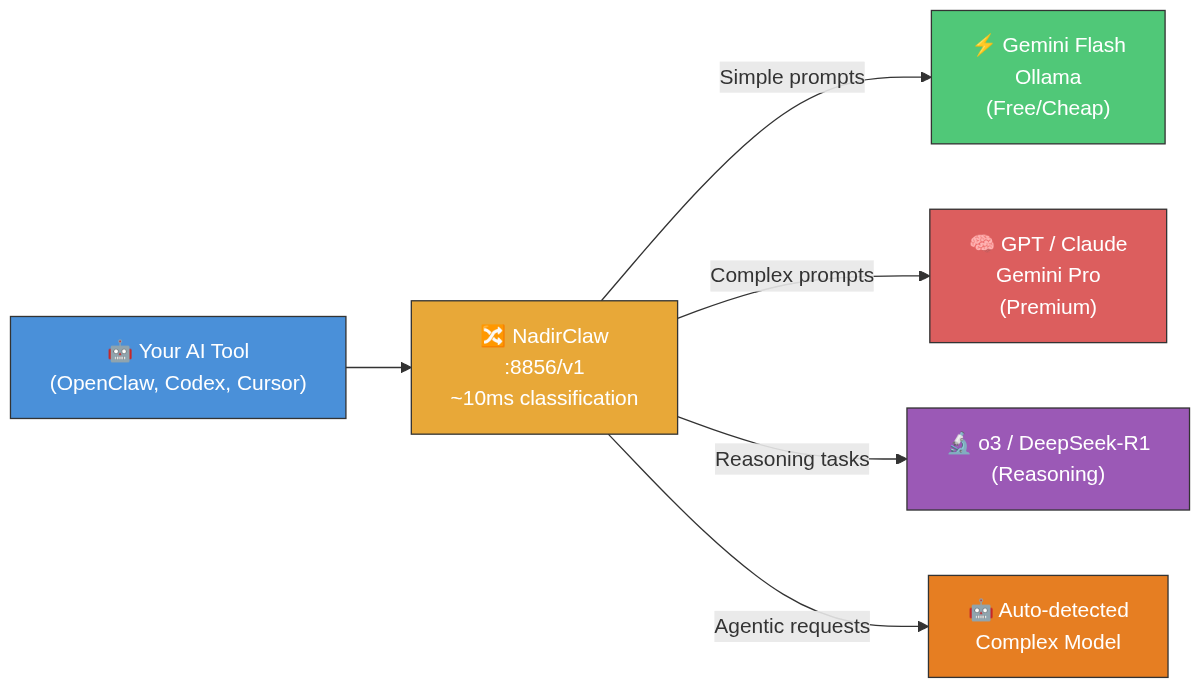
NadirClaw sits between your application and the LLM provider as a transparent proxy:
┌─────────────────┐
│  Your App       │
│  (Claude Code,  │
│   Cursor, etc)  │
└────────┬────────┘
         │ OpenAI API request
         ▼
┌─────────────────┐
│  NadirClaw      │
│  Classifier     │
└────────┬────────┘
         │ Route decision (10ms)
         ▼
┌─────────────────┐
│  LLM Provider   │
│  (Claude, GPT,  │
│   Gemini, etc)  │
└─────────────────┘
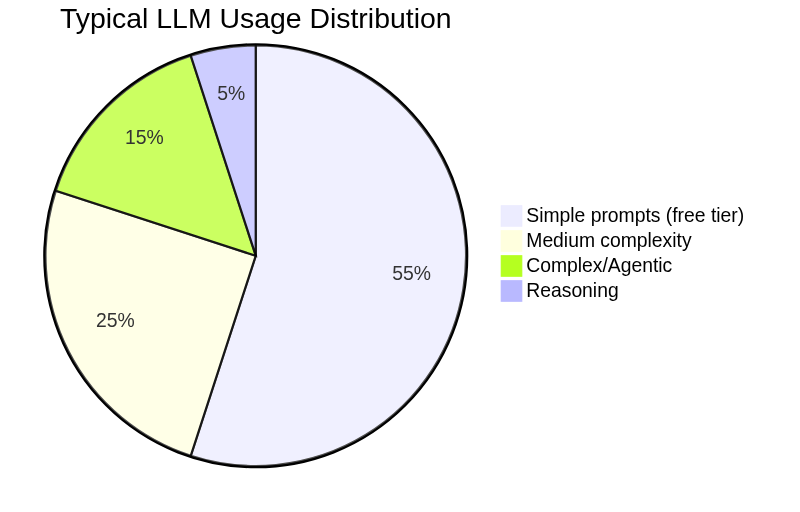
Most LLM usage doesn't need a premium model. NadirClaw routes each prompt to the right tier automatically:
Step-by-Step
Your tool sends a request to
localhost:8856/v1/chat/completions(OpenAI format)NadirClaw intercepts it and runs the prompt through a lightweight classifier based on sentence embeddings
Routes to the cheapest viable model based on the classification result and routing modifiers
Forwards the request to the chosen provider and returns the response
Logs everything for cost analysis and reporting
Total overhead: ~10ms (classifier inference on a warm encoder)
The Classifier
NadirClaw uses a binary complexity classifier based on sentence embeddings:
Pre-computed centroids: Ships two tiny centroid vectors (~1.5 KB each) derived from ~170 seed prompts. These are pre-computed and included in the package — no training step required.
Classification: For each incoming prompt, computes its embedding using all-MiniLM-L6-v2 (~80 MB, downloaded once on first use) and measures cosine similarity to both centroids. If the prompt is closer to the complex centroid, it routes to your complex model; otherwise to your simple model.
Borderline handling: When confidence is below the threshold (default 0.06), the classifier defaults to complex -- it's cheaper to over-serve a simple prompt than to under-serve a complex one.
Routing modifiers: After classification, NadirClaw applies intelligent overrides:
- Agentic detection — if tool definitions, tool-role messages, or agent system prompts are detected, forces the complex model
- Reasoning detection — if 2+ reasoning markers are found, routes to the reasoning model
- Vision routing — if image content is detected, swaps to a vision-capable model
- Context window check — if the conversation exceeds the model's context window, swaps to a model that fits
- Session persistence — reuses the same model for follow-up messages in the same conversation
Dispatch: Calls the selected model via the appropriate backend:
- Gemini models — called natively via the Google GenAI SDK for best performance
- All other models — called via LiteLLM, which provides a unified interface to 100+ providers
Fallback chains: If the selected model fails (429 rate limit, 5xx error, or timeout), NadirClaw cascades through a configurable fallback chain. Set
NADIRCLAW_FALLBACK_CHAIN=gpt-4.1,claude-sonnet-4-5-20250929,gemini-2.5-flashto define the order. Default chain uses all your configured tier models.Per-model rate limiting: Protect against runaway costs and provider quota exhaustion with configurable RPM limits per model. When a model hits its limit, NadirClaw automatically triggers the fallback chain — no failed requests. Configure via
NADIRCLAW_MODEL_RATE_LIMITS=gemini-3-flash-preview=30,gpt-4.1=60or set a blanket default withNADIRCLAW_DEFAULT_MODEL_RPM=120. Monitor usage in real-time at/v1/rate-limits.
Why This Works
The key insight: most prompts don't need the most expensive model.
In real-world coding assistant usage:
- 60-70% of prompts work fine on cheap models (Haiku, GPT-4o-mini, Gemini Flash)
- 20-30% need mid-tier (Sonnet, GPT-4o, Gemini Pro)
- 5-10% need flagship (Opus, o1, o3)
But without a classifier, everything hits the expensive default. NadirClaw's job is to route smartly without breaking your workflow.
Classification takes ~10ms on a warm encoder. The first request takes ~2-3 seconds to load the embedding model.
Cost Savings & Benchmarks — How Much Does NadirClaw Save?
Real-world usage shows NadirClaw typically reduces LLM costs by 40-70% depending on your workload and model choices.
Example: Claude Code Usage
A typical 8-hour coding day with Claude Code (tracked via JSONL session logs):
Without NadirClaw:
- Total requests: 147
- All routed to
claude-sonnet-4-5(premium model) - Prompt tokens: 138,420
- Completion tokens: 69,130
- Total cost: $24.18
With NadirClaw:
- Simple tier (62% of requests): 83 requests to
gemini-2.5-flash- Cost: $1.85
- Complex tier (31% of requests): 41 requests to
claude-sonnet-4-5- Cost: $7.32
- Direct (7% of requests): 8 requests (model override, reasoning tasks)
- Cost: $1.12
- Total cost: $10.29
Savings: $13.89 (57% reduction)
Example: OpenClaw Agent
Running an autonomous agent for 24 hours with mixed tasks (file operations, web searches, code generation):
Without routing:
- 412 LLM calls to
gpt-4.1 - Average 850 tokens per call
- Total cost: $31.45
With NadirClaw:
- Simple tier (68%): 280 calls to
ollama/llama3.1:8b(local, free) - Complex tier (32%): 132 calls to
gpt-4.1 - Total cost: $11.92
Savings: $19.53 (62% reduction)
What Gets Routed Where?
Based on 10,000+ production prompts:
Simple tier (typically 60-70% of requests):
- "What does this function do?"
- "Read the file at src/main.py"
- "Add a docstring to this class"
- "Show me the last 5 commits"
- "What's the error on line 42?"
- "Continue with that approach"
Complex tier (30-40% of requests):
- "Refactor this module to use dependency injection"
- "Design a caching layer for this API"
- "Explain the tradeoffs between these architectures"
- "Debug why this async operation deadlocks"
- Multi-file changes requiring context understanding
Auto-upgraded to complex:
- Agentic requests with tool definitions
- Prompts with 2+ reasoning markers
- Requests containing images (vision routing)
- Long conversations (>10 turns)
- Requests exceeding the simple model's context window
Monthly Projections
If you currently spend $100/month on Claude API:
| Routing Setup | Simple Model | Complex Model | Monthly Cost | Savings |
|---|---|---|---|---|
| No routing | Claude Sonnet | Claude Sonnet | $100.00 | - |
| Conservative | Claude Haiku | Claude Sonnet | $62.00 | 38% |
| Balanced | Gemini Flash | Claude Sonnet | $48.00 | 52% |
| Aggressive | Ollama (free) | Claude Sonnet | $35.00 | 65% |
Use nadirclaw report and nadirclaw savings to see your actual numbers.
Context Optimize Savings
On top of routing savings, Context Optimize compacts bloated payloads before they hit the provider. Benchmarked on Claude Opus 4.6 ($15/1M input tokens):
| Payload Type | Tokens Saved | Savings % | Saved / 1K req |
|---|---|---|---|
| Agentic assistant (8 turns, 5 tool schemas repeated) | 2,084 | 57% | $31.26 |
| RAG pipeline (6 chunks, pretty-printed JSON) | 158 | 29% | $2.37 |
| API response analysis (nested JSON) | 1,018 | 62% | $15.27 |
| Long debug session (50 turns + JSON logs) | 2,442 | 63% | $36.63 |
| OpenAPI spec context (5 endpoints) | 1,887 | 71% | $28.30 |
Average: 61.5% input token reduction across structured payloads. Enable with --optimize safe. See full analysis.
API Endpoints
Auth is disabled by default (local-only). Set NADIRCLAW_AUTH_TOKEN to require a bearer token.
| Endpoint | Method | Description |
|---|---|---|
/v1/chat/completions |
POST | OpenAI-compatible completions with auto routing (supports stream: true) |
/v1/classify |
POST | Classify a prompt without calling an LLM |
/v1/classify/batch |
POST | Classify multiple prompts at once |
/v1/models |
GET | List available models |
/v1/rate-limits |
GET | Per-model rate limit status (current RPM, remaining, limits) |
/v1/logs |
GET | View recent request logs |
/metrics |
GET | Prometheus metrics (request counts, latency histograms, token/cost totals, cache hits, fallbacks) |
/health |
GET | Health check (no auth required) |
Configuration Reference
| Variable | Default | Description |
|---|---|---|
NADIRCLAW_SIMPLE_MODEL |
gemini-3-flash-preview |
Model for simple prompts |
NADIRCLAW_COMPLEX_MODEL |
openai-codex/gpt-5.3-codex |
Model for complex prompts |
NADIRCLAW_MID_MODEL |
(falls back to simple) | Model for mid-complexity prompts (enables 3-tier routing) |
NADIRCLAW_TIER_THRESHOLDS |
0.35,0.65 |
Score thresholds for 3-tier routing: simple_max,complex_min |
NADIRCLAW_REASONING_MODEL |
(falls back to complex) | Model for reasoning tasks |
NADIRCLAW_FREE_MODEL |
(falls back to simple) | Free fallback model |
NADIRCLAW_FALLBACK_CHAIN |
(all tier models) | Comma-separated cascade order on model failure |
NADIRCLAW_DAILY_BUDGET |
(none) | Daily spend limit in USD (e.g. 5.00) |
NADIRCLAW_MONTHLY_BUDGET |
(none) | Monthly spend limit in USD (e.g. 50.00) |
NADIRCLAW_BUDGET_WARN_THRESHOLD |
0.8 |
Alert when spend reaches this fraction of budget |
NADIRCLAW_BUDGET_WEBHOOK_URL |
(none) | Webhook URL — receives POST with JSON alert payload |
NADIRCLAW_BUDGET_STDOUT_ALERTS |
false |
Print alerts to stdout (true/1/yes to enable) |
NADIRCLAW_MODEL_RATE_LIMITS |
(none) | Per-model RPM limits, e.g. gemini-3-flash-preview=30,gpt-4.1=60 |
NADIRCLAW_DEFAULT_MODEL_RPM |
0 (unlimited) |
Default max requests/minute for any model not in MODEL_RATE_LIMITS |
NADIRCLAW_AUTH_TOKEN |
(empty — auth disabled) | Set to require a bearer token |
GEMINI_API_KEY |
-- | Google Gemini API key (also accepts GOOGLE_API_KEY) |
ANTHROPIC_API_KEY |
-- | Anthropic API key |
OPENAI_API_KEY |
-- | OpenAI API key |
NADIRCLAW_API_BASE |
(empty — disabled) | Custom base URL for OpenAI-compatible endpoints (vLLM, LocalAI, LM Studio, etc.) |
OLLAMA_API_BASE |
http://localhost:11434 |
Ollama base URL |
NADIRCLAW_CONFIDENCE_THRESHOLD |
0.06 |
Classification threshold (lower = more complex) |
NADIRCLAW_PORT |
8856 |
Server port |
NADIRCLAW_LOG_DIR |
~/.nadirclaw/logs |
Log directory |
NADIRCLAW_OPTIMIZE |
off |
Context optimization mode: off, safe (lossless), aggressive (future) |
NADIRCLAW_OPTIMIZE_MAX_TURNS |
40 |
Max conversation turns to keep when trimming history |
NADIRCLAW_LOG_RAW |
false |
Log full raw requests and responses (true/false) |
NADIRCLAW_MODELS |
openai-codex/gpt-5.3-codex,gemini-3-flash-preview |
Legacy model list (fallback if tier vars not set) |
OTEL_EXPORTER_OTLP_ENDPOINT |
(empty — disabled) | OpenTelemetry collector endpoint (enables tracing) |
OpenTelemetry (Optional)
NadirClaw supports optional distributed tracing via OpenTelemetry. Install the extras and set an OTLP endpoint:
pip install nadirclaw[telemetry]

# Export to a local collector (e.g. Jaeger, Grafana Tempo)
OTEL_EXPORTER_OTLP_ENDPOINT=http://localhost:4317 nadirclaw serve
When enabled, NadirClaw emits spans for:
smart_route_analysis— classifier decision with tier and selected modeldispatch_model— individual LLM provider callchat_completion— full request lifecycle
Spans include GenAI semantic conventions (gen_ai.request.model, gen_ai.usage.input_tokens, gen_ai.usage.output_tokens) plus custom nadirclaw.* attributes for routing metadata.
If the telemetry packages are not installed or OTEL_EXPORTER_OTLP_ENDPOINT is not set, all tracing is a no-op with zero overhead.
Prometheus Metrics
NadirClaw exposes a built-in /metrics endpoint in Prometheus text exposition format. No extra dependencies required.
curl http://localhost:8856/metrics
Available metrics:
| Metric | Type | Labels | Description |
|---|---|---|---|
nadirclaw_requests_total |
counter | model, tier, status | Total completed LLM requests |
nadirclaw_tokens_prompt_total |
counter | model | Total prompt tokens consumed |
nadirclaw_tokens_completion_total |
counter | model | Total completion tokens generated |
nadirclaw_cost_dollars_total |
counter | model | Estimated cost in USD |
nadirclaw_request_latency_ms |
histogram | model, tier | Request latency in milliseconds |
nadirclaw_cache_hits_total |
counter | — | Prompt cache hits |
nadirclaw_fallbacks_total |
counter | from_model, to_model | Fallback events |
nadirclaw_errors_total |
counter | model, error_type | Request errors |
nadirclaw_uptime_seconds |
gauge | — | Seconds since server start |
Add to your prometheus.yml:
scrape_configs:
  - job_name: nadirclaw
    static_configs:
      - targets: ["localhost:8856"]
Project Structure
nadirclaw/
  __init__.py        # Package version
  cli.py             # CLI commands (setup, serve, classify, report, status, auth, codex, openclaw)
  setup.py           # Interactive setup wizard (provider selection, credentials, model config)
  server.py          # FastAPI server with OpenAI-compatible API + streaming
  classifier.py      # Binary complexity classifier (sentence embeddings)
  credentials.py     # Credential storage, resolution chain, and OAuth token refresh
  encoder.py         # Shared SentenceTransformer singleton
  oauth.py           # OAuth login flows (OpenAI, Anthropic, Gemini, Antigravity)
  routing.py         # Routing intelligence (agentic, reasoning, vision, profiles, aliases, sessions)
  report.py          # Log parsing and report generation
  metrics.py         # Built-in Prometheus metrics (zero dependencies)
  rate_limit.py      # Per-model rate limiting (sliding window, env-configurable)
  telemetry.py       # Optional OpenTelemetry integration (no-op without packages)
  auth.py            # Bearer token / API key authentication
  settings.py        # Environment-based configuration (reads ~/.nadirclaw/.env)
  prototypes.py      # Seed prompts for centroid generation
  simple_centroid.npy   # Pre-computed simple centroid vector
  complex_centroid.npy  # Pre-computed complex centroid vector
License
MIT
Yorumlar (0)
Yorum birakmak icin giris yap.
Yorum birakSonuc bulunamadi