Pygg
Health Uyari
- License — License: MIT
- Description — Repository has a description
- Active repo — Last push 0 days ago
- Low visibility — Only 9 GitHub stars
Code Gecti
- Code scan — Scanned 12 files during light audit, no dangerous patterns found
Permissions Gecti
- Permissions — No dangerous permissions requested
Bu listing icin henuz AI raporu yok.
A local AI gateway that routes your coding agents across the providers you already have, and records what every request cost.

Run your coding agents on cheaper models without losing the answers.
Pygg is a local gateway that routes each request to a model you connected, and measures what it saved:
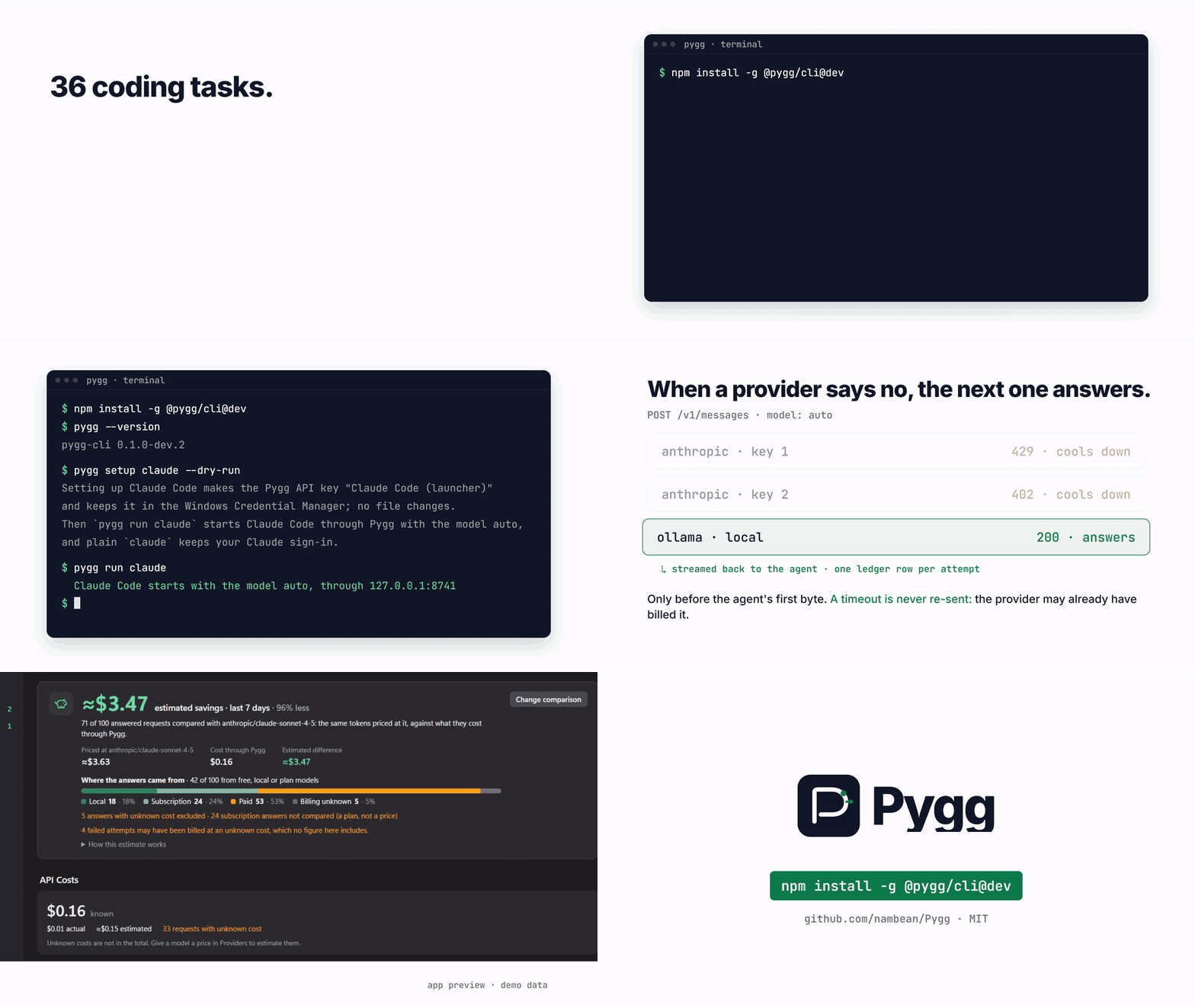
88% less per solved task in our benchmark, with every task still solved.







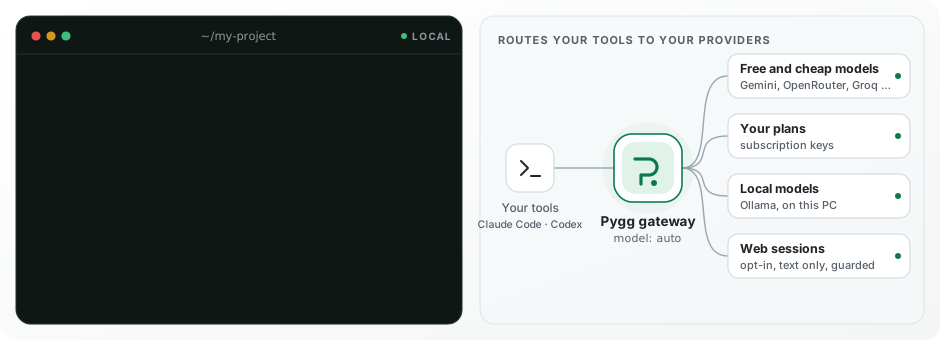
Pygg runs on your computer. Connect your providers once (API keys, coding plans, a local Ollama, even an AI website without an API), point Claude Code, Codex, OpenCode, an editor or an SDK at 127.0.0.1:8741, and choose the model auto. Each request goes to an eligible model you connected, free and cheap ones first where they qualify, within the limits you set; when a provider says no, the next one answers. Every attempt lands in a ledger with what it cost and where that figure came from.
[!NOTE]
Developer preview (2026-11-14). The gateway and the Windows desktop app are built and verified live, from first launch to "my coding tool usesauto". The Windows installer is a prerelease,v0.1.0-dev.1, not code-signed, so Windows SmartScreen warns before it runs. Thepyggcommand line is on npm for Windows, macOS and Linux. Spending limits rest on prices and token estimates, and clean-machine installs and long-running behaviour still need validation, so Pygg is not yet for unattended or financially critical use. What is built and how each part was verified: Implementation Status.
Why Pygg
autothat you can read. Rules over the models you connected, not a classifier: the lowest eligible tier at or above your key's minimum, at most five models in a route and at most two from one connection, so one empty account cannot end a request. Every response says why it chose what it chose, and How auto chooses simulates a route before you send anything.- Cost you can trace. Each attempt is recorded with its cost and that cost's source: actual (the provider said), estimated (a price you or a catalog set) or unknown, never shown as $0. Estimated savings compare the same tokens at a model you choose, and say what they left out.
- Fallback that does not double-bill. A 429, 402 or rejected key moves on to the next key or target, only before the agent got its first byte. A timeout stops instead, since the provider may already have billed it. Each attempt is written to disk before it is sent.
- The provider's cache keeps working. Anthropic requests from Claude Code pass through unchanged; for OpenAI-format agents such as Codex, Pygg turns on Anthropic's prompt cache. Measured: 30% less in all, 68% less on input (below).
- Several accounts, used in turn. A key ring holds API keys of separate accounts on one connection (in order, round robin, least used or quota aware); a pool groups connections of one provider. Each key cools down on its own.
- AI websites as providers, carefully. Web sessions (Muse, ChatGPT, Perplexity, DeepSeek, Grok) are opt-in and unofficial, signed in by you in Pygg's own window, and held behind a per-site guard: one request at a time, rests between them, a daily cap, longer rests after the site's own warnings.
- Local, with your own accounts. The gateway listens on 127.0.0.1 only and needs a Pygg API key; provider keys stay in the OS credential store. Each tool's setup is backed up first, and Remove puts it back.
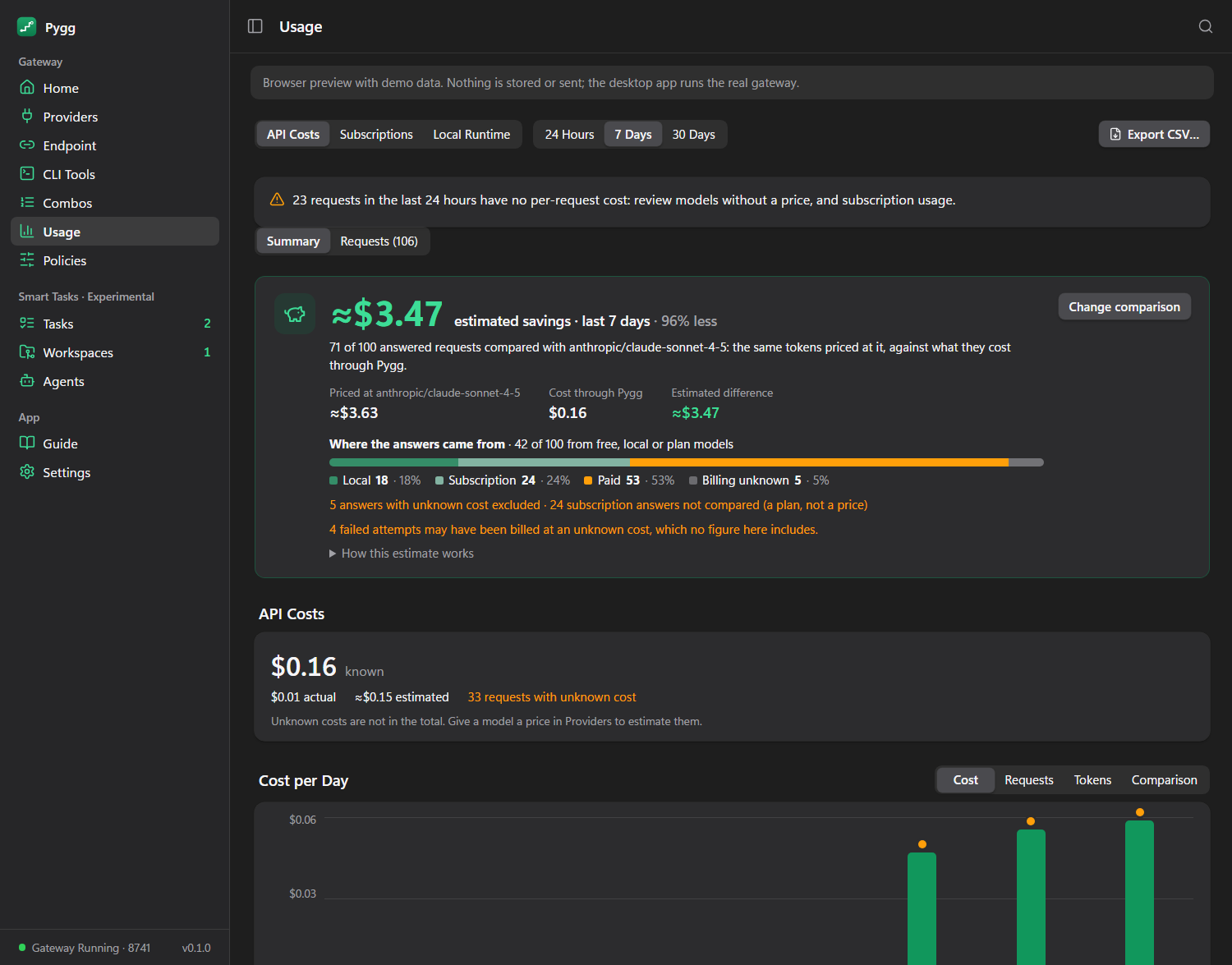
A look at the app
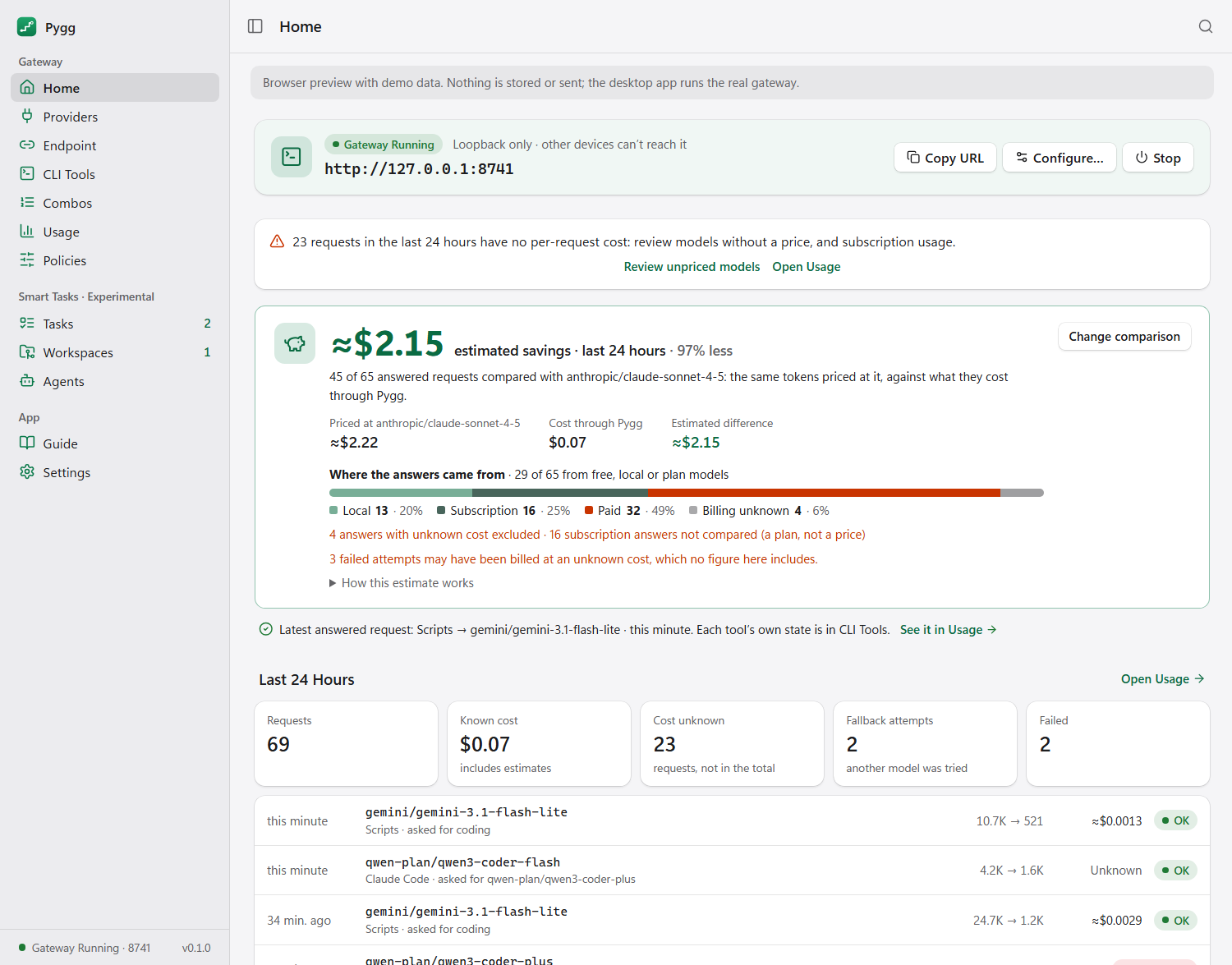
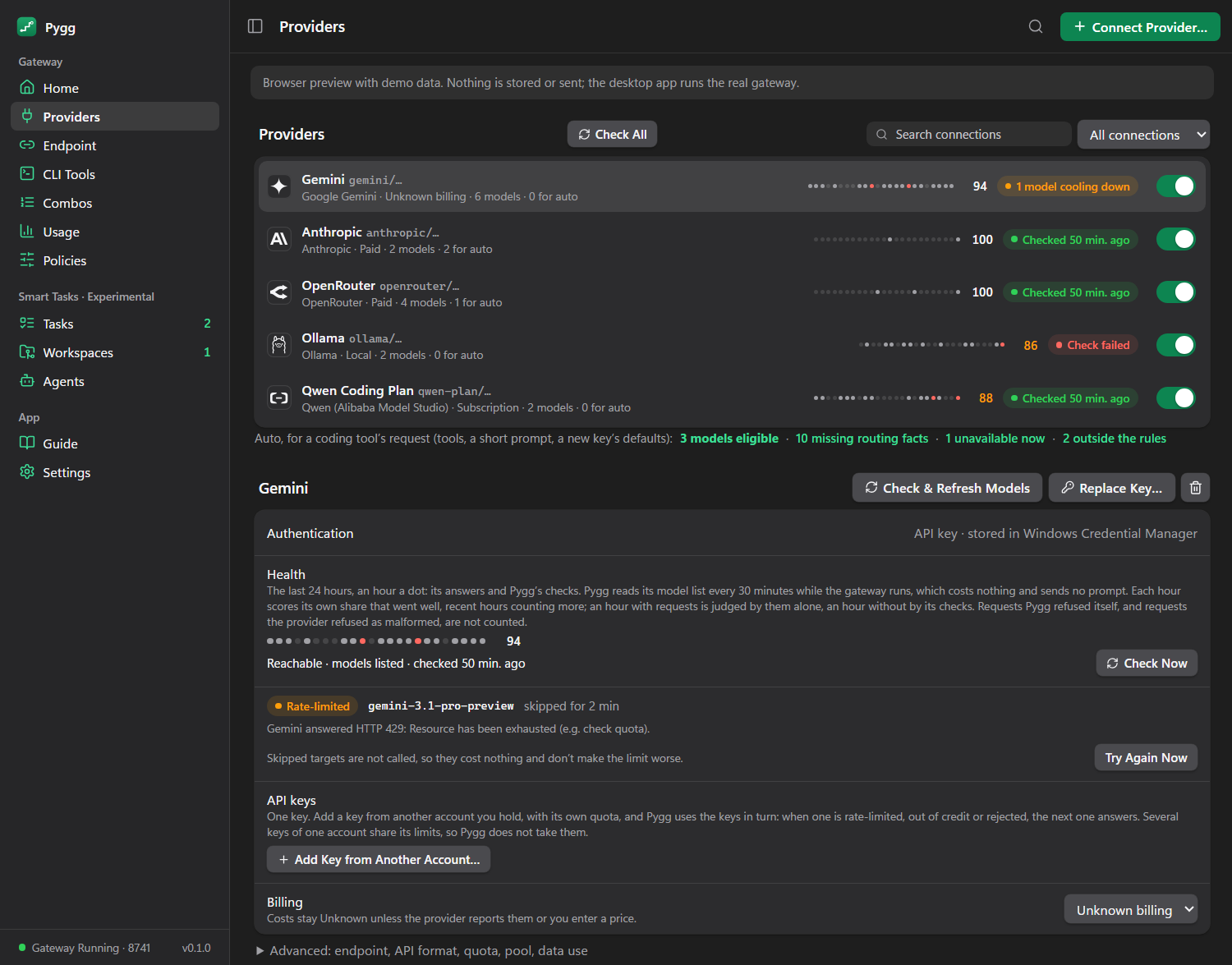
| Providers | Usage | CLI Tools |
|---|---|---|
 |
 |
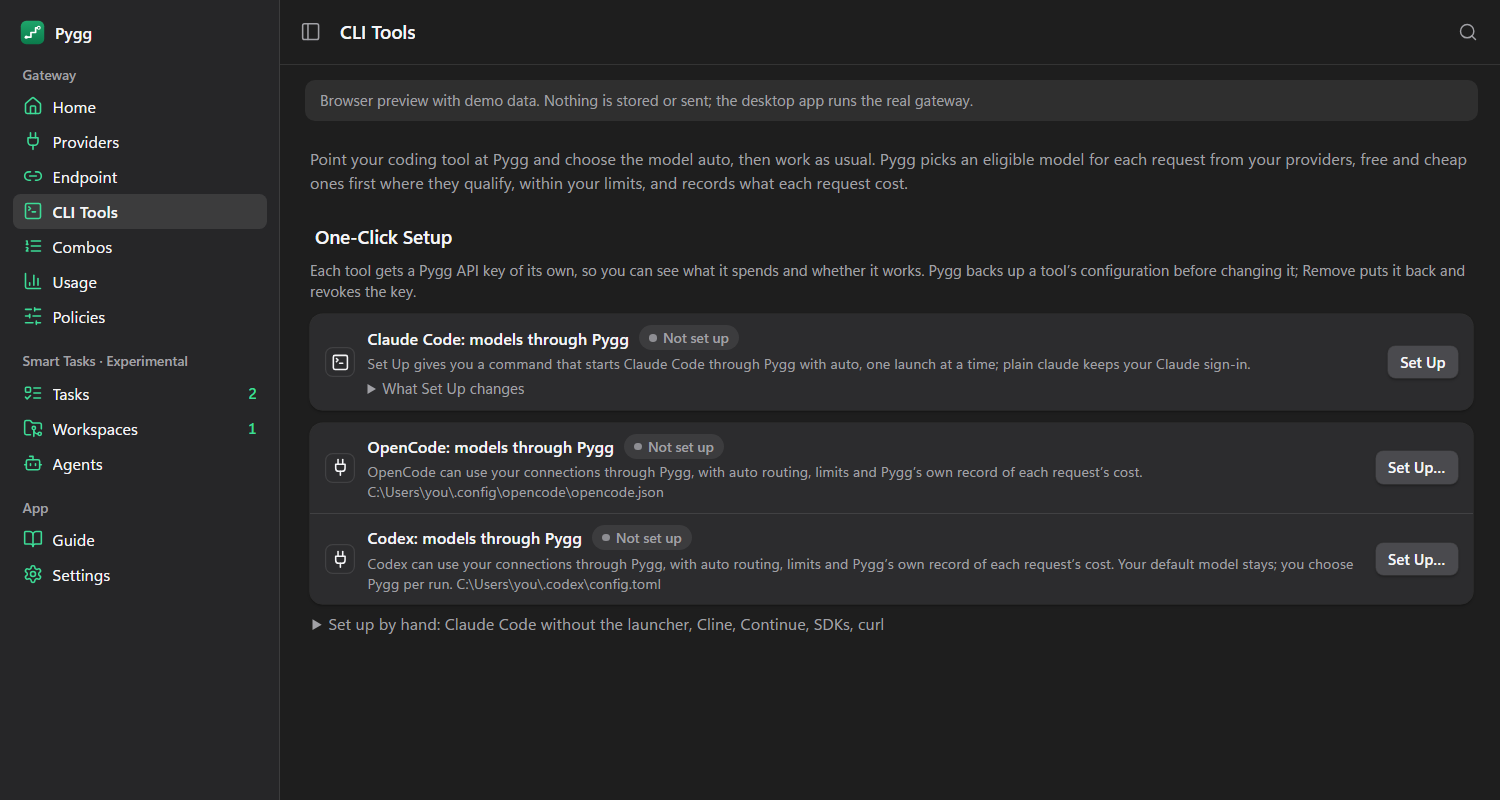 |
The browser preview with demo data (pnpm dev).
How a request flows
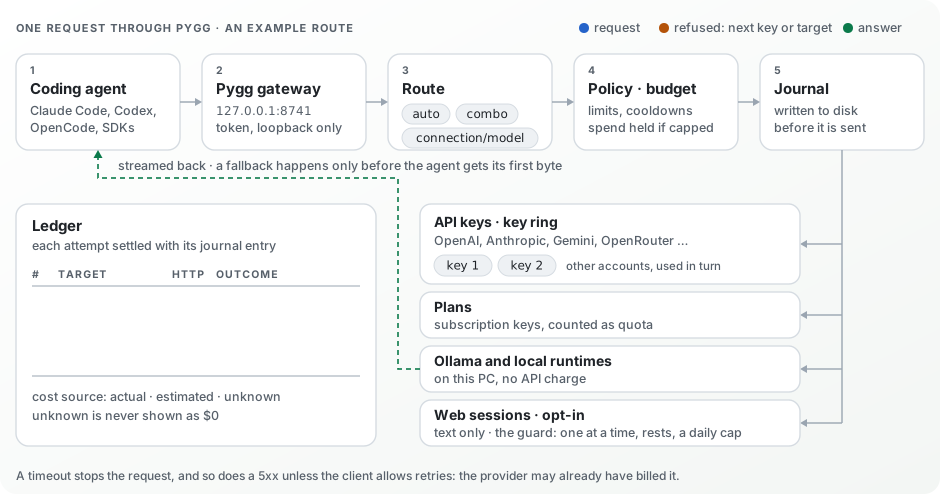
- Gateway. The agent calls
127.0.0.1:8741with its own Pygg API key, in OpenAI Chat Completions, OpenAI Responses (Codex) or Anthropic Messages, streamed, with tool calls. - Route. The model name is
autoorauto/cheap, a combo (a name for an ordered list, or cheapest first per request), a pool, or<connection>/<model>. - Policy and budget. The key's allowed connections, health and cooldowns, quota-group holds; a key with a monthly limit holds the attempt's estimated cost first, so concurrent requests cannot pass the limit together.
- Journal. The attempt is written to disk before it is sent, and settled with its ledger entry in one transaction.
- Send and fall back. Same format passes through untouched; other pairs are translated and say what they dropped. A 429 or 402 cools that key or model down for as long as the provider says, a rejected key (401) waits until you replace it, and the next key or target is tried.
The diagrams are generated by scripts/readme-diagrams.mjs and checked against apps/desktop/src-tauri/src/gateway/. More in Architecture.
Install
Desktop app (Windows 10/11 x64). It runs the gateway, holds your connections and shows usage. Download Pygg_0.1.0_x64-setup.exe (or the MSI) and SHA256SUMS.txt from the v0.1.0-dev.1 prerelease, then check the download before running it:
Get-FileHash .\Pygg_0.1.0_x64-setup.exe -Algorithm SHA256 # compare with the line in SHA256SUMS.txt
The installer is not code-signed, so SmartScreen says "Windows protected your PC": choose More info → Run anyway. It installs for the current user, with pygg-cli.exe next to the app. To build it yourself instead, see Development.
Command line (pygg), from npm (@pygg/cli):
npm install -g @pygg/cli@dev
0.1.0-dev.2 under the tag dev, for Windows x64, macOS (Apple silicon and Intel) and Linux x64 (glibc). On Windows the CLI uses the desktop app's store and gateway; on macOS and Linux, where there is no app yet, pygg gateway serve runs the gateway in a terminal of its own.
Quick start
Open Pygg, then Providers → Connect Provider and paste a key (Gemini, OpenRouter and Groq have free tiers; Ollama is local). Without the app, pygg gateway add-connection --preset gemini --key-env GEMINI_API_KEY reads the key from an environment variable. Then point your tool at Pygg:
Claude Code keeps your Claude sign-in; Pygg starts it through the gateway one launch at a time.
pygg setup claude          # a Pygg key of its own, kept in the credential store; no file changes
pygg run claude            # this launch through Pygg, model auto
Codex CLI gets a pygg provider and profile, after a backup; its default model is not changed.
pygg setup codex
pygg run codex             # or: codex --profile pygg -m auto/cheap
OpenCode gets a Pygg provider listing auto, auto/cheap and your enabled models, kept current.
pygg setup opencode
pygg run opencode          # then /models → Pygg → auto
Editors and SDKs (Cline, Continue, Roo Code, the OpenAI or Anthropic SDKs): base URL http://127.0.0.1:8741/v1, a key from Endpoint → API Keys, model auto.
Each setup takes --dry-run to show what would change and --remove to undo it. The same set-up is one click in CLI Tools. Step by step, with troubleshooting: Getting started.
Measured, not claimed
Real agents, real models, checks the agent cannot edit, about $16.7 of a $20 budget in all. Each report gives its method, raw results and what it does not show; read it before quoting a number. Summary: BENCHMARKS.md.
| What was measured | Result | Report |
|---|---|---|
| OpenCode on 12 harder coding tasks × 3, through Pygg to Claude Haiku 5.5 instead of Sonnet 5.5 | 88% less per solved task (95% CI 87–90%); 36/36 solved against 34/36 | N2 |
| Claude Code on the same tasks, Haiku 5.5 instead of Sonnet 5.5 | 79% less per solved task (95% CI 74–84%); auto/cheap with OpenCode: 34/36 at $0.0129 per solved task |
P0 |
| Claude Code on six tasks from a real production repository | Haiku 5.5: 6/6 for $1.50, 96% of input read from cache; Sonnet 5.5: 4/5 for $1.19; OpenCode with auto/cheap: 2/6 for $0.35 |
CCHT |
| Codex on Claude Haiku 5.5, Pygg's prompt caching off vs on | 16/16 either way; 30% less in all, 68% less on input | Prompt cache |
| The gateway's own overhead, against a local fake provider | About 4 ms per short request, 5 ms per 400 kB prompt; about 230 requests/s with 16 clients | Overhead |
| Web sessions on five sites, 48 short tasks | 47/48 correct, about 18 s each, $0 | Web sessions |
Not claimed: a quality ranking of models (a handful of tasks each), a provider's bill (costs are the ledger at list prices), or "60–95% fewer tokens". A longer web-session run on coding tasks got the owner's DeepSeek account suspended for three days (report); the guard has been stricter since.
Next to LiteLLM, measured with the same fake provider and requests (LiteLLM 1.106.2, defaults plus fallbacks; other projects compared from their docs in BENCHMARKS.md):
| When the primary provider… | Pygg | LiteLLM proxy |
|---|---|---|
| is rate-limited, out of credit or unreachable | 100% served, 1.04 provider requests each, ~70 ms | 100% served, 4 provider requests each, ~4.6 s (88 s with Retry-After: 30) |
| fails with 500 or drops the connection | 96% / 0% served: never re-sent unless you allow it (100% for a 500 with one retry allowed) | 100% served, after 3 attempts at the failing provider each |
| is Claude, reached by an OpenAI-format agent | 89.5% of the prompt read from cache, automatically | 0% by default; 89.5% (Chat Completions) or 39.7% (Codex's Responses API) with injection points configured |
| sits behind a key ring of several accounts | sessions stay on one key: 60 / 60 | 0 / 60 by default, 60 / 60 with affinity on |
Where Pygg is worse: about 230 requests/s on one PC (LiteLLM publishes 1,170 on four instances), no timeout fallback for a hung provider, and a 5xx or dropped connection reaches your agent as an error by default. Reports: resilience, tokens and cost, web guard.
What's inside
Coding agents ──HTTP──► Gateway 127.0.0.1:8741 (axum) ──► OpenAI- and Anthropic-compatible APIs, coding plans,
  Claude Code, Codex,     auth · route · policy · journal       local runtimes (Ollama …), web sessions (WebView2
  OpenCode, SDKs          translate · fall back · settle         windows behind the guard)
                                   │
       React UI ◄── Tauri ──► Rust core ──► SQLite store (ledger, journal, connections) · OS credential store
       pygg CLI ──────────────┘
- One Rust crate (Tauri 2): the gateway (axum), the SQLite store, the OS credential store, web-session windows, and the headless programs (
pygg-cli,gateway,pygg-mcp) built from the same library. - Interface: React 19, Vite and TypeScript, with a layout check over every screen in CI (
pnpm ui-check). - Skills & Prompts: one library of skills in the Agent Skills format, installed into Claude Code's, Codex's and OpenCode's own skills folders, and a count of what each agent sends with every request from its global files (ADR-039).
@pygg/clion npm: a Node launcher with one optional package per platform (ADR-037).- Smart tasks (experimental, on hold): IDE agents hand subtasks to Pygg over MCP; agent CLIs run them in Git worktrees against approved checks (AGENTS.md).
Is Pygg a fork of 9router?
No. Pygg is the same kind of tool as 9router: a local router that points your coding agents at the providers you already have. 9router was one of the inspirations for building the gateway first (ADR-016). Pygg's code is written from scratch in Rust; the one part that follows 9router is the Muse web-session recipe, credited under MIT in THIRD_PARTY_NOTICES.
Where they differ, read from 9router's documentation and source (not run here):
- Re-sending. 9router moves to the next model on a 5xx or a timeout; Pygg does not re-send a request the provider may already have run, unless you allow one retry.
Retry-After. 9router uses fixed cooldowns; Pygg waits as long as the provider says.- Prompt cache. Pygg keeps each session on one key by default (9router with its
smartstrategy) and adds Anthropic's cache marker for OpenAI-format agents such as Codex. - Cost. 9router's cost is "for tracking only"; Pygg records every attempt, fallbacks included, with where its cost came from.
- Web sessions. Both drive AI websites; Pygg holds each site behind a guard (one request at a time, rests, a daily cap) that cannot be switched off.
The full table, with LiteLLM, OpenRouter, OmniRoute and claude-code-router: BENCHMARKS.md.
Documentation
| Use | Getting started · Providers · Benchmarks · Security |
| Understand | Architecture · Decisions (ADR-001 to ADR-039) · Schema · Screens · Command line |
| Track | Implementation status · Roadmap · Benchmark reports |
| Contribute | Contributing · Code of conduct · Every document, indexed |
Only the app's data folder (app.smarttaskrouter.desktop) and its credential service name keep the engineering name SmartTaskRouter, so existing data stays readable. Brand assets are in branding.
Development
Requirements: Node.js LTS with pnpm 9 (corepack enable), stable Rust through rustup, and on Windows the Visual Studio C++ Build Tools and WebView2 (built into Windows 11).
pnpm install
pnpm dev                                              # the interface at http://127.0.0.1:1431 with demo data (?empty for a first run)
pnpm --filter @pygg/desktop tauri:dev     # the desktop app with the real gateway
pnpm typecheck
pnpm --filter @pygg/desktop tauri:build   # the installers, under apps/desktop/src-tauri/target/release/bundle
pnpm ui-check                                         # every screen at several window sizes, nothing overflowing
cd apps/desktop/src-tauri; cargo test --lib --tests   # core, gateway, web-session and task engine tests
node scripts/readme-diagrams.mjs                      # regenerate the README's animated diagrams
PYGG_DATA_DIR points the app at another store, for trying it without touching your own.
Licence
MIT, see LICENSE. Third-party code and data are listed in THIRD_PARTY_NOTICES.md.
Yorumlar (0)
Yorum birakmak icin giris yap.
Yorum birakSonuc bulunamadi