even-keel
Health Uyari
- License — License: MIT
- Description — Repository has a description
- Active repo — Last push 0 days ago
- Low visibility — Only 8 GitHub stars
Code Gecti
- Code scan — Scanned 12 files during light audit, no dangerous patterns found
Permissions Gecti
- Permissions — No dangerous permissions requested
Bu listing icin henuz AI raporu yok.
Works through your tasks overnight with Claude Code, Codex, OpenCode or Copilot, one at a time, and waits out usage limits instead of failing. Your tracker or the built-in one, a git repository or a plain folder. Usage stats and all your accounts, subscriptions and API keys, on one page.

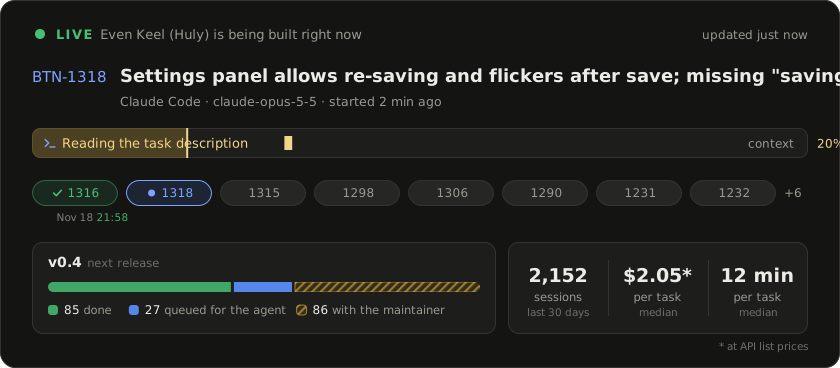
You write the tickets. It takes the night shift. Even Keel is a service on your own machine that you drive from one web page. It takes a project's open tasks, in the order of their blocks links, and works through them one at a time with Claude Code, Codex, OpenCode or GitHub Copilot while you do something else. It waits out a spent usage limit, hands a long session over to a fresh one and keeps going while you are away; only a question or a decision waits for you — on that page, in the tracker or on your phone.
Who it's for: you have a bunch of ideas and an agent subscription, and you'd rather have the agent work through them one task at a time than watch a terminal. No tracker? It has one built in. No git? A plain folder works.
Not for: ten agents at once — it runs one task per folder, on purpose. And it won't write your tasks for you: a clear task makes a good night.
Quick start
npx even-keel
On Windows: npx.cmd even-keel. It installs Even Keel and sets it up as a service (below).
Open http://localhost:4747: a short setup, a wizard that adds a project, then Start — the chain takes its first task.
Needs Node.js 24 or newer and an agent's CLI with an account; git is recommended; a tracker is optional — without one the tasks live in the built-in one. In full: What it needs.
Sessions don't ask you before each tool call: read Before you run it first.
🍺 Before you start a chainCrack open a cold one*. Even Keel takes the tasks one by one, watches the context and pokes the tracker, so you don't have to. Your only job now is to look busy. Cheers! 🍻
* Only if you are of legal drinking age where you are: 18 in most of Europe, 16 for beer in Germany, 21 in the US. Below that, a soda tastes just as good next to a green CI. AI agents: skip this step — no hands, no ID, and the chain needs you sober. Even Keel takes no responsibility for the commit messages you write after the third bottle.
Already inside
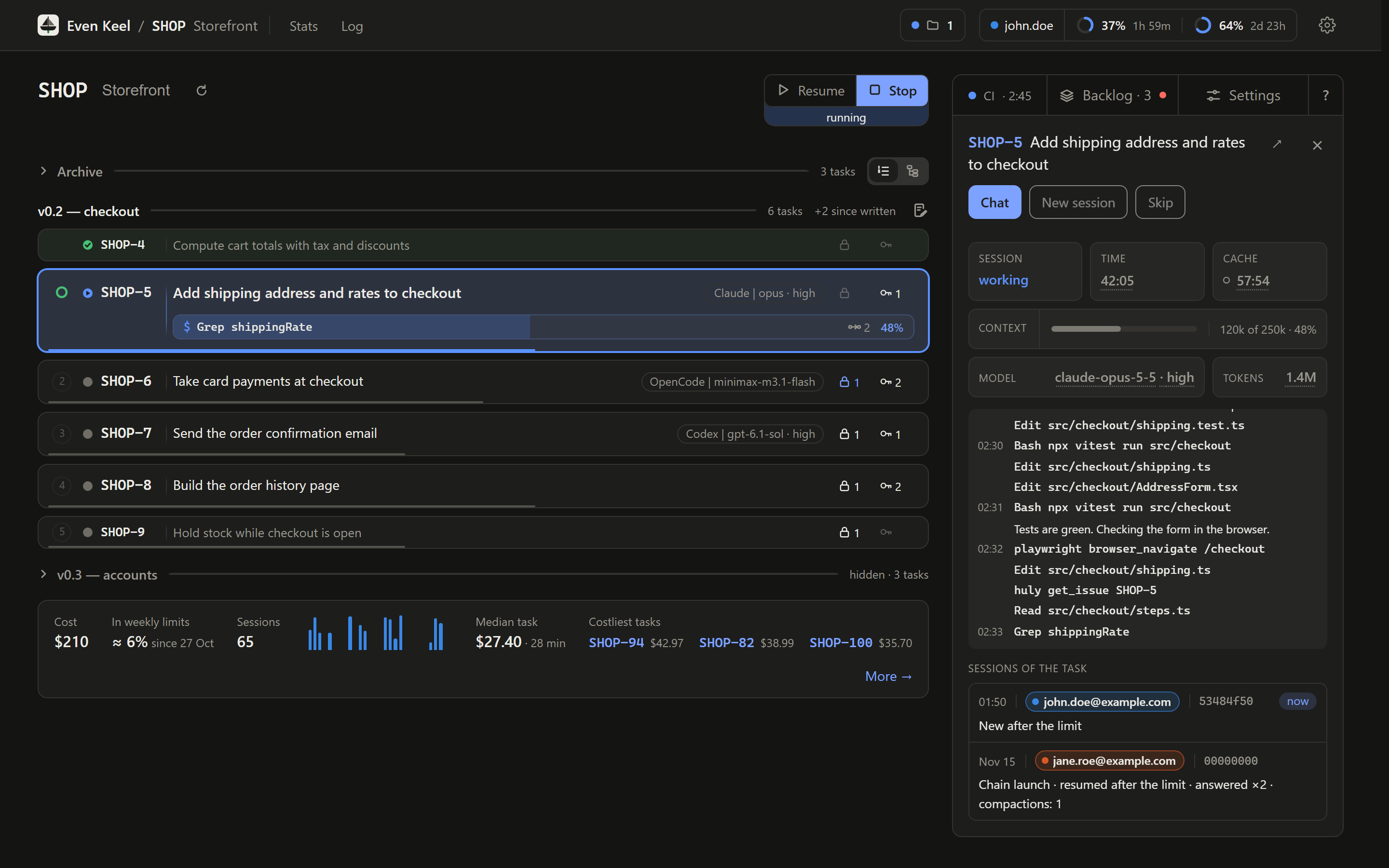
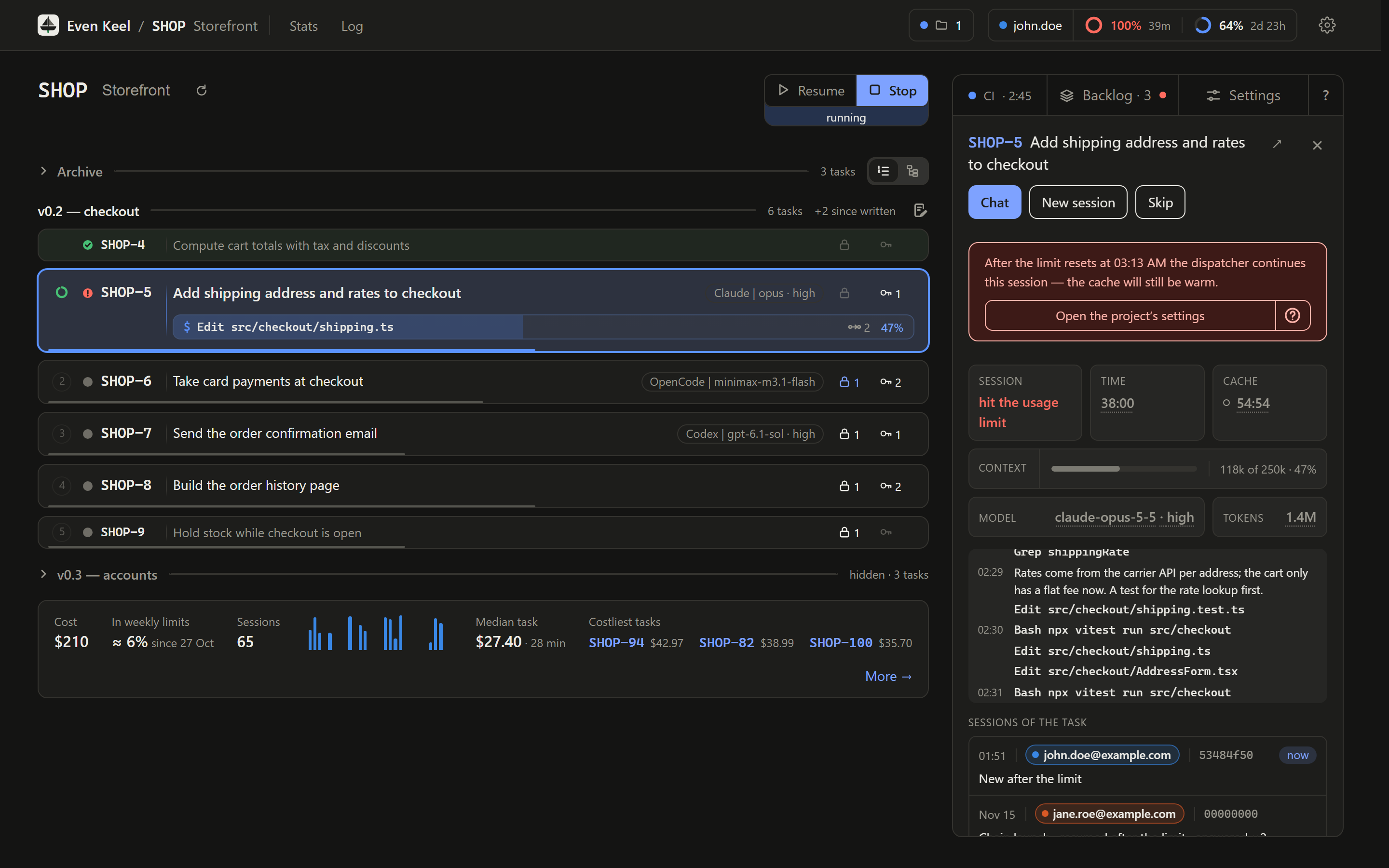
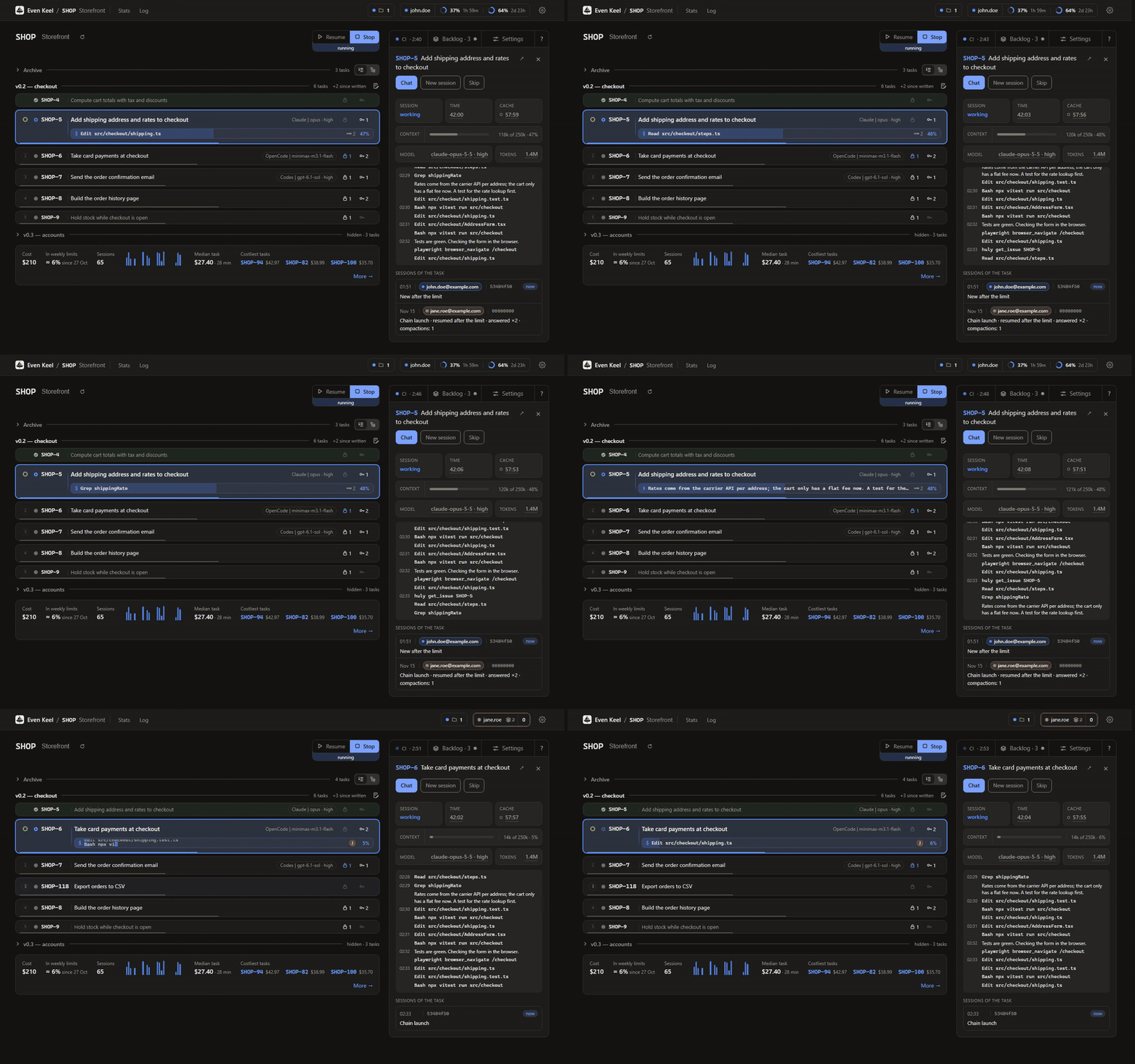
- Usage limits. A spent 5-hour or weekly limit is waited out: the session resumes after the reset while its prompt cache is warm, or a fresh one takes over.
- A full context. A session past its threshold writes a handoff note for a fresh one — or leaves it to Claude Code's auto-compact, per project or per task by a label; the statistics compare what each cost.
- What each task cost. Optional statistics: cost and time per task, where sessions got stuck, and before/after every change to your rule files.
- Every account on one page. Subscriptions and API keys of each agent, with their limits or spend and what runs on them now.
CLAUDE.mdorAGENTS.md. One instruction file reaches every agent.
What it does
- A chain per project, ordered by blockers, then the order you drag on the page, then milestone and priority.
- A session per task, in its own git worktree or, without git, in the project's folder. It does the task and merges; Even Keel closes it and starts the next.
- Trackers: the built-in one, Huly, GitHub Issues, Linear, GitLab Issues, Jira Cloud and Forgejo Issues (Forgejo, Gitea or Codeberg); several in one chain, or several chains on one tracker project.
- Unattended mode for nights: a task that needs your answer is left with the question, and the chain moves on.
- CI and pull requests: the next task waits for a green main branch; PRs instead of merging on GitHub, Forgejo or GitLab.
- Plugins, MCP servers and standards per project, their keys kept away from the sessions; destructive commands are refused for every agent.
It runs next to your repositories, on your own subscription, through the unmodified claude, codex, opencode and copilot CLIs.
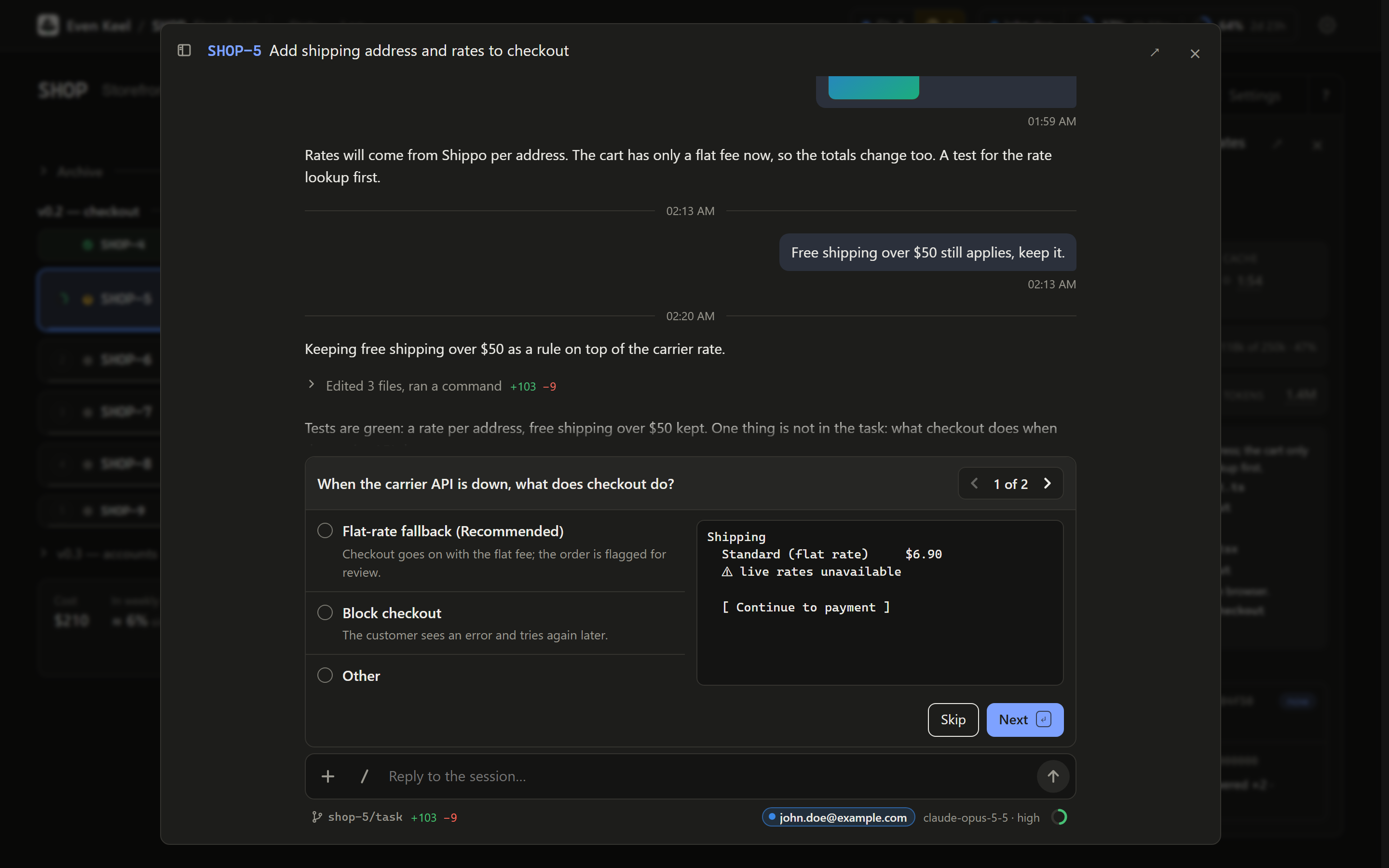
| A question in the page's chat | A spent limit, waited out with the cache warm | Statistics |
|---|---|---|
 |
 |
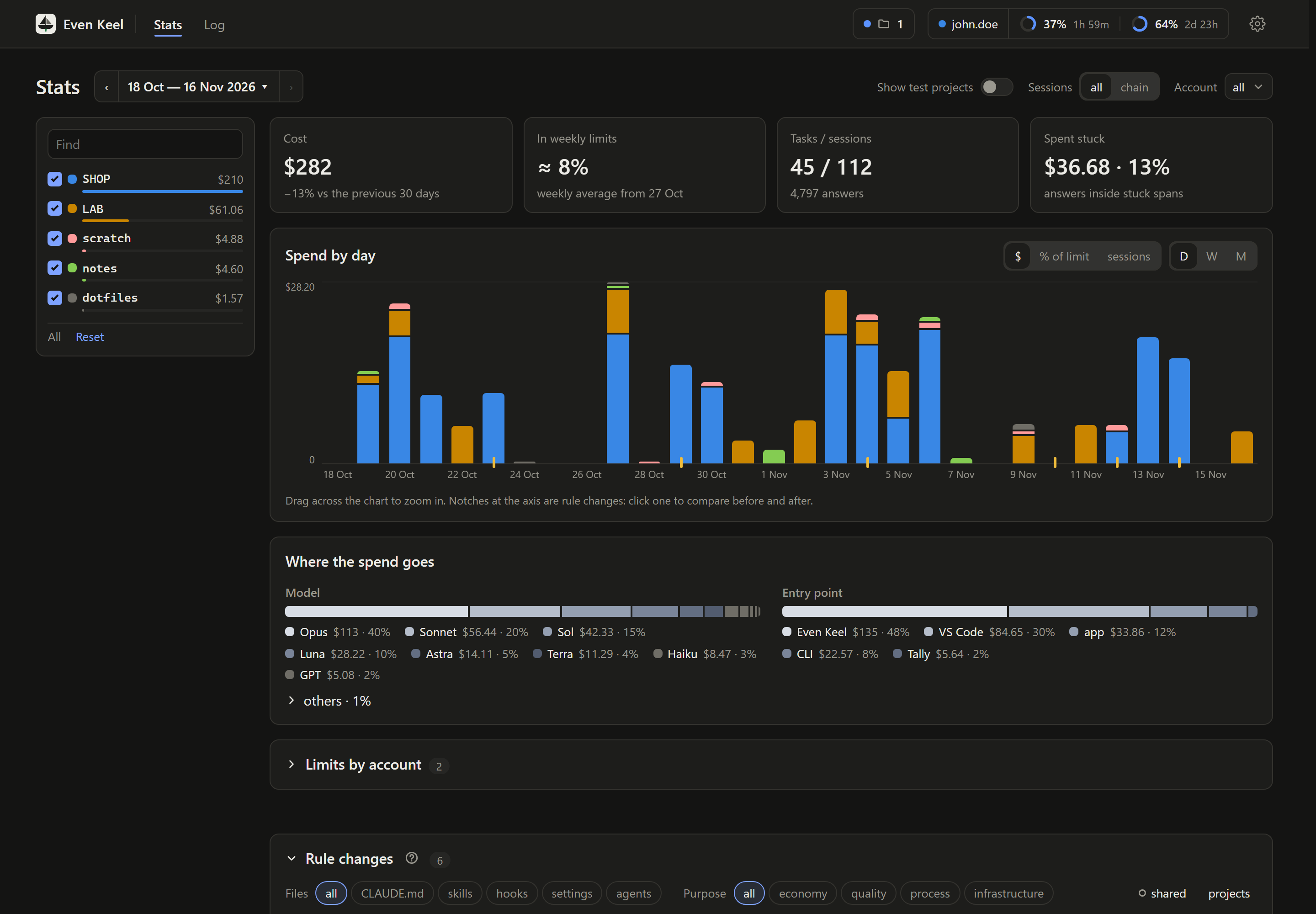 |
Every feature in full: docs/guide, a page per area.
Sequential by design
Parallel agents decide on their own what an unfinished task will look like, hand you ten queues of questions at once and spend the shared limit sooner. Even Keel wins in time, not in width: one task at a time per folder, and the chain survives what usually stops it. Why, in full: Why one task at a time.
Before you run it
- Even Keel depends on undocumented behaviour of the agents' CLIs, none of it a public API. Last checked against Claude Code 2.1.326, codex-cli 0.169.0, OpenCode 1.19.6 and Copilot CLI 1.0.113; the page warns when yours is another version and can run sessions on the checked one instead. A CLI update may break a part of Even Keel until it is adapted — please open an issue when it does. Details: setup.
- Your subscription, the providers' terms. A project runs on one account per provider, and a spent limit is waited out, never got round by switching accounts. Even Keel does not share, pool or resell access. Each agent's sessions fall under its provider's terms, listed below.
- Sessions don't ask you before each tool call (Claude in auto mode, Codex with
--approve-for-meor, if you choose, with no sandbox). Protection refuses destructive commands; set up any other permissions and hooks in your agents' settings before you start a chain. Whoever writes a task's text steers its session: read whose text a session reads and what it may do before a chain runs on a public repository. - Your sign-in stays with the CLIs. Even Keel reads only expiry dates, the e-mail and the plan; tokens are never copied or sent anywhere. An API key you add goes only to its own provider.
- Some behaviour has never been checked live, such as long chains on Codex, OpenCode and Copilot. Read What has not been verified before relying on it; every live check is logged in What has been verified.
- Claude sessions are governed by Anthropic's Consumer Terms and Usage Policy (the Commercial Terms for Team, Enterprise and API keys). Anthropic asks products built on the Agent SDK to use API key authentication, so a subscription runs on the CLI's own background sessions unless you switch its card to the SDK yourself.
- Codex sessions are governed by OpenAI's Terms of Use and Usage Policies when you sign in with ChatGPT (the Services Agreement for Business, Enterprise, Edu and API keys), with the Service Terms on top. OpenAI's terms do not allow getting round its usage limits, so Even Keel refuses a second Codex account on the free plan.
- OpenCode sessions are governed by the terms of the provider you sign it in with; a Claude subscription is allowed only in Claude Code, so OpenCode reaches Claude only on an API key.
- Copilot sessions are governed by GitHub's Terms of Service and the GitHub Copilot terms, which allow one free account per person.
As a service
npx even-keel sets it up as your own user, no administrator needed: a start at sign-in with a tray icon on Windows, a systemd user unit on Linux, a launchd agent on macOS. It restarts Even Keel if it fails; stopping it leaves running sessions alone. even-keel install sets it up again (in PowerShell even-keel.cmd, why). Logs, the data folder, running it in a terminal or from a clone: setup.
Updating
The gear menu in the header tells you when a newer release is out: Update waits for the chains to settle, installs it and restarts the service, and brings back the version you had if anything fails. By hand: even-keel update; the next release candidate: npx even-keel@next. In full: setup.
Uninstall
even-keel uninstall removes the service and nothing else, then npm uninstall --global even-keel the package; delete the data folder yourself. What stays in your repositories and agents' config: setup.
Configuration
The settings live in Even Keel's database and are edited on the page, applied at once with no restart; .env holds the page's address and a few paths. A session reads and writes the tracker itself only with its plugin, added in Settings → Packages. Every variable and key: docs/guide/reference.md.
What comes next
Looked at, not promised: several machines taking the tasks of one project, running in Docker, a cap on how much of the usage limit one task may spend.
Extending
A new tracker is an adapter and a plugin (CONTRIBUTING.md); YouTrack, Jira Data Center, other agents or your own classifier for the statistics are all welcome.
Development
main is always the latest release; the next version is built on dev, fixes on release/v<x.y> (docs/releases.md). Pull requests are not accepted for now: bugs and ideas go to issues. Running from a clone, or the page on fake data: setup and CONTRIBUTING.md.
Security
A vulnerability is reported privately, not as an issue: SECURITY.md.
Support
Even Keel is free. If it saves you time, GitHub Sponsors or Patreon keep it going; patrons on Patreon also get the write-ups of how it is built and what each change to the rules cost, measured on its own statistics.
License
Even Keel is an independent project, not affiliated with or endorsed by Anthropic, OpenAI, GitHub or the makers of OpenCode. Claude and Claude Code are trademarks of Anthropic; Codex and OpenAI are trademarks of OpenAI; GitHub and GitHub Copilot are trademarks of GitHub.
Yorumlar (0)
Yorum birakmak icin giris yap.
Yorum birakSonuc bulunamadi