nanoflow
Health Uyari
- License — License: MIT
- Description — Repository has a description
- Active repo — Last push 0 days ago
- Low visibility — Only 8 GitHub stars
Code Basarisiz
- process.env — Environment variable access in cli/src/e2e/fake-gh.mjs
- spawnSync — Synchronous process spawning in demo/common.mjs
- process.env — Environment variable access in demo/common.mjs
- spawnSync — Synchronous process spawning in demo/director.mjs
- exec() — Shell command execution in demo/fake-github.mjs
- process.env — Environment variable access in demo/fake-github.mjs
Permissions Gecti
- Permissions — No dangerous permissions requested
Bu listing icin henuz AI raporu yok.
Run Claude Code tasks in parallel without losing track: each in its own worktree and ports, followed from ticket to PR to CI to teardown. By nanosite.ai
🌳 nanoflow
Run Claude Code tasks in parallel without losing track.
by nanosite.ai


Run many tasks at once with Claude Code, each in its own git worktree on its own ports, and see all of
them at a glance: which ticket, which branch, which PR, whether CI is red, what's running, what's ready to
tear down.
Install · What you get · The CLI · Config · CLI reference
The problem
Coding agents made parallel work cheap. You start a session per task, each in its own worktree, and an
hour later you have six of them. Then you're lost:
- Which terminal is working on which ticket? Which worktree is on port 5193?
- Is the PR for #712 open? Did its CI go red while you were in another session?
- Which worktrees are merged and just sitting there holding 1 GB of
node_modulesand a port? - The agent spends half its turns re-deriving the same
gh/git/curlrituals, and gets them wrong.
nanoflow keeps ticket → worktree → branch → ports → PR → CI → teardown connected, shows it live inside
Claude Code, and turns every ritual into one deterministic command.
✨ What you get
A live dashboard pane
/nanoflow opens a pane next to your session:
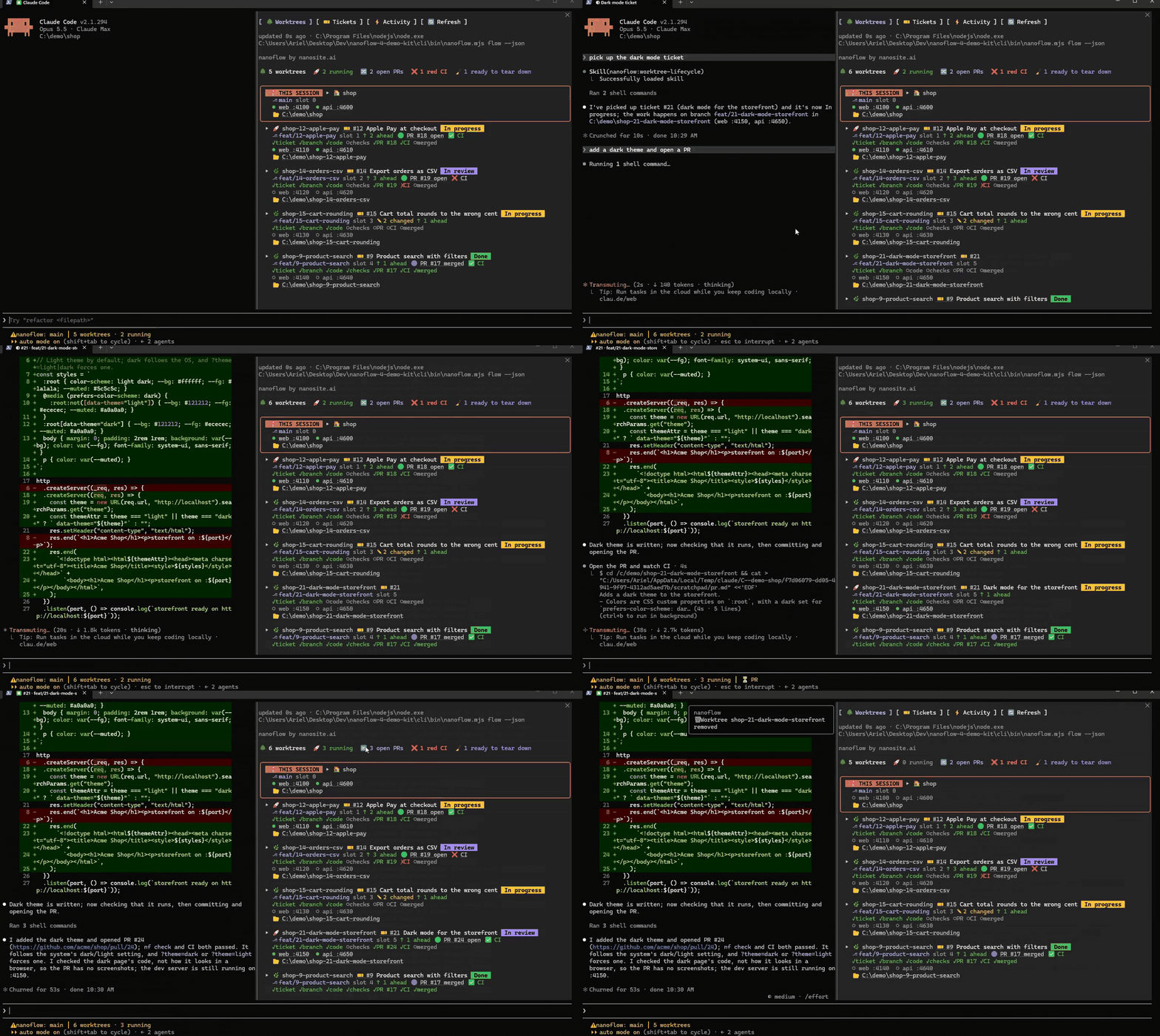
- Your session's worktree is framed and badged, so you always know where this agent is.
- Everything is a link: the ticket, the PR, the failing CI run, each running service, the worktree folder.
- Select a worktree for actions: ▶ Start dev, ■ Stop, 🌐 Open app, 🔀 Open PR, 📋 Copy path, and
🧹 Teardown (offered once its PR is merged, and it asks first). - Tickets tab: your board's Ready / In progress / In review columns. ▶ Start a ticket (the agent runs
the kickoff), jump to the worktree already on it, or create a new one. - Activity tab: the last 50 moments, linked.
A status line that tracks the task
#712 Sites go offline… │ ✓ticket ✓branch ✓code ✓checks ✓PR #713 ✗CI ○merged │ 8 worktrees · 2 running │ ⏳ tests
Toasts on every moment that matters
Worktree created or removed · a service came up (with its URL) or went down · PR opened, merged or
closed · CI turned green or red · ticket closed · tests, typecheck, lint, e2e passed or failed · a red
test turned green (your bug repro now passes) · a skill loaded · the Playwright browser opened, saved a
screenshot, closed · and after a merge: "Tear down app-712-site-offline? Close the browser and delete your
screenshots too."
Dev skills
Bundled with the plugin, written for agents, and they use the CLI:
| Skill | What it makes the agent do |
|---|---|
worktree-lifecycle |
ticket first → worktree → work → PR → CI → merged → teardown with your approval |
fix-bug |
reproduce with a failing test at the lowest layer, name the root cause, fix, watch it pass |
pr-screenshots |
verify visual changes in a real browser (Playwright MCP), attach before/after to the PR |
wrap-up-summary |
end every task with one scannable status footer |
🚀 Install
1. The Claude Code plugin (dashboard, status line, toasts, skills):
/plugin install nanoflow --marketplace nanosite-ai/nanoflow
2. The CLI (optional but recommended; the pane works without it, from plain git + gh):
npm install -g @nanosite/nanoflow # gives you `nanoflow` and the short `nf`
3. In your repo:
nf init --board <org>/<project-number> --team   # writes .claude/nanoflow.json; --team offers the plugin to teammates
nf doctor                                       # checks git, gh auth, config, board
Edit the services in .claude/nanoflow.json (ports and start commands), commit .claude/, and you're done.
With --team, everyone who trusts the repo in Claude Code is offered the plugin automatically.
Requirements: git, the GitHub CLI (
gh auth login; add-s projectfor
boards), Node ≥ 20.12 for the CLI. The dashboard, status line and toasts use Claude Code mods
(function-hook plugins), which are rolling out; on a build without them, the CLI and the skills still
work on their own.
🔌 Ports per worktree, one shared database
Each worktree gets a slot. The main checkout is slot 0; every service's port is base + slot × step:
| Service | Slot 0 (main) | Slot 1 | Slot 2 | Slot N |
|---|---|---|---|---|
| web | 5173 | 5183 | 5193 | 5173 + 10N |
| api | 3001 | 3011 | 3021 | 3001 + 10N |
nf wt create (or nf task start) picks the next free slot, copies your gitignored files (.env…) from
the main checkout so secrets and the database are shared, writes the slot's ports into them, and
records the slot. nf up exports the slot's env (PORT, VITE_PORT, API_URL… whatever you map) and
waits until each service answers. So two branches run side by side on one machine against the same data.
Need a branch with its own database (say, a divergent migration)? Map it in that worktree's copied.env, e.g. DATABASE_URL=…/app_712. Or for every worktree: "env": { "worktree": { "QUEUE_PREFIX": "jobs-{feature}" } } keeps shared queues apart. Per-worktree databases are on the roadmap.
⚡ The CLI: fewer tokens, fewer mistakes
An agent doing a ritual by hand runs five to fifteen tool calls: look the issue up, find the board item
id in a 1,000-item JSON dump, set the column, create the worktree, copy and patch the .env files, pick a
free port, install, rename the session, comment on the issue. Each call costs tokens twice (the command
and its output), and each is a chance to get it wrong.
nf task start 712 is one call with a six-line answer.
This comes from our own monorepo, where nanoflow started as an in-house CLI. Before it existed, in two weeks
of agent sessions we counted:
- 226 hand-rolled board edits, 39 of them failed (missing
jq, wrong owner, empty id); - 167
curlpolling loops waiting for a dev server to come up; - session titles skipped so often that nobody could tell the terminals apart.
nf board set, nf up --bg (waits until the app answers) and nf task start replaced them: written once,
tested, the same every time.
| Why it helps an agent | How |
|---|---|
| Small outputs | nf check prints one line per check and only the tail of a failure. nf ci --watch --failed-log waits without a poll loop and returns only the failing steps. nf pr comments returns unresolved threads, one line each. |
| One call, not ten | task start, pr create (push + valid title + Closes #N + screenshots + board + title), wt remove (stop processes, delete, prune, branch). |
| Never blocks | No prompts without a TTY. A command that needs a yes fails fast and names --yes. |
| Parseable | --json on every command; progress goes to stderr. |
| Safe | --dry on everything that writes. wt remove refuses uncommitted or unpushed work. Teardown and anything destructive need an explicit yes. |
| Cross-platform | Windows, macOS, Linux; npm/pnpm/yarn shims and Windows file locks handled. |
| Cheap on GitHub | nf flow reads every worktree's ticket, PR, CI and the board in one GraphQL query. |
The commands
| Ritual | Command |
|---|---|
| Start a task (issue → In progress → worktree → title → comment) | nf task start <issue#> · nf task start --new "<title>" |
| A ticket for later | nf ticket new "<title>" --type bug --definition "…" |
| Board columns | nf board list [ready] · nf board set <issue#> in-review |
| Worktrees | nf wt create · nf wt list · nf wt remove <name> --delete-branch · nf wt clean |
| This slot's ports and env | nf env |
| Run the app on the slot, wait until it answers | nf up --bg · nf status · nf logs <svc> · nf kill |
| The repo's checks, condensed | nf check [typecheck test …] |
| Open the PR | nf pr create --body-file pr.md --shots before.png after.png |
| Screenshots onto a PR | nf shots <pr#> <files…> --attach |
| CI | nf ci --watch --failed-log · nf ci --rerun-failed |
| Review comments | nf pr comments · --reply <id> --body "…" |
| PR merged | nf task done |
| Everything at once | nf flow (--json is the dashboard's feed) |
| The wrap-up footer | nf summary --what "…" --next "…" |
Full reference: docs/cli.md.
🧪 Tests, e2e and screenshots
nf checkruns whatever you map ("checks": { "typecheck": "…", "test": "…", "e2e": "npx playwright test" }).- The plugin recognises test runners (vitest, jest, pytest, go test, cargo test,
npm test…),tsc,eslintandplaywright testwith no config, and toasts each pass or fail. A check that goes from red
to green raises "now passes". - Playwright MCP sessions are tracked: opening, screenshots, closing. At teardown you're reminded to close
the browser and delete local screenshots. --shotsputs screenshots on one orphan branch (assets/pr-screenshots/pr-<n>-<slug>/) and embeds them
in the PR body. They render inline (private repos too) and never enter the merge diff.
🧩 Works with
| Languages / frameworks | Any. Services are just a port + a start command. |
| Package managers | npm, pnpm, yarn, bun (detected by nf init). |
| Tickets | GitHub Issues + GitHub Projects (v2) boards: titles, columns, PRs, CI. Jira/Linear: links via ticket.urlTemplate. |
| OS | Windows, macOS, Linux. |
| Your own CLI | Already have a dev CLI? Make it print the provider contract and the dashboard uses it instead. |
⚙️ Configuration
One committed file, .claude/nanoflow.json, read by both the plugin and the CLI. Everything is optional.
{
  "$schema": "https://raw.githubusercontent.com/nanosite-ai/nanoflow/main/nanoflow.schema.json",
  "github": { "board": { "owner": "acme", "number": 3 } },
  "services": [
    { "name": "web", "base": 5173, "step": 10, "open": true, "start": { "run": "npm run dev", "cwd": "apps/web" } },
    { "name": "api", "base": 3001, "step": 10, "path": "/healthz", "start": { "run": "npm start", "cwd": "apps/api" } }
  ],
  "env": {
    "export": { "VITE_PORT": "{port:web}", "API_URL": "{origin:api}" },
    "files": { "apps/api/.env": { "PORT": "{port:api}" } }
  },
  "worktree": { "copy": [".env", "apps/api/.env"], "install": "npm install" },
  "checks": { "typecheck": "npm run typecheck", "lint": "npm run lint", "test": "npm test" },
  "provider": { "snapshot": ["nanoflow", "flow", "--json"], "local": ["nanoflow", "flow", "--json", "--local"] }
}
Every field, the placeholders and the pane's action buttons: docs/config.md.
🗺️ Roadmap
- Per-worktree databases (create / drop with the worktree).
- Linear and Jira ticket titles and status.
- Agent-session awareness: which Claude Code session is in which worktree, across terminals.
🤝 Contributing
Issues and PRs welcome. Layout: the plugin is the repo root (hooks/, types/, skills/), the CLI iscli/. We build nanoflow with nanoflow: the repo's own .claude/nanoflow.json drives nf task start,nf check and nf pr create, and the dashboard shows our worktrees while we work.
nf checkruns everything: the CLI's typecheck and tests,claude plugin validate .andclaude plugin test ..npm testincli/builds, then runs the unit tests, the--help/docs checks and the end-to-end suite:
the whole task lifecycle on a throwaway repo with a real service and a fakegh, so it never touches
GitHub.NANOFLOW_GH=<script.mjs>is the hook that swapsghfor the fake.- CI runs both on Linux, macOS and Windows for every PR.
New CLI commands need --help examples (a test enforces it), --json output and --dry before side
effects. Regenerate the reference with nf docs --write.
Made by nanosite.ai
nanoflow is built and used daily by nanosite.ai. It grew out of the CLI and rituals
we use to run many agent sessions in parallel on our own monorepo, and we open-sourced it so you don't have
to rebuild it. Questions, ideas, war stories: open an issue.
License
MIT © nanosite.ai
Yorumlar (0)
Yorum birakmak icin giris yap.
Yorum birakSonuc bulunamadi