agent-roast
Health Gecti
- License — License: MIT
- Description — Repository has a description
- Active repo — Last push 0 days ago
- Community trust — 10 GitHub stars
Code Basarisiz
- rm -rf — Recursive force deletion command in action.yml
- process.env — Environment variable access in benchmarks/cases.mjs
Permissions Gecti
- Permissions — No dangerous permissions requested
Bu listing icin henuz AI raporu yok.
Stops AI coding agents from making the build green by weakening tests, coverage gates or CI. Stop hook for Claude Code, Codex and Cursor, pre-commit, GitHub Action. Offline, no tokens.
Your AI agent made the tests pass.
Did it fix the code, or the tests?



agent-roast catches the changes that turn a red build green by weakening the checks instead of fixing the code: a
loosened assertion, a skipped or deleted test, a lowered coverage threshold, a CI step allowed to fail. A linter cannot see
these, because every new line looks fine on its own. agent-roast compares the before and after of each change, as an
agent hook, a Git hook and a pull request check. It is deterministic and offline: no model, no tokens, no network.
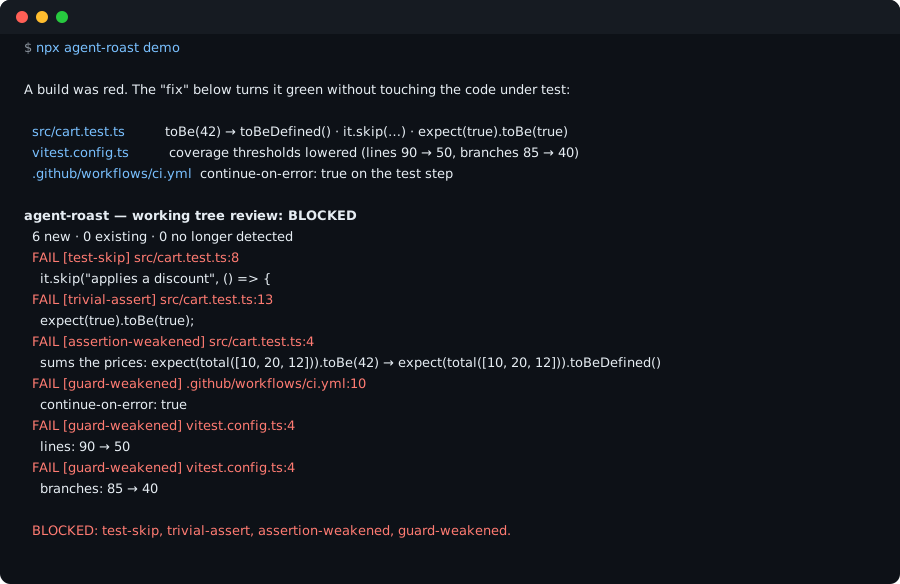
Real output of npx agent-roast demo, shortened. The scenario is scripted; the review is not.
Try it
npx agent-roast demo     # ten seconds: a scripted example in a temporary repository, nothing of yours is read
npx agent-roast          # review what you have not committed yet (on a clean tree: replay your last commits)
Stop your coding agent from doing it
npx agent-roast hook install # Claude Code, Codex and Cursor
For Claude Code there is also a plugin: /plugin install agent-roast --marketplace Nari-Ab/agent-roast.
When the agent is about to finish, agent-roast reviews everything it changed. If a check got weaker, the agent is sent back
once, with the file, the line and the before and after, and told to fix the code instead. If it tries again, you get a
warning rather than an endless loop. Anything agent-roast cannot check lets the agent finish: it never breaks a session. An
intended change is accepted by committing it. Setup for each agent, what it does not do, and how to pause it:
docs/integrations.md.
The agent hooks follow each agent's documented hook protocol and are tested with simulated hook input, not yet in long live
sessions with every agent. Reports of what you see are welcome.
Check every pull request
# .github/workflows/agent-roast.yml
name: Agent Roast
on: pull_request
permissions: { contents: read, pull-requests: write }
jobs:
  audit:
    runs-on: ubuntu-latest
    steps:
      - uses: actions/checkout@v4
        with: { fetch-depth: 0 }
      - uses: Nari-Ab/agent-roast@v1
        with: { comment: true }      # one comment, updated on every push; add `advisory: true` to try it without failing PRs
Also: npx agent-roast review --base origin/main in any CI, npx agent-roast init --hook or the
pre-commit framework for the next commit, and SARIF output for code scanning.
Policy is read from the base branch, so a pull request cannot switch off the rules that review it. Before you decide,npx agent-roast replay shows what it would have said about your last 50 commits.
What it catches
| Rule | Fires when | By default |
|---|---|---|
assertion-weakened |
an exact check is replaced by a weaker one: toBe(42) → toBeDefined(), assert x == 1 → assert x |
blocks |
guard-weakened |
a coverage threshold is lowered, strict is switched off, a lint rule is downgraded, a CI step may fail, a workflow stops running tests |
blocks |
test-skip |
a test is switched off: it.skip, @pytest.mark.skip, t.Skip, #[ignore], @Disabled, [Ignore], xit, ... |
blocks |
test-focus, trivial-assert |
.only / fit; expect(true).toBe(true) and its relatives in ten languages |
blocks |
assertion-removed, test-removed, expectation-rewritten |
a test loses assertions, disappears, or its expected value is edited next to production code | warns |
swallowed-error, type-escape, stub-abandonment |
catch {} / except: pass, as any / # type: ignore, throw new Error("Not implemented") |
warns |
Renames, moved tests, parametrization, moved assertions and reformatting are recognized and not reported, and neither is a skip
that depends on the environment (if testing.Short() { t.Skip() }, test.skip(isMobile, ...)). JavaScript/TypeScript, Python
and Go get the full before/after comparison; skips and placeholder assertions also cover Rust, Java, Kotlin, C#, Ruby, PHP and
Swift; CI and config files are checked whatever the language. Each rule with examples and limits: docs/rules.md.
Configure
Rules, severities and paths live in .agentroastrc.json at the repository root (npx agent-roast init writes a starting file):
{
  "failOn": ["assertion-weakened", "guard-weakened", "test-skip", "test-focus", "trivial-assert"],
  "rules": { "type-escape": "off" },
  "ignorePaths": ["**/generated/**"]
}
A change cannot edit this file to relax its own review, because it is read from HEAD or the base branch. To accept one
intentional finding, add an expiring exception instead of turning a rule off, and adopt an existing project without blocking on
old debt with a baseline: docs/reference.md.
Does it work?
Measured, with the denominators and the caveats in docs/benchmarks.md. Weakened checks are rare, mostly
deliberate, and not specific to AI. agent-roast is a tripwire that stays silent until a check gets weaker.
- 64 of 64 hand-labeled cheating edits are caught and 44 of 44 harmless look-alikes (reformats, moves, raised
thresholds, environment-gated skips) stay silent. The cases were written with the detector, so they guard against regressions;
they do not prove accuracy. Three gaps are documented and still open. - 12,645 commits that touch tests or CI/config in 166 public repositories: blocking rules fired on 0.3% of AI-signed commits
(Claude, Copilot, Cursor, Codex, Devin, aider) and on 0.3% of the others. Inside the same repositories the odds for an
AI-signed commit were 0.81 times those of another commit (95% CI 0.40–1.67). There is no sign that AI-signed commits weaken
checks more often. - About one finding in five was a false alarm, and most of the rest were deliberate, explained changes a reviewer should
see rather than mistakes. The labels come from one reader (an AI assistant), so treat them as a first estimate. replayran on 179 public repositories that use coding agents: no commit would have been blocked in 149 of them.
How it compares
TDD Guard and Probity enforce a process (tests first) through agent hooks; aislop scans for broad "AI slop" across 11
languages; hallucinot, fakegreen and SlopGate look at diffs for the same shortcuts; linters and coverage gates see the current
code but not that a check got weaker. agent-roast narrows to one question, reads the full before and after, and says how it was
measured. Most of these tools are complementary. docs/comparison.md has the details.
Safe to run on code you do not trust
- Offline. No network request, no model call, no telemetry; a test inspects the bundle for network modules.
- Reads, never runs. It reads Git objects (or regular files inside the repository for
--worktree) and never executes
project code, hooks, diff programs or package scripts. Reports escape control characters. - Policy from the trusted side. The rules come from
HEADor the base branch, not from the change under review. - Honest about gaps. An incomplete scan exits 2, never "clean". SECURITY.md says how to report a problem.
It is a review aid. It cannot prove who wrote a change or that code is correct, and it reads text, not program meaning.
Documentation
Rules · Integrations · Reference (commands, exit codes,
configuration, exceptions, baselines, limits) · Comparison · Measurements ·
Try it on your repository · Contributing · Changelog
Found a finding that was wrong, or a shortcut it missed? That is the most useful report there is:
open an issue.
License
MIT. Created by Nariman Abdukarimov.
Yorumlar (0)
Yorum birakmak icin giris yap.
Yorum birakSonuc bulunamadi