court-vision
Health Uyari
- License — License: NOASSERTION
- Description — Repository has a description
- Active repo — Last push 0 days ago
- Low visibility — Only 5 GitHub stars
Code Gecti
- Code scan — Scanned 12 files during light audit, no dangerous patterns found
Permissions Gecti
- Permissions — No dangerous permissions requested
Bu listing icin henuz AI raporu yok.
Multi-sport forecasting platform: CV player tracking from broadcast video, calibrated win-probability models across 4 sports, leak-guarded walk-forward validation, pre-registered claims ledger, and a documented reject graveyard. Calibration rigor, not edge claims.
CourtVision -- calibrated multi-sport forecasting: computer vision, walk-forward validation, and a receipt-cited analytics product
Two measured results, each against a stated baseline. Conditioning a win-probability
forecaster on the realized mid-game state cuts Brier from 0.209 to 0.159 (NBA) and
0.241 to 0.126 (MLB) -- leak-free, out-of-sample, on real corpora. The NBA player-prop
stack scores PTS MAE 4.83 / REB 1.92 / AST 1.39 / FG3M 0.89 on a 20,354-row chronological
holdout, scored through the production inference path and re-measured byscripts/verify_production_mae.py, which exits nonzero if any stat drifts more than 0.02.
Both are calibration and sharpness, not a dollar edge -- a live book sees the same realized
state and scores the same. Provenance for every number in this README:
docs/JOB_EVIDENCE_PACKET.md.

The badge re-runs every analytics module's own --check self-verification (check_all.py)
on a bare clone -- committed-artifact verification only, no private data; it proves the receipts
re-verify, not that any claim beats a market. Latest committed run: 77/77 PASS
(scripts/platformkit/analytics_showcase/out/check_all_report.json). Reproduce it yourself:
REPRODUCE.md.
Start here: CourtVision Analytics -- the Reading Room
Live: neeljshah.github.io/court-vision/analytics
An editorial analytics publication for five sports where every number on the page carries the
artifact path it was read from. Nothing is hand-typed, nothing is asserted, and a null result is
printed as a finding rather than hidden. What is actually there:
- 74 analytics modules and 1,549 entity atlas cards, rendered as 1,618 static pages -- the
module catalog, per-entity cards, explainers, and the forecaster
(scripts/platformkit/analytics_showcase/out/site_manifest.json:module_count: 74,atlas_card_count: 1549). - 6 novel stats, each gated against prior art before it is allowed a name
(novel_stats_index.json): Line Half-Life (NOVEL_PACKAGING), Live-Clock Fraction
(INCREMENTAL_NOVEL), Overreaction Harvest Gap (NOVEL_SELF_CRITICAL_CROSS, published as an
honest null), plus Load-Bearing Index, Market Foresight Premium, and Schedule Fatigue Tax
(INCREMENTAL). Every card ships its formula, its source artifacts, andedge_claimed: false. - Scout, the on-page AI, in three honest tiers. (1) Scout notes attached to each module;
(2) Ask Scout -- a 236-entry precomputed corpus (webapp/public/data/ask/corpus.json) that
answers from receipts and returns a visible NO_DATA when it has none, rather than improvising;
(3) connect your own Claude to the MCP server for the live tools. No LLM sits on the page, and
no question leaves your machine. - A self-grading claim ledger. 259 claim families tracked forward: 121 verified, 99 null,
28 not-testable, 7 retracted, 4 provisional across 287 ledger rows, with 5 families flagged as
having flipped verdict (fwd_claim_scoreboard.json). The mechanism ledger reads the same way --
130 confirmed / 126 null / 31 not-testable of 287 (mechanism_ledger_export.json).
121 verified findings survived 259 tracked claim families, each carrying its artifact path
and its verdict. Publishing the 99 nulls and the 7 retractions alongside them is the credential:
a ledger that only ever confirmed would be a marketing document, not a measurement.
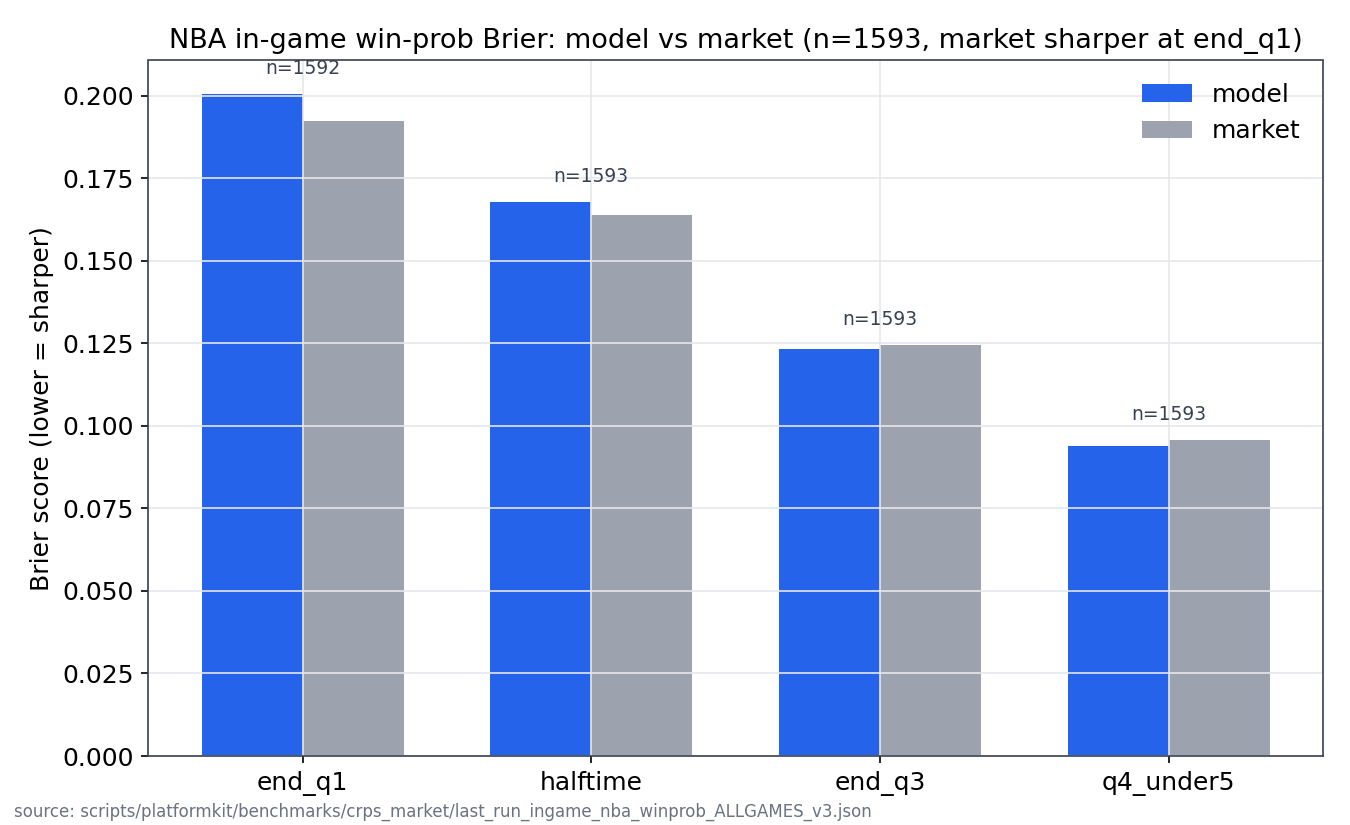
The measured win the product is built around: in-game conditioning
Conditioning on the realized game state is the one calibration result that clears every honesty
rail: Brier drops sharply and leak-free, out-of-sample, on real corpora -- NBA 0.209 -> 0.159,
MLB 0.241 -> 0.126 (edge_claimed: false). The end-of-Q3 projection heads add a leak-clean
~26% MAE lift over a naive carry-forward baseline. (The separate endQ3 win-probability
figure is a known Q4 leak and is retracted -- it appears only in
docs/KNOWN_LIMITATIONS.md, never as a live result.) A live book sees the same
realized state, so this is forecaster quality, not a dollar edge. Full proof and framing:
docs/INGAME_PROOF.md.
The engine underneath
The publication is a read-out of one calibrated prediction engine. It is wide: NBA, MLB, club
soccer, the World Cup, and tennis, every one speaking the same predict / to_jd / predict_live
interface, every market (moneyline, totals, spreads, 1X2, BTTS, correct-score, player props,
alt-line ladders, same-game-parlays) priced off one calibrated anchor. It is deep: under each
team number sits a per-player projected distribution, a ~190-feature prop stack across 23 feature
blocks -- each block annotated with the walk-forward result that kept or killed it -- 44
player/team "atlases", playstyle archetypes, and a possession-level Monte-Carlo simulator whose
teammate correlation emerges at rho ~= -0.10, matching realized, replacing a prior simulator's
hand-tuned +0.65. And it is
honest: pregame it matches the Shin-devigged closing line within sampling noise on
team-strength markets across six independent corpora (NBA/MLB moneyline, soccer O/U-2.5) --
the honest ceiling against an efficient market, and it never beats it. On totals and ATP it
trails, and the gap is freshness (injury / lineup / weather / park / starting pitcher) the
market sees and a public-data model cannot. In-game, conditioning on the realized state makes
its own Brier much lower, while the distributional tests against the in-game market stay
UNDERPOWERED / PROVISIONAL.
No dollar edge, ROI, or "beat the close" is ever claimed -- candidates are tiered by evidence
and proven only by forward closing-line value (CLV).
Built by Neel Shah -- solo human architect and director of an
agentic build pipeline. Engineering judgment, ship/reject decisions, and the validation methodology
are mine; the commit author on most of the history is the build harness identity (GSD Executor),
which is exactly what an agent-directed pipeline looks like from the outside --
docs/BUILT_WITH_CLAUDE.md is the full account, and the runtime
prediction path contains no LLM at all.
Open to ML / data / quant / founding-engineer roles. US citizen, no sponsorship needed,
available anywhere in the US or fully remote.
Resume (PDF) -
Portfolio -
[email protected]
How the whole brain works together
Everything is one funnel, and every stage feeds the next. A model change in one place
propagates coherently to every market through a single seam.
  DATA            keyless, leak-free ingest across 5 sports (ESPN, MLB StatsAPI, Sackmann,
   |              football-data, prediction markets, DFS prop feeds) -> as-of-stamped parquet
   v
  SIGNALS         leak-safe per-entity features + priors: team ratings (MOV-Elo / EW-Poisson /
   |              surface-Elo / serve-hold), per-player per-exposure rates, 44 atlases, archetypes
   v
  MODELS          one CALIBRATED win-probability per sport (the anchor) + per-player count
   |              distributions (Poisson / Negative-Binomial, dispersion-calibrated)
   v
  ENGINES         JointDistribution (coherent score matrix) + the possession Monte-Carlo sim
   |              (emergent teammate correlation) + the live repricer (conditions on realized state)
   v
  PREDICTIONS     ONE seam -> the full market surface: ML / totals / spreads / 1X2 / BTTS /
   |              correct-score / player-prop ladders / SGP -- pregame and in-game, coherent
   v
  INTELLIGENCE    the edge-intelligence corpus + the proving spine: every candidate edge tiered
                  hypothesis -> calibration-proven -> CLV-proven; cut where markets are efficient
The cohesion is the point: one win-probability anchors the moneyline, the spread, the total,
and the in-game reprice -- they are coherent reads off the same engine, not four independent
models that can disagree. Pregame and in-game agree at tip-off by construction. Adding a sport
is an adapter, not a kernel rewrite; adding a market is a read off the same anchor.
Product 2: the quant terminal
The original dark operator surface -- scoreboard, evidence spine, receipts drill, graveyard,
counterfactual and microstructure labs -- is still live at its original URLs
(neeljshah.github.io/court-vision) and now serves
the operator, not the visitor. Same artifacts, same honesty rails, denser presentation.
Verify it, and use it with YOUR Claude
The proof harness is the first thing to run: every analytics module carries its own --check
self-verification and check_all.py runs all of them on a bare clone -- 77/77 PASS in the
committed report, committed artifacts only, no private data.
This repo also ships a working MCP server — clone it, connect it to Claude Code
or Claude Desktop, and ask in plain English: scouting reports, comparables,
matchup previews, atlas cards, verified-claim receipts. Every answer is a typed
envelope (ok / no_data / not_supported / refused) with a source_artifact
and as_of — it reads a committed artifact or fails closed; it never answers
from model memory and never claims a dollar edge. A fresh clone ships the 9
fail-closed tools + JSON manifests (atlas cards, mechanism ledgers, refusal
rules all work bare); the private data/ lake is gitignored, so the data-backed
tools honestly return NO_DATA until you build it — an honest NO_DATA is the
correct answer, not a failure.
Connect in 5 min: docs/MCP_QUICKSTART.md · per-tool reference: docs/MCP_TOOLS.md · deeper start: docs/USE_WITH_CLAUDE.md · reproduce the harness: REPRODUCE.md
Explore the whole system, link by link
docs/INDEX.md is the full map -- every tracked document, by role and by funnel
stage, from the raw feeds through the models, the simulator, the calibration gates, execution, the
live repricer, and the self-improvement loop. It is deep on purpose.
- New here? -> docs/INDEX.md (the map) and the GLOSSARY
(CLV, leak-free, walk-forward, Shin devig, Brier, Kelly, ...) - Want the honest numbers first? -> docs/JOB_EVIDENCE_PACKET.md
- What's actually strong (in-game accuracy, calibration-only)? -> docs/IN_GAME_SHOWCASE.md
- Want the guided demo path? -> docs/PRODUCT_DEMO.md
- How AI built it? -> docs/BUILT_WITH_CLAUDE.md
- Subsystem deep-dives -> DAEMONS - PLATFORM_HARNESS -
PAPER_TRADING_STACK - INGEST_PIPELINES -
DATA_DEPTH - ASK_SURFACES -
SPORTS_COVERAGE
What it predicts
| Sport | Pregame market surface | Per-player props | In-game reprice |
|---|---|---|---|
| NBA | moneyline, total, spread/margin | pts/reb/ast/3pm/stl/blk + PRA + DD + SGP | end of Q1 / Q2 / Q3 |
| MLB | moneyline, run-line, total | K / hits / TB / walks / outs / ER ... | after inning 3 / 5 / 7 |
| Club soccer | 1X2, O/U-2.5, BTTS, correct-score, Asian handicap | shots / SOT / fouls / cards / saves ... | half-time |
| World Cup | 1X2 (neutral-site), O/U-2.5, BTTS, correct-score | shots / SOT / fouls / fouls-drawn / saves | live minute-by-minute |
| Tennis | match-win, games O/U, sets, holds | (aces buildable; feed-gated) | after set 1 |
Every output is a calibrated probability or a point forecast with dispersion -- never a
recommended wager. The buyer-facing CLI stamps "edge_claimed": false on every response.
NBA 2025-26 season coverage. games.parquet carries all 1,156 scheduled games of the
2025-26 season; per-player boxscores now cover the FULL season -- 74 games from the original
quarter-level cache plus 1,082 games backfilled from ESPN full-game summaries into the samequarter_box cache the pipeline already reads (q0 = full-game totals, q1-q4 = real quarters,
zero downstream transform changes). The season's canonical shooter leaderboard claim is
produced and independently VERIFIED on this corpus.
Ask it what kind of shooter someone is. Not a ranking -- a ten-axis trait vector
(volume/efficiency/difficulty/gravity/context), each axis citing its own VERIFIED claim, never
combined into one score:
python -m scripts.platformkit.intel_query.ask "what kind of shooter is Stephen Curry"
# or directly:
python -m scripts.platformkit.intel_query.compose_profile "Luka Doncic"
Ask how the paper book is doing. Streamed off the live paper ledger (never whole-file
loaded), every answer paired with its channel's fail-closed greenlight verdict so a units figure
never appears without its gate status:
python -m scripts.platformkit.intel_query.paper_analytics "this week by channel"
python -m scripts.platformkit.intel_query.paper_analytics "settlement backlog"
Wide in knowledge -- and it knows every little detail
Breadth (wide). Five domains share one interface and one validation gate. A keyless, free,
idempotent, leak-free backbone refreshes all five (~93 MB of as-of parquet) -- MLB StatsAPI
boxscores, ESPN rosters + athlete season splits, Sackmann tennis, football-data, prediction
markets (Kalshi / Polymarket), DFS prop feeds (Underdog / PrizePicks). The opportunity surface is
bounded by data breadth, not model breadth: one best-line / Shin-devig / EV / arbitrage core
covers every event the feeds return.
The claims scale. Every derived stat the brain answers from must pass an independent validator
that marks it VERIFIED, MISMATCH, or UNVERIFIABLE -- 101,089 VERIFIED claim rows stand
behind the ask surfaces today (71 claim stores, 7 sports, tallied from every *_validation.json
under data/cache/intel_claims/). A machine-readable data census inventories 67 derivable
families across NBA, MLB, soccer, soccer_intl, tennis, WNBA, NPB, KBO and cross-sport markets, and
ranks every still-UNBUILT one by leverage_rank into the queue the autoloop builds from.
Per-sport breakdown: docs/SPORTS_COVERAGE.md.
Depth (every little detail). Under each team number sits the individual-player layer:
- Per-player projected distributions. Not a point estimate -- a full count distribution per
player per stat (per-exposure rate x expected exposure -> Poisson/Negative-Binomial), so it
prices the entire alt-line ladder ("over 0.5 / 1.5 / 2.5 ... shots", "10 vs 30 points") and
the joint structure behind a same-game parlay, not just one line. - A ~190-feature NBA prop stack (rolling form, opponent defense, pace, rest/B2B, shot-zone
tendencies, on/off, synergy play-type PPP, referee tendencies, schedule hardship, ...): 10 wired
feature blocks plus 7 candidate blocks, each candidate carrying its recorded leak-free
walk-forward SHIP/REJECT verdict (docs/models/feature-inventory.md). - 44 "atlases" (28 player + 16 team: usage role, pace fit, matchup splits, vs-scheme splits,
rest/B2B splits, spacing gravity, clutch shape, foul-drawing, ...) -- a deep descriptive +
correlation asset. - Playstyle archetypes, never people -- striker / winger / holding-mid / keeper; power-hitter
/ contact-hitter / strikeout-pitcher; high-usage creator / 3-and-D wing / rim-runner;
big-server / grinder / returner -- so the shrinkage prior knows what a role typically does. - A coherent possession Monte-Carlo simulator whose teammate correlation EMERGES correct from
a shared scoring pie (measured rho ~ -0.10 vs realized) instead of a hand-tuned matrix -- one
~3-4s GPU run prices the whole prop / combo / SGP surface coherently. This is the one thing a
marginal prop model structurally cannot do.
Player props + the edge hunt (honest)
The deepest, most actionable part of the brain is the player-prop engine, and it is where the
search for genuine edge concentrates -- precisely because that is where edge can plausibly
exist.
The thesis (load-bearing). Sharp mainline markets (moneyline / spread / total on liquid
sports) are efficient pregame: leak-free and out-of-sample, nothing beats the Shin-devigged close,
which is a few thousandths sharper on every row (the measured table is in
the thesis section below
and in docs/MARKET_EFFICIENCY_PROOF.md). That is the expected
honest outcome, not a failure.
In-game is different -- and honestly labelled. Against the in-game market, the
distributional (CRPS) checkpoint tests read slightly model-favorable at some late-game
checkpoints but carry UNDERPOWERED / PROVISIONAL verdicts at today's sample sizes. Two things are
explicitly untested: performance against instantly-updating live lines at real tick latency
(all comparisons use captured price series, not live execution), and forward paper
excess-vs-close, which at n=36 settled is NOT SIGNIFICANT (CI includes zero). The beatable
pockets the brain hunts are different in kind: lazily-priced soft / DFS player props, live /
in-game lag, stale lines on slow books, prediction-market vs sportsbook divergence, and
correlated SGPs a coherent sim can price but a book misprices -- and it cuts effort where it
has proven there is no edge.
How a prop edge is found, end to end: scrape the soft DFS / book line -> build the player's
full distribution from leak-free history (empirical-Bayes shrunk to the role archetype, blended
with a club-season prior) -> price every rung of the ladder -> compare to the offered line ->
rank by EV -- and then label it by evidence tier and prove it before trusting it:
- HYPOTHESIS -- a plausible mispricing, not yet measured (most candidates start here).
- CALIBRATION-PROVEN -- the model's P(over) is sharper than the line out-of-sample, leak-free
(Brier-skill-score > 0). Genuine, claimable. - CLV-PROVEN -- forward closing-line value accrues on paper at meaningful sample size. The bar
for real money -- and the only thing that ever justifies a dollar claim.
A too-tight distribution would fabricate fake edges, so the brain calibrates dispersion (NB where
counts are over-dispersed), demotes any stat it has measured to be weak, and ranks proven-stat
edges above raw-EV blowups in unproven stats. The honest current state: in-game conditioning is
calibration-proven 4/4 sports; goalkeeper Saves is calibration-proven; most prop candidates are
HYPOTHESES awaiting CLV. Paper-only; no dollar edge is claimed anywhere. That discipline is
the product -- an instrument that hunts edge and tells you, truthfully, which of its findings
are real.
The deep-intelligence layer
Beyond the models sits a living edge-intelligence corpus (~100 markdown + structured files)
that makes the breadth and depth navigable and actionable -- the brain's own map of where to
push and where to stop:
- Per sport: an edge-map (every market tagged beatable vs efficient, with evidence), a
data-source ledger (have / missing / how-to-acquire), the full market + prop surface, an
inefficiency catalog (detection recipe + proof method per pocket), and a model-lever ledger
(every lever with a SHIP / REJECT / PENDING verdict). - Cross-cutting: edge theory + the cut-list of markets to stop spending on, proof standards
(the leak-free / OOS / CLV bar and the overfit traps that fake edges), per-source scrape specs,
a reusable method library (Poisson-vs-NegBinom, empirical-Bayes shrinkage, Shin devig, Kelly +
correlation sizing, CLV computation, walk-forward leak guards), and one living edge-ledger of
every candidate's evidence tier.
The scale under it is real and countable: a 291,625-pair player-vs-player matchup matrix built
from 2,214 raw per-game tracking files across three seasons
(data/cache/coverage_faced_allseasons.parquet), feeding the 44 player/team atlases. Honest scope:
the descriptive/atlas intelligence is a scouting + correlation asset and a predict-time input the
funnel is still wiring in -- measured point-accuracy lift on the served model is ~0 today and is
reported as such. See docs/INTELLIGENCE.md.
The loop runs itself -- autonomy layer + the answer-engine oracle
Beyond the discovery loop (mine residuals -> validate behind the ship gate -> ship or
reject) sit the two autonomy stages that used to need a human: self-shadowing
forward-settles the loop's own not-yet-confirmed verdicts against real outcomes as they
land, and self-proposal generates and gates new hypotheses on a schedule with zero
LLM calls and zero human trigger. A sentinel layer watches the watchers -- disk
pressure, exception bursts, stalled heartbeats, tamper-evidence hashes on the
invariant-enforcing code itself -- and a one-command system-liveness harness
composes every gate/sentinel/ledger into a single readout that refuses to paper over a
down section: a live run this week correctly reported OVERALL: RED with the specific
failing subsystem named (a stale scraper heartbeat, 8 census-drift entries), not a
decorative green.
On top of the funnel sits an answer-engine oracle: a "what affects what" effect
graph (555 nodes / 296 edges across NBA, MLB, soccer, and tennis) built entirely from
rows the knowledge engine already adjudicated -- zero new statistics computed, only
labeled and linked -- plus a resolver registry that maps every supported question
type to exactly one deterministic source and REFUSES anything unregistered rather than
improvising a plausible-sounding answer. The knowledge engine is drained across all 4 sports:
287 mechanism rows closed out -- 130 confirmed, 126 null, 31 not locally testable
(mechanism_ledger_export.json) -- every "does X actually happen" question the oracle fields
carries a verdict, sample size, p-value, and source file, not folklore.
Full account: docs/PRODUCT_DEMO.md.
The thesis in numbers (calibration / sharpness -- NEVER a dollar edge)
Pregame -- vs the devigged closing line, leak-free OOS
Lower Brier / RMSE is sharper. MATCH = within sampling noise of the sharp close. BEHIND = the
market's injury / lineup / weather / park / starting-pitcher freshness a public + box-score model
cannot see. Source: vault/_Edge_Maps/_Beat_The_Close.md, reproduced below verbatim from a livescripts.platformkit.beat_the_close_scoreboard run against the real corpora; full framing +
the candidate-REJECT table in docs/MARKET_EFFICIENCY_PROOF.md.
| Sport / market | Our model | Close | Verdict |
|---|---|---|---|
| NBA moneyline | Brier 0.1735 | 0.1672 | MATCH (within noise) |
| NBA total O/U | RMSE 19.17 | 18.11 | BEHIND (injury/lineup freshness) |
| MLB moneyline | Brier 0.2429 | 0.2390 | MATCH (tiny pitcher-blindness) |
| MLB total O/U | RMSE 4.72 | 4.44 | BEHIND (park/weather/SP) |
| Soccer O/U-2.5 | Brier 0.2465 | 0.2390 | MATCH (pooled Platt) |
| Tennis ATP ml | Brier 0.2177 | 0.2028 | BEHIND (ATP closes very tight) |
In-game -- conditioning on the realized state beats the static pregame line. All 4 WIN.
A live book also sees the state, so this is forecaster QUALITY, not a dollar edge.
Source: vault/_Edge_Maps/_Ingame_Scoreboard.md.
| Sport | Static -> Conditional Brier | When |
|---|---|---|
| NBA | 0.209 -> 0.159 | end Q1/Q2/Q3 (rating prior + score) |
| MLB | 0.241 -> 0.126 | after inning 3/5/7 |
| Soccer | 1X2 0.626 -> 0.502; O/U 0.264 -> 0.176 | half-time |
| Tennis | 0.219 -> 0.151 | after set 1 (leak-free leader) |
Reading it. Pregame MATCHES the devigged close on team-strength win markets and is BEHIND on
totals / ATP only by freshness data the market sees and we cannot -- a data-bound gap, not a model
defect. The sharpest forecaster FUSES the pregame intelligence prior with the realized state. We
never claim a dollar edge, an ROI, or beating the close.
Run it in minutes
Slim install -- the predictor needs only a small scientific-Python surface (numpy, pandas,
pyarrow, scipy, scikit-learn). The heavy CV / web / daemon dependencies are NOT required.
pip install -r requirements-predictor.txt # or: pip install -e . -> cv-matchup / cv-predict / cv-live
One matchup -- pregame + in-game in a single JSON read
python -m scripts.platformkit.predict_matchup --sport nba --home BOS --away LAL \
    --elapsed 0 --home-score 0 --away-score 0
{
  "sport": "nba", "home": "BOS", "away": "LAL",
  "edge_claimed": false,
  "framing": "Pregame MATCHES the devigged close (calibration/sharpness, not an edge); in-game ADDS the realized state. No $ edge.",
  "pregame": { "p_home_win": 0.605, "total_mean": 211.3, "margin_home": 3.0 },
  "ingame":  { "p_home_win": 0.5732, "pregame_p_home": 0.605, "proj_total": 211.3, "proj_margin_home": 4.4 }
}
Swap --sport for mlb, soccer, soccer_intl, or tennis. Reproduce the leak-free scoreboards
on committed fixtures in under 60s on a fresh clone:
python -m scripts.platformkit.beat_the_close_scoreboard --corpus tests/fixtures/proof
python -m scripts.platformkit.ingame_scoreboard        --corpus tests/fixtures/proof
Why trust it -- the rigor IS the product
- Leak-free by construction. Expanding-window walk-forward with assertion-level per-fold leak
guards, purge + embargo, and truncation-invariance tests (a feature at time T is byte-identical
with or without future events). Cluster-robust Diebold-Mariano significance. The close is a
comparison forecaster, never a model input. - Honest nulls are successes. "BEHIND by freshness", "MATCH within noise", "this lever is a
measured NULL", "this recalibration OVERFITS out-of-sample -> deferred" -- all stated plainly.
An efficient market proven efficient is a headline result, not buried. - It disproves its own hype. The same harnesses that grade the market were pointed inward and
retired a market-follow ROI artifact, a Q4 look-ahead leak, and an L5-proxy ceiling mislabeled
as edge. Building the instrument that refutes your own claims is the strongest signal here. - A units number is never shown without its gate. The paper-execution stack's greenlight
gate evaluates every channel against seven pre-registered criteria (sample size in both
independent halves, both-halves profitability, CLV significance, after-cost units, trust +
eval-gate honesty, excess win rate) and writes a fail-closed RED/AMBER/GREEN verdict nightly --
RED, never a bare pass, on any missing or stale input. Fills are priced against real captured
order-book depth (a VWAP walk of the opposite side's bid ladder, honest partial fills,fill_quality: no_bookrather than a fabricated fill when the book is stale). As of this
writing every channel is RED or AMBER -- the gate reporting honestly that no edge has been
proven yet is the feature, not a gap to paper over. Full account:
docs/PAPER_TRADING_STACK.md.
Honesty truth-source: every number's provenance + every retracted over-claim live in
docs/JOB_EVIDENCE_PACKET.md. Open gaps:
docs/KNOWN_LIMITATIONS.md. We never claim a dollar edge / ROI /
beating the close / a CV predictive moat (CV SHAP ~ 0 in production today).
See the receipts, not just the claims. Every calibration number is published two ways:
- RECEIPTS.md -- the append-only, honesty-gated ledger. Each row is read
verbatim from a machine-readable artifact on disk (path cited per row, nothing hand-typed),
verdicts include the losses (MARKET_SHARPER,UNDERPOWERED) exactly as measured. The same
ledger renders as a browsable page, live at
neeljshah.github.io/court-vision/receipts.html
(static snapshot, as-of date shown on the page). - Evidence pages -- one per claim family, each running claim -> receipt -> reproduce:
retraction-story (the flagship: the instruments that
refuted my own headline numbers) -
ingame-conditioning (the one measured calibration win,
market losses stated plainly) -
calibration-decomposition (my own Brier gap vs
the market split into reliability vs resolution, plus the ranked list of the game states my
model handles worst -- charts: reliability,
state-calibration heatmap) -
devig-stack (four devig methods; the Shin-devigged close as the
honest yardstick) -
leak-instruments (walk-forward guard, truncation
invariance, multi-corpus gate, ship gate) -
agent-fleet-direction (directing the agent fleet under
fail-closed gates) -
cv-pipeline (broadcast video to court coordinates, with the
not-demonstrated list stated).
Origin / NBA computer-vision lineage (engineering history, not the headline)
The platform grew out of CourtVision, an NBA broadcast-video CV pipeline (YOLOv8n detection ->
SIFT homography -> Kalman + Hungarian tracking -> OSNet re-ID -> EasyOCR -> EventDetector) that
turns a raw broadcast into court-coordinate data at ~$0.10-0.13 / full game on one consumer GPU.
It is where the validation machinery came from -- but it is lineage, not the product: the
CV-derived features carry ~0 measured predictive value today (SHAP ~ 0), and are not sold as an
edge. Full audited account: docs/JOB_EVIDENCE_PACKET.md section 2;
CV internals: docs/CV_TRACKING.md.
Buyer / reviewer docs
| Document | What it covers |
|---|---|
| docs/INDEX.md | The full map -- every document, by role and by funnel stage (start here to go deep) |
| docs/BUILT_WITH_CLAUDE.md | The agentic build pipeline -- Opus orchestrator + Sonnet executors under hard ship-gates |
| docs/GLOSSARY.md | Every term defined once (CLV, leak-free, walk-forward, Shin devig, Brier, Kelly, ...) |
| docs/INTELLIGENCE.md | The deep-intelligence corpus index -- the brain's map of every edge, source, and lever |
| docs/PREDICTOR_PLATFORM.md | Full platform: thesis, scorecards, architecture, why it sells |
| docs/PROOFS.md | The provability index -- every claim -> the runnable leak-free proof |
| docs/JOB_EVIDENCE_PACKET.md | The single honesty truth-source -- every number + the do-not-claim list |
| docs/PRODUCT_DEMO.md | The 15-minute demo path -- system health, a live prediction, an oracle query with a receipt, the composed board, the honesty ledgers |
| docs/KNOWN_LIMITATIONS.md | Open gaps and what is not yet demonstrated |
| docs/PLATFORM.md | Kernel + adapter multi-sport architecture direction |
Tech stack
ML / data: Python, NumPy, pandas, pyarrow, scipy, scikit-learn (Isotonic + Platt + NNLS),
XGBoost, LightGBM. Quant / validation: walk-forward CV (season / era purged), Shin (1992)
devig, per-stat isotonic / temperature recalibration, NegBinom dispersion calibration,
multi-corpus calibration acceptance gate, cluster-robust Diebold-Mariano, truncation-invariance
leak tests, CLV ledger. CV lineage: YOLOv8n, OpenCV, SIFT homography, OSNet re-ID, EasyOCR.
Live capture: MLB GUMBO feed/live diffPatch poller at 10s cadence while any game is live
(5s politeness floor); an order-book fill simulator VWAP-walks captured Kalshi depth ladders
so a paper fill is priced against real liquidity, not a snapshot mid. Serving: FastAPI,
uvicorn, SSE, parquet feature store, compute-once snapshot service. AI agents: Claude Code --
Opus orchestrator + parallel Sonnet/Opus executors under hard ship gates (this codebase, including
the ~100-file intelligence corpus, was built by that pipeline under human direction). The runtime
is Claude-free -- classical models + a deterministic self-improve loop, no LLM on the
prediction path. The build harness itself is live: an autonomous probe-plan-spawn-gate-merge
loop (scripts/platform_harness/) has planned, executed, gated, and merged 53 backlog tasks
autonomously (of 83 queued) with zero human required to click "continue." Full account:
docs/BUILT_WITH_CLAUDE.md -
docs/PLATFORM_HARNESS.md.
Licensing, stated plainly
This repository's own code is proprietary (see LICENSE) and is published as a
portfolio and evaluation piece. It is not copyleft-clean: the detection stack depends on
Ultralytics YOLO (AGPL-3.0), so a closed-source commercial derivative would need that
dependency replaced or an Ultralytics commercial license. Saying so is cheaper than being
asked.
Contact
Solo-built (human-directed agentic pipeline). Available for senior ML / data / quant /
founding-engineer roles.
- Start here: docs/JOB_EVIDENCE_PACKET.md -- the honest, audited account
- Resume (PDF): docs/assets/NeelShahResume.pdf
- Portfolio: neelshahportfolio.netlify.app
- Email: [email protected]
All prediction numbers in this README are calibration / sharpness (Brier / RMSE / ECE), never a
dollar edge. Candidate prop edges are tiered by evidence (hypothesis -> calibration-proven ->
CLV-proven) and proven only by forward CLV, never asserted. The single honesty truth-source is
docs/JOB_EVIDENCE_PACKET.md; retracted / inflated numbers appear
only there and in docs/KNOWN_LIMITATIONS.md, in explicit retraction
context, and never here.
Yorumlar (0)
Yorum birakmak icin giris yap.
Yorum birakSonuc bulunamadi