iforgeai
Health Warn
- License — License: MIT
- Description — Repository has a description
- Active repo — Last push 0 days ago
- Low visibility — Only 5 GitHub stars
Code Pass
- Code scan — Scanned 1 files during light audit, no dangerous patterns found
Permissions Pass
- Permissions — No dangerous permissions requested
No AI report is available for this listing yet.
10 specialized AI agents for GitHub Copilot — PM, Architect, DBA, UI Designer, Project Manager, Frontend, .NET, QA, DevOps — forming a structured software delivery team with defined handoffs, gate reviews, and phased workflow. Also supports Claude Code and OpenAI Codex CLI.









A multi-platform, multi-role AI agent toolkit for software delivery teams.
Supports GitHub Copilot, Claude Code, Codex CLI, and TraeCN.
by jordium.com
iforgeAI provides 10 specialist AI agents — one per delivery role. Each agent has defined inputs, outputs, and handoff points. A coordinator agent (@digital-team) connects them into a sequential workflow with human gate reviews between phases.
To avoid conflicts with existing products using similar names in the market, the project has been renamed from forgeai to iforgeAI.
Backend support: .NET (C#), Java (Spring Boot), and Python (FastAPI). Multiple backend engineers can coexist in a single project.
The DevOps role includes Docker configuration and CI/CD pipeline delivery capabilities, and generates these artifacts on demand based on the docker and cicd settings in .ai/context/workflow-config.md.
VS Code 1.115.0 supports a visual Prompt UI for project initialization, making configuration easier.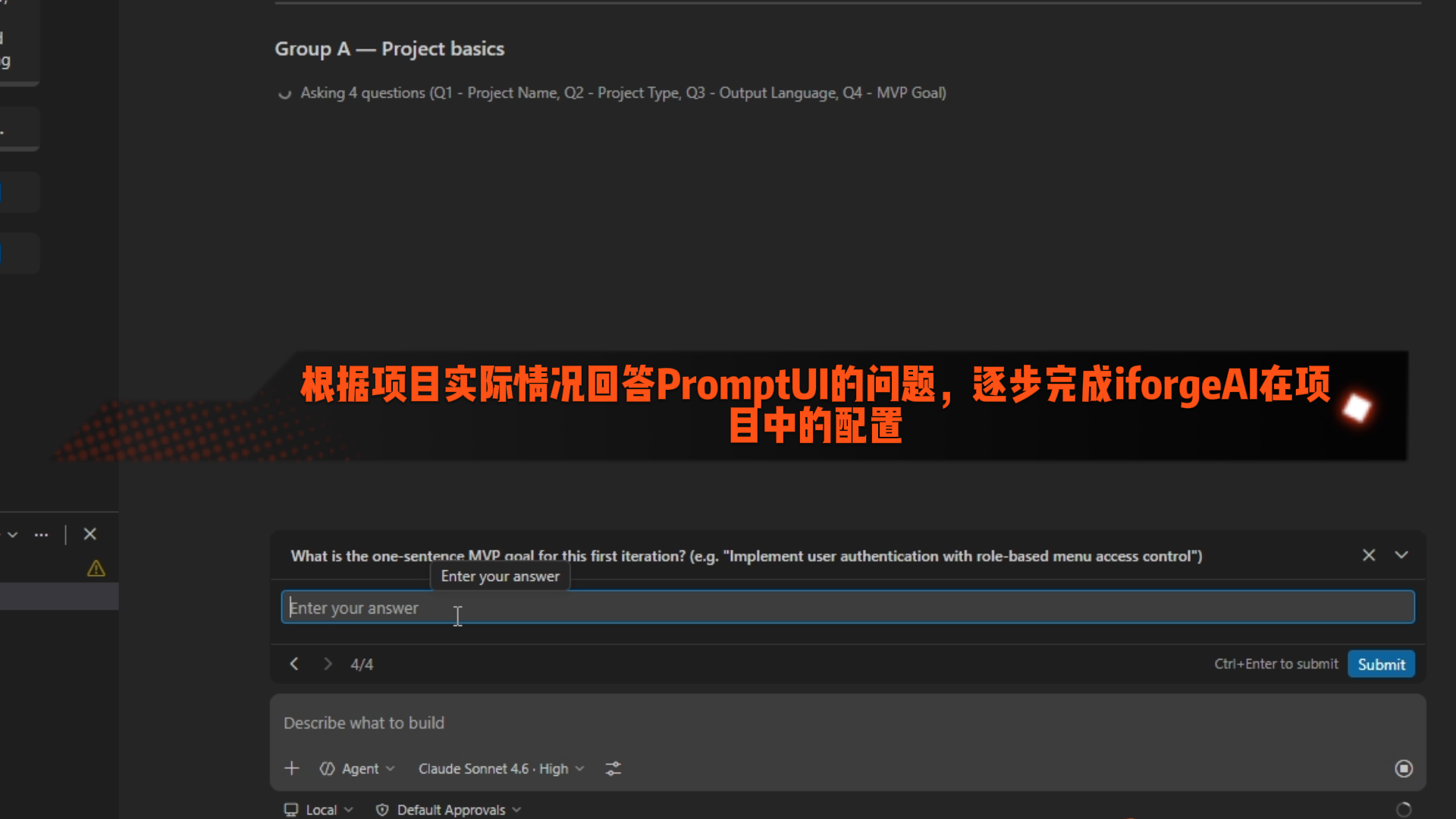
Quick Start
GitHub Copilot
git clone https://github.com/nelson820125/iforgeai.git
cd iforgeai
pwsh ./install.ps1          # Select platform: 1 Copilot  (or 3 Both)
Then in VS Code:
Ctrl+Shift+P→ Developer: Reload Window- Open your project workspace
- Copilot Chat → run
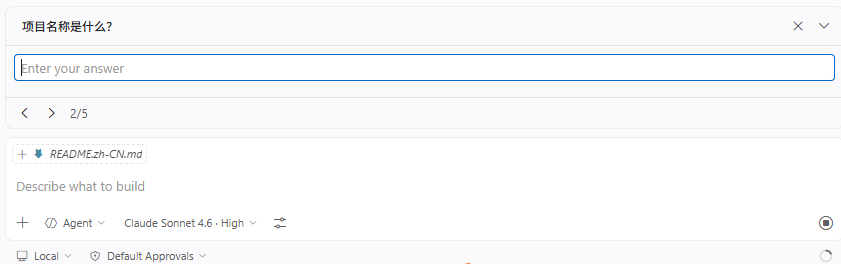
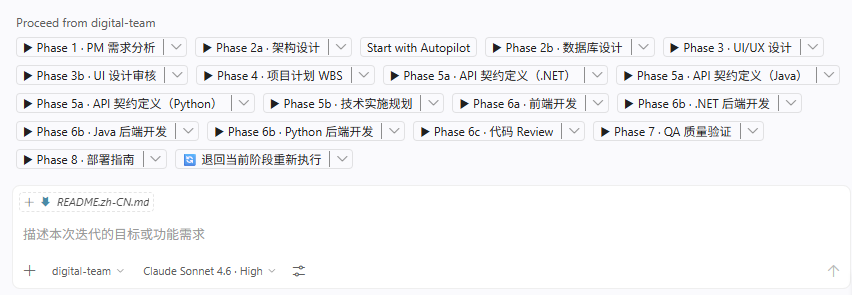
/init-projectto scaffold.ai/directories - Switch to Agent mode → select
digital-team→ describe your iteration goal
Trae (0.6.0+)
Method 1 — Script install (recommended)
git clone https://github.com/nelson820125/iforgeai.git
cd iforgeai
pwsh ./install.ps1          # Select platform: 2 Trae  (or 3 Both)
This installs all role skills globally to ~/.trae-cn/skills/ (Trae CN) or ~/.trae/skills/ (Trae International), and coding-standard instructions to the corresponding instructions/ directory.
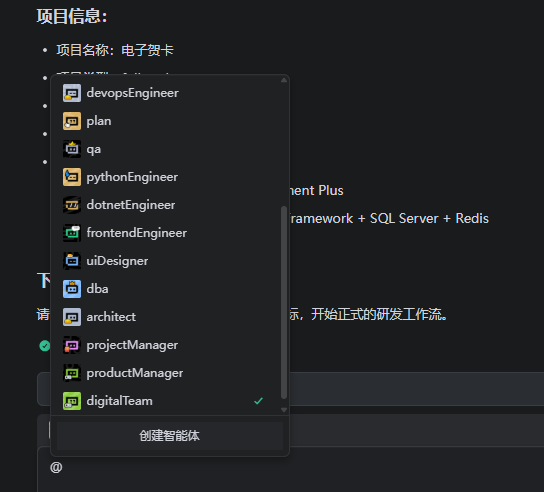
After installation, invoke any role in Trae chat using @agent-name:
@digital-team      — coordinator; use /init-project to scaffold a new project
@product-manager   — requirements analysis
@architect         — architecture design
@dba               — database design
Method 2 — One-click shared agents (Trae CN only)
Click to add an agent directly to your Trae workspace (no install required):
| Agent | Link |
|---|---|
| digital-team (coordinator) | Add agent |
| product-manager | Add agent |
| project-manager | Add agent |
| architect | Add agent |
| dba | Add agent |
| ui-designer | Add agent |
| frontend-engineer | Add agent |
| dotnet-engineer | Add agent |
| java-engineer | Add agent |
| python-engineer | Add agent |
| qa-engineer | Add agent |
| plan | Add agent |
| devops-engineer | Add agent |
Initialize a project
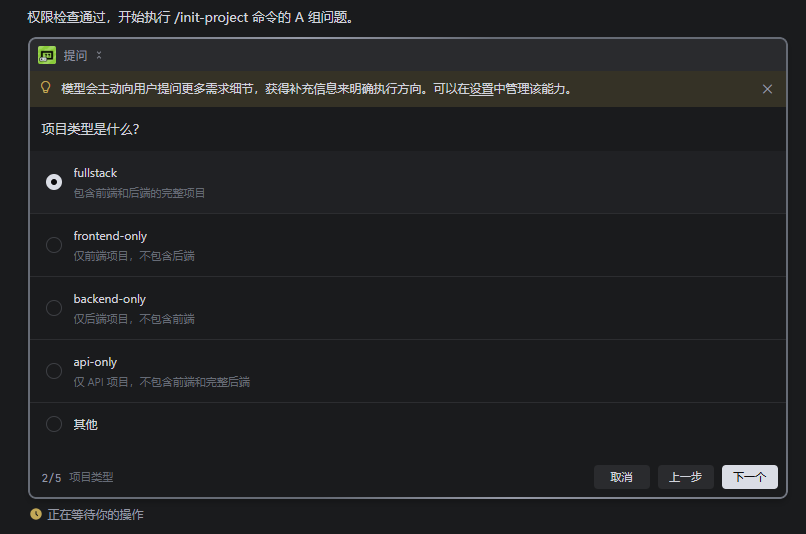
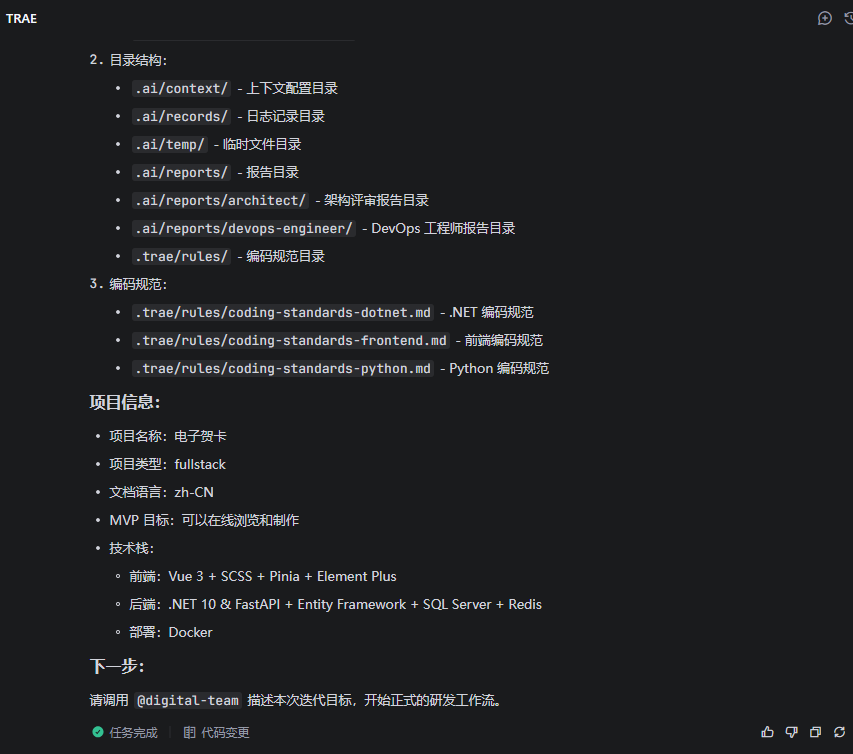
In Trae chat, use @digital-team and run /init-project to scaffold .ai/ directories for your project:
@digital-team /init-project
The guided interview creates .ai/context/workflow-config.md and copies relevant coding standards from the global instructions into .trae/rules/.
Claude Code
# Copy to your project root (or ~/.claude/ for all projects)
cp claude-code/CLAUDE.md /path/to/your/project/CLAUDE.md
Start with a trigger word in Claude Code chat: PM: / Architect: / Frontend: …
Codex CLI
cp codex/AGENTS.md /path/to/your/project/AGENTS.md
For Chinese versions, use
zh-CN/prefix:zh-CN/claude-code/CLAUDE.md,zh-CN/codex/AGENTS.md.
Roles
| Phase | Role | Agent | Output |
|---|---|---|---|
| P1 | Product Manager | @product-manager |
.ai/temp/requirement.md |
| P2a | Architect | @architect |
.ai/temp/architect.md · .ai/temp/api-contract.md (skeleton) |
| P2b | DBA | @dba |
.ai/temp/db-design.md · .ai/temp/db-init.sql |
| P3 | UI Designer | @ui-designer |
.ai/temp/ui-design.md · .ai/temp/ui-wireframe.html · .ai/context/ui-designs/_index.md |
| P3b | UI Designer · Design Review | @ui-designer (UI review:) |
.ai/context/ui-designs/_index.md (finalised) · .ai/temp/ui-design.md (final) |
| P4 | Project Manager | @project-manager |
.ai/temp/wbs.md |
| P5a | Backend Engineer | @dotnet-engineer / @java-engineer / @python-engineer |
.ai/temp/api-contract.md (completed) |
| P5b | Plan | @plan |
.ai/temp/plan.md |
| P6a | Frontend Engineer | @frontend-engineer |
Source code |
| P6b | Backend Engineer | @dotnet-engineer / @java-engineer / @python-engineer |
Source code |
| P6c | Architect | @architect |
.ai/reports/architect/review-report-{v}.md |
| P7 | QA Engineer | @qa-engineer |
.ai/reports/qa-report.md |
| P8 | DevOps Engineer | @devops-engineer |
.ai/reports/devops-engineer/deploy-guide-{v}.md |
@digital-team is the Orchestrator. It reads .ai/temp/ to detect the current phase, displays progress, and runs gate reviews.
Copilot Chat (Agent mode): Switch to Agent mode and select agents from the agent picker — the
@nameabove is the agent's picker name, not a chat command. Claude Code / Codex CLI: Use trigger phrases to set role context.
Workflow
flowchart TD
    START(["🚀 Start iteration\n@digital-team"])

    P1["P1 · Product Manager\n@product-manager\nrequirement.md"]
    G1{"Gate 1\nReview"}

    P2A["P2a · Architect\n@architect\narchitect.md + api-contract skeleton"]
    P2B["P2b · DBA\n@dba\ndb-design.md + db-init.sql"]
    G2{"Gate 2\nJoint Review"}

    P3["P3 · UI Designer\n@ui-designer\nui-design.md + wireframe.html"]
    G3{"Gate 3\nReview"}

    P4["P4 · Project Manager\n@project-manager\nwbs.md"]
    G4{"Gate 4\nReview"}

    P5A["P5a · Backend Engineer(s)\n@dotnet / java / python-engineer\napi-contract.md (full schemas)"]
    P5B["P5b · Plan\n@plan\nplan.md"]
    G5{"Gate 5\nReview"}

    P6A["P6a · Frontend Engineer\n@frontend-engineer\nsource code"]
    P6B["P6b · Backend Engineer(s)\n@dotnet / java / python-engineer\nsource code"]
    P6C["P6c · Architect\n@architect /review\nreview-report.md"]
    G6{"Gate 6\nReview"}

    P7["P7 · QA Engineer\n@qa-engineer\nqa-report.md"]
    G7{"Gate 7\nRelease Assessment"}

    P8["P8 · DevOps Engineer\n@devops-engineer"]
    G8{"Deployment\nCapability?"}
    P8A["📋 Deploy Checklist\ndeploy-guide.md"]
    P8B["🐳 Dockerize\nDockerfile · docker-compose.yml"]
    P8C["⚙️ CI/CD Pipeline\npipeline config · auto-trigger"]
    DONE_M(["✅ Human deployment\nManual execution"])
    DONE_A(["🚀 Auto deployment\nMerge to main → CI/CD triggers"])

    REJECT["🔄 Return to role\nfor revision"]

    START --> P1
    P1 --> G1
    G1 -->|Approved| P2A & P2B
    G1 -->|Rejected| REJECT
    P2A & P2B --> G2
    G2 -->|Approved| P3
    G2 -->|Rejected| REJECT
    P3 --> G3
    G3 -->|Approved| P4
    G3 -->|Rejected| REJECT
    P4 --> G4
    G4 -->|Approved| P5A & P5B
    G4 -->|Rejected| REJECT
    P5A & P5B --> G5
    G5 -->|Approved| P6A & P6B
    G5 -->|Rejected| REJECT
    P6A & P6B --> P6C
    P6C --> G6
    G6 -->|Approved| P7
    G6 -->|Rejected| REJECT
    P7 --> G7
    G7 -->|Approved| P8
    G7 -->|Issues found| REJECT
    P8 --> G8
    G8 -->|No Docker / No CI/CD| P8A
    G8 -->|Docker only| P8B
    G8 -->|CI/CD enabled| P8C
    P8A & P8B --> DONE_M
    P8C --> DONE_A
Requirements
- VS Code 1.99 or later with the GitHub Copilot and GitHub Copilot Chat extensions installed and active
- PowerShell 7+ (
pwsh) for the installer
Install PowerShell 7 if not already present:
# Windows
winget install Microsoft.PowerShell

# macOS
brew install powershell
Installation
1. Clone the repository
GitHub:
git clone https://github.com/nelson820125/iforgeai.git
cd iforgeai
Gitee:
git clone https://gitee.com/jordium/iforgeai.git
cd iforgeai
2. Run the installer
pwsh ./install.ps1
The installer detects your OS and shows the default target path for each component (agents, skills, instructions, prompts). Press Enter to accept a path or type a replacement.
Available flags:
| Flag | Effect |
|---|---|
-Force |
Overwrite files that already exist |
-DryRun |
Preview all planned operations without writing anything |
-SkipSkills |
Skip installing skill definitions |
Default paths:
| OS | Agents / Instructions / Prompts | Skills |
| OS | Agents / Instructions / Prompts | Skills |
|---|---|---|
| Windows | %APPDATA%\Code\User\ |
%USERPROFILE%\.copilot\skills\ |
| macOS | ~/Library/Application Support/Code/User/ |
~/.copilot/skills/ |
| Linux | ~/.config/Code/User/ |
~/.copilot/skills/ |
3. Reload VS Code
Ctrl+Shift+P > Developer: Reload Window
Agents and instructions are loaded at startup. The reload is required after the first install.
4. Grant file-write permission to digital-team
Why this matters:
digital-teamand all specialist agents write their deliverables (requirements, architecture docs, DB design, etc.) directly to.ai/temp/. Without the Edit files permission, every document is printed to the Chat window instead, consuming large amounts of context and degrading the quality of downstream agents.
- Open the Copilot Chat panel in VS Code
- Click the Tools icon to the left of the input box
- Make sure Edit files is checked
digital-teamperforms this check automatically on every startup. If the permission is missing it will pause and guide you through enabling it — you can also choose to continue without it (documents will print to Chat instead).
Uninstall
pwsh ./uninstall.ps1
Removes all installed agents, skills, instructions, and prompts, and restores settings.json to its pre-install state. If you had a chat.pluginLocations entry before installing iforgeAI, the original value is preserved; if the key did not exist, it is removed entirely.
To preview what will be removed without making any changes:
pwsh ./uninstall.ps1 -DryRun
Claude Code & Codex CLI
The same 10-role workflow is available for Claude Code and OpenAI Codex CLI. No installer is required — copy one config file to your project root.
Platform support
All three platforms run on Windows, macOS, and Linux.
| Platform | Requirement | Config file |
|---|---|---|
| GitHub Copilot | VS Code 1.99+, pwsh install.ps1 |
Deployed via installer |
| Claude Code | Claude Code CLI | CLAUDE.md in project root or ~/.claude/ |
| Codex CLI | OpenAI Codex CLI | AGENTS.md in project root |
Setup
Claude Code — copy to project root:
cp claude-code/CLAUDE.md /path/to/your/project/CLAUDE.md
Or place at the global location to apply to all projects:
# macOS / Linux
cp claude-code/CLAUDE.md ~/.claude/CLAUDE.md

# Windows
cp claude-code\CLAUDE.md $env:USERPROFILE\.claude\CLAUDE.md
Codex CLI — copy to project root:
cp codex/AGENTS.md /path/to/your/project/AGENTS.md
Simplified Chinese locale:
# Claude Code
cp zh-CN/claude-code/CLAUDE.md /path/to/your/project/CLAUDE.md

# Codex CLI
cp zh-CN/codex/AGENTS.md /path/to/your/project/AGENTS.md
Trigger phrases
Invoke any role by prefixing your message with its trigger phrase. After each phase, a gate review card is shown — type approve to advance or return [reason] to revise.
| Trigger | Role |
|---|---|
status |
Orchestrator — check current phase |
PM: |
Product Manager (P1) |
Architect: |
Architect (P2a) |
DBA: |
DBA (P2b) |
UI: |
UI Designer (P3) |
Project Manager: |
Project Manager (P4) |
API contract: |
.NET Engineer — contract (P5a) |
Java contract: |
Java Engineer — contract (P5a) |
Python contract: |
Python Engineer — contract (P5a) |
Plan: |
Technical Plan (P5b) — outputs .ai/temp/plan.md |
Frontend: |
Frontend Engineer (P6a) |
.NET: |
.NET Engineer — dev (P6b) |
Java: |
Java Engineer — dev (P6b) |
Python: |
Python Engineer — dev (P6b) |
Code review: |
Architect — code review (P6c) |
QA: |
QA Engineer (P7) |
DevOps: |
DevOps Engineer (P8) |
Claude Code and Codex CLI run the entire workflow in a single conversation thread. Role context is set by your trigger phrase — there is no automatic agent switching.
Language Support
iforgeAI installs in English by default. The output language of agent-generated deliverables (requirements, architecture docs, DB design, etc.) is controlled per-project by the output_language field in .ai/context/workflow-config.md.
Chinese (Simplified) Users
A full Simplified Chinese locale is available in the zh-CN/ directory — all agent and skill files are in Chinese:
pwsh ./install.ps1 # Select language: zh-CN during install
This installs the same components from the zh-CN/copilot/ source tree.
Setting the output language for a project
After running /init-project, open .ai/context/workflow-config.md and set:
output_language: "zh-CN" # en-US | zh-CN
All agents read this value at startup and write their deliverables in the specified language.
Scrum Mode
By default iforgeAI uses standard delivery mode: all phase outputs are written to a single .ai/temp/ directory. For projects with multiple releases and sprints, enable Scrum mode during project init.
Enabling Scrum mode
During /init-project, answer Q9 with scrum. The prompt then asks for the first version and sprint name (e.g. v1.0, sprint-1).
This creates the following directory structure:
.ai/
├── context/                    # Shared config — not versioned
├── v1.0/
│   ├── sprint-1/
│   │   ├── temp/               # Phase outputs for this sprint
│   │   └── reports/            # QA and review reports for this sprint
│   └── sprint-2/
│       ├── temp/
│       └── reports/
└── records/                    # Engineer work logs (continuous, not per-sprint)
The workflow-config.md file tracks the active context:
delivery_mode: "scrum"
current_version: "v1.0"
current_sprint: "sprint-1"
digital-team and all specialist agents resolve their file paths from these values automatically.
Starting a new sprint or version
- Update
current_versionandcurrent_sprintin.ai/context/workflow-config.md - Create the new directories:
.ai/{version}/{sprint}/temp/and.ai/{version}/{sprint}/reports/ - Restart
digital-team— it will detect the empty sprint and start from Phase 1
Standalone agent usage in Scrum mode
All agents read the path configuration automatically. If invoked standalone and current_version / current_sprint are not set in the config, the agent will ask you to specify them:
dotnet-engineer:  implement the order approval API
# Agent asks: "Scrum mode is active. Which version and sprint should I use?"
Project Setup
In a new project workspace, run the following in Copilot Chat:
/init-project MyProject fullstack
This creates a .ai/ directory in the project root:
.ai/
├── context/
│   ├── workflow-config.md       # Role on/off switches, tech stack, design approach, and output_language
│   ├── architect_constraint.md  # Architecture and library constraints
│   ├── ui_constraint.md         # Brand colours, style tone, layout — filled manually before UI phase
│   └── ui-designs/              # External design tool exports (Stitch, Figma) — place files here after export
│       ├── _index.md            # Page inventory — created by @ui-designer Phase A, finalised in Phase B
│       └── {page}/              # Per-page folder (Stitch) or flat .html files (Figma)
├── temp/                        # Phase outputs (written by each agent)
├── records/                     # Engineer work logs
└── reports/                     # QA reports
Configure before starting
Open .ai/context/workflow-config.md and set the following fields before the first iteration:
db_approach — database schema strategy
db_approach: "database-first" # default
| Value | Behaviour |
|---|---|
database-first |
DBA outputs a ready-to-run db-init.sql. Engineers read it to write ORM entities. Use when the schema is the authoritative source of truth. |
code-first |
DBA outputs a design document only. Engineers drive the schema via ORM migrations (e.g. EF Core). Use when the codebase owns the schema lifecycle. |
design_approach — phase order for UI design
design_approach: "architecture-first" # default
| Value | Phase order | Best for |
|---|---|---|
architecture-first |
PM → Architect → DBA → UI Designer → … | B2B / industrial / high-integration systems. UI Designer reads requirement.md + architect.md to ensure the design stays within technical constraints. |
ui-first |
PM → UI Designer → Architect → DBA → … | C-side products or prototype-driven projects. Architect and DBA additionally read ui-design.md so their designs accommodate the desired UX. |
ui_constraint.md — brand and style constraints
This file is filled manually by the PM, tech lead, or designer — not generated by AI.
Fill it in before @ui-designer runs. It contains:
- Brand colours — 12 CSS custom property values (
primary,danger,surface, etc.) - Style tone —
clean-light/enterprise-gray/professional-dark - UI library — must match the
ui_libraryvalue in the Tech Stack section - Typography and layout — base font size, sidebar width, border radius, etc.
If any field is left blank, @ui-designer will propose and apply a neutral enterprise default and state the chosen value in its output.
@ui-designer uses these values in two ways:
- Defines matching CSS custom properties in the Style Variables section of
ui-design.md - Applies them at the top of the
<style>block in the generatedui-wireframe.html
UI Design Workflow — Two-Phase Roundtrip
@ui-designer supports a two-phase workflow when an external design tool (Stitch, Figma, etc.) is used. Skip Phase B if no external tool is involved.
P3 — /design mode (Copilot Chat: select ui-designer from the agent picker)
- Generates
ui-wireframe.html(layout skeleton) andui-design.md(draft spec with proposed tokens) - Creates
.ai/context/ui-designs/_index.mdas a page inventory skeleton (file: [TBD])
Human step — Place exported files
Extract the design tool export zip into .ai/context/ui-designs/. No reorganisation required — both structures are supported:
.ai/context/ui-designs/
  _index.md            ← created by P3
  Dashboard.html       ← Figma flat export
  Login.html
  login/               ← Stitch per-page folder
    code.html
    screen.png
P3b — /review mode (trigger: UI review: / UI design review:)
- Scans
ui-designs/, fills_index.mdwith actual file paths, marksreviewed: true - Compares exports against the wireframe; updates
ui-design.mdwith final colours, spacing, and component variants
ui-design.mdmust reflect the reviewed final state before@frontend-engineerbegins work.
@frontend-engineer reads _index.md to locate per-page layout HTML. Falls back to ui-wireframe.html if _index.md is absent.
Usage
Start an iteration
- Open Copilot Chat and switch to Agent mode
- Select
digital-team - State the iteration goal, for example:
Iteration goal: implement user permissions module — role assignment and menu-level access control
The Orchestrator reads current phase state and tells you what to do next.
Gate reviews
After each phase, the Orchestrator presents a summary and two options: approve to advance to the next phase, or reject to send the current phase back for revision.
Skip a role
Open .ai/context/workflow-config.md and mark any role as skipped:
ui-designer:       skip | no frontend
frontend-engineer: skip | no frontend
Roles with a skip entry are excluded from the workflow for the current project. The Orchestrator reads this file at startup.
Use roles individually
All agents work independently without going through the Orchestrator.
Copilot Chat (Agent mode): Select the agent from the picker, then type your task:
architect           assess whether event sourcing is needed for operation auditing
dba                 design the permissions-related tables, reference .ai/temp/architect.md
frontend-engineer   implement the permissions page, reference .ai/temp/ui-design.md Task #3
Claude Code / Codex CLI: Use trigger phrase prefixes — see Trigger phrases.
Agent phase modes
Some agents serve more than one phase in the workflow and behave differently depending on how they are invoked:
| Agent | Phase | Mode | Behaviour |
|---|---|---|---|
dotnet-engineer |
P5a · API Contract | /contract |
Fills request/response schemas in api-contract.md. Outputs documentation only — no code. |
dotnet-engineer |
P6b · Backend Dev | /develop (default) |
Implements backend code using api-contract.md as the authoritative spec. |
java-engineer |
P5a · API Contract | /contract |
Fills request/response schemas in api-contract.md. Outputs documentation only — no code. |
java-engineer |
P6b · Backend Dev | /develop (default) |
Implements backend code using api-contract.md as the authoritative spec. |
python-engineer |
P5a · API Contract | /contract |
Fills request/response schemas in api-contract.md. Outputs documentation only — no code. |
python-engineer |
P6b · Backend Dev | /develop (default) |
Implements backend code using api-contract.md as the authoritative spec. |
ui-designer |
P3 · UI Design | /design (default) |
Generates ui-wireframe.html layout skeleton and ui-design.md draft spec. Creates _index.md page inventory. |
ui-designer |
P3b · Design Review | /review (trigger: UI review:) |
Scans exported design files, fills _index.md with actual file paths, and updates ui-design.md to the final reviewed state. |
architect |
P2a · Architecture | /design (default) |
Produces architecture design and API contract skeleton. |
architect |
P6c · Code Review | /review |
Reviews engineer deliverables for standards, structure, performance, and API completeness. |
digital-team passes the correct mode automatically when routing through the workflow. When invoked standalone:
- Agents default to their primary mode (
/developfordotnet-engineer,/designforarchitect) - If required prerequisite files are absent and no task is described in the prompt, the agent asks for clarification rather than proceeding with assumptions
Coding Standards
Two instruction files are applied automatically via applyTo glob patterns:
| File | Auto-applied to |
|---|---|
coding-standards-dotnet.instructions.md |
**/*.cs |
coding-standards-java.instructions.md |
**/*.java |
coding-standards-python.instructions.md |
**/*.py |
coding-standards-frontend.instructions.md |
**/*.vue, **/*.jsx, **/*.tsx, **/*.ts, **/*.scss |
To add project-specific overrides, copy project-template/.github/instructions/ into your workspace and fill in the marked sections. Project-level files take precedence over global ones.
Repository Structure
iforgeai/
├── install.ps1
├── uninstall.ps1
├── zh-CN/                     Simplified Chinese locale
│   └── copilot/               Chinese versions of agents, skills, instructions, and prompts
├── shared/                    Platform-agnostic role and standard definitions
│   ├── roles/
│   └── standards/
├── copilot/                   GitHub Copilot — full implementation (English)
│   ├── agents/
│   ├── skills/
│   ├── instructions/
│   └── prompts/
├── claude-code/               Claude Code adapter — copy CLAUDE.md to project root
│   └── CLAUDE.md
├── codex/                     Codex CLI adapter — copy AGENTS.md to project root
│   └── AGENTS.md
└── project-template/          Copy to new project workspace
    ├── .github/instructions/
    └── .ai/context/
Issues
File a GitHub Issue for:
- Installation failures — include OS, PowerShell version, and the full error output
- Agent behavior not matching the role spec — include the role name, your input, and the expected vs. actual output
- Feature requests — describe the problem or use case
Premium Models and Network Access
iforgeAI works best with Claude Sonnet or CodeX in Copilot's premium request mode. Larger context windows and stronger instruction-following improve role adherence across the 10-agent workflow.
Premium request models require a GitHub Copilot Individual or Business subscription with premium request credits enabled.
Mainland China Users
GitHub Copilot and its model endpoints may be inaccessible in mainland China without a proxy. We recommend DOVE: dovee.cc.
This is a referral link. Ensure VPN usage complies with applicable local laws and regulations.
License
MIT. Copyright 2025 Jordium.com Engineering Team. See LICENSE.
Reviews (0)
Sign in to leave a review.
Leave a reviewNo results found