Ant3
Health Uyari
- License — License: MIT
- Description — Repository has a description
- Active repo — Last push 0 days ago
- Low visibility — Only 9 GitHub stars
Code Gecti
- Code scan — Scanned 12 files during light audit, no dangerous patterns found
Permissions Gecti
- Permissions — No dangerous permissions requested
Bu listing icin henuz AI raporu yok.
Swarm intelligence for AI agents in Rust. Peer agents self-organize via stigmergy: pheromone traces, adaptive division of labor, atomic task claiming. No fixed role pipelines — collective intelligence emerges. Local-first, single binary, MCP-ready.
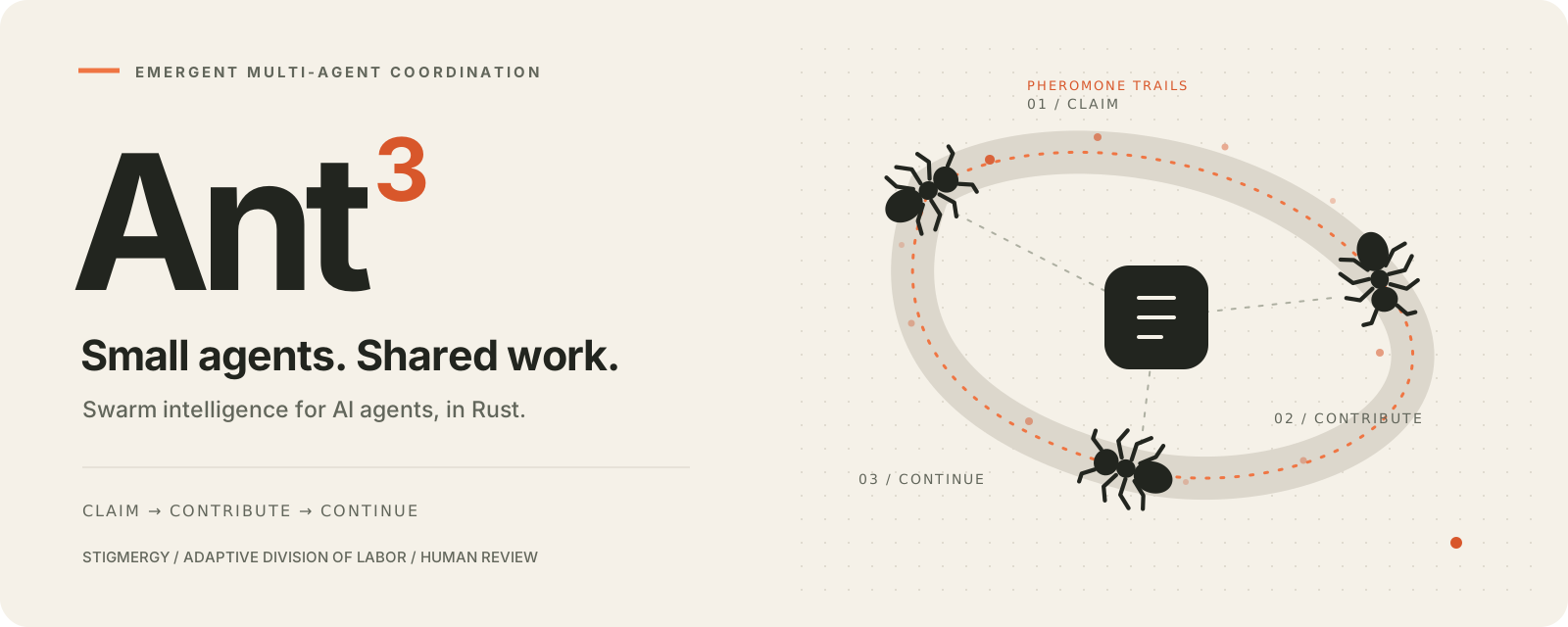
Ant³
Swarm intelligence for AI agents, built in Rust.
Small agents. Shared work. Emergent outcomes.


Ant³ is a multi-agent platform where peer AI agents self-organize like an ant colony. Publish a task with acceptance criteria; agents claim work from a shared board, split it, reuse each other's results, and integrate — coordinating through stigmergy (a pheromone-style trace field) rather than a fixed planner. No hardcoded role pipelines: division of labor and collective progress emerge from local rules.
简体中文 · Documentation · Architecture · Current status · Contributing
Contents
- Why Ant³
- Swarm mechanisms
- Quick start
- How the colony works
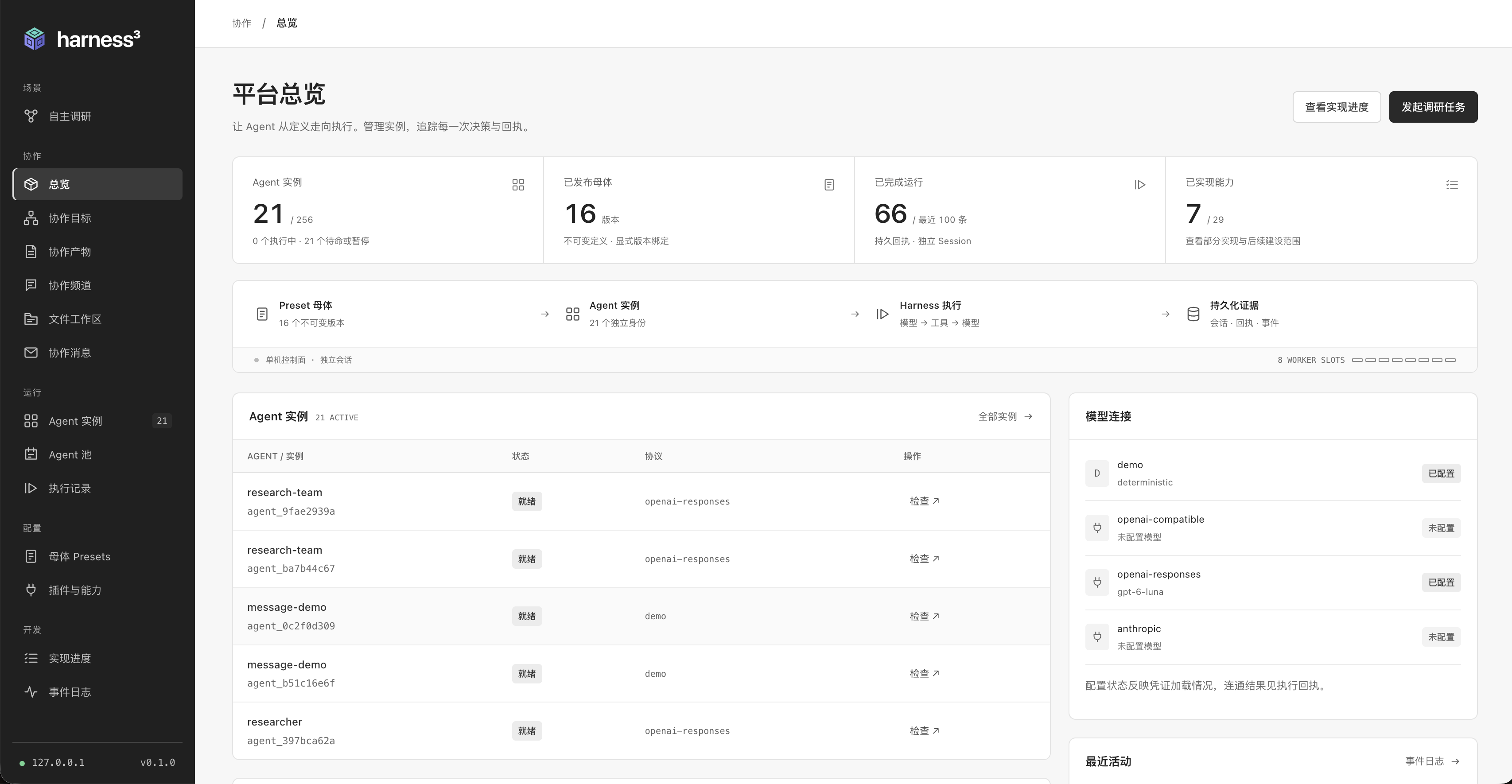
- What you can use
- Architecture
- Use the runtime independently
- Status & boundaries
- Contribute
Why Ant³
Most multi-agent frameworks hand you a fixed workflow — a planner, a researcher, a summarizer, wired in a script. That is orchestration, not intelligence.
Ant³ takes the opposite bet, inspired by how ants solve hard problems with no central command:
- No fixed roles. Planning and integration are tasks any peer can claim, not identities baked into the kernel.
- Coordination through the environment. Agents leave durable traces; later agents follow what worked. This is stigmergy, the mechanism behind ant trails.
- Emergence, measured. A built-in evaluation harness compares one agent against a swarm on the same task and budget, so "the swarm is better" is a claim you can test, not assume.
The result is a local-first, single-binary Rust platform you can run, inspect, and extend — with the model/tool loop usable as a standalone crate.
Swarm mechanisms
These are implemented today, not roadmap promises:
| Mechanism | What it does |
|---|---|
| Pheromone trace field | Tasks and results carry a concentration that reinforces on completion, human acceptance, and peer reuse, and evaporates with a 30-minute half-life. Strong trails attract work; stale ones fade. |
| Response-threshold division of labor | Each Preset's threshold adapts with experience (success lowers it, failure raises it). Specialists respond to faint trails; novices chase strong ones. |
| Crowding avoidance | A task's stimulus is diluted by how many workers already crowd its branch, so the swarm spreads across the board instead of piling up. |
| Recruitment & negative feedback | A successful run amplifies the paths it used; a definite failure penalizes them. Dead ends lose attractiveness. |
| Local perception | Agents see their neighborhood by default, not the whole board — global order grows from local rules. |
| Individual-loss robustness | Lose a worker and its task requeues under a bounded retry budget; a fresh peer takes over and the swarm still converges. |
| Atomic claim & split | One effective owner per task; subtasks return to the board and trigger fresh selection. No peer controls another. |
Ant³ implements stigmergy as durable, auditable records with a bounded control plane — not a literal ant-colony optimization solver. See the trace-field design and evaluation baseline.
Quick start
Requires Rust 1.99+ (latest stable recommended). Single binary, no external database or Node build.
git clone https://github.com/NeoPanic/Ant3.git
cd Ant3
cargo run --locked -p ant3-cli -- up
Open localhost:7333 and sign in with the contents of .ant3/token. Then:
- Configure a model provider and publish a Preset in 母体 Presets.
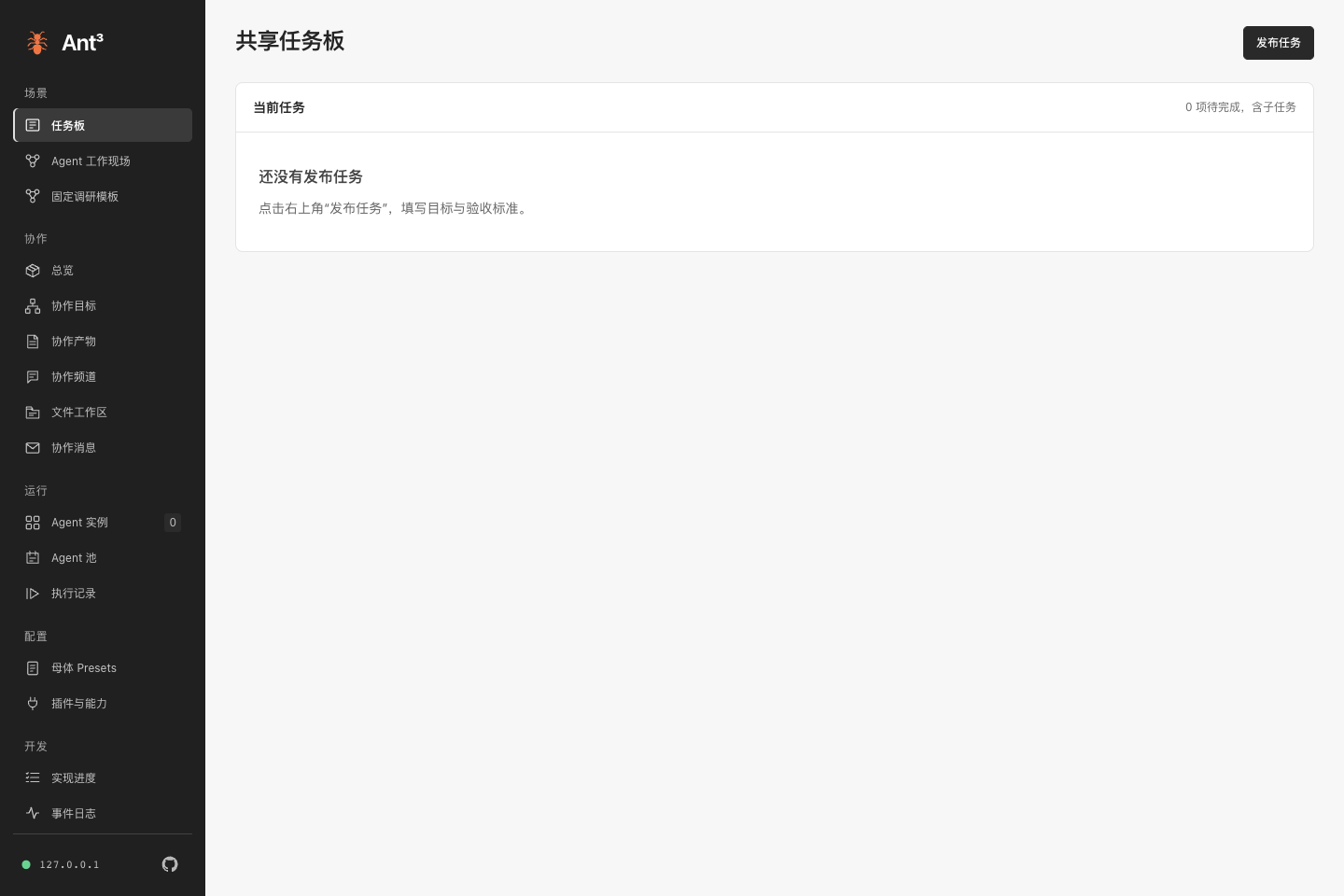
- Publish work + acceptance criteria in 任务板 (Task Board).
- Watch selection, claim, split, and integration in Agent 工作现场; inspect trace concentrations on each task.
Ant³ speaks OpenAI-compatible Chat Completions, OpenAI Responses, and Anthropic Messages. Configuration, CLI/API/MCP usage, and local process plugins are in the getting-started guide.
How the colony works
| Colony principle | Ant³ mechanism |
|---|---|
| Shared traces | A persistent task board holds work, claims, progress, results, and pheromone concentration. |
| Local action | Each agent claims a task and executes within its scope and neighborhood. |
| Division of labor | Versioned Presets supply models/instructions/tools; adaptive thresholds specialize them. |
| Collective progress | Subtasks return to the board; a peer integrates completed contributions. |
| Feedback | Humans accept a root result or request another round; success/failure reshapes the trails. |
The control plane selects Presets, provisions instances, and enforces capacity, permissions, and budgets — but it is not a permanent leader. Every agent runs the same model/tool loop with its own specialization.
What you can use
| Area | Available behavior |
|---|---|
| Agent definitions | Versioned Presets, pinned inheritance, parameters, model and plugin bindings. |
| Lifecycle | Independent instances; Agent pools for provisioning, scaling, retirement, and TTL. |
| Shared task board | Publish unassigned tasks; select Presets, provision instances, claim atomically, split, requeue on failure. |
| Swarm coordination | Pheromone traces, response-threshold division of labor, crowding avoidance, recruitment, local perception. |
| Explicit scaffolding | Goal dependency graphs, candidate-based claiming, bounded dynamic delegation (user/agent-initiated, not fixed pipelines). |
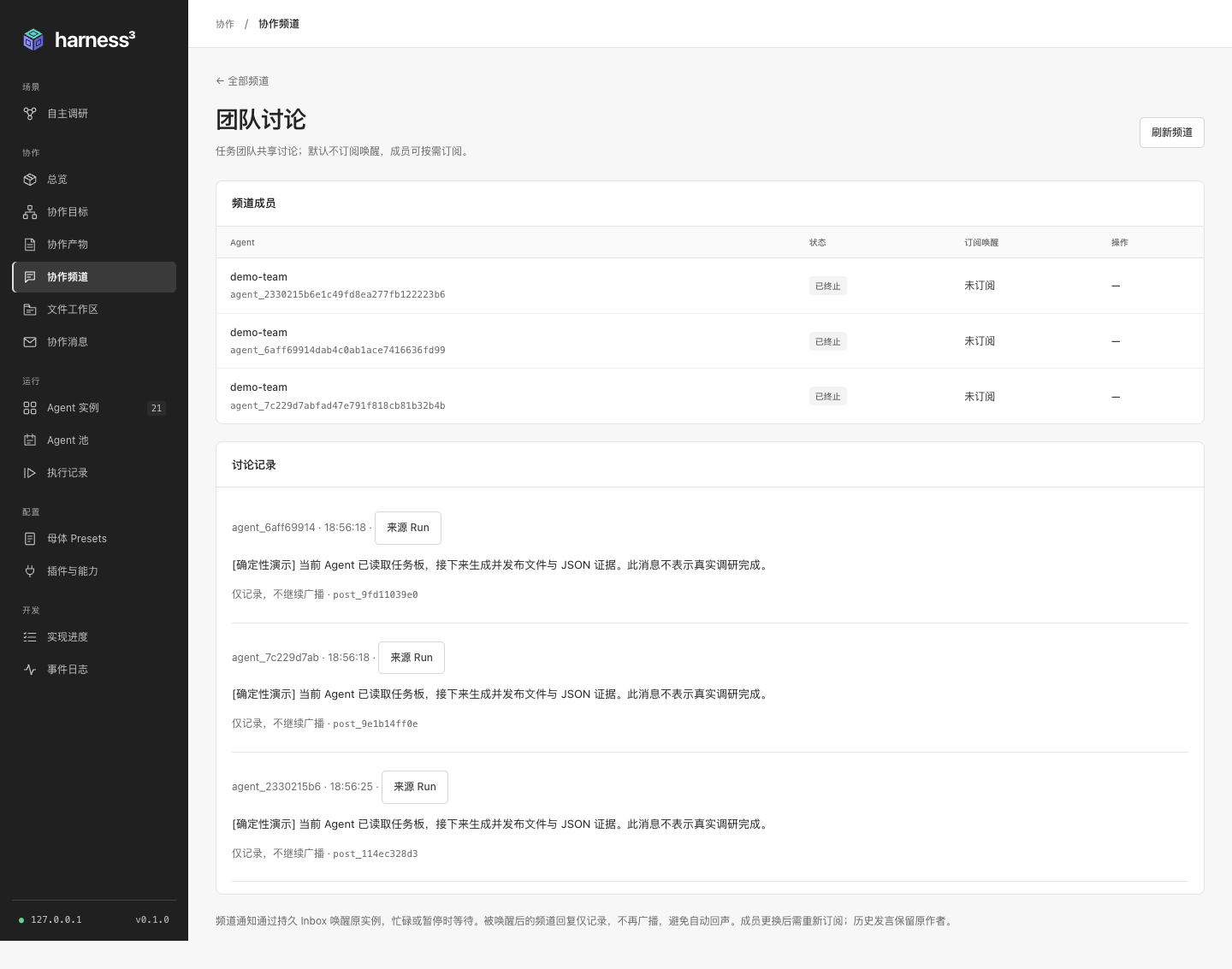
| Collaboration | Direct messages, Goal channels, subscriptions, shared versioned context. |
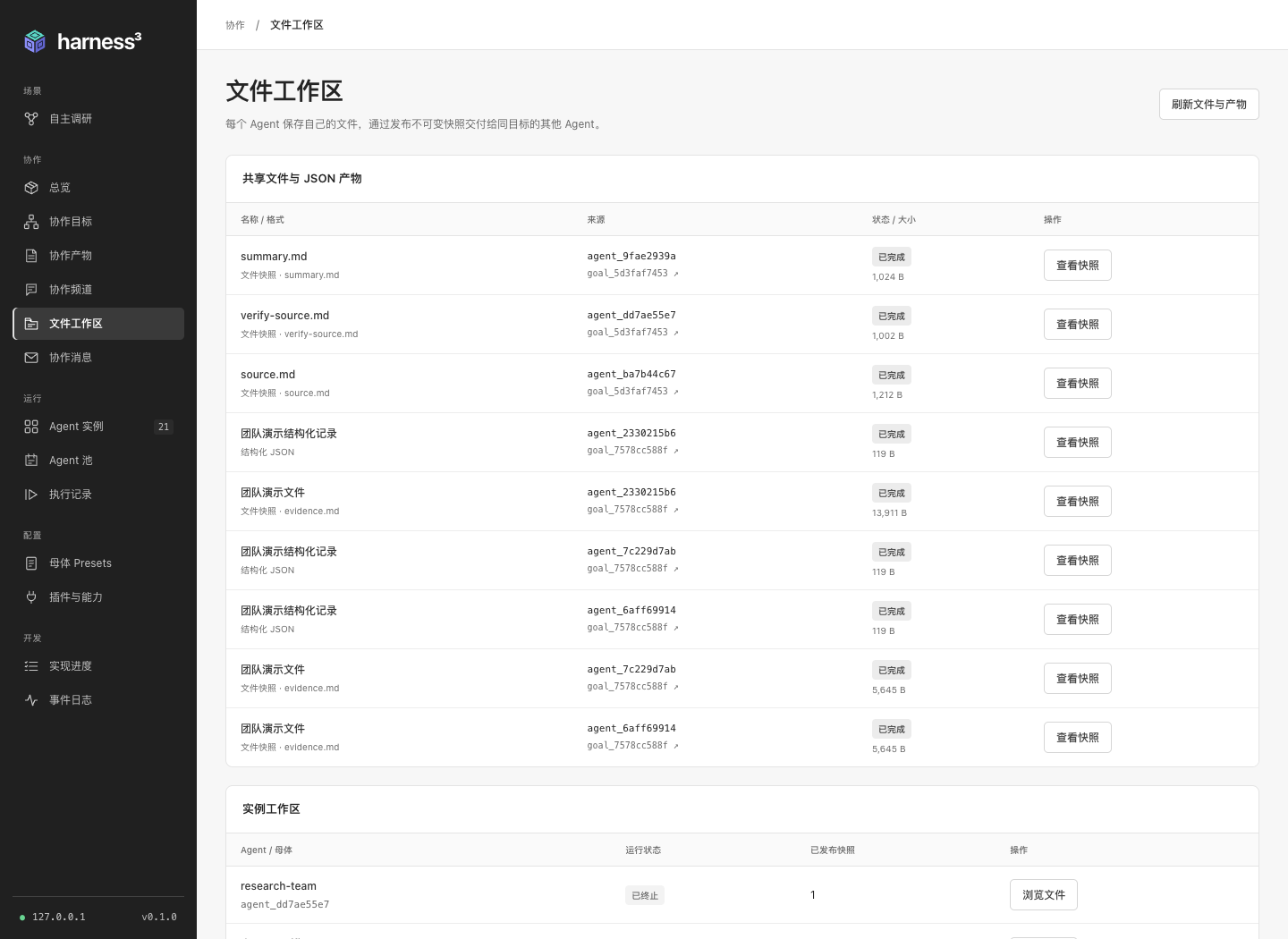
| Deliverables | Private workspaces, immutable text/file/JSON snapshots, peer evidence handoffs. |
| Review | Independent verification, evidence-linked repair, review rounds, human acceptance. |
| Extension | Prompt packages and local process Tool plugins with pinned versions and health checks. |
| Access | Desktop Web, HTTP API, CLI, and outward MCP stdio share persistent local state. |
Completed root results await human review: accept to archive, or request changes to resume with feedback. Automatic independent verification is not yet wired into the board itself.
More console views: workstation, collaboration, and artifacts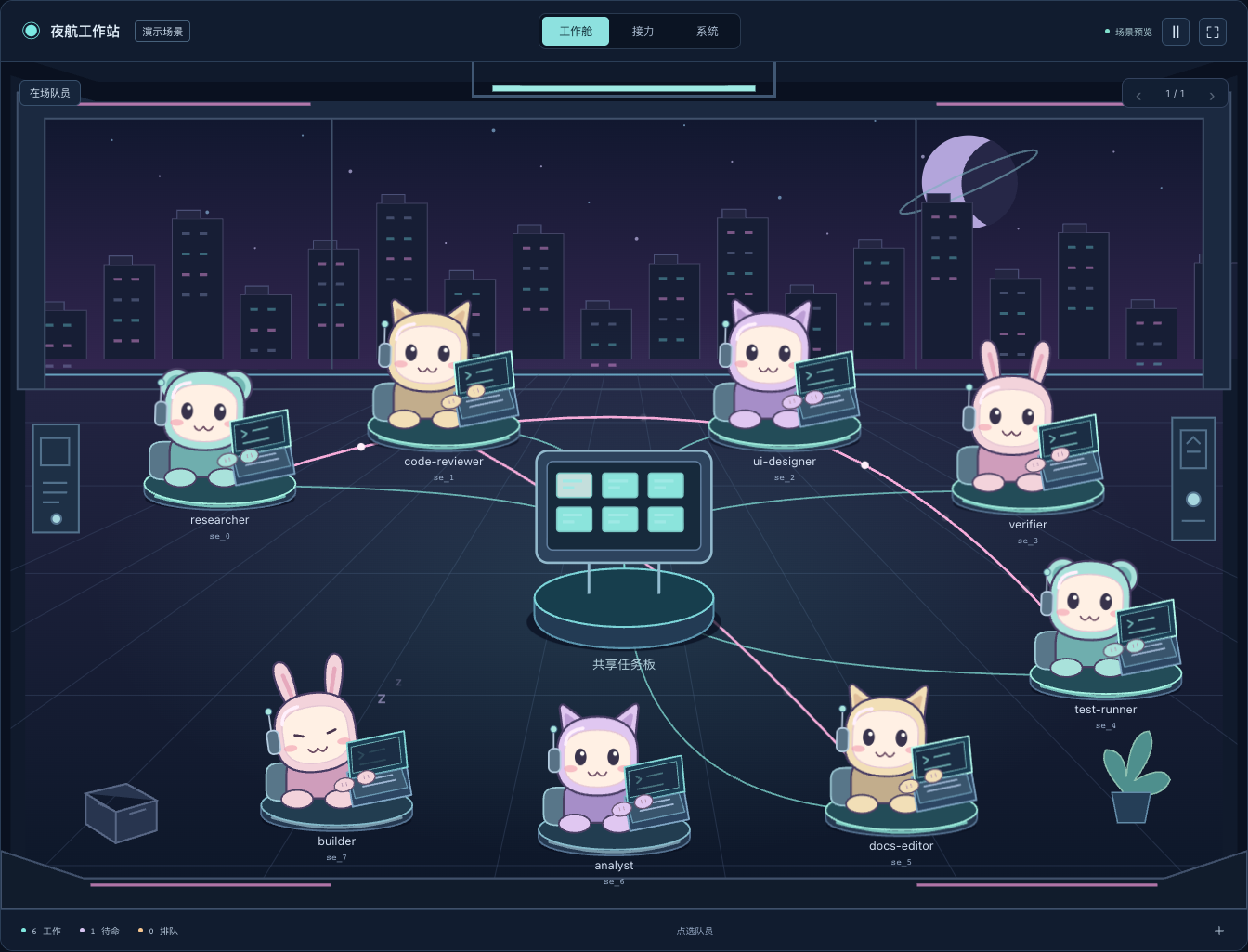
Crew animations reflect recorded execution states: working, waiting, or sleeping.
Architecture
flowchart LR
    Entry[Publish task] --> Board[Shared task board + trace field]
    Board --> Control[Control plane: select Preset]
    Preset[Versioned Presets + experience] --> Control
    Control -->|start and manage| A[Agent A: independent Ant]
    Control -->|start and manage| B[Agent B: independent Ant]
    A -->|claim / results / subtasks / traces| Board
    B -->|claim / results / subtasks / traces| Board
    Board <--> State[SQLite: tasks / claims / Runs / traces]
The independent Ant owns model/tool execution, policies, session checkpoints, cancellation, and receipts. Checkpoints do not guarantee exactly-once external effects: tools supply their own idempotency or transaction contract. See runtime contracts and the target architecture.
Use the runtime independently
The model/tool loop is a standalone crate, usable without the platform:
cargo run --locked --example quickstart
[dependencies]
ant3 = { git = "https://github.com/NeoPanic/Ant3.git", branch = "main" }
use ant3::{Ant, Limits, Registry};

let agent = Ant::new(Registry::default(), Limits::default());
The offline example runs a model → tool → model cycle and redelivers the same event to demonstrate session deduplication. Pin a Git revision for reproducible builds. API reference: cargo doc --locked --workspace --no-deps --open.
Status & boundaries
Ant³ is a pre-1.0 local platform for trusted environments. Local defaults: 256 instances, 8 execution slots, 64 tasks per Goal — configured limits, not measured capacity claims. Not yet provided: distributed scheduling, hosted deployment, strong multi-tenant isolation, hard cost budgets, and remote MCP plugin loading. See current status and the capability/source index for precise boundaries.
The display name is Ant³, the repository is Ant3, and technical identifiers use ant3 (CLI, Cargo packages, protocols, .ant3/ data directory). ³ expresses the collaboration loop: claim → contribute → continue. Brand assets · upgrade guide.
Contribute
See development checks, security reporting, and the code of conduct. The documentation index links setup, design goals, capabilities, and workflow contracts.
If Ant³'s take on emergent multi-agent coordination interests you, star the repo to follow along — issues and PRs are welcome.
Yorumlar (0)
Yorum birakmak icin giris yap.
Yorum birakSonuc bulunamadi