qubership-apihub
Health Uyari
- License — License: Apache-2.0
- No description — Repository has no description
- Active repo — Last push 0 days ago
- Community trust — 13 GitHub stars
Code Gecti
- Code scan — Scanned 12 files during light audit, no dangerous patterns found
Permissions Gecti
- Permissions — No dangerous permissions requested
This MCP server acts as a centralized registry and Dev Portal for an organization's API specifications. It allows users to browse, compare, lint, and evolve various API types (OpenAPI, GraphQL, AsyncAPI) in a single unified platform.
Security Assessment
The overall risk is rated as Low. The automated code scan reviewed 12 files and found no dangerous patterns, hardcoded secrets, or requests for excessive permissions. Because it is a Kubernetes-native portal, it inherently makes network requests and manages enterprise authentication (SAML, OIDC, LDAP, API keys). However, the base MCP functionality appears strictly focused on reading and comparing API definitions rather than executing arbitrary shell commands or scraping local sensitive files.
Quality Assessment
The project is highly maintained, with its most recent code push occurring just today. It uses the standard Apache-2.0 license, making it safe and flexible for both personal and commercial use. While the repository description is surprisingly blank, the provided README is exceptionally detailed. The project currently has 13 GitHub stars, indicating it is a relatively new or niche tool but backed by the reputable Netcracker organization.
Verdict
Safe to use, provided your infrastructure team properly configures the enterprise authentication methods required to secure the portal.
Qubership APIHUB
Product site: Qubership APIHUB on GitHub Pages — use cases, feature tour, capabilities matrix, releases, and deployment entry points.
One place for your organization’s API specifications — browse, compare, lint, and evolve APIs with confidence. Qubership APIHUB is Netcracker’s API registry and Dev Portal: a Kubernetes-native platform that turns scattered OpenAPI, GraphQL, AsyncAPI, and related specs into a single source of truth, with rich UI, automation, and optional cluster-side discovery.
Why APIHUB?
| Quality | Normalize, diff, and classify changes (breaking vs safe) so teams ship compatible APIs. |
| Visibility | Search, dashboards, and versioning across workspaces — no more specs lost in repos or tickets. |
| Integration | Publish from CI/CD, lint on publish, export reports; MCP and AI-assisted workflows where configured. |
| Scale | Microservice architecture, horizontal workers, and pluggable extensions (linter, agents). |
Outcomes you can expect: higher documentation completeness, faster onboarding for consumers, and safer API evolution backed by structured diffs and optional quality scoring.
What you get
- Catalog & versioning — Workspaces, groups, packages, versions, revisions; favorites and dashboards.
- Multi-format specs — OpenAPI 3.x (and Swagger 2 via conversion), GraphQL, AsyncAPI, Markdown documents, JSON Schema; gRPC/protobuf stubs where applicable.
- Deep analysis — Changelog between versions, deprecated tracking, backward-compatibility signals, global search.
- Quality pipeline — Spectral (OpenAPI & AsyncAPI) plus optional AI-assisted review for OpenAPI; version-level scoring in the linter service.
- Rich Portal — Interactive docs (including AsyncAPI), comparison views, API quality views, export with document shareability options.
- Kubernetes agent (optional) — Discover OpenAPI, GraphQL, AsyncAPI, Markdown, and JSON Schema in-cluster; snapshots and promotion into the catalog.
- Enterprise-ready — SAML, OIDC, LDAP, RBAC, API keys and PATs; Helm charts and Docker Compose for different lifecycles.
Screenshots
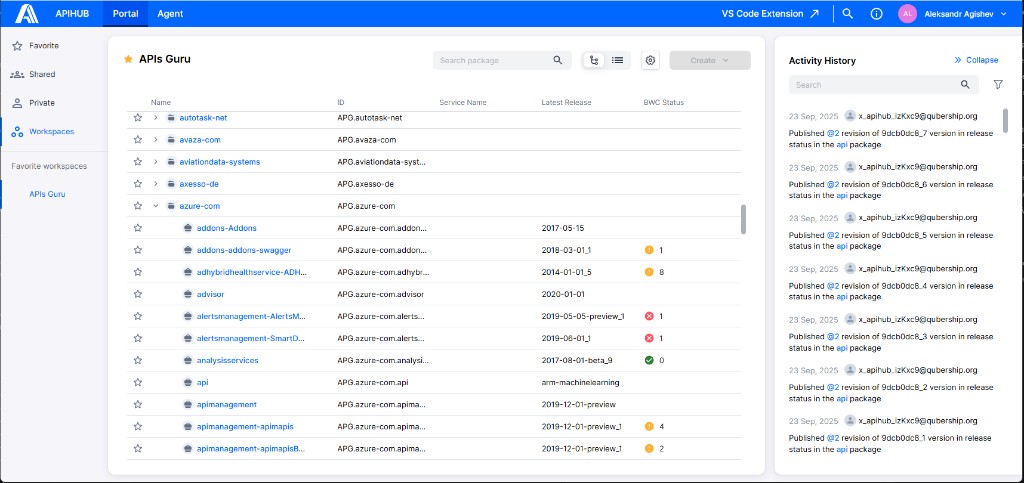
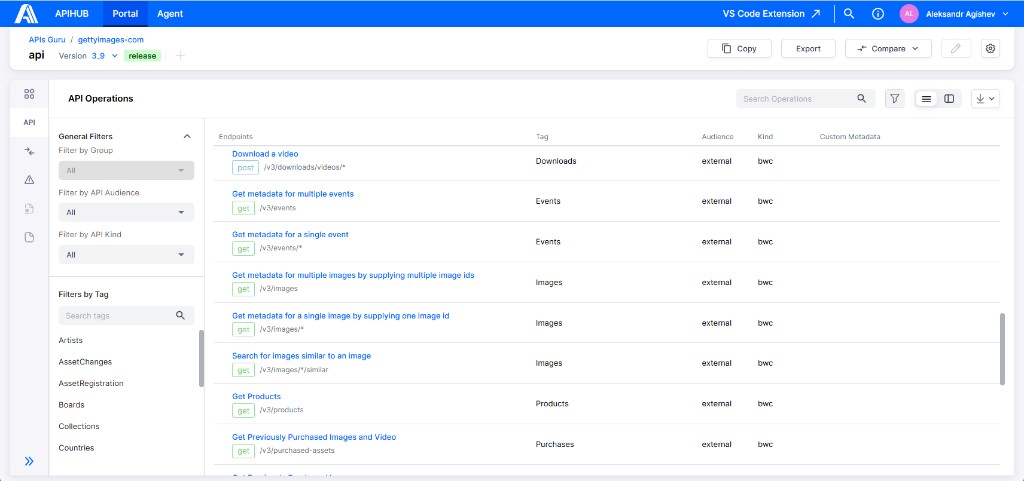
The Portal UI: catalog, version comparison, interactive documentation, and operation lists.
| Workspace & governance | Compare package versions |
|---|---|
 |
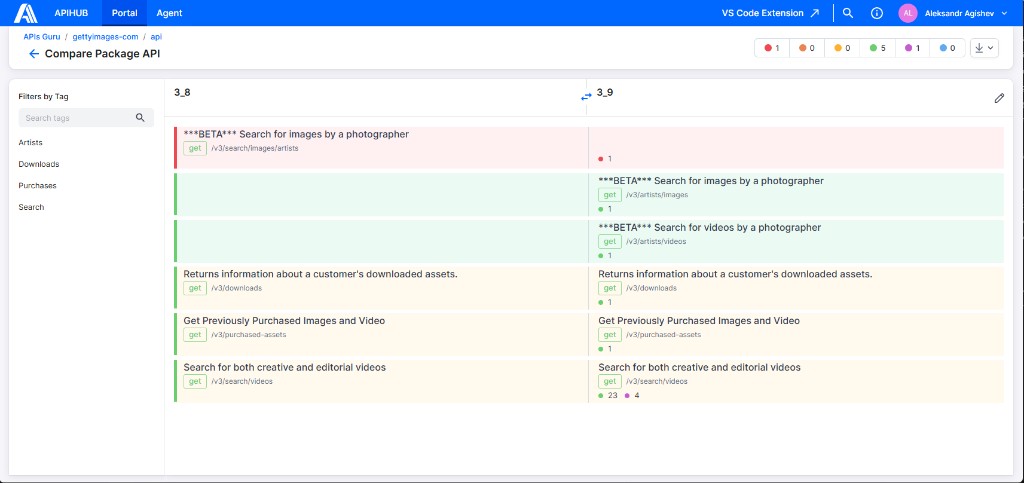 |
| Workspaces: searchable package tree, latest releases, BWC signals, and audit trail. | Compare releases: color-coded breaking vs safe changes across operations. |
| API operations | Endpoint documentation |
|---|---|
 |
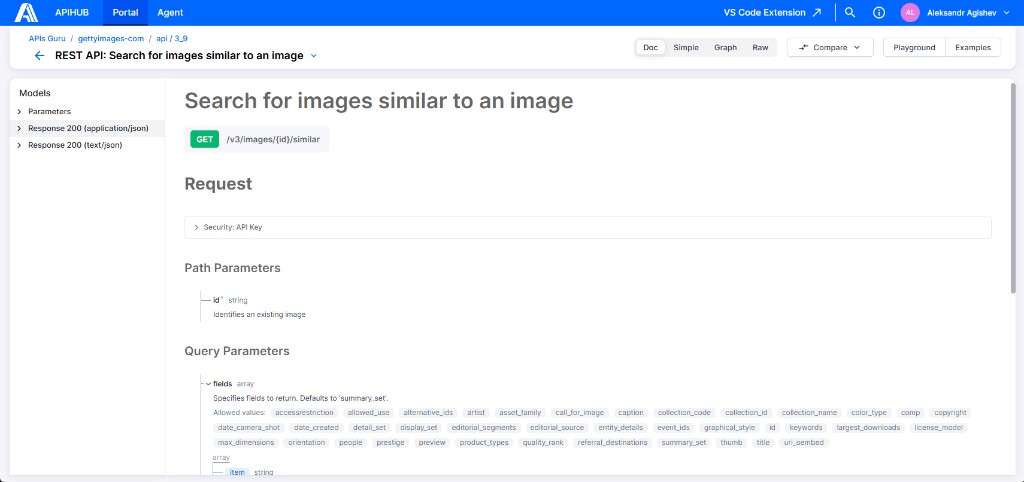 |
| Per-version operation index with filters and export/compare actions. | Rich Doc view for a single operation, with parameters and schemas. |
Architecture at a glance
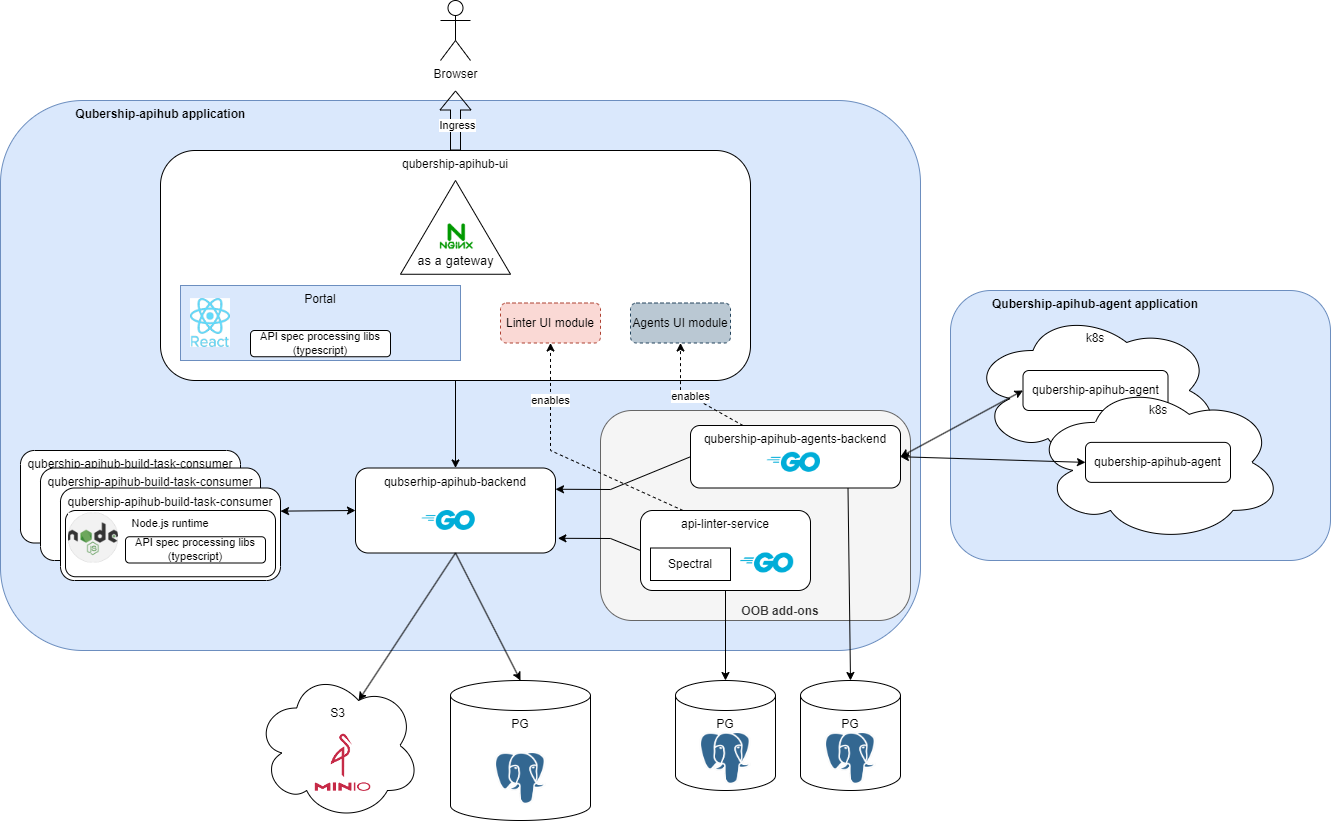
| Layer | Role |
|---|---|
| Portal UI | React SPAs (Portal + Agents) behind nginx — unified entry for users and operators. |
| API Registry | Go backend: REST API, auth, packages/versions, build orchestration, MCP & AI chat hooks. |
| Builder | NestJS workers consume the TypeScript processing stack (normalize → diff → changelog → export). |
| Extensions | API Linter (Spectral / AI / scoring), Agents Backend for remote discovery agents. |
For a detailed diagram, API-type matrix, and extension roadmap, see the Architecture landscape on the wiki.
For a full feature list, see Features list.
Core components
API Registry (backend)
The central Go service: REST API, authentication (SAML / OIDC / LDAP), RBAC, package and version lifecycle, build task orchestration, and integrations (e.g. MCP server, AI chat). It persists state in PostgreSQL and coordinates asynchronous builds and notifications.
Repository: qubership-apihub-backend
Builder service
Stateless NestJS workers pull build tasks, run the api-processor pipeline (parse → operations → normalize → diff → changelog / export), and return artifacts to the registry. Supports REST, GraphQL, AsyncAPI, Markdown, and unknown/generic documents.
Repository: qubership-apihub-build-task-consumer
Web portal
React + MUI + Vite: the main Dev Portal for browsing the catalog, comparing versions, viewing API quality, managing settings, and (separately) the Agents app for cluster discovery workflows.
Repository: qubership-apihub-ui
Extensions (typical delivery)
API Linter service
Pluggable quality gate: Spectral for OpenAPI and AsyncAPI, optional OpenAI-based review for OpenAPI, plus aggregated version scoring exposed via the linter API. Subscribes to publish events so new versions are validated automatically.
Repository: qubership-api-linter-service
APIHUB Agents
Agents backend registers and manages APIHUB agents deployed in customer clusters. Agents perform service discovery (OpenAPI, GraphQL, AsyncAPI, Markdown, JSON Schema, and more) and support snapshots and promotion flows.
More context: Supplementary applications on the wiki.
Documentation
| Hub (start here) | docs/README.md — maps guides, Helm, Compose, ERD, wiki links |
| Installation | docs/installation-guide.md |
| Administration | docs/admin-guide.md |
| User guide | docs/user-guide.md |
| Maintenance | docs/maintenance-guide.md |
| Project history | docs/apihub-history.md |
| Wiki | Qubership APIHUB Wiki |
Deploy
- Helm (production-oriented): see helm-templates/README.md and docs/installation-guide.md.
- Docker Compose (dev/test): docker-compose/apihub-generic/.
- Local Kubernetes quickstart (developers / R&D, not production): helm-templates/local-k8s-quickstart/README.md.
Repository role
This repository (qubership-apihub) is the umbrella deployment project: Helm charts, Compose stacks, and product-level documentation. Application source code lives in the component repositories linked above; reusable CI is in qubership-apihub-ci.
Qubership APIHUB — align teams on APIs, ship changes with clarity.
Yorumlar (0)
Yorum birakmak icin giris yap.
Yorum birakSonuc bulunamadi