localmind
Health Uyari
- License — License: MIT
- Description — Repository has a description
- Active repo — Last push 0 days ago
- Low visibility — Only 7 GitHub stars
Code Basarisiz
- rm -rf — Recursive force deletion command in config/config.example.toml
- rm -rf — Recursive force deletion command in install.sh
- rm -rf — Recursive force deletion command in uninstall.sh
Permissions Gecti
- Permissions — No dangerous permissions requested
Bu listing icin henuz AI raporu yok.
Run any local LLM with persistent memory and context. CLI agent over Ollama with SQLite-backed hybrid recall. No cloud.
localmind
Run any local LLM with persistent memory.
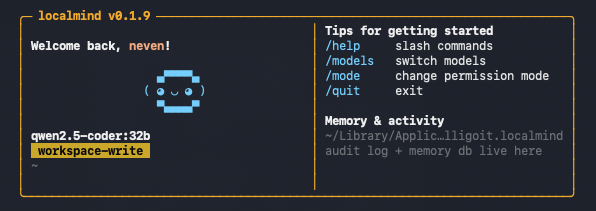
What it is
A single CLI binary (llm) that turns an Ollama-served
model into an interactive agent with long-term memory, learnable skills, and
permissioned tools. Everything runs on your machine — no cloud, no telemetry,
no dependencies beyond Ollama.
What it does
- Talk to any local chat / vision / embedding model Ollama has installed.
- Remember what you tell it across sessions. Facts, decisions, skills,
embeddings, an entity graph — all in one SQLite file you can back up
or move. - Recall relevant prior context automatically at the start of every turn
via a hybrid BM25 + vector + graph retriever. - Resume each session where you left off, per working directory.
- Read files, PDFs, docx, xlsx, images. Describe images with vision models.
- Run shell, networking, and web tools with per-call permission prompts and
a hard credential deny-list.
How it works
you type  ─►  auto-extract facts  ─►  hybrid recall  ─►  agent loop  ─►  streamed reply
                    │                       │                 │
                    ▼                       ▼                 ▼
              SQLite memory.db      BM25 + vector +       tool calls
                                    graph, fused by RRF
- Auto-extract. A regex catches obvious directives (
my name is X,call me X,remember X) before the model sees the turn. Stored
regardless of whether the model would have calledstore_memory. - Recall. Three retrievers run concurrently: BM25 (FTS5), vector
ANN (sqlite-vec), and optional graph retrieval (Personalized PageRank
over the entity graph). Results are fused via Reciprocal Rank Fusion —
rank-based, parameter-free — then pruned by temporal decay. An optional
LLM-as-judge reranker can rescore the top N before the final cut.
Trivial turns (hi,ok,thanks) skip recall entirely. - Agent loop. The model sees tool specs and may call
read_file,shell,web_fetch,store_memory, etc. Side-effecting tools are
gated by the permission mode and / or prompt before running. - Streamed reply. Tokens are printed as they're generated — no long
"thinking…" pause before the wall of text drops. Reasoning-model
chain-of-thought (<think>…</think>) is filtered out; only the final
answer reaches the transcript. - Persistence. Conversation messages, new memories, and extracted
entities are written back to SQLite. Embedding + entity extraction
run on a background worker so turns never wait on them. - Context care. When the live message history approaches
num_ctx,
a summariser compacts the oldest middle messages into a single system
message automatically — the system prompt and last few turns stay
verbatim./compacttriggers manually.
Features
Memory
- Portable. Single SQLite file;
llm backup/llm restorecopy it
cleanly between machines. No re-teaching. - Hybrid recall. BM25 + vector ANN + optional graph retrieval, fused
by Reciprocal Rank Fusion. Rank-based fusion removes the "tune the
weights" problem that plagues score-based setups. - Graph retrieval (opt-in). Entities and relationships extracted from
each memory populate a knowledge graph. Personalized PageRank seeded
from query entities finds memories that are multi-hop related even
when they share no keywords. - Contextual embeddings (opt-in). A one-sentence model-generated
context line is prepended to each memory before embedding — improves
recall on short or ambiguous notes. - LLM-as-judge reranker (opt-in). A small instruct model can rescore
the top-N candidates in a single batched call before the final cut. - Temporal decay. Older memories fade in ranking; the half-life is
configurable. - Learnable skills. Tell it "from now on when X, do Y" — stored as
akind="skill"memory, surfaced automatically on matching turns.
The verify harness (llm run) and conversation compaction also distill
reusable procedures into skills so the agent does not rediscover the
same fix next time. - Decisions ledger. Structured append-only log of choices
(log_decision/list_decisions) mirrored into searchable memory. - Verify harness.
llm run "<task>"runs plan → act → verify across
local models; failed verifies retry the act stage. Shared SQLite memory
only — no markdown memory files. - Session persistence. Each working directory gets its own persistent
conversation thread. Re-launchingllmin the same directory resumes
the last N messages./new(aliases/clear,/reset) starts fresh. - Auto-compaction. In-session message history is summarised
automatically when it approachesnum_ctx. Summaries are written back
to long-term memory./compacttriggers manually.
Agent behaviour
- Reasoning-model aware.
<think>…</think>blocks are stripped from
the streamed transcript so users see the final answer only. - Narrated-write detector. Some models describe file writes by
printing numbered diff rows in prose instead of actually callingwrite_file. When detected, the agent nudges the model once per turn
to call the tool for real. - Streaming responses. Tokens appear in real time.
- Fast repeat turns.
keep_alive: 30mstops Ollama from unloading
the model between turns; no cold-load per message. - Cascade router. Optional two-model setup: short / chatty turns and
auxiliary calls (query expansion, etc.) run on a smallfast_model;
code-heavy or long turns route to the configuredchat_model./retry-bigmanually escalates the last turn when the router picked
wrong.
Tools & safety
- Safe-by-default tools. Workspace-confined writes, SSRF guard on
web_fetchandwhois, destructive-pattern detection onshell,
credential deny-list that's always on. - Interactive permission grants. When the model wants to write / run
something it isn't pre-approved for, you get a prompt:[y]es [a]lways this session [f]orever [n]o [e]dit(reason).
Pickforeverand the grant is saved to your config (comment-preserving
toml_edit — other settings untouched) so the next session starts
already pre-approved. - Permission modes.
read-only,workspace-write(default),unrestricted. Switch mid-session with/mode.
Operations
- Self-updating. Daily background check for a newer release;
llm updatere-runs the installer in place. - Model picker.
llm modelslists installed Ollama models and lets
you set chat / vision / embed non-interactively or via a picker. - Inspectable.
llm healthreports DB, embedder, and Ollama state./recall <q>,/context,/auditexpose what the model is actually
seeing. JSONL audit log of every tool call.
Install
One-liner (macOS arm64, Linux x86_64/arm64). Downloads the latest release
binary, verifies SHA256, installs to ~/.local/bin/llm, installs Ollama
(headless CLI via Homebrew on macOS, official installer on Linux), starts
the server, and pulls the default chat + embed models:
curl -fsSL https://raw.githubusercontent.com/nevenkordic/localmind/main/install.sh | sh
Environment overrides:
| var | what |
|---|---|
LOCALMIND_INSTALL_DIR |
install target (default $HOME/.local/bin) |
LOCALMIND_VERSION |
pin a release tag (default latest) |
LOCALMIND_CHAT_MODEL |
override the chat model the installer pulls |
LOCALMIND_EMBED_MODEL |
override the embed model the installer pulls |
LOCALMIND_OLLAMA_GUI=1 |
install the full Ollama.app (macOS cask) |
LOCALMIND_SKIP_OLLAMA=1 |
don't install or start Ollama |
LOCALMIND_SKIP_MODELS=1 |
don't pull models (saves ~5 GB on metered) |
Build from source (Intel Mac / Windows, or if you don't want the release
binary):
git clone https://github.com/nevenkordic/localmind
cd localmind
./scripts/install.sh        # macOS / Linux
.\scripts\install.ps1       # Windows
Use
llm                          # interactive REPL, resumes last session for cwd
llm ask "fix the failing test"
llm run "fix the failing test"  # plan → act → verify harness; records skills
llm health                   # DB stats, Ollama reachability, recall config
llm memory search "deploy procedure"
llm memory search "deploy procedure" --bm25    # skip embedding (fast)
llm memory reembed           # re-run the embedding + extraction pipeline
llm memory reindex           # rebuild the ANN index over existing vectors
llm memory stats             # counts: memories, vectors, entities, edges
llm models                   # pick chat / vision / embed models
llm backup [<path>]          # copy memory DB to a file
llm restore <path>           # replace memory DB from a backup
llm update                   # grab a newer release
REPL slash commands:
/help    /quit    /init    /stats    /health    /audit
/config  /tools   /mode    /model
/skills  /forget <id>  /remember <fact>
/recall <query>  /context
/compact                        summarise history now (auto-fires near num_ctx)
/new     /clear   /reset        wipe this session's history, start fresh
/retry-big                      re-run the last turn on chat_model
Configure
cp config/config.example.toml config/local.toml
[ollama]
| key | effect |
|---|---|
chat_model |
capable model — used for code / tools / long prompts |
fast_model |
optional small model for short turns + auxiliary calls |
vision_model |
used when a turn includes image input |
embed_model |
used by the memory index |
num_ctx |
per-reply token budget |
keep_alive |
how long Ollama holds the model in RAM (default 30m) |
temperature |
sampling temperature |
top_p |
nucleus sampling |
auto_compact_at |
compaction threshold as fraction of num_ctx (0 = off) |
compact_keep_tail |
messages preserved verbatim at the tail on compaction |
resume_messages |
messages to reload from previous session per cwd (0 = off) |
[memory]
| key | effect |
|---|---|
vector_search |
false = pure BM25 recall (~10× faster, less semantic) |
expansion_variants |
LLM query paraphrasings (0 = off; uses fast_model) |
temporal_half_life_days |
how fast old memories decay in ranking |
auto_persist |
auto-summarise turns into memories |
contextual_embed |
prepend a model-generated context line before embedding |
entity_extraction |
populate the entity graph from each new memory |
graph_search |
PPR-based graph retriever in the fusion mix |
rerank_model |
LLM-as-judge reranker model (empty = disabled) |
rerank_fetch_k |
candidate pool size when reranking |
bm25_weight / vector_weight |
legacy score-fusion weights; ignored (RRF now) |
[tools]
| key | effect |
|---|---|
mode |
read-only / workspace-write / unrestricted |
workspace_root |
confines writes to a directory tree |
deny_globs |
extra paths to refuse |
allow_rules |
auto-approve patterns (populated by [f]orever grants) |
deny_rules |
hard refusals |
ask_rules |
always prompt, even when allowed elsewhere |
[web]
| key | effect |
|---|---|
brave_api_key |
enables web_search |
block_private_addrs |
refuse fetches to RFC1918 / metadata IPs |
Env vars override: LOCALMIND_CHAT_MODEL, LOCALMIND_DB_PATH,BRAVE_API_KEY, LOCALMIND_NO_UPDATE_CHECK, etc.
Permission modes
read-only          no writes, no shell mutations, no outbound network
workspace-write    writes confined to workspace_root; shell/web prompt
unrestricted       prompts only; no extra guard-rails
Switch mid-session with /mode <ro|ww|full>. Default in [tools].mode.
Backup / move to another machine
The memory DB is a single SQLite file — everything the agent knows lives there.
llm backup                          # ~/localmind-backup-YYYYMMDD-HHMMSS.db
llm backup /path/to/somewhere.db    # explicit destination

# On the other machine:
llm restore /path/to/somewhere.db   # prompts y/N before overwriting
backup uses SQLite's VACUUM INTO — safe while localmind is running.restore keeps your previous DB at memory.db.bak-YYYYMMDD-HHMMSS so repeat
restores never clobber each other's rollback points.
After a restore, or after changing embed_model / enablingcontextual_embed, run llm memory reembed to regenerate vectors
against the current settings.
Update
localmind checks GitHub for a newer release once every 24 hours (background,
non-blocking). When one is available, you see this at startup:
↑ v0.2.0 available (you have 0.1.6) — run 'llm update' to upgrade
Then:
llm update            # re-runs install.sh
llm update --force    # reinstall even when on latest
Disable with [updates] check = false or LOCALMIND_NO_UPDATE_CHECK=1.
Uninstall
curl -fsSL https://raw.githubusercontent.com/nevenkordic/localmind/main/uninstall.sh | sh
Removes the binary and strips the PATH line. Your memory DB and audit log are
kept. Opt-in flags: LOCALMIND_PURGE_DATA=1 wipes the memory DB;LOCALMIND_PURGE_MODELS=1 runs ollama rm on the default models. Ollama
itself is never removed.
Where things live
~/Library/Application Support/com.calligoit.localmind/   macOS
~/.local/share/localmind/                                Linux
%LOCALAPPDATA%\localmind\                                Windows
  ├── memory.db       facts, skills, embeddings, KG, session history
  ├── audit.log       JSONL log of every tool call
  └── history.txt     REPL history (mode 0600 on Unix)
llm health prints the resolved paths.
Development
cargo test                 # unit + smoke + e2e
bash scripts/preflight.sh  # full pre-ship verification
cargo build --release      # binary at target/release/llm
License
MIT — see LICENSE.
Yorumlar (0)
Yorum birakmak icin giris yap.
Yorum birakSonuc bulunamadi