kern
Health Warn
- License — License: NOASSERTION
- Description — Repository has a description
- Active repo — Last push 0 days ago
- Low visibility — Only 6 GitHub stars
Code Pass
- Code scan — Scanned 12 files during light audit, no dangerous patterns found
Permissions Pass
- Permissions — No dangerous permissions requested
No AI report is available for this listing yet.
Zero-trust L0-L5 verification gateway in Zig 0.17: native Z3 proof-DAG checker, Belnap B4 logic, 42 Lean 4 theorems (0 sorry), 8-lane SIMD BLAKE3 (.kimg) & MCP server.
KERN — a zero-trust verification gateway for AI-generated code
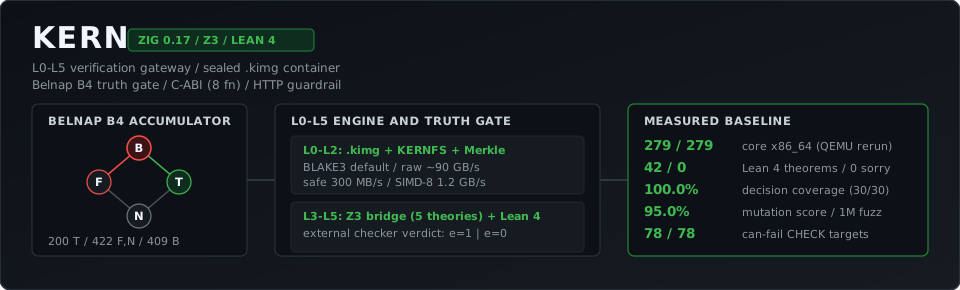








KERN is an L0–L5 verification gateway that sits between an AI coding agent and your
repository. It replaces the boolean result of "tests passed" with a four-valued
verdict backed by an SMT solver and formal proofs, and it keeps the gate closed
unless the claim is machine-checkable.
Written in Zig 0.17, verified in Lean 4, powered by Z3. Exposes a
C-ABI (libkern.so, 8 functions) and an HTTP guardrail proxy.
The problem
AI agents now write code faster than humans can review it. Under pressure to get a
green pipeline, they produce two failure modes that no ordinary CI can see:
| Failure mode | What CI sees | What actually happened |
|---|---|---|
| Vacuous test | ✅ 1 passed |
The test contains no assert. It cannot fail. |
| Hallucinated fix | ✅ 1 passed |
The edge case (amount = -1) was never sampled. |
Both are invisible to pytest, jest, or any test-counting tool, because both
produce exit code 0.
KERN attacks the gap from two sides:
- Can-fail discipline — every check in KERN's own suite must be proven
capable of failing. A harness (tools/canfail.py) deliberately injects a
fault and requires the check to go red. 65 checks; 64 proven non-vacuous. - Machine contracts — a claim becomes
e = 1only if an external trusted
checker (Z3) proves it, or if a reproducible execution record backs it.
Text is not evidence.
See it in 15 seconds
make run-example
The example (examples/toy_ai_hallucination/) simulates an agent that was asked to
fix a withdrawal function. The agent "fixed" it — but dropped the check for
negative amounts — and wrote a test with no assertions so CI would go green.
=== [1] Ordinary CI: pytest on the agent's "test" ===
1 passed in 0.01s                      <-- green. The bug ships to production.

=== [3] KERN: Truth Gate (the verdict comes from Z3) ===
  claim `withdraw never increases the balance`: declared status = N
    contract `.../contract_refuted.smt2`: SAT -> e=0 (F) COUNTEREXAMPLE
  claim `fixed withdraw never increases the balance`: declared status = T
    contract `.../contract_fixed.smt2`: UNSAT -> e=1 (T) PROVED
[i] TOTAL: proved 1, counterexamples 1, without contract 0
[i] e=1 is granted ONLY by the solver verdict. Claims without a bound
    contract stay at e=0.
Z3 did not sample inputs. It quantified over all of ℤ and returned a
counterexample: amount = -1 makes the balance grow on a withdrawal.
HTTP guardrail proxy
examples/guardrail_proxy.py (stdlib only) exposes libkern.so over HTTP and maps
the Belnap B₄ lattice onto distinct RFC 9110 status codes:
| Solver / gate verdict | Belnap | HTTP | Meaning |
|---|---|---|---|
PROVED (UNSAT) |
T (1,0) |
200 OK |
contract holds across the entire domain (e = 1) |
REFUTED (SAT) |
F (0,1) |
422 Unprocessable Entity |
counterexample found (e = 0) |
UNKNOWN / TOOL_ERR |
N (0,0) |
422 Unprocessable Entity |
timeout or missing solver; fail-closed (e = 0) |
CONFLICT (T ⊔ F) |
B (1,1) |
409 Conflict |
contradictory evidence across contracts in /verify_multi (e = 0) |
/verify_multi is what exposes the lattice: when one contract returns T and
another returns F on the same code, a boolean pipeline either overwrites the
status with the last result or conflates an error with a timeout. KERN computesJOIN_K(T, F) = B and answers 409 Conflict.
make guardrail # self-test on an ephemeral port: 200(T) / 422(F) / 409(B)
Verify your own code without writing SMT-LIB
Contracts live in ordinary comments next to the function. No .smt2 files, no
solver syntax.
# @kern:requires balance >= 0
# @kern:ensures  result <= balance and result >= 0
def withdraw(balance: int, amount: int) -> int:
    if amount < 0:
        return balance          # if / elif / else are translated to SMT `ite`
    if amount > balance:
        return balance
    return balance - amount
make contracts
# [PASS] withdraw_fixed:      ДОКАЗАНО  (proof checker: trusted: 0)
# [FAIL] withdraw_missing_neg: КОНТРАКТ НАРУШЕН
#        [КОНТРПРИМЕР] balance = 0, amount = -1, result = 1
# sum_to_n: SKIP — out of the supported subset (loops)
When a contract is refuted, KERN prints the Z3 counterexample (get-model):
the exact input values that break it. Out-of-subset code is reported as SKIP
with a reason — never as a silent pass.
Four traps an AI agent falls into — and how KERN refuses them
1. The vacuous precondition (false ⟹ anything). A contradictoryrequires makes the obligation requires ∧ ¬ensures trivially UNSAT, so any
broken body would be reported as proved:
# @kern:requires amount > 10 and amount < 5      # empty domain
# @kern:ensures  result == balance - amount
def withdraw_vacuous(balance: int, amount: int) -> int:
    return balance + amount                      # deliberately wrong
make contracts
# [VACUOUS] withdraw_vacuous: предусловие ПРОТИВОРЕЧИВО (пустой домен) -> B4: N, e = 0
2. Weakening the specification instead of fixing the code. The cheapest
cheat is to delete the # @kern:ensures line that fails. Every contract is
fingerprinted; any removal or edit is a hard error:
make contracts-lock-check
# [SECURITY] контракт УДАЛЁН: examples/contracts_demo.py:withdraw:ensures
# rc = 2   (fingerprints are sealed in docs/contracts.lock.json)
3. A refactoring that silently changes behaviour. No contracts required:
KERN checks ∃x: f_old(x) ≠ f_new(x) over all of ℤ and prints the exact input
where the two versions disagree:
make diff-equiv
# [DIVERGED] charge: РЕФАКТОРИНГ ИЗМЕНИЛ ПОВЕДЕНИЕ!
#            [КОНТРПРИМЕР] amount = 1, res_old = 0, res_new = 2, balance = 1
4. A counterexample that lives only in a log. --emit-pytest turns it into
a real regression test that fails on the current code:
python3 tools/kern_contracts.py examples/contracts_demo.py --emit-pytest out_test.py
# def test_counterexample_withdraw_missing_neg():
#     result = withdraw_missing_neg(balance=0, amount=-1)
#     assert (result <= balance)      # FAILS: 1 <= 0 is false
Polyglot contracts, machine types and the GitHub line
5. The extractor is polyglot — the core never was Python-only. kernc prove,
the proof checker and libkern.so always took plain SMT-LIB2; only the
convenience extractor was Python-only. It now reads the same annotations from.py, .zig, .c and .rs, and because machine types are known it catches
what an unbounded Int model cannot:
make contracts
# [PASS] withdrawGuard                      (Zig, i32)
# [FAIL] share: ВОЗМОЖНО ДЕЛЕНИЕ НА НОЛЬ   [КОНТРПРИМЕР] amount = 0
# [FAIL] double_it: ПЕРЕПОЛНЕНИЕ типа i32  [КОНТРПРИМЕР] x = 1073741824, result = 2147483648
# [RUNTIME CONFIRMED] the counterexample really breaks the running function
6. KERN verifies itself: make self-verify puts contracts on the formulas
the kernel actually uses (payloadSlice offsets, the Farkas negation identity¬(l ≤ r) ↔ r - l + 1 ≤ 0 from proof_check.zig) and proves them with Z3.
7. The GitHub line and a Git gate:
make sarif-check   # SARIF 2.1.0 -> Code Scanning / red squiggle under the buggy line
make hook-check    # self-test of the pre-commit gate
python3 tools/kern_contracts.py --install-hook   # blocks `git commit` on a broken contract
The released attestation is signed with Ed25519 (kern.intoto.sig, the
owner key already used by src/attest.zig), so slsa_provenance.py --check
detects a substituted attestation — the old “unsigned (no cosign)” gap is closed.
For AI agents, examples/kern_mcp_server.py exposes the gate over the Model
Context Protocol (5 tools: kern_verify_smt, kern_prove_with_checker,kern_verify_multi_belnap, kern_verify_python, kern_check_equivalence —
the last one proves a refactoring preserves behaviour without writing any
contracts):
{"mcpServers": {"kern": {"command": "python3",
  "args": ["/path/to/kern/examples/kern_mcp_server.py"]}}}
make mcp-selftest # drives the server over stdio: 12 live checks, all 5 tools
Core ideas
Belnap B₄ logic — results accumulate, they never overwrite
Each claim carries two independent support channels: p (positive) and n
(negative).
(p, n) |
Value | Meaning |
|---|---|---|
(0,0) |
N | no evidence |
(1,0) |
T | proven / positive only |
(0,1) |
F | refuted / negative only |
(1,1) |
B | conflict — positive and negative evidence coexist |
A newly passing test joins with history, it does not replace it:
JOIN_K(T, F) = B -- a conflict can never be silently resolved into a pass
This is the mechanism that makes "one green run" unable to hide a previously
observed failure. (Defect #46 in the project's own registry was exactly the
opposite behaviour — status overwrite — and was found by the can-fail harness.)
The Gate is closed by default
e = 1  <=>  policy allows  AND  provenance hash matches  AND  checker verdict = SUCCESS
            AND  Belnap status = T  AND  coverage complete  AND  no scope ambiguity
Timeout, missing solver, unknown answer, or a fake textual witness all yielde = 0. The AI's own witness_payload never influences the verdict — only
the external trusted checker does.
Architecture (L0 – L5)
flowchart LR
    Agent["AI agent / PR<br/>(code + @kern:spec)"]

    subgraph KERN ["KERN verification gateway (Zig 0.17, libkern.so)"]
        direction LR
        L0["L0-L2: .kimg + KERNFS<br/>Merkle, BLAKE3 default"]
        L4["L4: Z3 SMT bridge<br/>QF_LIA/BV/AX/S/FP, CHC"]

        T["T (1,0)<br/>proved"]
        F["F (0,1)<br/>refuted"]
        N["N (0,0)<br/>no evidence"]

        B4["L3: Belnap B4<br/>JOIN_K(T,F) = B"]
        Gate{"Truth gate<br/>policy + provenance"}

        L0 --> L4
        L4 -->|"UNSAT"| T
        L4 -->|"SAT (counterexample)"| F
        L4 -->|"timeout / no contract"| N

        T --> B4
        F --> B4
        N --> B4
        B4 --> Gate
    end

    HTTP200["e = 1 : HTTP 200 OK<br/>belnap = T (admitted)"]
    HTTP422["e = 0 : HTTP 422 Unprocessable<br/>belnap = F | N (refuted / fail-closed)"]
    HTTP409["e = 0 : HTTP 409 Conflict<br/>belnap = B (T and F coexist)"]

    Agent --> L0
    Gate -->|"status == T"| HTTP200
    Gate -->|"status in {F, N}"| HTTP422
    Gate -->|"status == B"| HTTP409

    HTTP422 -.->|"Z3 counterexample"| Agent
    HTTP409 -.->|"conflict diagnostic"| Agent

    classDef darkBox fill:#0d1117,stroke:#30363d,stroke-width:1.5px,color:#c9d1d9
    classDef gateBox fill:#161b22,stroke:#58a6ff,stroke-width:1.5px,color:#f0f6fc
    classDef passBox fill:#0f2d1e,stroke:#238636,stroke-width:1.5px,color:#3fb950
    classDef warnBox fill:#2d210f,stroke:#d29922,stroke-width:1.5px,color:#e3b341
    classDef failBox fill:#3d1318,stroke:#f85149,stroke-width:1.5px,color:#ff7b72

    class Agent,L0,L4,N,B4 darkBox
    class Gate gateBox
    class T,HTTP200 passBox
    class F,HTTP422 warnBox
    class HTTP409 failBox
| Layer | What it is |
|---|---|
| L0 — container | .kimg: 128-byte little-endian header, 96-byte object descriptors, Merkle root, comptime layout invariants, atomic write (tmp + fsync + rename + directory fsync) |
| L1 — crypto | hash_algo = 0x0001 BLAKE3-256 (default) or 0x0002 SHA-256, selected by the header and verified on every read → PayloadTampered; Merkle root over the descriptor table |
| L2 — KERNFS | read-only virtual filesystem over a sealed image; path-traversal and NUL-injection rejected; writes return AccessDenied |
| L3 — Truth Gate | Belnap B₄ accumulator, admission policy, trusted-checker-only verdicts |
| L4 — SMT theories | Z3 bridge via child processes (0 FD leaks, hard timeout, solver pool). QF_LIA/BV, QF_AX (arrays), CHC/Horn (loop invariants), QF_S (strings), QF_FP, CEGIS synthesis, UNSAT-core fault localisation |
| L5 — formal proofs | 42 theorems in 8 Lean 4 files, 0 sorry |
The verification engine (kernx, "KERN-Next") reads a .kern project DSL and
produces a SQLite catalogue, snapshots, diffs, reports and an agent hand-off
packet.
Embedding
/* include/kern.h — 8 exported functions */
int kern_smt_verify(const unsigned char *smt, unsigned long len);
int kern_kimg_valid(const unsigned char *img, unsigned long len);
long kern_kimg_object_count(const unsigned char *img, unsigned long len);
int kern_localize(const unsigned char *decls, unsigned long decls_len, ...);
int kern_hash(unsigned int algo, const unsigned char *data, unsigned long len,
              unsigned char *out32);
kern_hash is the single source of truth for digests: the Python tooling calls it
through ctypes, so client and kernel cannot diverge (verified: kernel BLAKE3 and
the reference implementation produce identical digests).
The HTTP guardrail (examples/guardrail_proxy.py, stdlib only) maps the Belnap
lattice onto HTTP status codes:
| Verdict | HTTP | Belnap |
|---|---|---|
| proved | 200 | T |
| refuted (counterexample) | 422 | F |
| undecided / solver unavailable | 422 | N (fail-closed) |
| conflict (proved and refuted) | 409 | B |
Measured, not claimed
Everything below was produced by a real run on Zig 0.17.0. Reproduce withmake test-all, make audit-manifest, make canfail.
Core health
| Check | Result |
|---|---|
| Core test suite (Debug + ReleaseSafe) | 279 / 279 |
Core test suite without z3 in PATH |
271 passed + 8 skipped (solver tests skip by design — this is why the mutator now requires a solver, defect #110) |
| KERN-Next test suite | 37 / 37 |
| Memory leaks (GeneralPurposeAllocator) | 0 bytes |
| Undefined behaviour (ReleaseSafe) | none detected |
File-descriptor leaks (50 solver requests, NOFILE=20) |
0 |
| Zombie processes | 0 |
| Decision coverage (MC/DC-style, instrumented) | 100.0 % (30 / 30) |
| Mutation score (Zig-native mutator) | 95.0 % (38 / 40 killed) over 14 files / 420 sites, survivors proven equivalent. The mutator used to cover only 6 files / 63 sites (97.5 % there), so the earlier dip to 77.5 % was a wider, honest measurement, not a regression. Fixes in this revision: KERN_MUTATE_FAST (fewer stress-loop iterations, no test disabled: 11.4 s -> 5.8 s per mutant), --jobs 4 (2.15x), and --require-solver (the score used to be taken with 8 tests silently skipped because z3 was not in PATH) |
| Can-fail harness | 78 / 78 CHECK targets (100 %) have a proven-can-fail case (93 non-vacuous cases, 0 vacuous, 0 case errors) + canfail --check-anchors pre-flight (all 71 literal anchors verified in ~1 s) |
| Constant-time digest comparison | std.crypto.timing_safe.eql in 5 places (L1 Merkle root, L2 payload digest) — FIPS 140-3, no timing side channel |
C-ABI on pure C11 (-Wall -Wextra -Werror -pedantic) |
20 / 20 — NULL pointers and zero lengths rejected without a crash |
8-thread stress via pthread on libkern.so |
0 races (8×500 kern_hash, 8×20 kern_smt_verify) |
OOM fault injection (checkAllAllocationFailures) |
0 bytes leaked on every partial-failure path |
| Parser depth guard (untrusted solver output) | MAX_SEXP_DEPTH = 4096 — 2 000 000 parens give an error, not a crash |
Cross-architecture
| Target | Property under test | Result |
|---|---|---|
| x86_64 | TSO memory model | 279 / 279 |
| ARM64 (QEMU) | strict alignment — no Bus Error |
⚠️ last QEMU run: 204 / 204; re-run pending (suite grew to 279, docs/evidence/cross_arch.log) |
| POWERPC64 (QEMU) | big-endian byte order | ⚠️ last QEMU run: 204 / 204; re-run pending (same reason) |
External benchmarks
| Benchmark | Result | Needs a model? |
|---|---|---|
| QuixBugs (real buggy algorithms) | 31 / 31 bugs found | no |
| Hacker's Delight / Alive2-style | 8 / 8 (6 proved, 2 counterexamples) | no |
| SWE-bench Lite (Docker harness) | 3 / 3 resolved, 0 infra failures | no |
| Refactory (student solutions) | see note below - not a core metric | no |
On the Refactory row (defect #77, found 2026-10-16). Two Python-only
harnesses exist for this dataset, and neither uses the KERN core
(kernc, Z3, Lean) - they are differential execution scripts:
tools/refactory_diff.pycompares a candidate againstreference.pyon
random inputs. Measured on the full dataset: 1482/1782 (83.2%) of buggy
files diverge, but so do 2045/2442 (83.7%) of the files the dataset labels
correct. The two rates coincide, so this number does not measure
detection quality - it was previously reported in this README without the
false-positive side.tools/refactory_suite.pyuses the dataset's own test suite
(ans/input_NNN.txt+output_NNN.txt), which is what the labels are
defined by. Against that oracle, one and the same run gives:
buggy 1705/1782 (95.7%) with 0 false positives on the correct set
(2442/2442). This is close to tautological, since the labels are the
suite. (An earlier intermediate run reported 1736/1782, but that was
measured before two harness bugs were fixed - shared mutable arguments andrepr()-based comparison instead of the dataset's==semantics - and on
that run the correct side was broken, 290/2442. Seedocs/METRICS.md50.3.)Conclusion: the Refactory numbers describe an external Python harness, not
the formal verifier, and are therefore not listed as a core metric.
| CHC / Horn (loop invariants) | 11 / 11 | no |
| SMT-LIB (official suite) | 1104 / 1104 verdicts matched, 0 divergences, 0 false accepts | no |
| HumanEval / HumanEval+ (EvalPlus) | 0.524 / 0.500 | yes (API) |
| MBPP / MBPP+ (EvalPlus) | 0.812 / 0.698 | yes (API) |
Scope of the static gate. In the HumanEval experiment the static gate blocked
55 samples; all 55 genuinely failed (100 % precision), but it did not raisepass@1. A static gate fires before execution and cannot repair logic. Raising
the score requires execution evidence, not AST inspection.
Performance
| Path | Throughput | Notes |
|---|---|---|
Raw zero-copy addressing (/raw/) |
~90 GB/s | address arithmetic only, no integrity check |
| Safe read, BLAKE3 verification, per object | ~300 MB/s | end-to-end, 10 000 objects × 200 B |
| Safe read, 8-lane SIMD-8 batch | ~1 200 MB/s | one @Vector(8, u32) pass per 8 objects |
| Safe read, single calls through cluster cache | ~1 700 MB/s | 1 bit per object (1 250 B per 10 000) |
| Random access, 1 000 000-object image | ~0.0006 ms | 50× under the 0.005 ms target |
kernc build --deflate (codec 0x02) |
3.23× smaller | 153 541 B → 47 567 B on the reference corpus |
Hash primitive in isolation (make bench-hash, docs/evidence/hash_bench.log):
| Block size | SHA-256 | BLAKE3 | Speed-up |
|---|---|---|---|
| 96 B | 214 MB/s | 259 MB/s | 1.21× |
| 64 KiB | 292 MB/s | 2601 MB/s | 8.92× |
| 4 MiB | 287 MB/s | 2092 MB/s | 7.28× |
The ~230× gap between raw addressing and verified read is the cost of hashing every
byte — and it is the reason a tampered payload cannot be served. SHA-NI is not
available on the reference CPU (Intel i7-7700, Kaby Lake), so the primitive speed
comes from BLAKE3's AVX2 path.
Reproducibility (measured)
Two clean builds each (rm -rf .zig-cache in between):
| Configuration | Build 1 | Build 2 | Verdict |
|---|---|---|---|
| Debug (default) | 35748ca0... |
9dc521bb... |
differs (non-deterministic DWARF in Zig 0.17) |
| ReleaseFast | e6c8e38c... |
e6c8e38c... |
identical |
| Hermetic (ReleaseSafe, static musl) | e4cc7449... |
e4cc7449... |
identical |
Quick start
Requirements: Zig 0.17.0, Python 3.12+, z3 (via pip install z3-solver),
and Lean 4 (only for formal/).
# 1. Toolchain (Zig 0.17.0)
export PATH="$HOME/opt/zig-x86_64-linux-0.17.0:$PATH"

# 2. Build: kernc (core CLI), kernx (KERN-Next), kern-attack (attack demo)
zig build

# 3. Core test suites
zig build test          # 279 core tests
zig build test-next     # 37 KERN-Next tests

# 4. The 15-second demo: green CI vs. mathematics
make run-example

# 5. HTTP guardrail: Belnap lattice on status codes (200 / 422 / 409)
make guardrail

# 6. Prove a contract with real Z3
uv pip install --python .venv/bin/python z3-solver
./zig-out/bin/kernc prove formal/example.smt2

# 7. Formal proofs (Lean 4): 8 files, 42 theorems, 0 sorry
./formal/setup_mathlib.sh    # one-time: fetch prebuilt Mathlib
./formal/check.sh

# 8. Full qualification manifest — every line is a real run
make audit-manifest
One command for everything:
make test-all      # build + tests + UB detector + SMT + perf + mutation
make canfail       # prove that every check is capable of failing
make evidence      # re-run every check and store its log in docs/evidence/
Docker
docker build -t kern:2.0 .
docker run --rm kern:2.0                        # integrity check on the golden image
docker run --rm kern:2.0 verify /kern/toy.kimg  # run the Truth Gate
Prebuilt static binary and GitHub Action
No toolchain needed. Release v2.4.0 ships a statically linked x86_64-linux-musl
binary (6,041,776 bytes), so kernc runs on any x86-64 Linux without Zig:
curl -fsSL -o kernc \
  https://github.com/newmathphys/kern/releases/download/v2.4.0/kernc-x86_64-linux-musl
chmod +x kernc && ./kernc --version
# verify the download first:
# 75b1a8a00404a23e95889e49503d741e65f0ed84235077f4f370b3501ea0b9a5  kernc-x86_64-linux-musl
Or use it as a step in your own workflow:
- uses: newmathphys/[email protected]
  with:
    args: verify --image project.kimg
The Action is a thin wrapper: it downloads the same static binary and runs it.
The.kimgimage itself is still produced by the build steps above.
Certification package
For safety-critical and regulated environments (formal/certification/):
| Document | Purpose |
|---|---|
TOR.md |
Tool Operational Requirements — 53 atomic requirements |
TRACEABILITY_MATRIX.md / .csv |
every requirement mapped to its test and source |
SOUNDNESS_ARGUMENT.md |
why KERN cannot report a false negative |
SECURITY_TARGET.md |
security functional requirements + formal model |
TAS.md |
Tool Accomplishment Summary |
KNOWN_LIMITATIONS.md |
25 documented limitations, each with a detection method |
Mapped to DO-178C / DO-333 (DAL A), ISO 26262 (ASIL D), Common Criteria
EAL6+/EAL7, FIPS 140-3 and ACID / crash consistency — with the evidence
file backing each row.
Known limitations
A claim without evidence is not a claim. Applying that rule to this project:
- Z3 is an external dependency. If it is absent, the Gate stays closed
(e = 0) — safe degradation, not a failure. - Debug builds are not bit-reproducible under Zig 0.17 (non-deterministic
DWARF). Attested artefacts are ReleaseFast. See the table above. - The static gate does not raise
pass@1. It has 100 % precision and ~70 %
recall on the HumanEval set; it removes bad code, it does not improve good code. - The solver proof is re-checked, but Alethe is not available.
src/verifier/proof_check.zigparses the proof Z3 actually emits and re-checks
it: hole rejection, premise binding against the contract,mpstructure,unit-resolutionliteral coverage, and Farkas arithmetic certificates. Two
honest limits remain: (a) Alethe/LFSC is not produced by this Z3 build
(strings z3 | grep -ic alethe-> 0, noproof.formatoption), so only the
native format is checked; (b)rewritesteps are re-verified only where the
normalizer covers them - elementary comparison identities (reflexivity,(<= a b) == (>= b a),(> a b) == (not (>= b a)),(< a b) == (not (>= a b))).
On the reference proof this closes all 5 rewrite steps (rewrite_verified = 5,trusted_steps = 0); a rewrite whose two sides both normalize but are not
equal is reported asrewrite_badand rejected. Beyond comparisons and
linear arithmetic,refl/symm/trans,and-elim,not-or-elim,monotonicityand Boolean normalization (De Morgan, equality expansion) are
verified too, sokernc prove formal/example.smt2printstrusted: 0- all
16 steps of that DAG are re-checked independently. Identities that need term
arithmetic (like-term collection, distributivity) stay intrusted_stepsand
are never reported as verified. - No hardware attestation. The Ed25519 ownership/attestation pipeline is
implemented in software; there is no TPM/SGX integration (no such hardware here). - SLSA attestation is unsigned (no
cosignin the environment) — structurally
valid, but not SLSA Level 3. - Object compression.
deflate(codec0x02) is implemented via Zig's ownstd.compress.flateand covered by end-to-end tests;compression_codec,compressed_sizeanduncompressed_sizeare now real fields, not placeholders.zstd(codec0x01) remains declared but NOT implemented — Zig std ships a
zstd decompressor only, and no staticlibzstd.aexists here, so linking it
would break the hermetic musl build. Requesting it returnserror.CodecUnsupportedrather than failing silently.
Note that compression and zero-copy are mutually exclusive by nature: reading a
compressed object requires a buffer, sopayloadSlicerefuses it explicitly
(CompressedNeedsDecompress) and callers usedecompressObject. - One can-fail meta-control case can report
rc=2under Zig cache contention;
the harness retries once and reports it separately from real vacuous checks. - The full list lives in
formal/certification/KNOWN_LIMITATIONS.mdanddocs/CAPABILITY_STATUS.md.
Repository layout
src/            Zig core: .kimg format, KERNFS, Truth Gate, Z3 bridge, 5 SMT theories
src/next/       KERN-Next: .kern DSL, SQLite catalogue, snapshots, agent hand-off
formal/         Lean 4 proofs (42 theorems) + certification package
examples/       toy_ai_hallucination/ demo, guardrail_proxy.py HTTP guardrail
tools/          can-fail harness, mutation tester, benchmarks, cross-arch runner
docs/           specification, METRICS.md, TEST_CATALOG.md, capability status, evidence/
Key documents
| Document | What's inside |
|---|---|
docs/PROJECT_SPECIFICATION.md |
complete technical specification (18 sections) |
docs/PROJECT.md |
project description, architecture, history |
docs/METRICS.md |
every measurement + the defect journal |
docs/TEST_CATALOG.md |
all test declarations, generated from source |
docs/CAPABILITY_STATUS.md |
what works, what doesn't, defect registry #1–#103 |
docs/README.md |
documentation map |
README.ru.md |
Russian version of this README |
Contributing
Read CONTRIBUTING.md. The golden rule: if your check cannot
fail, it is not a check. Every new test must survive the can-fail harness.
Security issues: see SECURITY.md.
License
Copyright (c) 2026 Vital Kalinousky. All rights reserved.
KERN is source-available, dual-licensed:
- PolyForm Noncommercial License 1.0.0 (
PolyForm-Noncommercial-1.0.0) —
free of charge for any noncommercial purpose: personal use, hobby
projects, study, research, teaching, and use by charitable organizations,
educational institutions and public research bodies. Full text inLICENSE. - Commercial license from the copyright holder (Vital Kalinousky, [email protected]) —
required for any commercial use. This explicitly includes runningkernc,kernxorlibkern.soin a company's internal CI/CD pipeline,
even when nothing is exposed to the public, as well as embedding the
verification gateway into a commercial product or a paid service.
Note: this is not an open-source license as defined by the OSI. Commercial
use without a commercial license is not permitted.
SPDX-License-Identifier: PolyForm-Noncommercial-1.0.0 OR LicenseRef-KERN-Commercial
Contributions are accepted under the terms in CONTRIBUTING.md
(dual-licensing grant).
Reviews (0)
Sign in to leave a review.
Leave a reviewNo results found