Nexus
Health Gecti
- License — License: MIT
- Description — Repository has a description
- Active repo — Last push 0 days ago
- Community trust — 24 GitHub stars
Code Uyari
- network request — Outbound network request in src/bridges/wormhole.ts
- process.env — Environment variable access in src/lib/config.ts
Permissions Gecti
- Permissions — No dangerous permissions requested
This tool is a cross-chain bridge monitor for Solana that tracks asset flows between Solana and EVM chains. It filters out noisy transactions and uses Claude to detect anomalies, specifically highlighting deployable capital rather than parked or circular bridge inventory.
Security Assessment
The tool is rated as Low risk overall. It does not request any dangerous system permissions or execute arbitrary shell commands, and no hardcoded secrets were detected. However, developers should note two minor warnings: the codebase makes external outbound network requests (specifically in the Wormhole bridge module to fetch on-chain data) and accesses environment variables for configuration. As long as standard practices are followed—such as keeping API keys out of your environment files and restricting network access via a firewall if needed—there are no major security concerns.
Quality Assessment
The project demonstrates strong maintenance and basic community validation. It uses the permissive MIT license, includes a clear description, and received a push very recently (0 days ago), indicating active development. While it is a smaller tool with 24 GitHub stars, the detailed documentation and focused scope suggest a reliable, purpose-built utility.
Verdict
Safe to use.
Cross-chain bridge monitor for Solana. Tracks asset flows between Solana and EVM chains and detects anomalies using Claude.
Nexus
Bridge-ingress radar for Solana capital flows.
Spot the bridge flows that actually land on Solana with deployable capital behind them.
bun run dev
- watches landed size, stablecoin share, corridor concentration, and landing quality
- ignores circular bridge churn and parked inventory that never turns into positioning
- promotes inbound capital that still looks deployable after it reaches Solana


Ingress Console • Ingress Alert • Operating Surfaces • Why Nexus Exists • Real Ingress • Technical Spec • Quick Start
At a Glance
Use case: filter bridge noise into deployable Solana ingressPrimary input: landed size, stablecoin share, corridor concentration, landing qualityPrimary failure mode: confusing parked bridge inventory with real market fuelBest for: operators tracking whether capital is arriving in a usable form
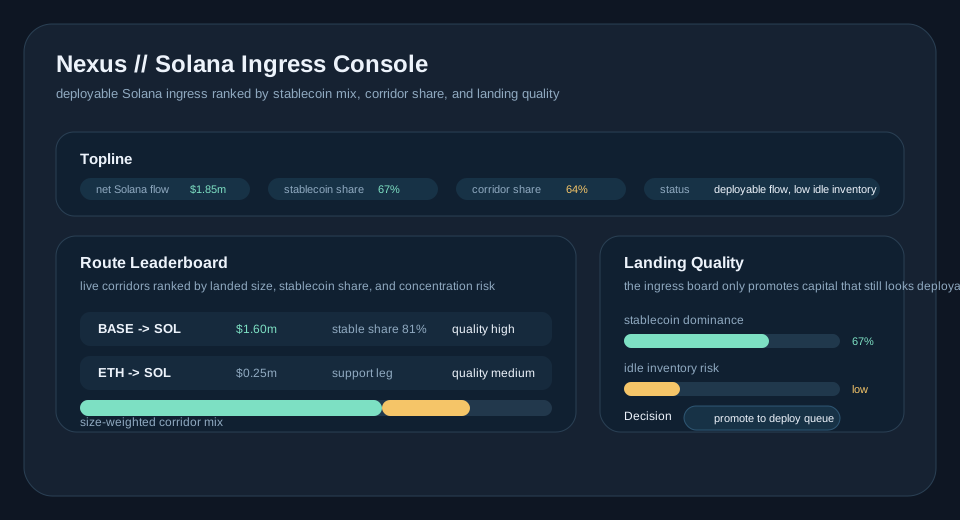
Ingress Console
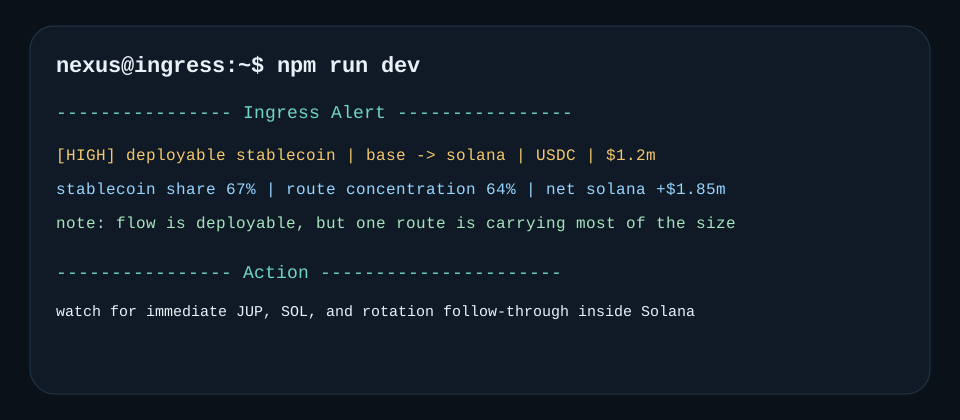
Ingress Alert
Operating Surfaces
Topline: compresses landed flow, stablecoin share, corridor share, and status into one stripRoute Leaderboard: ranks the corridors carrying deployable capital into SolanaLanding Quality: separates ready capital from idle bridge inventoryIngress Alert: prints the actual event the operator sees when a route is promoted
What Nexus Watches That Other Dashboards Ignore
Most bridge boards are happy to tell you that capital moved. That is not enough. Big transfers can be inventory management, arb routing, exchange reshuffling, or capital that never actually expresses itself inside Solana after landing.
Nexus is more selective. It wants to know whether the flow arrived in a form that still looks usable by the time it reaches Solana. That means stablecoin-heavy, low-churn, and not obviously trapped inside one crowded corridor.
Why Nexus Exists
Large bridge transfers are noisy on their own. The real question is whether capital is moving into Solana in a form that can be deployed quickly into memes, DeFi, or funding rotations.
What Counts As Real Ingress
Nexus treats deployable stablecoin flow very differently from capital that is only passing through. A large bridge transfer can still be useless if it is parking, roundtripping, or crowding into one corridor that everyone else is already watching.
The console is trying to answer one narrow question: if this size landed on Solana, does it still look like capital that can rotate into the market now?
How The Console Is Read
Toplinetells you whether the board should matter at allRoute Leaderboardshows which corridor is carrying the real sizeLanding Qualitytells you whether that size still looks usableIngress Alertis the moment an operator would actually escalate the event
How It Works
Nexus processes ingress in a straightforward order:
- measure inbound and outbound bridge flow around Solana
- isolate the corridors carrying the meaningful size
- check how much of that inbound flow is stablecoin-dominant
- discount transfers that look circular, parked, or overly crowded
- promote the routes that still look deployable after landing
The key distinction is not whether capital moved. It is whether the capital still matters once it is on Solana.
Typical Operator Questions
Nexus is useful when the market starts asking questions like:
- is this capital really landing on Solana, or only touching it briefly
- is the inbound flow mostly stablecoins or mostly inventory
- is one route becoming so crowded that the signal is losing value
- does the landed capital still look deployable into the market now
Those are better questions than simply watching gross bridge size.
Example Output
NEXUS // INGRESS ALERT

lead corridor      BASE -> SOL
net landed flow    $1.85m
stablecoin share   67%
corridor share     64%
landing quality    ready to deploy

operator note: inbound capital looks usable, but monitor corridor crowding on the next cycle
Technical Spec
Core Metrics
netUsd = inboundUsd - outboundUsdstablecoinSharePct = stablecoinInboundUsd / inboundUsdrouteConcentrationPct = largestInboundRouteUsd / inboundUsd
Detection Logic
- High
netUsdinto Solana with highstablecoinSharePctimplies deployable capital. - High
routeConcentrationPctmeans the event may be route-specific and crowded. - Rapid roundtrip behavior lowers conviction because it often reflects inventory management or arb.
Anomaly Types
solana_ingress: broad inbound capital to Solanadeployable_stablecoin: inbound flow dominated by stablecoinsroute_concentration: one route is carrying most of the flowroundtrip_churn: bridge activity looks transient rather than committedsuspicious_timing: concentrated flow before a catalyst window
What A Strong Nexus Alert Looks Like
- net Solana inflow is meaningfully positive
- stablecoin share is high enough to imply usable dry powder
- the lead corridor is clear, but not so dominant that it looks crowded
- landing quality still looks good after the transfer settles
If those conditions are not present, the board should downgrade the event quickly.
Risk Controls
stablecoin quality gate: discounts inbound flow that arrives as non-deployable inventorycorridor concentration cap: prevents one overheated route from being treated as clean signalroundtrip churn filter: rejects capital that is only touching Solana brieflylanding quality filter: requires the flow to still look usable after arrival
Nexus is supposed to miss noisy transfers on purpose. A false ingress read wastes attention exactly when the market is busiest.
Why Nexus Matters
When Solana turns active, bridge dashboards get noisy fast. Nexus is deliberately opinionated about what matters because non-deployable flow wastes attention.
It is better to miss a harmless bridge blip than to promote parked inventory as if it were real market fuel.
Quick Start
git clone https://github.com/NexusSOL/Nexus
cd Nexus
npm install
cp .env.example .env
npm run dev
Configuration
ANTHROPIC_API_KEY=sk-ant-...
WORMHOLE_API_KEY=...
LARGE_TRANSFER_THRESHOLD_USD=500000
MIN_SOLANA_INGRESS_USD=1000000
DEPLOYABLE_STABLECOIN_SHARE_PCT=45
ROUTE_CONCENTRATION_THRESHOLD_PCT=62
SCAN_INTERVAL_MS=120000
Local Audit Docs
Support Docs
License
MIT
Yorumlar (0)
Yorum birakmak icin giris yap.
Yorum birakSonuc bulunamadi