source-of-truth
Health Gecti
- License — License: MIT
- Description — Repository has a description
- Active repo — Last push 0 days ago
- Community trust — 41 GitHub stars
Code Gecti
- Code scan — Scanned 8 files during light audit, no dangerous patterns found
Permissions Gecti
- Permissions — No dangerous permissions requested
Bu listing icin henuz AI raporu yok.
Give your coding agent a persistent memory. source-of-truth keeps a living docs/ catalog of what exists, why, and what rules apply — so AI stops rebuilding, deleting, and breaking things it never knew were there. Works with Claude, Codex, Cursor, Gemini, Copilot & more.
source-of-truth



Stop your AI from silently deleting features it doesn't know exist.
source-of-truth gives your coding agent a persistent memory: it reads what already exists before writing code, and updates the record after a feature ships — so it stops rebuilding, deleting, and breaking things it never knew were there.
One skill, every coding agent — Claude Code · Codex · Cursor · Gemini · Copilot · Kimi · OpenCode · Pi. → Install
Under the hood it's a self-maintaining Spec-Driven Development (SDD) catalog skill: a docs/ folder that acts as the project's source of truth for what exists, why it exists, and what rules apply.
The catalog is the source of truth for "what exists, why, and what rules apply".
The code is the source of truth for "how it works".
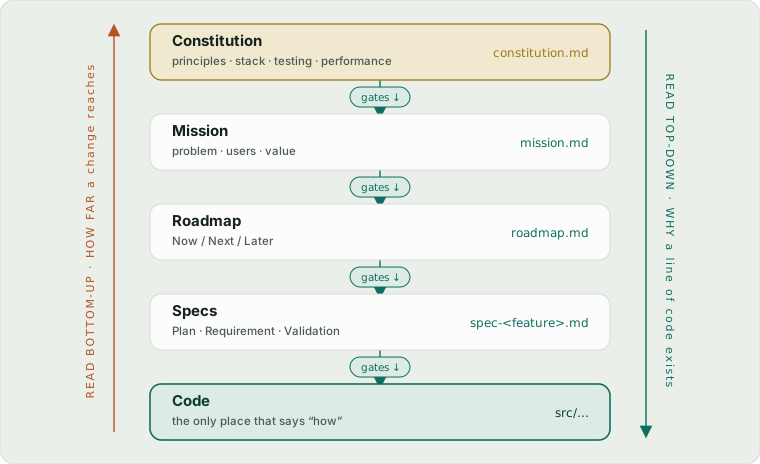
See the live explainer for the full visual walkthrough of the workflow.
Works well with
Source-of-Truth is a catalog skill, not a workflow engine — it's designed to sit alongside a development methodology, not replace one. Pairing it with one of these is a great fit:
- superpowers drives how you work (brainstorming → planning → TDD → review). Source-of-Truth keeps the persistent record of what exists and why, so each superpowers cycle reads the catalog before coding and syncs it after shipping.
- spec-kit generates specs and plans up front for a feature. Source-of-Truth turns those one-off specs into a living catalog that stays in sync with the code as the project evolves.
In short: the methodology produces the work; Source-of-Truth keeps the source of truth honest across sessions.
Quickstart (Claude Code)
Using Codex, Cursor, Gemini, Copilot, Kimi, OpenCode, or Pi instead? Skip to Installation for the per-platform steps — the skill itself is identical everywhere.
1. Install the plugin, then reload so the skill activates:
/plugin marketplace add ngocquang/source-of-truth
/plugin install source-of-truth@source-of-truth-dev
/reload-plugins
2. Have a PRD or SDD ready first. The catalog is built from your intent, not guessed from scratch — so before you run anything, have a Product Requirements Document (PRD) or Software Design Document (SDD) on hand, even a rough one. Already ran superpowers or spec-kit for the feature? Their specs and plans count too. Bootstrap pulls whatever you have in as the primary source of feature intent and mission (code shows how; the doc shows why).
3. Then just type /source-of-truth. That's the whole trigger. It reads your PRD/SDD, bootstraps the docs/ catalog, and from then on activates on its own — READ before each change, SYNC after each ship.
Using another agent (Codex, Cursor, Gemini, Copilot, Kimi, OpenCode, Pi)? See Installation for per-platform steps.
Why it exists
When an AI edits a codebase with no reference source, four failures recur:
- Rebuilding a feature that already exists.
- Silently deleting features during a refactor.
- Breaking invariants by changing behavior without knowing the contract.
- Building features that violate project principles or aren't on the roadmap.
The catalog is the reference that blocks all four — read before code is written, kept in sync after it ships.
How it works
The catalog enforces a gate chain — each layer authorizes the one below it:
constitution → mission → roadmap → specs → code
Principles gate plans → mission gates the roadmap → the roadmap gates specs → specs gate code. Read top-down to learn why a line of code exists; nothing reaches code until the layer above permits it.
It all lives in a docs/ folder of plain, greppable markdown:
overview.md— index linking every project doc and feature spec.constitution.md— principles: tech stack, code quality, testing, UX, performance.mission.md— why the project exists: problem, users, value, success metrics.roadmap.md— forward plan (Now / Next / Later); shipped work leaves it.CHANGELOG.md— removals, renames, contract changes, constitution changes.specs/spec-<feature>.md— one file per feature: Plan + Requirement + Validation.
The catalog owns what exists & why; the code owns how it works. Exact schemas live in the skill's references/.
Installation
Installation differs by agent. If you use more than one, install source-of-truth separately for each. The skill is identical across them — each platform just needs to discover the skills/ directory, then it activates automatically when a task touches a docs/ spec catalog.
Claude Code
Register the marketplace shipped in this repo:
/plugin marketplace add ngocquang/source-of-truth
Then install the plugin:
/plugin install source-of-truth@source-of-truth-dev
Update later:
/plugin marketplace update source-of-truth-dev
Codex
Codex reads .codex-plugin/plugin.json, which registers ./skills/. Point Codex's plugin manager at this repository (or a local clone) to install it.
Cursor
Cursor reads .cursor-plugin/plugin.json, which registers ./skills/. Install it from this repository (or a local clone) via Cursor's plugin manager.
Gemini CLI
Install the extension from this repository:
gemini extensions install https://github.com/ngocquang/source-of-truth
Update later:
gemini extensions update source-of-truth
Gemini loads GEMINI.md, which imports the skill so it's active from the first message.
GitHub Copilot CLI
Copilot reads the same marketplace as Claude Code. Register it, then install:
copilot plugin marketplace add ngocquang/source-of-truth
copilot plugin install source-of-truth@source-of-truth-dev
Kimi Code
Install directly from this repository:
/plugins install https://github.com/ngocquang/source-of-truth
OpenCode
Tell OpenCode to follow the bundled install guide:
Fetch and follow instructions from https://raw.githubusercontent.com/ngocquang/source-of-truth/main/.opencode/INSTALL.md
Or add it to your opencode.json directly:
{
  "plugin": ["source-of-truth@git+https://github.com/ngocquang/source-of-truth.git"]
}
Pi
Install source-of-truth as a Pi package from this repository:
pi install git:github.com/ngocquang/source-of-truth
The package loads the skill via the .pi/extensions/source-of-truth.ts extension's resources_discover hook.
The Basic Workflow
You don't invoke the skill manually — it activates on context. The whole loop is bootstrap once → READ before each change → SYNC after each ship:
- First time in a project — bootstrap the catalog (once). Ask "set up the source-of-truth catalog". The skill auto-detects your stack, asks a single batch of questions (principles, mission), and writes
docs/after you confirm. Skip this ifdocs/overview.mdalready exists. - Ask for a change as usual. Before writing any code the skill enters READ: it loads the catalog and prints a Catalog check (what exists, invariants, roadmap status, conflicts) for you to review.
- Resolve conflicts, then approve. If the change collides with an existing feature, a documented invariant, the constitution, or isn't on the roadmap, the skill stops and asks. Add a roadmap entry or adjust the plan, then let it proceed.
- Implement. The skill writes code against the approved plan and the documented contracts.
- Ship / commit. Say "done", "commit", or "merge". The skill enters SYNC: it reads the diff, updates the affected specs, moves shipped items off the roadmap, records removals/renames in the CHANGELOG, shows you the catalog diff, then commits code and catalog together.
The catalog stays true to the code with no separate "update the docs" step — READ and SYNC are the only two touchpoints you need to remember.
What's Inside
The skill operates in three modes, selected automatically by context:
| Mode | When | What happens |
|---|---|---|
| BOOTSTRAP | docs/overview.md does NOT exist + project has code |
Auto-detect stack → interview user for principles/mission → confirm & write the catalog. Runs once. |
| READ | Before writing / modifying / deleting code (incl. bug fixes, refactors, "does X already exist?") | Load catalog, output a Catalog check to the user, stop on conflicts, only then write code. |
| SYNC | A feature shipped ("ship it", "done", "commit", "merge", "xong rồi") or "update/sync the catalog" | Reconcile catalog with the diff: update specs, remove shipped entries from the roadmap, record deletions/renames in CHANGELOG. |
RE-BOOTSTRAP: a special case of BOOTSTRAP — when docs/overview.md exists but constitution.md or mission.md is missing/empty, re-bootstrap the missing file before any code change.
Commit gate: a commit request is itself a SYNC trigger. When you ask to commit (or the agent is about to), SYNC runs and completes before the commit — so the code and the catalog are committed together. This is automatic, not a question.
Ambiguous? Ask once: "Sync the catalog now, or keep going?"
READ mode — the Catalog check
Before any code is written, the skill prints this to the user (so it can be overridden):
Catalog check:
- Constitution: <relevant principle, or "no conflict">
- Roadmap status: <Now | Next | Later | shipped (off-roadmap) | NOT TRACKED>
- Related existing features: <list, or "none found">
- Invariants I must preserve: <list, or "none">
- Acceptance criteria that must still pass: <list, or "none">
- Already exists? <yes + which feature, or no>
- Plan: <what I'm about to do and why it doesn't conflict>
If the change collides with an existing feature, a documented invariant, a constitution principle, or the roadmap — the skill stops and asks instead of proceeding.
SYNC mode — after shipping
SYNC reconciles the catalog with what changed: it reads the diff (git diff --name-only, current commit, date), updates the affected specs, moves shipped roadmap entries off Now, and records removals / renames / contract changes in the CHANGELOG. Full procedure lives in the skill's references/.
BOOTSTRAP mode — three phases
- A — Auto-detect (no user input): scan repo for tech stack, test framework, design system, README intro, and feature entry points.
- B — Interview (single batch): ask only what can't be detected (code-quality rules, performance budgets, mission users/value/metrics).
- C — Confirm & write: show populated docs, get OK, then write all 5 project docs, including CHANGELOG, plus per-feature specs, and update CLAUDE.md.
constitution.md and mission.md must have real content before bootstrap completes — _TBD: <question>_ markers are acceptable for deferred sections, but blank fields and fabricated content are not.
Philosophy
Source-of-Truth is rigid, not advisory — its value comes from being followed exactly:
- Read before you write; sync after you ship. Don't skip a mode or shortcut the Catalog check to "save time" — small changes break invariants most often.
- Every unit of work goes on the roadmap. New feature, enhancement, refactor, and bug fix — each gets a
roadmap.mdentry before code is written. The rule blocks the agent's own "too small to track" rationalizing; an explicit user override (e.g. a live hotfix) is honored, with a recommended retroactive entry. - Never fabricate. If it isn't visible in code, tests, or stated by the user, don't assert it — tests are the best source of invariants; the user is the only source of mission and code-quality principles. A vague invariant is worse than none.
- The catalog owns what & why; the code owns how. The two never compete for the same truth.
Contributing
Issues and pull requests are welcome at github.com/ngocquang/source-of-truth. The skill itself lives in skills/source-of-truth/ — SKILL.md is the entry point, with references/ for the detailed BOOTSTRAP / SYNC / CHANGELOG procedures. Edit there and the change reaches every supported agent.
License
MIT © QuangDN. See the plugin metadata in .claude-plugin/plugin.json.
Community
Questions, ideas, or bugs? Open an issue or start a discussion on GitHub.
Yorumlar (0)
Yorum birakmak icin giris yap.
Yorum birakSonuc bulunamadi