longbrain
Health Warn
- License — License: MIT
- Description — Repository has a description
- Active repo — Last push 0 days ago
- Low visibility — Only 5 GitHub stars
Code Pass
- Code scan — Scanned 12 files during light audit, no dangerous patterns found
Permissions Pass
- Permissions — No dangerous permissions requested
No AI report is available for this listing yet.
Local-first shared memory for AI agents: persistent AI memory across Claude Code, Codex, Hermes Desktop, and any MCP client. Automatic record, recall, consolidation, forgetting, and backup. Self-hosted on Qdrant + LlamaIndex; one-command install.
Longbrain — Local-first Shared Memory for AI Coding Agents
Shared long-term memory for Claude Code, Codex, Hermes Desktop, and any
MCP-compatible AI agent. Longbrain is a self-hosted, Docker-packaged memory
system that lets multiple agents share the same project-aware context. Each
user runs an independent stack, so data stays local and fully private.
Website · User guide · Latest release
By default it needs no API key, no Ollama, and no Python packages to
install — the host-side scripts and hooks run on the stock systempython3, stdlib only.
Two full adapters ship today: Hermes Desktop and Claude Code. Both
access the same memory store, so what you teach one agent, the other
recalls. Codex ships with official lifecycle hooks for automatic recall,
turn recording, and session-start consolidation catch-up; its older notify
adapter remains as a write fallback. Any MCP client can connect manually — see the
support tiers. Adding a new agent only
means writing a new adapter — the system's architecture doesn't change.
Why it exists
- Real long-term memory, not a stopgap. A plain chat forgets everything
when the window closes; a hand-maintainedCLAUDE.mdneeds you to curate
it forever. Longbrain records, distills, recalls and drops outdated
information automatically. - Shared across agents. Teach something in one tool, the others already
know it — no re-explaining every time you switch. - Cost per turn stays roughly flat. Only what's relevant to the current
question is recalled, and the injection is size-capped — unlike aCLAUDE.mdthat loads in full, every turn, and only grows. - Doesn't have to cost extra money. Runs on a subscription you already
pay for (Claude Code) or a local model (Ollama) — a paid API key is never
required. - Visible and correctable, fully private. The
/uipage shows
everything the system remembers as an interactive graph — fix or delete
entries instead of guessing what the AI thinks it knows. Everything stays
on your machine, with nightly backups.
Memory Atlas
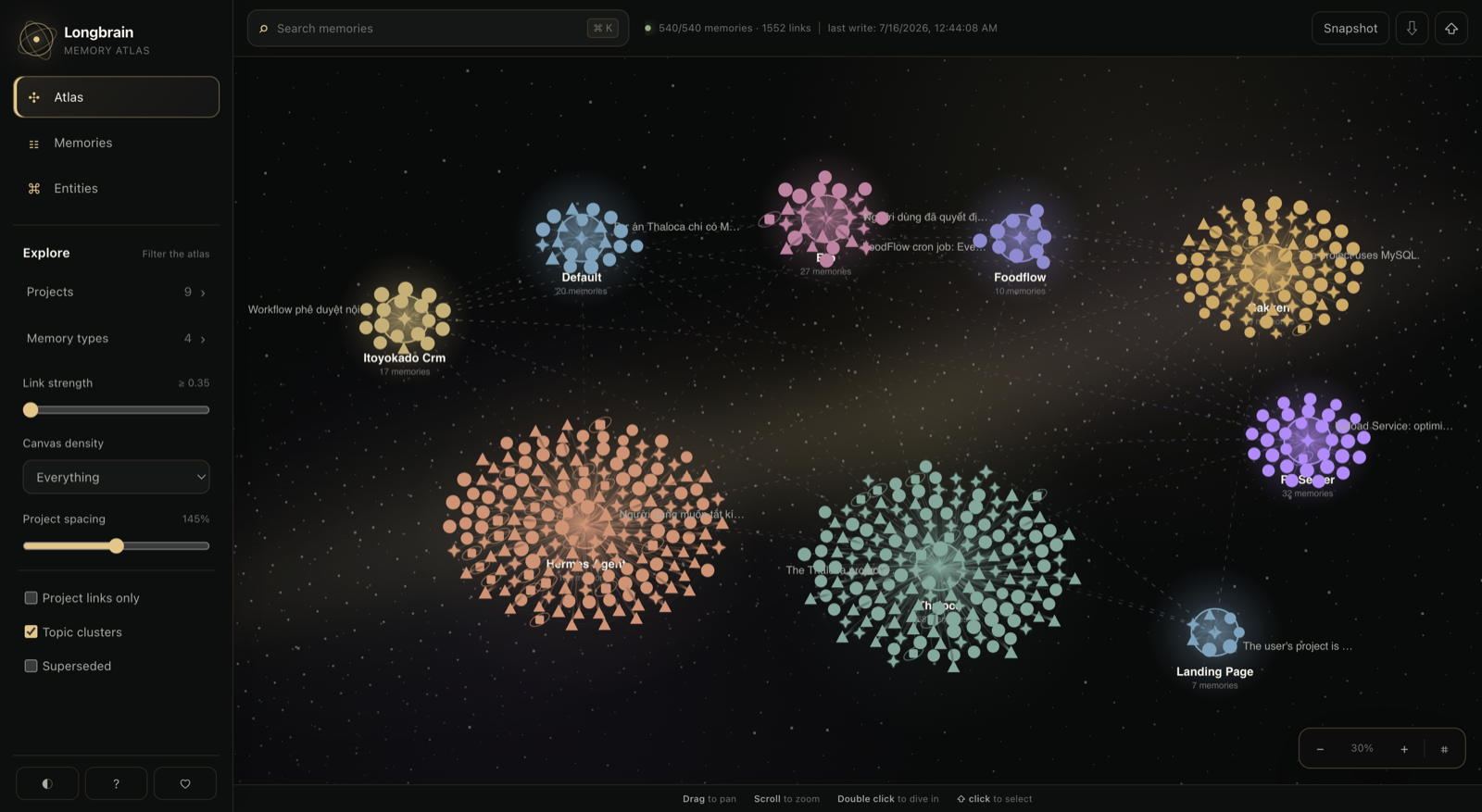
Each project is a movable, color-coded galaxy. Memories form stable rings
around their project hub, while filters, adjustable spacing and wide-range
zoom keep large collections readable.
Verified by evals, not claims
- 187 tests (pytest, run in-container) — idempotency, dedup/supersede,
recall filtering, hook payload parsing, adapter config patching. - Recall regression eval: 12/13 expected hits, 0 violations (no
irrelevant memory leaked into the context), 11,460 chars injected across
the whole eval set. The tracked miss is a genuine two-hop graph query;
results are gated against a committed baseline (scripts/recall_eval.py). - Hybrid BM25 measured on a real 450-chunk corpus: exact-token hit@top-2
went 1/12 (dense-only) → 11/12; prompts without identifier-like tokens
return byte-identical results.
Known limitations (read before installing)
- Docker required — 1–2 background containers running permanently.
- macOS-first: launchd jobs (backup, docs watcher) and the agent wiring
are built and tested on macOS. The service itself is plain Docker, but
Linux agent wiring is untested. - Personal, single-machine by design — no sync, no multi-user, no
realtime multi-device (see docs/ARCHITECTURE.md). - Codex lifecycle gap: Codex has no
SessionEndhook, so consolidation
catches up on the nextSessionStartinstead of firing when a chat closes. - Distillation quality depends on the configured LLM — a weak local
model extracts facts less reliably;LLM_PROVIDER=nonedelegates
distillation to the agent's own model via MCP. - Status: stable — one-command install, eval-guarded recall quality,
and a full test suite; scope stays personal, single-machine, macOS-first
(the limitations above).
Architecture at a glance
flowchart TB
    subgraph Agents["User's machine — chat agents"]
        HD["Hermes Desktop<br/>hooks/*.py"]
        CC["Claude Code<br/>hooks/claude/*.py"]
        CX["Codex<br/>SessionStart · UserPromptSubmit · Stop hooks"]
    end

    HD -- "POST /memory/append<br/>POST /memory/recall<br/>MCP /mcp" --> SVC
    CC -- "POST /memory/append<br/>POST /memory/recall<br/>MCP /mcp" --> SVC
    CX -- "POST /memory/append<br/>POST /memory/recall<br/>MCP /mcp" --> SVC

    subgraph SVC["llamaindex-service — FastAPI (host :8800 → container :8000)"]
        REST["REST API"]
        MCP["MCP Streamable HTTP (/mcp)"]
        ENGINE["Memory Engine<br/>L1 Working · L2 Episodic · L3 Semantic · L4 Knowledge"]
        REST --> ENGINE
        MCP --> ENGINE
    end

    ENGINE -- "HTTP :6333" --> QD[("Qdrant<br/>longbrain_chat_history · longbrain_memories<br/>longbrain_documents · longbrain_meta")]
    QD -.-> VOL[("volume: qdrant_data")]
    ENGINE -.-> DVOL[("volume: longbrain_data<br/>/data — original document files")]

    OLLAMA["ollama (optional profile)"] -. "--profile ollama" .-> SVC
- L1 Working memory — current session's recent turns
- L2 Episodic memory — every conversation turn, searchable semantically
- L3 Semantic memory — facts/preferences/decisions/tasks distilled by
consolidation, with automatic dedup/supersede - L4 Knowledge base — document RAG (each project's
docs/folder is
auto-ingested)
The whole lifecycle runs automatically: record → recall → consolidate →
controlled forgetting → nightly backup. Before every turn, a hook injects
only the relevant, size-capped slice of memory — nothing relevant, nothing
injected.
Install
- Install Docker Desktop.
- Install Hermes Desktop and/or Claude Code — whichever agents you use.
- Run from the directory where you want Longbrain to live:
curl -fsSL https://raw.githubusercontent.com/ngocthanh06/longbrain/main/install.sh | bash
The bootstrap clones Longbrain into ./longbrain (override withLONGBRAIN_INSTALL_DIR), or updates that checkout when re-run from the
same directory, then runs ./setup.sh. To update later, re-run the command
from the same place — or git pull && ./setup.sh inside the checkout. To
inspect everything first, clone the repository manually and run ./setup.sh
from its directory.
No manual steps remain. The script creates .env, builds & starts the
containers, wires every installed agent (hooks + MCP), and installs the
nightly backup and the docs/ ingest watcher. Idempotent — safe to re-run.
Restart open agent sessions to pick the hooks up.
Verify after a few chats:
curl localhost:8800/health # last_written_at must advance after every turn
Then open http://localhost:8800/ui to watch your memory graph grow.
Documentation
| Document | What's in it |
|---|---|
| docs/USER_GUIDE.md | Daily use: how memory works, the /ui browser, fixing/forgetting memories, the docs/ folder, backup, export/import |
| docs/API.md | REST + MCP reference: every endpoint and tool with sample requests/responses |
| docs/ARCHITECTURE.md | How it works inside: data flows, Qdrant schema, multi-agent provenance, source layout |
| docs/OPERATIONS.md | Setup internals, provider config (.env), health checks, backup restore, troubleshooting |
| docs/ROADMAP.md | Completed milestones, what's next, deliberate non-goals |
| adapters/README.md | Writing an adapter for a new agent: the 4-lifecycle-moment contract |
| CONTRIBUTING.md | Dev setup, tests, what PRs are welcome |
Repository layout
longbrain/
├── setup.sh                 # one-command install (Docker + automatic agent wiring)
├── docker-compose.yml       # qdrant + llamaindex (+ optional ollama profile)
├── docs/                    # user guide, API reference, architecture, operations, roadmap
├── hooks/                   # agent adapters (Hermes Desktop + hooks/claude/ for Claude Code)
├── scripts/                 # setup, backup, ingest watcher, transfer, evals
├── adapters/                # adapter contract docs + minimal example
└── llamaindex-service/      # the memory service (FastAPI + LlamaIndex + MCP) + tests
License
MIT — see LICENSE.
Reviews (0)
Sign in to leave a review.
Leave a reviewNo results found