nhatnguyet-lunar-ziwei-bazi-numerology
Health Uyari
- License — License: MIT
- Description — Repository has a description
- Active repo — Last push 0 days ago
- Low visibility — Only 7 GitHub stars
Code Basarisiz
- spawnSync — Synchronous process spawning in .github/scripts/check-dist.mjs
- execSync — Synchronous shell command execution in .github/scripts/make-cli-demo.mjs
- process.env — Environment variable access in .github/scripts/make-cli-demo.mjs
- eval() — Dynamic code execution via eval() in .github/scripts/run-readme-code.mjs
- exec() — Shell command execution in .github/scripts/run-readme-code.mjs
- spawnSync — Synchronous process spawning in .github/scripts/run-readme-code.mjs
- process.env — Environment variable access in .github/scripts/run-readme-code.mjs
Permissions Gecti
- Permissions — No dangerous permissions requested
Bu listing icin henuz AI raporu yok.
Lunisolar calendar, Zi Wei Dou Shu, BaZi, numerology, I Ching and feng shui for JavaScript and Python: astronomically accurate (NASA, IMCCE), country-aware (China, Korea, Japan, Vietnam and 7 more), results in English, Chinese and Vietnamese. MCP server for AI, 17,291 shared test vectors, open datasets. 农历 紫微斗数 八字 易经 风水
Nhat Nguyet
Lunisolar calendar, Zi Wei Dou Shu, BaZi, numerology, I Ching and feng shui for JavaScript and Python: astronomically accurate, country-aware, and the same answer in every language.
New moons and solar terms checked against NASA and IMCCE from 1900 to 2100 · the lunar calendars of China, Korea, Japan, Vietnam and 7 more countries and regions · MCP server for AI assistants · 3.6 million open charts whose readings quote the classics by book and chapter · results in English, 中文 and Tiếng Việt · 17,291 shared test vectors (28,586 in all)
English · Tiếng Việt · 中文 · 日本語 · 한국어 · Français · ไทย
Playground ·
Docs ·
Paper ·
Hugging Face ·
Project page
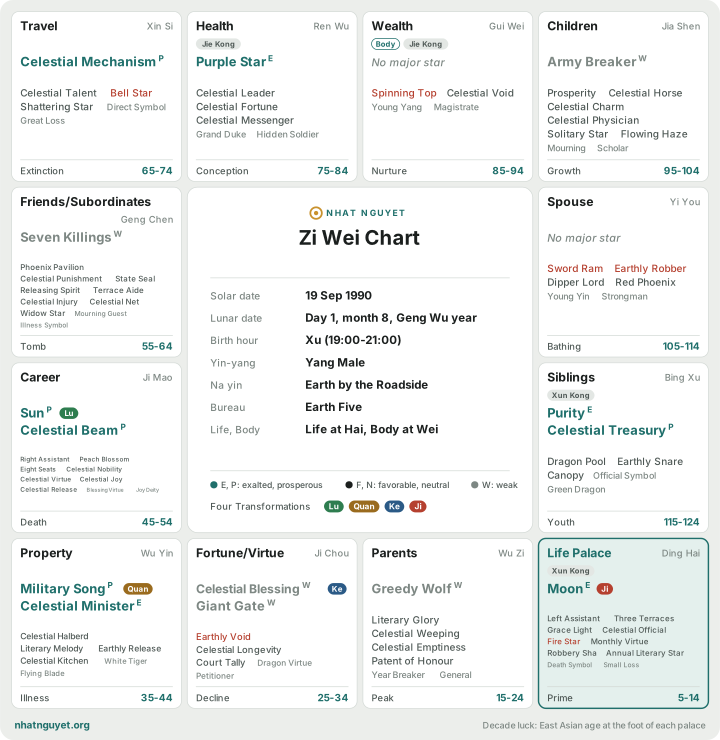







Quick start
JavaScript, TypeScript (Node 18+, browsers)
npm i @nhatnguyet/ziwei @nhatnguyet/lunar
import { writeFileSync } from "node:fs";
import { castZiWei } from "@nhatnguyet/ziwei";
import { toLunar } from "@nhatnguyet/lunar";

const chart = castZiWei({ date: "1990-09-19", time: "20:00", gender: "male" });
const life = chart.palaces[chart.lifePalace];
console.log(chart.bureau.name, "|", life.name, life.branch, "|", life.stars[0].name, life.stars[0].brightness);
writeFileSync("chart.svg", chart.toSvg());   // the chart image above

// The same day can be a different lunar date in Beijing, Seoul and Hanoi time
for (const date of ["2027-02-06", "2030-02-02"]) {
  const lunar = ["CN", "KR", "VN"].map((country) => {
    const d = toLunar(date, { country });
    return `${country} ${d.year}-${d.month}-${d.day}`;
  });
  console.log(date, "|", lunar.join(" | "));
}
Earth Five | Life Palace Hai | Moon Exalted
2027-02-06 | CN 2027-1-1 | KR 2026-12-30 | VN 2027-1-1
2030-02-02 | CN 2029-12-30 | KR 2029-12-30 | VN 2030-1-1
country defaults to "VN" (Vietnam, UTC+7), the calendar the project
started from; castZiWei takes it too. The other ten countries and regions
are listed under Lunar calendar.
Python (3.9+, standard library only): same results, same SVG byte for byte.
pip install nhatnguyet
from nhatnguyet import cast_zi_wei, to_lunar, zi_wei_svg

chart = cast_zi_wei(date="1990-09-19", time="20:00", gender="male")
life = chart["palaces"][chart["lifePalace"]]
print(chart["bureau"]["name"], "|", life["name"], life["branch"], "|", life["stars"][0]["name"], life["stars"][0]["brightness"])
open("chart.svg", "w", encoding="utf-8").write(zi_wei_svg(chart))

for date in ["2027-02-06", "2030-02-02"]:
    lunar = [f"{c} {d['year']}-{d['month']}-{d['day']}" for c in ("CN", "KR", "VN") for d in [to_lunar(date, country=c)]]
    print(date, "|", " | ".join(lunar))
Command line: no install with npx, or nhatnguyet ... after pip install nhatnguyet.
npx @nhatnguyet/cli ziwei 1990-09-19 20:00 male --year 2026
┌────────────────────┬────────────────────┬────────────────────┬────────────────────┐
│ Travel             │ Health             │ Wealth · Body      │ Children           │
│ Xin Si             │ Ren Wu Jie Kong    │ Gui Wei Jie Kong   │ Jia Shen           │
│ Celestial Mechanism│ Purple Star Ex     │ Spinning Top,      │ Army Breaker We    │
│   Pr               │ Celestial Leader,  │ Celestial Void     │ Prosperity,        │
│ Celestial Talent,  │ Celestial Fortune, │ Nurture            │ Celestial Horse,   │
│ Bell Star,         │ Celestial Messen…  │                    │ Celestial Charm,   │
│ Shattering Star    │ Conception         │                    │ Celestial Physic…, │
│ Extinction         │                    │                    │ Solitary Star,     │
│                    │                    │                    │ Flowing Haze       │
│                    │                    │                    │ Growth             │
├────────────────────┼────────────────────┴────────────────────┼────────────────────┤
│ Friends/Subordinat…│                                         │ Spouse             │
│ Geng Chen          │                                         │ Yi You             │
│ Seven Killings We  │                                         │ Sword Ram,         │
│ Phoenix Pavilion,  │                                         │ Earthly Robber,    │
│ Celestial Punish…, │                                         │ Dipper Lord,       │
│ State Seal,        │                                         │ Red Phoenix        │
│ Releasing Spirit,  │                                         │ Bathing            │
│ Terrace Aide,      │                                         │                    │
│ Celestial Injury,  │                                         │                    │
│ Celestial Net,     │          ZI WEI DOU SHU CHART           │                    │
│ Widow Star         │       Born 1990-09-19 20:00 (Xu)        │                    │
│ Tomb               │       Lunar 1990-08-01 · Geng Wu        │                    │
├────────────────────┤                Yang Male                ├────────────────────┤
│ Career             │           Bureau: Earth Five            │ Siblings           │
│ Ji Mao             │      Na yin: Earth by the Roadside      │ Bing Xu Xun Kong   │
│ Sun Pr Lu          │          Life: Hai · Body: Wei          │ Purity Ex          │
│ Celestial Beam Pr  │                                         │ Celestial Treasury │
│ Right Assistant,   │                                         │   Pr               │
│ Peach Blossom,     │                                         │ Dragon Pool,       │
│ Eight Seats,       │                                         │ Earthly Snare,     │
│ Celestial Nobili…, │                                         │ Canopy             │
│ Celestial Virtue,  │                                         │ Youth              │
│ Celestial Joy,     │                                         │                    │
│ Celestial Release  │                                         │                    │
│ Death              │                                         │                    │
├────────────────────┼────────────────────┬────────────────────┼────────────────────┤
│ Property           │ Fortune/Virtue     │ Parents            │ Life Palace        │
│ Wu Yin             │ Ji Chou            │ Wu Zi              │ Ding Hai Xun Kong  │
│ Military Song      │ Celestial Blessing │ Greedy Wolf We     │ Moon Ex Ji         │
│   Pr Quan          │   We Ke            │ Literary Glory,    │ Left Assistant,    │
│ Celestial Minister │ Giant Gate We      │ Celestial Weeping, │ Three Terraces,    │
│   Ex               │ Earthly Void,      │ Celestial Emptin…, │ Grace Light,       │
│ Celestial Halberd, │ Celestial Longev…, │ Patent of Honour   │ Celestial Offici…, │
│ Literary Melody,   │ Court Tally        │ Peak               │ Fire Star,         │
│ Earthly Release,   │ Decline            │                    │ Monthly Virtue,    │
│ Celestial Kitchen  │                    │                    │ Robbery Sha,       │
│ Illness            │                    │                    │ Annual Literary …  │
│                    │                    │                    │ Prime              │
└────────────────────┴────────────────────┴────────────────────┴────────────────────┘
Brightness: Ex exalted, Pr prosperous, Fa favorable, Ne neutral, We weak. Ages are East
Asian ages (1 at birth).

Year 2026 (Bing Wu)
  age 37 · Year palace: Health · Minor limit: Friends/Subordinates ·
  Decade: Property (35-44) · Hua Lu: Celestial Blessing → Fortune/Virtue ·
  Hua Quan: Celestial Mechanism → Travel · Hua Ke: Literary Glory → Parents ·
  Hua Ji: Purity → Siblings

Ten-year periods
    5-14  1994-2003  Life Palace (Hai)  Moon
   15-24  2004-2013  Parents (Zi)  Greedy Wolf
   25-34  2014-2023  Fortune/Virtue (Chou)  Celestial Blessing, Giant Gate
   35-44  2024-2033  Property (Yin)  Military Song, Celestial Minister
   45-54  2034-2043  Career (Mao)  Sun, Celestial Beam
   55-64  2044-2053  Friends/Subordinates (Chen)  Seven Killings
   65-74  2054-2063  Travel (Si)  Celestial Mechanism
   75-84  2064-2073  Health (Wu)  Purple Star
   85-94  2074-2083  Wealth (Wei)  -
   95-104 2084-2093  Children (Shen)  Army Breaker
  105-114 2094-2103  Spouse (You)  -
  115-124 2104-2113  Siblings (Xu)  Purity, Celestial Treasury

Patterns
  Mechanism, Moon, Blessing and Beam 機月同梁 · Life Palace
  Left and Right Assistants Meeting 左右同會 · Life Palace
  Sun Rising from Fusang 日出扶桑 · Career
  Moon Setting in the Hai Palace 月落亥宮 · Life Palace

Birth time 20:00 falls in the Xu double hour (19:00-20:59). The lunar date follows the
Vietnamese calendar (UTC+7).
Other commands: bazi, lunar, solar, terms, numerology, festivals (--ics for a calendar file), hours, hexagram, cast (Six Lines chart), daily-hexagram, kua, flying-stars, luban; --lang vi|zh, --json, --svg chart.svg, and the school options below. Full English API with every option: docs/api-en.md.
Contents
- Why trust it
- Install
- Features
- Datasets
- For AI
- Widgets
- Examples and docs
- Migrating from iztro
- FAQ
- Contributing
- Citation and license
Why trust it
The calendar is astronomy, computed for the country you ask about. East
Asian lunisolar calendars share their rules but not their clock: a month
starts on the day of the new moon in local time, so Beijing, Seoul and Hanoi
can start a month, or a year, on different days. The library computes each
country on its own time zone and checks the astronomy against NASA and IMCCE
over 1900 to 2100:
| Check | Result |
|---|---|
| New moons vs NASA (2,474) | 0.9 min late on average, 3.9 min at most |
| Lunar months rebuilt from NASA new moons and IMCCE solar terms | 2,459 of 2,461 match (the other two: new moon within a minute of midnight) |
| Solar terms vs IMCCE (4,824) | 0.27 min off on average, 0.9 min at most (rounded to the minute), every term on the right day |
| Hanoi (UTC+7) vs Beijing (UTC+8), same rules | 2,814 days and 10 New Year dates differ |
| Seoul (UTC+9) vs Beijing (UTC+8), same rules | 2,818 days and 11 New Year dates differ |
- Technical paper: Computing the Vietnamese lunisolar calendar
(PDF) gives the method, the error budget, the verification against NASA,
IMCCE and JPL DE440, and an explanation for each day the Vietnamese and
Chinese calendars differ. Every number in it is recomputed bydocs/paper/reproduce.sh. - Shared test vectors:
ca-kiem/holds 17,291 core cases
(inputvao, expected outputra) generated by the reference engine that
runs nhatnguyet.org: 14,936 calendar cases, 777 Zi
Wei charts, 777 BaZi charts, 600 numerology profiles and 201 festival years,
plus 432 cases for the school options, 1,096 days of auspicious hours, 6,684
I Ching cases and 3,083 feng shui cases (28,586 in all). TypeScript and
Python pass all of them on every push. - Tết history:
history/lists Tết for every year
1900 to 2100 at UTC+7 and UTC+8, with the calendar Vietnam actually used and
a source for each documented year. - Honest scope: the science is in the method, not in the predictions. Zi Wei Dou Shu, BaZi, numerology, the I Ching and feng
shui are the rules of traditional schools, not validated science; do not use them for health,
money or legal decisions. Where schools disagree, the library says which
rule it follows and lets you switch (school options).
How it compares
iztro and
lunar-javascript are careful,
widely used libraries, and both are correct for what they implement: the
Chinese calendar on Beijing time (UTC+8). Used for another country, they give
Beijing's date. Vietnam is the clearest case: same rules, Hanoi time (UTC+7).
Comparing every day from 1900 to 2100
(doi-chieu/, reproducible with node chay.mjs):
| Result | |
|---|---|
| Days whose lunar date differs from lunar-javascript | 2,724 of 73,414 |
| Years whose Tết differs from lunar-javascript | 9 of 201 |
| Years whose leap month differs from lunar-javascript | 6 of 201 |
Days that still differ from lunar-javascript with country: "CN" |
150 (5 months) |
| Zi Wei charts (every day × 12 hours) whose bureau (Cục), Life palace or a major star differs from iztro | 38,752 of 880,968 (4.40%) |
of which from the time zone (iztro uses Beijing time even with vi-VN) |
26,602 (3.02%) |
of which from the leap-month rule (iztro fixLeap, an option) |
11,818 (1.34%) |
| of which neither | 332 (0.04%) |
| Solar terms vs IMCCE, largest difference: Nhat Nguyet / lunar-javascript | 0.9 min / 0.28 min |
Two numbers, two questions. 2,724 days and 9 Tết years compare Nhat
Nguyet (Vietnam, UTC+7) with lunar-javascript. The 2,814 days and 10 Tết years
in the table above compare the Nhat Nguyet engine with itself, at UTC+7 and at
UTC+8. They are not the same because country: "CN" is not identical to
lunar-javascript: 150 days still differ, one month each in 1914, 1916, 1920,
2057 and 2097. In 1914, 1916 and 1920 lunar-javascript deliberately corrects
dates before 1960 to match historical Chinese almanacs; in 2057 and 2097 the
new moon falls at exactly midnight in Beijing (16:00 UT), too close to call.
The 332 charts that are neither all fall in one month, the 30 days from 28
September 2057. Its new moon is at 16:00 UT: Nhat Nguyet puts it just before
Beijing midnight and starts the month on the 28th in both time zones;
lunar-javascript (and so iztro) puts it just after and starts on the 29th. It
is the same midnight tie as above, and no time zone or leap rule changes it.
Example: born 21 January 1985, in the Si (Tỵ) hour. iztro gives the 1st day
of the 12th month of the Jia Zi (Giáp Tý) year, Metal Four bureau (Kim Tứ Cục),
Life palace in Shen (Thân). Nhat Nguyet gives Tết, the 1st day of the Yi Chou
(Ất Sửu) year, Water Two bureau (Thủy Nhị Cục), Life palace in You (Dậu). Passcountry: "CN" and Nhat Nguyet gives the Chinese calendar too.
Install
Version 0.4.0. The JavaScript packages are ESM with TypeScript types and no
external dependencies (only the MCP server needs its SDK and zod); the Python
package uses the standard library only.
npm i @nhatnguyet/lunar @nhatnguyet/ziwei @nhatnguyet/bazi @nhatnguyet/numerology @nhatnguyet/festivals @nhatnguyet/iching @nhatnguyet/fengshui
pip install nhatnguyet
| Package | Also published as | What it does |
|---|---|---|
@nhatnguyet/lunar |
@nhatnguyet/am-lich |
Lunar and Gregorian conversion for China, Korea, Japan, Vietnam and 7 more countries and regions; stems and branches; 24 solar terms to the minute; 28 lunar mansions; na yin; auspicious hours |
@nhatnguyet/ziwei |
@nhatnguyet/tu-vi |
Zi Wei Dou Shu: 12 palaces, star brightness, Four Transformations, Xun Kong and Jie Kong (Tuần, Triệt), ten-year and yearly periods, transiting stars, patterns with the original classical line, school options; SVG; text for LLMs; iztro-compatible layer |
@nhatnguyet/bazi |
@nhatnguyet/bat-tu |
BaZi: four pillars by solar term, hidden stems, Ten Gods, symbolic stars, luck pillars, minor luck; SVG |
@nhatnguyet/numerology |
@nhatnguyet/than-so-hoc |
Pythagorean numerology (life path, expression, soul urge, pinnacles, challenges, personal year), Vietnamese names with diacritics; SVG |
@nhatnguyet/festivals |
@nhatnguyet/le-hoi |
206 Vietnamese festivals with their dates in any year, provinces, ethnic groups, venues; iCalendar export |
@nhatnguyet/iching |
I Ching: the 64 hexagrams with names in English, pinyin, Chinese and Vietnamese, Eight Palaces, nuclear and changed hexagrams, three-coin and Plum Blossom casting, Six Lines (najia) chart, Gua Qi daily hexagram, the Zhou Yi text with Legge's 1882 translation; SVG | |
@nhatnguyet/fengshui |
Feng shui rules of traditional schools: Eight Mansions life gua (Kua number) and house gua, 24 mountains, Xuan Kong flying star charts, annual stars, Luban rulers; compass and flying star SVG | |
@nhatnguyet/cli |
Charts as terminal grids, JSON, SVG or iCalendar; the same commands as nhatnguyet in Python |
|
@nhatnguyet/mcp |
MCP server for AI assistants | |
@nhatnguyet/widgets |
5 web components | |
nhatnguyet (PyPI) |
All of the above in one Python package, same results field by field |
The Vietnamese-named packages are the same code under their original names;
existing imports keep working.
Features
Every library reproduces, field by field, the engine that runs
nhatnguyet.org and the Nhat Nguyet app. No network
calls. Results come in English (lang: "en", default), Vietnamese ("vi") or
Chinese ("zh"); in English, stems and branches are pinyin by default
(terms: "han" or "vi" for Chinese characters or Sino-Vietnamese).
 Zi Wei Dou Shu · castZiWei().toSvg() |
 BaZi · castBaZi().toSvg() |
 Numerology · numerology().toSvg() |
Every image is an SVG drawn by the library; click one to open it full size.
Lunar calendar and auspicious hours
toLunar, toSolar, solarTerms and auspiciousHours in@nhatnguyet/lunar (to_lunar, to_solar, solar_terms,auspicious_hours in Python). country picks the calendar: China
(CN), Taiwan (TW), Hong Kong (HK), Macau (MO), Singapore (SG),
Malaysia (MY), Indonesia (ID), the Philippines (PH) at UTC+8; Korea
(KR), Japan (JP) at UTC+9; Vietnam (VN, the default) at UTC+7; ortimeZone in hours. The command line (--country), the MCP server and the
widgets take the same codes.
auspiciousHours gives the twelve double hours of a day with the auspicious
(hoàng đạo) or inauspicious (hắc đạo) flag and the presiding spirit, as
Chinese and Vietnamese almanacs print them (command line nhatnguyet hours, MCP toolauspicious_hours):
import { auspiciousHours } from "@nhatnguyet/lunar";

const day = auspiciousHours("2027-02-06");   // Tết 2027
console.log(day.day, "|", day.hours.filter((h) => h.auspicious).map((h) => `${h.branch} ${h.range} ${h.spirit}`).join(", "));
Bing Chen | Yin 03:00-04:59 Si Ming, Chen 07:00-08:59 Qing Long, Si 09:00-10:59 Ming Tang, Shen 15:00-16:59 Jin Kui, You 17:00-18:59 Bao Guang, Hai 21:00-22:59 Yu Tang
from nhatnguyet import auspicious_hours

day = auspicious_hours("2027-02-06")   # Tết 2027
print(day["day"], "|", ", ".join(f"{h['branch']} {h['range']} {h['spirit']}" for h in day["hours"] if h["auspicious"]))
Zi Wei Dou Shu
castZiWei builds the full chart: Life and Body palaces, bureau, the 14 major
stars and 55 minor stars with brightness, the Four Transformations, Xun Kong and
Jie Kong (Tuần, Triệt), ten-year periods, a viewing year with its transiting stars, and the
patterns of the Zi Wei Dou Shu Quan Shu with the original classical line.chart.toSvg() draws it; chartToText turns it into compact Markdown for a
language model. The iztro-compatible layer has the lookups and the horoscope:palace(), star(), surroundedPalaces(), horoscope(), fliesTo()
(Migrating from iztro).
School options
Where the books disagree, the library picks a default, names the book it
follows and lets you switch to the rule another named source gives
(docs/schools.md). Defaults never change, and every
option has its own test vectors.
| Option | Values (default first) | What changes |
|---|---|---|
fireBell |
vietnamese, quanshu, swap-for-female, swap-for-yin-male-yang-female |
Fire Star and Bell Star |
leapMonth |
whole, split-at-15, next-month |
the month used for a birth in a leap month |
transformations |
vietnamese, quanshu, zhongzhou |
the Four Transformations of the Geng stem |
heavenlyKitchen |
vietnamese, chinese |
Celestial Kitchen in a Gui year |
injuryMessenger |
standard, zhongzhou |
Celestial Injury and Messenger |
ziHour (BaZi) |
next-day-from-23, split-at-midnight |
the day pillar of a birth from 23:00 to 24:00 |
import { castZiWei } from "@nhatnguyet/ziwei";

const opts = { date: "1990-09-19", time: "20:00", gender: "male" };
const where = (chart, star) => chart.palaces.find((p) => p.stars.some((s) => s.name === star)).branch;
const viet = castZiWei(opts);
const quanshu = castZiWei({ ...opts, schools: { fireBell: "quanshu" } });
console.log("Bell Star:", where(viet, "Bell Star"), "|", where(quanshu, "Bell Star"));
console.log(quanshu.notes.at(-1));
Bell Star: Si | Chou
School options (not the default): Fire and Bell stars: both forward (Quan Shu).
from nhatnguyet import cast_zi_wei

opts = dict(date="1990-09-19", time="20:00", gender="male")
where = lambda chart, star: next(p["branch"] for p in chart["palaces"] if any(s["name"] == star for s in p["stars"]))
viet = cast_zi_wei(**opts)
quanshu = cast_zi_wei(**opts, schools={"fire_bell": "quanshu"})
print("Bell Star:", where(viet, "Bell Star"), "|", where(quanshu, "Bell Star"))
print(quanshu["notes"][-1])
On the command line: --fire-bell quanshu, --leap-month split-at-15,--zi-hour split-at-midnight... Compared with iztro 2.6.5 on 610 charts,{ fireBell: "quanshu", transformations: "quanshu", heavenlyKitchen: "chinese" }
brings the Fire and Bell positions (484 differences), the Geng-year
transformations (126) and the Gui-year Celestial Kitchen (59) to 0.
BaZi and numerology
castBaZi takes the year at Start of Spring (Lập Xuân) and the month at each
sectional term, to the minute; it gives hidden stems, Ten Gods, the twelve
stages, symbolic stars, luck pillars and minor luck. numerology follows the
Pythagorean method and folds Vietnamese diacritics ("Đ" counts as "D"),
keeping master numbers 11, 22 and 33.
Festivals
@nhatnguyet/festivals is a dataset of Vietnamese festivals. festivals(year) gives the 164 festivals with a
fixed lunar or Gregorian date for any year from 1900 to 2100, out of 206 in
the dataset (the other 42 are dated by their organizers each year). Each one
has its province on the 2025 map of 34 provinces, the ethnic group whose
festival it is where the description says so, and its venues, with
coordinates only where a source gives them. group, scope and level are
English codes in every language. festivalsIcs(year) writes an iCalendar
(RFC 5545) file with one all-day event per festival.
import { writeFileSync } from "node:fs";
import { festivals, festivalsIcs } from "@nhatnguyet/festivals";

const f = festivals(2027).find((x) => x.id === "khai-hoi-chua-bai-dinh");
const venue = f.venues[0];
console.log(f.date, f.name, "|", f.provinces[0].name, "|", venue.name, venue.coordinates.lat, venue.coordinates.lon);
writeFileSync("vietnam-festivals-2027.ics", festivalsIcs(2027));
2027-02-11 Bái Đính Pagoda Festival Opening | Ninh Bình | Bái Đính Pagoda 20.276944 105.862778
from nhatnguyet import festivals
from nhatnguyet.en import festivals_ics

f = next(x for x in festivals(2027) if x["id"] == "khai-hoi-chua-bai-dinh")
venue = f["venues"][0]
print(f["date"], f["name"], "|", f["provinces"][0]["name"], "|", venue["name"], venue["coordinates"]["lat"], venue["coordinates"]["lon"])
open("vietnam-festivals-2027.ics", "w", encoding="utf-8", newline="").write(festivals_ics(2027))
The same file from the command line: nhatnguyet festivals 2027 --ics > vn.ics.
I Ching
hexagram, castCoins, castFromNumbers (Plum Blossom), najia anddailyHexagram in @nhatnguyet/iching (nhatnguyet.iching in Python). A
hexagram is a King Wen number, six lines or a name in English, pinyin, Chinese
or Vietnamese. The Six Lines chart gives each line its stem and branch, six
relation, six spirit, world and response, void and month state; the daily
hexagram follows the Han Gua Qi calendar of Meng Xi; text(n) is the public
domain Zhou Yi with James Legge's 1882 translation. Method and sources:
docs/iching.md.
import { castCoins, najia, dailyHexagram } from "@nhatnguyet/iching";

// a cast recorded by hand: line values bottom first (6 and 9 are moving lines)
const cast = castCoins({ lines: [9, 8, 7, 6, 7, 8] });
const chart = najia(cast, { date: "2026-11-19" });
console.log(cast.primary.name, "->", cast.changed.name, "| moving", cast.moving.join(", "));
for (const l of [...chart.lines].reverse()) {
  const mark = l.world ? " (world)" : l.response ? " (response)" : "";
  console.log(`${l.position} ${l.stem} ${l.branch} ${l.element} ${l.relation} / ${l.spirit}${mark}`);
}
console.log("Daily hexagram:", dailyHexagram("2026-11-19").hexagram.name);
After Completion -> Influence | moving 1, 4
6 Wu Zi Water Sibling / Azure Dragon (response)
5 Wu Xu Earth Officer/Ghost / Dark Warrior
4 Wu Shen Metal Parent / White Tiger
3 Ji Hai Water Sibling / Soaring Snake (world)
2 Ji Chou Earth Officer/Ghost / Hooked Chen
1 Ji Mao Wood Offspring / Vermilion Bird
Daily hexagram: Biting Through
from nhatnguyet.iching import cast_coins, najia, daily_hexagram

cast = cast_coins(lines=[9, 8, 7, 6, 7, 8])
chart = najia(cast, date="2026-11-19")
print(cast["primary"]["name"], "->", cast["changed"]["name"], "| moving", ", ".join(map(str, cast["moving"])))
for l in reversed(chart["lines"]):
    mark = " (world)" if l["world"] else " (response)" if l["response"] else ""
    print(f"{l['position']} {l['stem']} {l['branch']} {l['element']} {l['relation']} / {l['spirit']}{mark}")
print("Daily hexagram:", daily_hexagram("2026-11-19")["hexagram"]["name"])
Feng shui
lifeGua, houseGua, flyingStarChart, annualStars and lubanRuler in@nhatnguyet/fengshui (nhatnguyet.fengshui in Python): the Eight Mansions
life gua, which turns at the lunar New Year in Vietnam time, Xuan Kong flying
star charts of the Shen school for periods 1 to 9, annual stars, the 24
mountains and the three Luban rulers, with compass and flying star SVG. These
are the rules a school states, not verified effects; where the books
disagree: docs/fengshui.md.
import { lifeGua, flyingStarChart, lubanRuler } from "@nhatnguyet/fengshui";

const g = lifeGua("1990-09-19", "female");
console.log("Kua", g.number, g.trigram.name, g.groupName, "|", g.directions.filter((d) => d.favorable).map((d) => `${d.directionName} ${d.starName}`).join(", "));
const c = flyingStarChart({ period: 9, facing: "wu" });
const stars = c.grid.map((row) => row.map((n) => `${c.palaces[n - 1].mountain}${c.palaces[n - 1].facing}`).join(" "));
console.log(c.patternName, "| mountain and facing stars, south on top:", stars.join(" / "));
const r = lubanRuler(80);
console.log(r.rulerName, r.sector.name, r.auspicious ? "good" : "bad", "| nearest good:", r.nearestAuspicious.map((x) => x.lengthCm).join(", "), "cm");
Kua 8 Gen West group | Southwest Sheng Qi, Northwest Tian Yi, West Yan Nian, Northeast Fu Wei
Double Stars at Sitting | mountain and facing stars, south on top: 63 18 81 / 72 54 36 / 27 99 45
42.9cm Luban rule Hai bad | nearest good: 69.7, 80.5 cm
from nhatnguyet.fengshui import life_gua, flying_star_chart, luban_ruler

g = life_gua("1990-09-19", "female")
print("Kua", g["number"], g["trigram"]["name"], g["groupName"], "|", ", ".join(f"{d['directionName']} {d['starName']}" for d in g["directions"] if d["favorable"]))
c = flying_star_chart(period=9, facing="wu")
stars = [" ".join(f"{c['palaces'][n - 1]['mountain']}{c['palaces'][n - 1]['facing']}" for n in row) for row in c["grid"]]
print(c["patternName"], "| mountain and facing stars, south on top:", " / ".join(stars))
r = luban_ruler(80)
print(r["rulerName"], r["sector"]["name"], "good" if r["auspicious"] else "bad", "| nearest good:", ", ".join(str(x["lengthCm"]) for x in r["nearestAuspicious"]), "cm")
Datasets
Calendar data, terminology, test vectors and classical texts are CC BY 4.0, usable for commercial products and AI training with credit. The reading and knowledge datasets (*-readings, *-knowledge) are CC BY-NC 4.0 from 20 November 2026: free for research and non-commercial use with credit; for commercial use, ask at [email protected]. Releases before that date keep CC BY 4.0.
| Dataset | Contents | Size |
|---|---|---|
nhatnguyet/ziwei-readings |
1,761,936 Zi Wei charts with readings: every day 1900 to 2100 × 12 hours × 2 genders | 6.83 GB |
nhatnguyet/bazi-readings |
1,761,936 BaZi charts with readings, same range | 1.26 GB |
nhatnguyet/numerology-readings |
73,414 numerology profiles, one per birth date | 0.07 GB |
nhatnguyet/ziwei-knowledge |
2,790 knowledge units (a star in a palace, a pattern...) with the site's text in three languages and 894 classical passages | |
nhatnguyet/bazi-knowledge |
973 units (day master by month, day pillar and hour, Ten Gods...), 1,589 classical passages | |
nhatnguyet/numerology-knowledge |
143 units (core numbers, cycle numbers, life topics), 195 passages | |
nhatnguyet/sach-co |
373 public domain classical texts (about 350 works), 72.7 million characters, full text | 147 MB text, 70 MB Parquet |
nhatnguyet/classical-parallel |
1,328 aligned segments of the I Ching: Classical Chinese with public domain English (952) and French (376) translations | |
| Terminology | 672 terms in Vietnamese, traditional and simplified Chinese, pinyin and English, every name the libraries output | |
| AI evaluation set | 1,520 computed questions in English, Vietnamese and Chinese (lunar dates, Tết, pillars, charts), 626 of them (41%) hard cases | |
| Tết 1900 to 2100 | Tết at UTC+7 and UTC+8 for 201 years, with the calendar actually used and sources | |
| 33 calendar and culture datasets | lunisolar calendar 1900 to 2100, solar terms, 64 hexagrams, 78 Tarot cards, 206 festivals, 456 ritual prayers... CSV, JSON, Parquet, with a DOI |
The three reading datasets total 3,597,286 charts, 8.16 GB compressed, in
three parts: structured charts with reading IDs (charts/, 1.55 GB), full text
prebuilt per language (assembled/<system>/<en|vi|zh>/, 6.56 GB) and the text store
where each reading, classical quote and article is kept once (store/,
0.04 GB). Readings quote the classics with book and chapter. Files are one per
birth year. Uncompressed they are very large (the text repeats across
charts: one year of prebuilt Zi Wei text is about 0.8 GB per language), so
stream them or download a year at a time.
The knowledge datasets are the compact version: one row per unit, with the
same text ids as the readings, the public domain passages the reading engine
looks up for that unit, and rule ids. The classical texts: 306 in Classical
Chinese, 36 in English, 20 in French, 11 in Vietnamese; by topic, 192 on the I
Ching and divination, 24 beliefs and rites, 22 Vietnamese history and culture,
21 numerology, 20 the Three Arts, 19 calendar and date selection, 17 BaZi and
destiny, 16 feng shui, 14 Buddhism, 13 physiognomy, 7 astrology and Tarot, 6
Zi Wei, 2 other. 38 are OCR text and carry an ocr flag. Each text has apd_basis field saying why it is in the public domain. By the owner's choice,sach-co names each text by a neutral code (sc-0416) rather than its title
and author; the knowledge datasets and the readings store give the title and
author of every passage they quote.
from datasets import load_dataset

units = load_dataset("nhatnguyet/ziwei-knowledge", "major-star-in-palace", split="train")
row = units[0]
print(len(units), row["unit_id"])
print(row["classical"][0]["book_title_original"], "|", row["classical"][0]["classical_text"][:20])

books = load_dataset("nhatnguyet/sach-co", split="train")
print(len(books), sum(books["characters"]))
2016 major-star-in-palace/zi-wei.life.zi
紫微斗数全书 | 子宫喜丁己庚生人贵格,壬癸生人不耐久。
373 72650969
For AI
Language models should not work out lunar dates or star positions in their
heads. Four ways to give them the numbers:
MCP server, runs locally, tools
lunar_convert,solar_terms,auspicious_hours,cast_ziwei,cast_bazi,numerology,festivals,render_chart_svg(school options included),hexagram,six_lines_chart,daily_hexagram,life_gua,flying_star_chart,luban_ruler:claude mcp add nhatnguyet -- npx -y @nhatnguyet/mcp. Setup for Claude
Desktop, Cursor and VS Code: js/packages/mcp.Agent Skill that tells an assistant to call the tools instead of
guessing: skills/.chartToText(chart_to_textin Python) turns a chart into compact
Markdown for a prompt:import { castZiWei, chartToText } from "@nhatnguyet/ziwei"; const chart = castZiWei({ date: "1990-09-19", time: "20:00", gender: "male" }); console.log(chartToText(chart, { detail: "summary" }));# Zi Wei Dou Shu chart Computed data only, no interpretation. - Gender: male - Birth date (Gregorian): 1990-09-19 20:00 - Birth hour: Xu (19:00-20:59) - Birth date (lunar): 1990-08-01 - Year pillar: Geng Wu - Yin-yang: Yang Male - Bureau: Earth Five (5) ...Data: the AI evaluation set measures how often a
model gets these facts right with and without the tools
(ai-eval/score.py); the terminology
maps every term between Vietnamese, Chinese and English; the
datasets serve training and retrieval.
Widgets
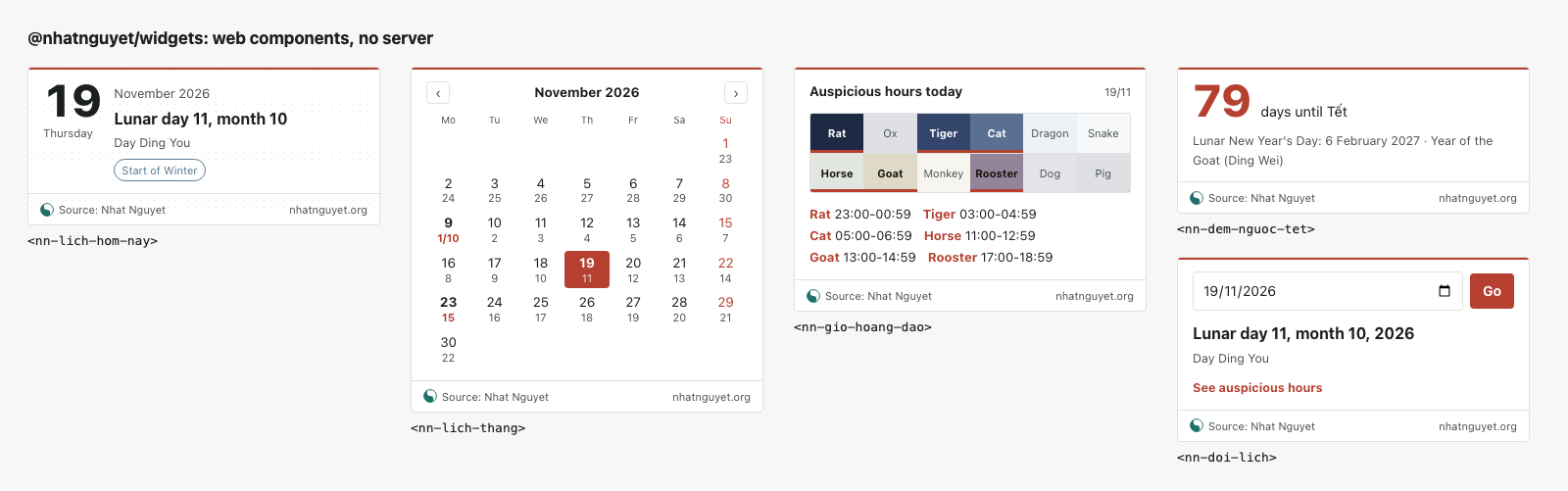
@nhatnguyet/widgets is 5 web components (today's
date, month grid, auspicious hours, Tết countdown, date converter) that run in
the reader's browser: open code in this repo, no server, no network calls,
light and dark themes, English, Vietnamese and Chinese.
<script type="module" src="https://cdn.jsdelivr.net/npm/@nhatnguyet/widgets/dist/nn-widgets.js"></script>
<nn-lich-thang lang="en" theme="auto" country="VN"></nn-lich-thang>
country (VN default, CN, KR, JP...) switches to another country's
lunar calendar. Attributes and previews: widgets/.
nhatnguyet.org also hosts 14 iframe widgets (glossary, good dates, lottery
results...); they are a service of the website, not open code in this repo:
nhatnguyet.org/widget.
Examples and docs
- Playground: nhatnguyet.org/en/ma-nguon-mo/thu, runs the packages in your browser.
- API docs: nhatnguyet.org/en/ma-nguon-mo/tai-lieu and docs/api-en.md.
- Guides: build a Tử Vi chart with JavaScript · lunar calendar and festivals for your app · an AI assistant that cites the classics · analyze chart data with Python.
- Background: lunar calendar and solar terms ·
Zi Wei chart ·
BaZi ·
numerology ·
classical texts and readings ·
how Nhat Nguyet checks its work.
examples/ has quick tries (an HTML page with no
build step, Node, Python) and four templates to copy:
| Template | What it is |
|---|---|
nextjs-lunar-calendar |
Next.js page (static export): month grid with lunar dates and solar terms, Tết countdown, Zi Wei chart from a form |
telegram-bot |
grammY bot: /today, /tet, /ziwei, replies in English, Vietnamese or Chinese |
google-sheets |
=LUNARDATE(), =SEXAGENARY(), =SOLARTERM(), =SOLARDATE() in one Code.gs file |
jupyter |
notebook: Tết, lunar months and leap months in Vietnam and China, 1900 to 2100, with charts |
Migrating from iztro
@nhatnguyet/ziwei/iztro is compatible with iztro: astro.bySolar andastro.byLunar take the same parameters and return the same JSON shape as
iztro's FunctionalAstrolabe, with its six display languages and its methods
(palace(), star(), surroundedPalaces(), horoscope(), fliesTo(),use()...), computed on the calendar of the country you pass
({ country: "CN" } for Beijing time, as iztro does; Vietnam by default).
- import { astro } from "iztro";
+ import { astro } from "@nhatnguyet/ziwei/iztro";
Measured against iztro on 2,006 horoscopes, the decade, age and year palaces
and the yearly star positions match; every remaining difference (the Geng-year
transformations, the leap-month rule, two months with a new moon at Beijing
midnight) is counted and explained. A few placements deliberately
follow the Vietnamese books: major star brightness on five levels (iztro has seven),
Tiangui, and Kui and Yue in Geng years. Not placed: five adjective stars found
only in Chinese texts, the Jiang Xing ring, and the decade and month moving
stars. Pass the school options above to follow iztro on Fire and Bell, the
Geng transformations and the Celestial Kitchen. Full list:
docs/chuyen-tu-iztro.md.
FAQ
Why can the same day have a different lunar date in China, Korea and Vietnam?Same rules, different clock. A month starts on the day of the new moon, and
the day is decided in local time. When a new moon falls between 16:00 and
17:00 UT it is before midnight in Hanoi and after midnight in Beijing, so the
month starts a day earlier in Vietnam; between 15:00 and 16:00 UT it is after
midnight in Seoul and Tokyo, so the month starts a day later there. The Lunar
New Year of 1985 is a whole month apart (21 January in Vietnam, 20 February in
China) because the leap month falls in a different year.
The Zi (Tý) hour runs 23:00 to 00:59. Zi Wei keeps the date you entered (some books move it
to the next day; enter the next date to follow them). BaZi turns the day pillar
at 23:00, or at midnight with schools: { ziHour: "split-at-midnight" }. Both
are stated in the chart's notes.
The solar terms: the year turns at Start of Spring (Lập Xuân), the month at
each sectional term. Using the lunar month instead gives a different month
pillar on about a quarter of all days (24.3% from 1900 to 2100).
Yes. Calendar data, terminology, test vectors and classical texts allow it
commercially under CC BY 4.0. The reading and knowledge datasets are CC BY-NC
4.0: free for research and non-commercial models, commercial use by permission
([email protected]). Credit "Data: Nhat Nguyet (nhatnguyet.org)".
Diacritics are folded ("Đ" counts as "D"), then the Pythagorean letter table
is applied. Master numbers 11, 22 and 33 are kept.
Contributing
Bug reports with a source (a book and chapter, or astronomical data) are the
most useful; see CONTRIBUTING.md.
Port challenge: write the engine in another language (Go, Rust, Dart,
Swift, C#...) and pass all 17,291 test vectors in ca-kiem/.
Read vao, compare with ra; the rules are in
CONTRIBUTING.md.
Citation and license
| Part | License |
|---|---|
| Code | MIT |
| Calendar data, terminology, test vectors | CC BY 4.0: commercial use and AI training allowed, credit required |
Reading and knowledge datasets (*-readings, *-knowledge) |
CC BY-NC 4.0 from 20 November 2026: non-commercial use with credit, commercial use by permission; earlier releases stay CC BY 4.0 |
| Classical texts | Public domain originals; the digitization and cleaning are CC BY 4.0 |
Credit line: Data: Nhat Nguyet (nhatnguyet.org), with a link where possible.
The Nhat Nguyet name and logo are not covered by these licenses. To cite the
software (the calendar method is in the technical paper):
@software{nhatnguyet_2026,
  author = {{Nhat Nguyet}},
  title  = {Nhat Nguyet: open source code and data for Zi Wei Dou Shu, BaZi and numerology},
  year   = {2026},
  url    = {https://nhatnguyet.org/en/ma-nguon-mo},
  doi    = {10.5281/zenodo.24358013}
}
Website: nhatnguyet.org · Email: [email protected]
Data: Nhat Nguyet (nhatnguyet.org) · Code MIT · Data CC BY 4.0 · Readings CC BY-NC 4.0
Yorumlar (0)
Yorum birakmak icin giris yap.
Yorum birakSonuc bulunamadi