Forge
Health Gecti
- License — License: MIT
- Description — Repository has a description
- Active repo — Last push 0 days ago
- Community trust — 11 GitHub stars
Code Gecti
- Code scan — Scanned 12 files during light audit, no dangerous patterns found
Permissions Gecti
- Permissions — No dangerous permissions requested
Bu listing icin henuz AI raporu yok.
Forge is an open-source, self-hosted alternative for visually building and shipping AI agents and workflows without giving up control of your infrastructure.
Forge
The open-source, self-hosted platform for visually building, testing, and shipping AI agents & workflows.
Wire agents, tools, knowledge, and logic on a canvas - ground them in your data, connect them to your systems, and deploy to email, an API, an MCP server, or an embeddable web widget. No framework code required.







Forge is built directly on the MIT-licensed LangChain v1 + LangGraph v1 framework - and never depends on langgraph-api (Elastic 2.0) or LangSmith (commercial). Everything you orchestrate runs on your own infrastructure; nothing is sent to a third-party orchestration service.
- Fully open source (MIT). No proprietary core, no usage caps, no vendor lock-in.
- Zero-infra local dev. Boots on SQLite + embedded Chroma + an in-process scheduler - no Docker, Postgres, or Redis required to start.
- Production-ready. Swap to Postgres + pgvector, Redis, and a real secret store with config only - a hardening guard refuses to boot with insecure defaults.
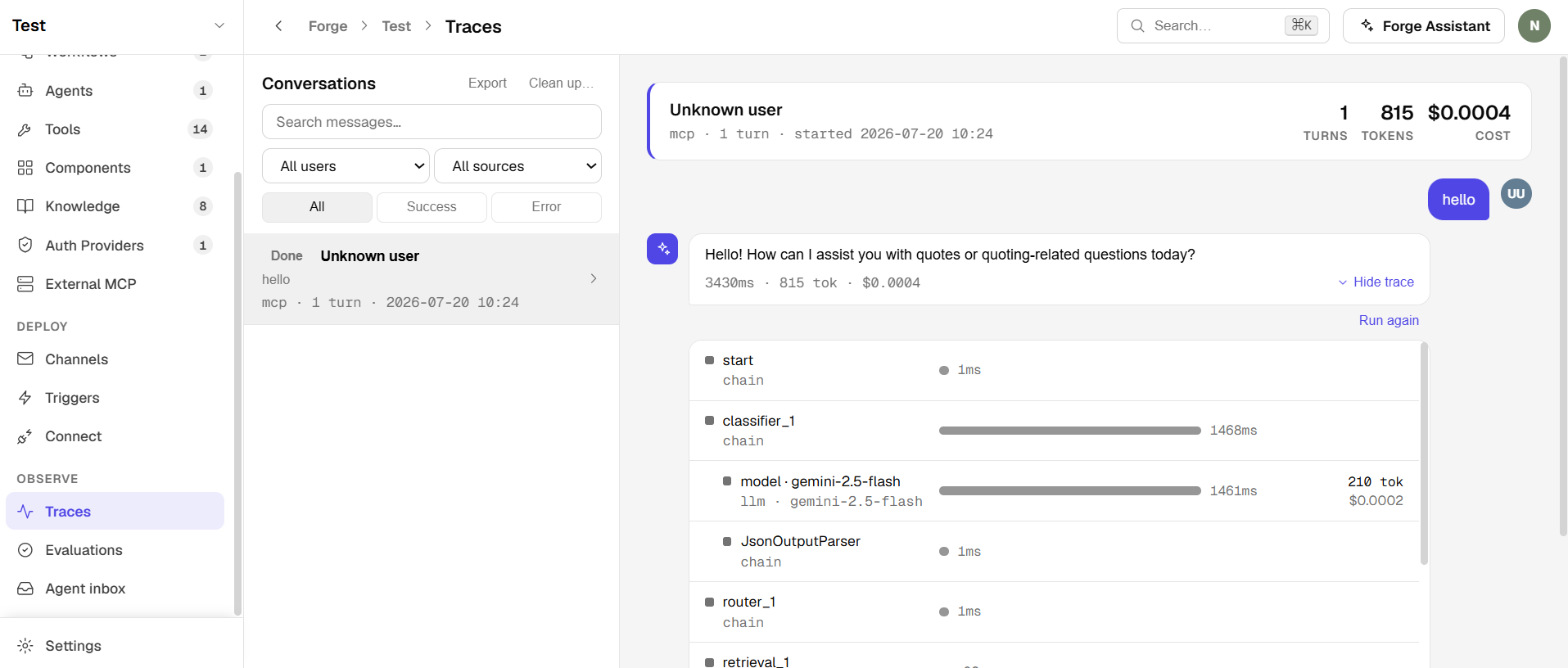
- Observable by default. Every run is a span waterfall with tokens, latency, and cost down to fractions of a cent.
Table of contents
Features
Watch the demo - the in-product Forge Assistant builds and runs a workflow end to end. (If the player doesn't load inline, click the link to play.)
Visual Workflow Builder
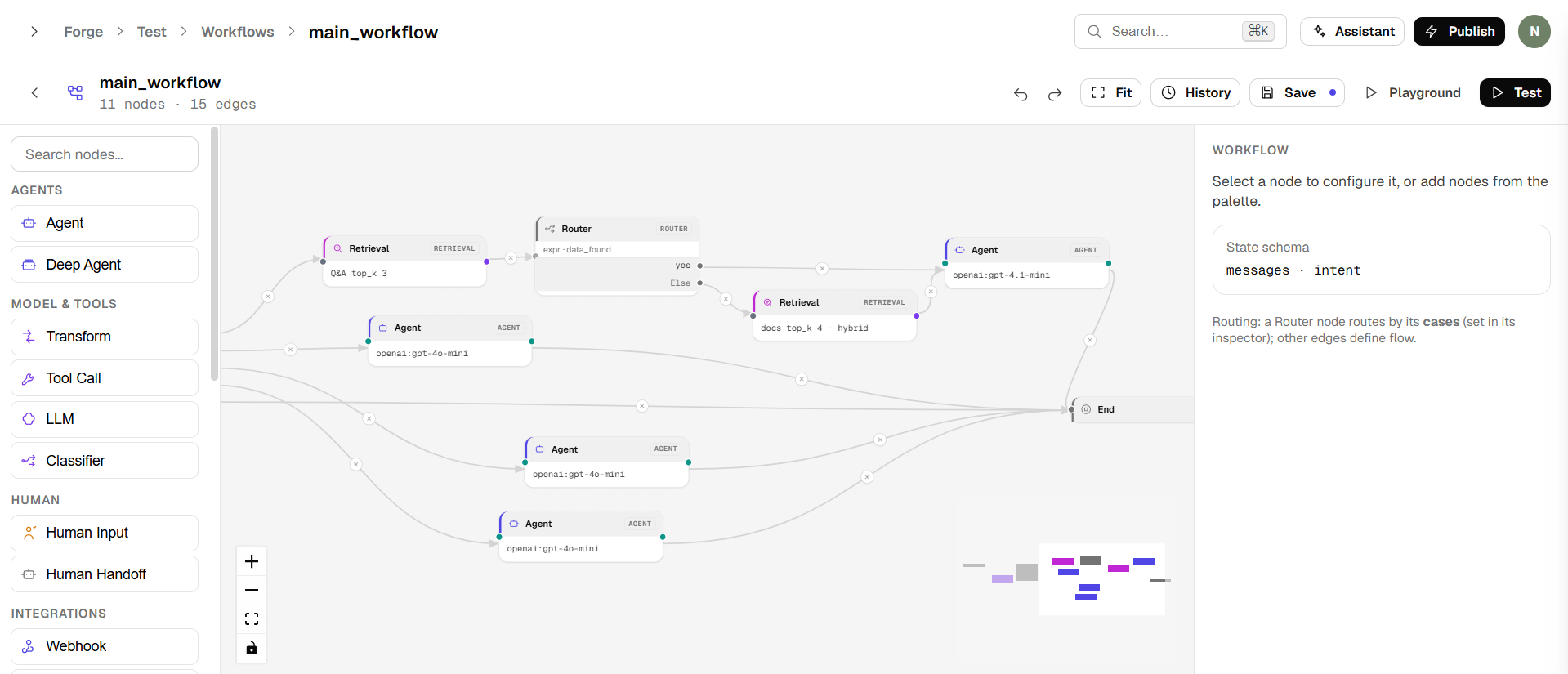
Wire an entire app on a drag-and-drop canvas (React Flow): drop nodes from the palette - agents & deep agents, model calls, classifiers, tools, transforms, retrieval, human input/handoff, routers, loops, parallel fan-out/join, subworkflows, and triggers - and connect them with typed, validated edges. A per-node inspector and a live state schema keep runs type-safe, while a minimap, undo/redo, and copy/paste keep big graphs manageable. Save, Test, or open the Playground to watch nodes light up as the run streams - then Publish.
Visual Agent Builder
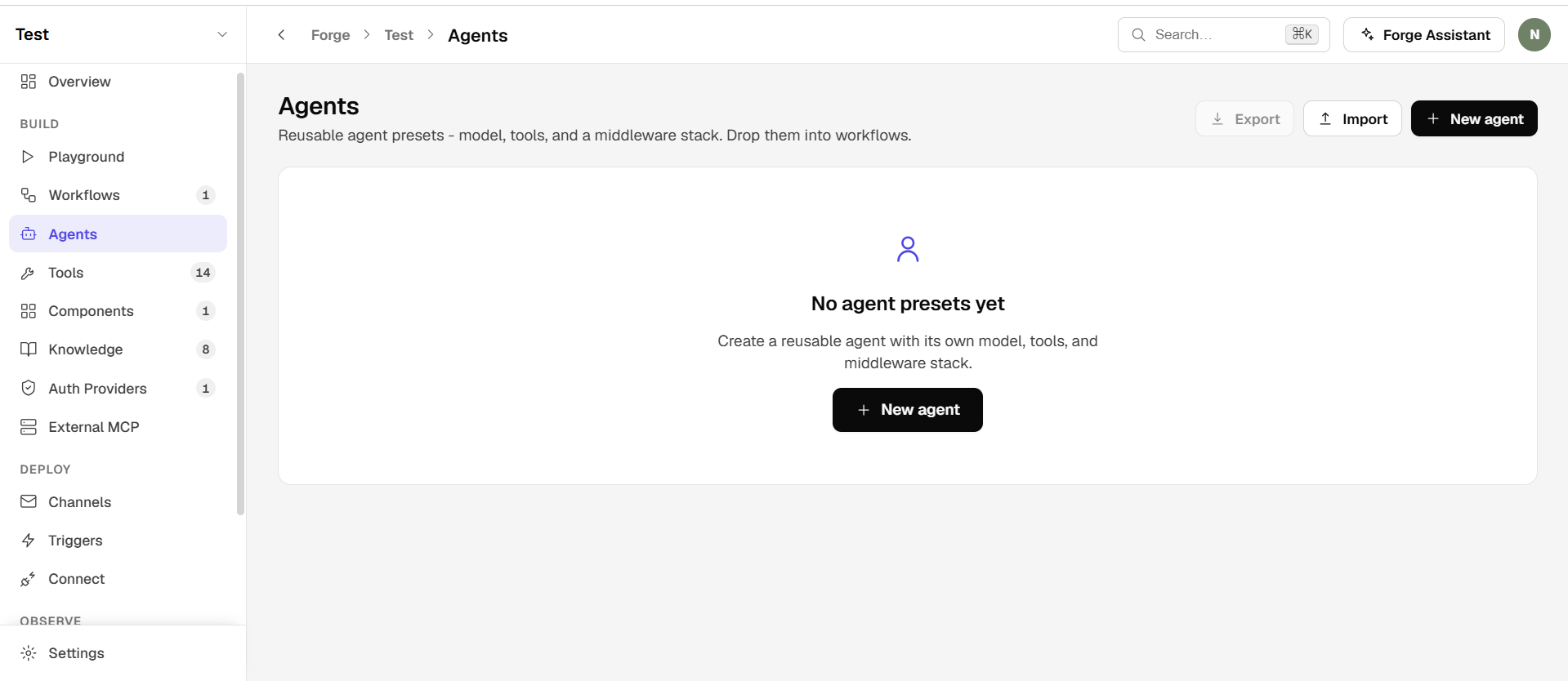
Compose an Agent or a Deep Agent (planning + subagents for long multi-step tasks) from a model, a system prompt, tools, knowledge, Q&A, and a reorderable middleware stack - all from friendly forms, no JSON. A live "what the model sees" panel shows the exact compiled prompt and middleware execution order before you ship.
Tool Builder with Response Projection
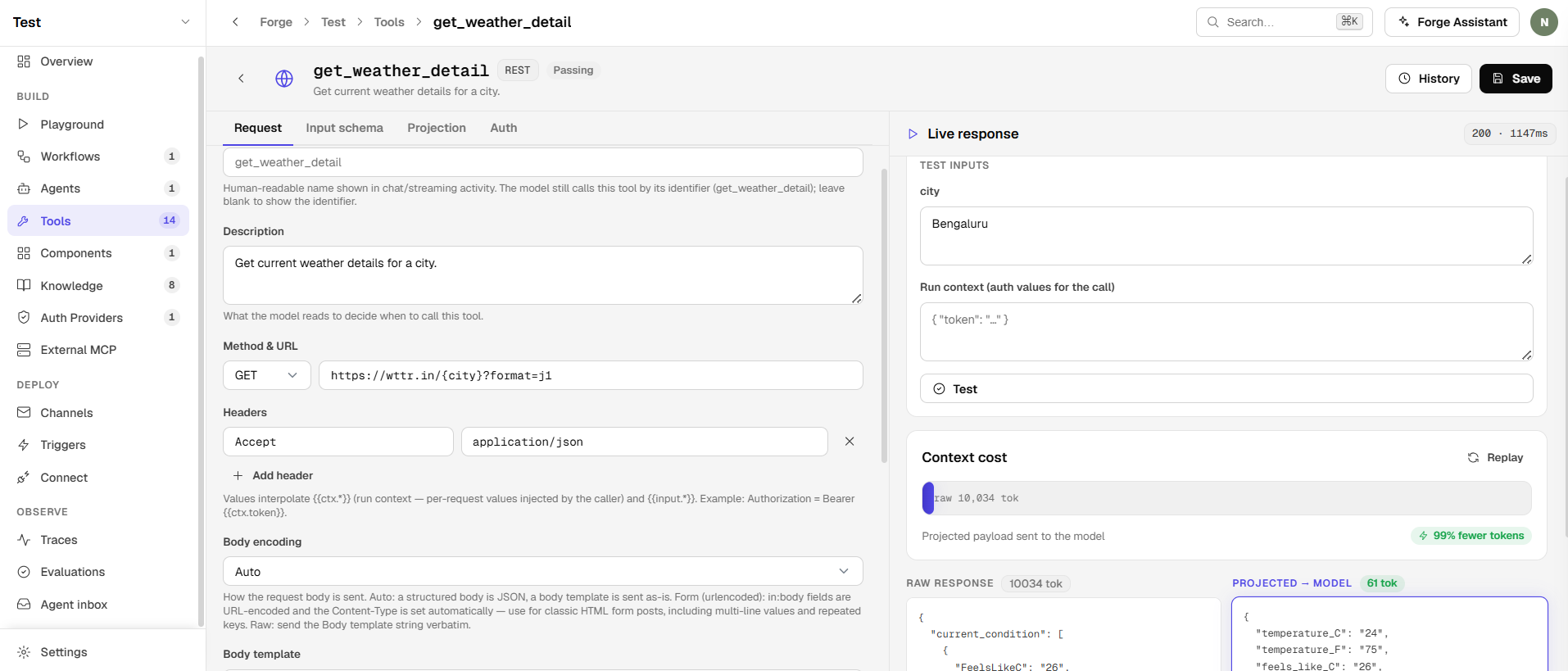
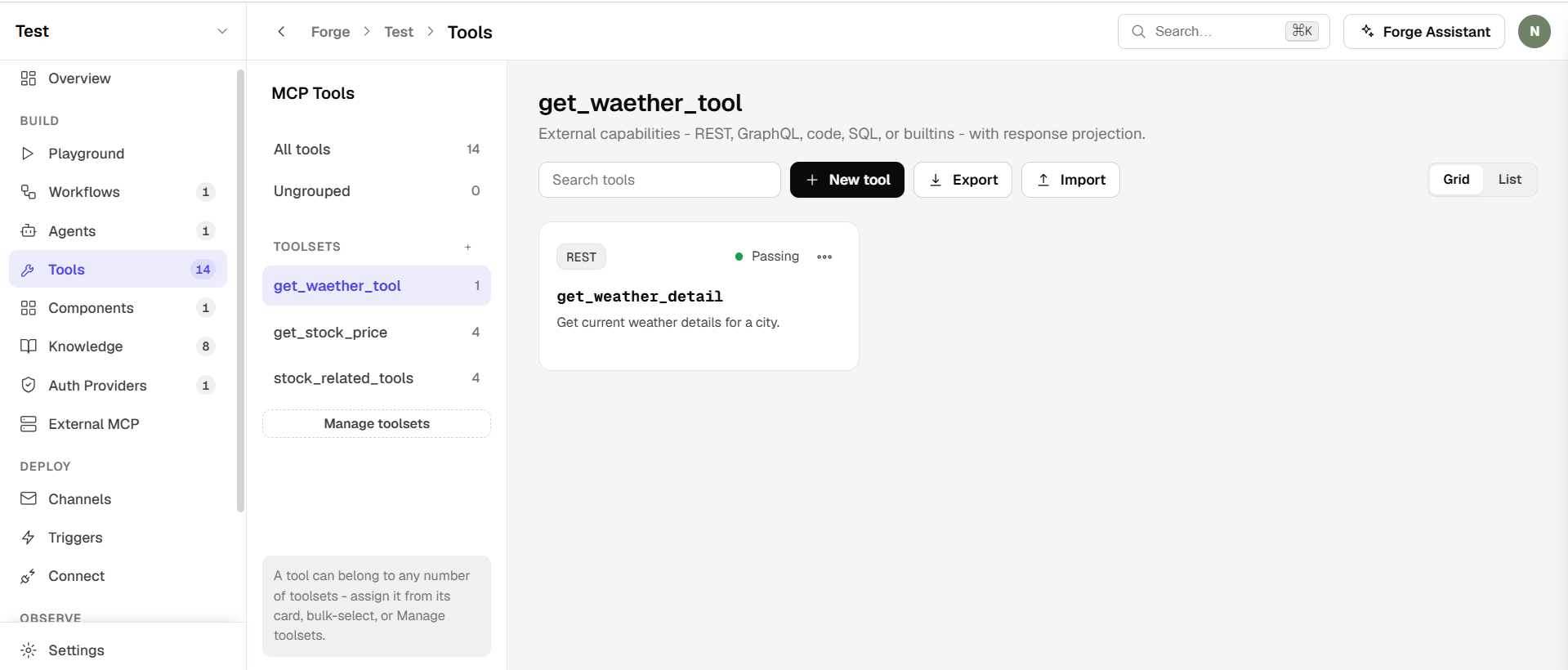
Register REST, GraphQL, Code, SQL, MCP, or built-in tools and test them live against real inputs. A JMESPath response projection trims bulky payloads before they reach the model - watch the raw → projected token meter shrink in real time to control cost. Every outbound call is screened by an SSRF guard, with optional retries, rate limits, and caching. Organize tools into tool sets - reusable, many-to-many groups that double as folders on the screen, get granted to an agent in one click, and publish as MCP toolsets.
The Tools screen groups everything by set (switchable between grid and list), with one-click export / import to move tools between projects:
Knowledge & RAG
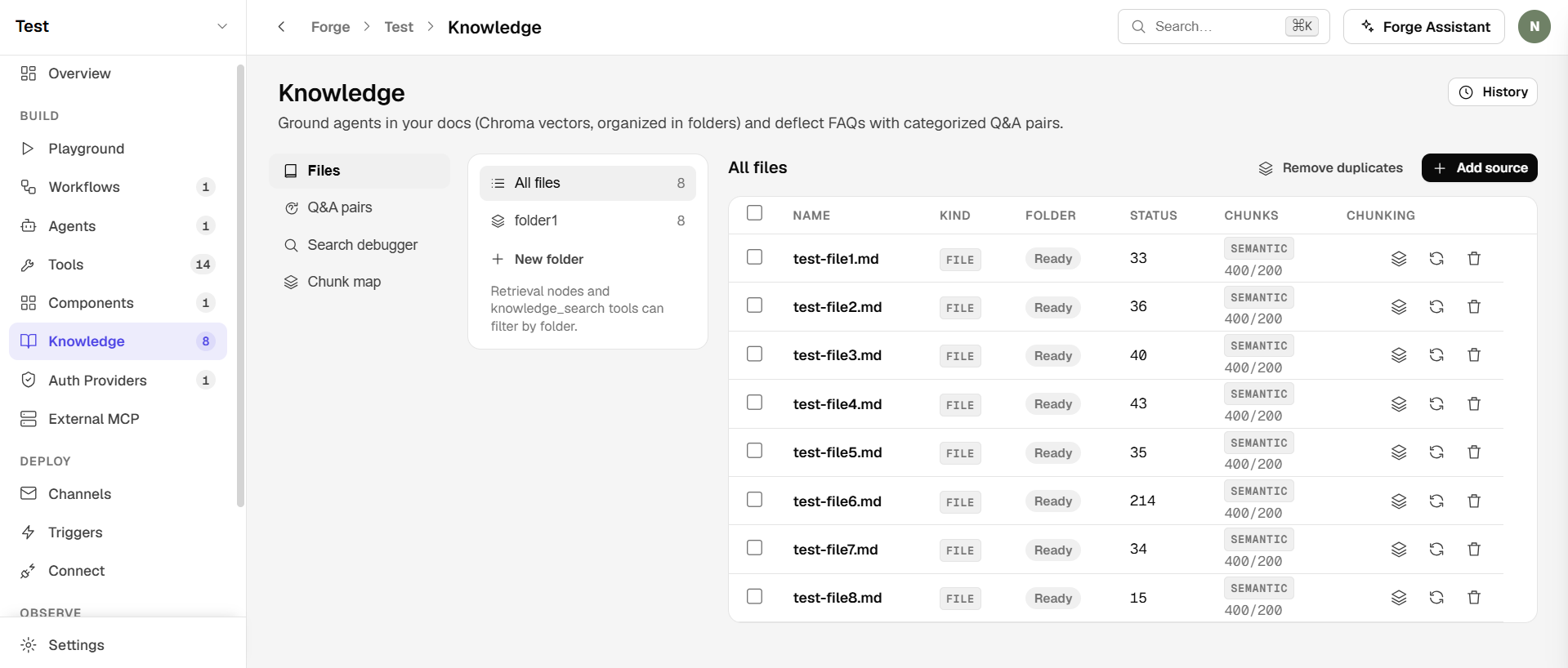
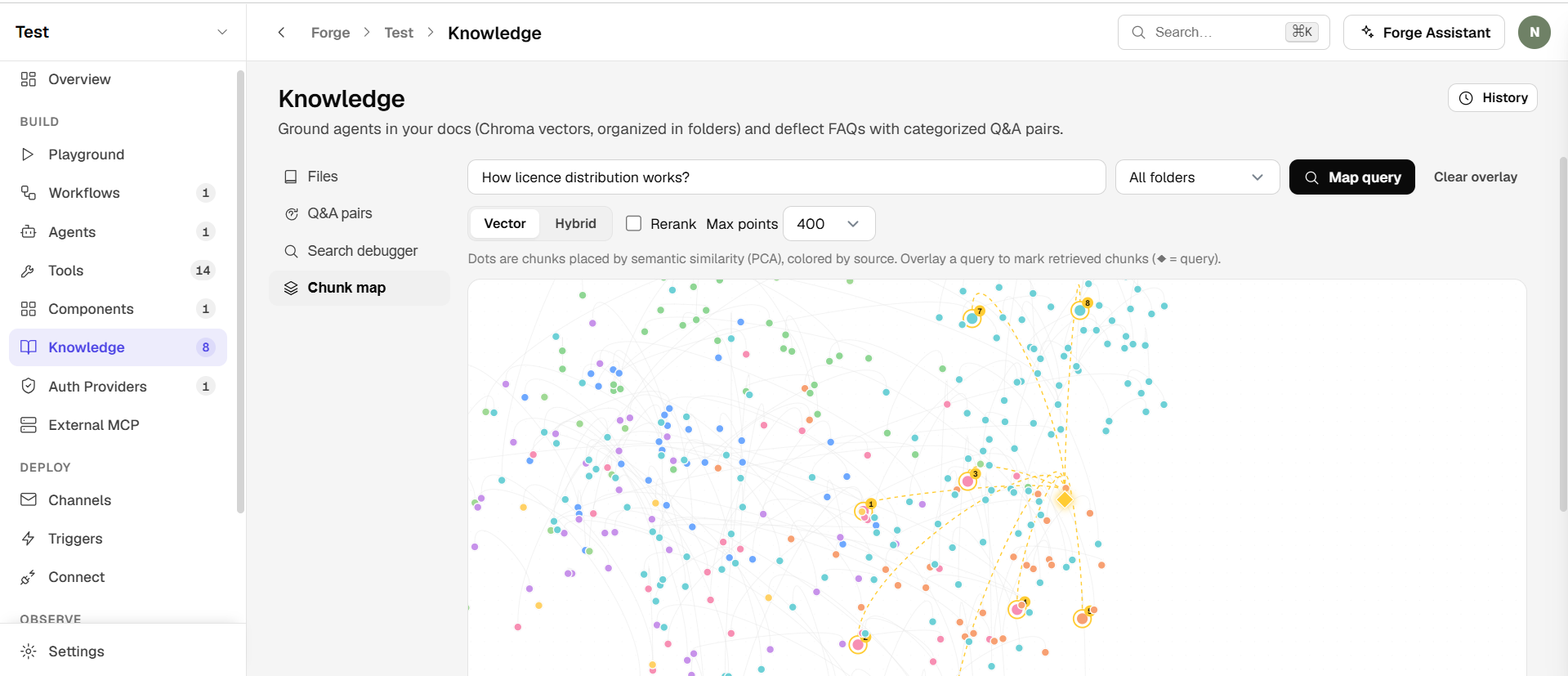
Ground agents in your own data. Add pasted text, URLs, crawled sites, or uploaded files (.txt/.md/.csv/.json/.html/.pdf); Forge chunks, embeds (offline-capable by default), and stores them as vectors organized in folders. Curated Q&A pairs deflect common questions, and a search debugger lets you inspect exactly what retrieval returns.
The built-in search debugger plots every chunk by semantic similarity and overlays a query - so you can see exactly which chunks a search retrieves, and why:
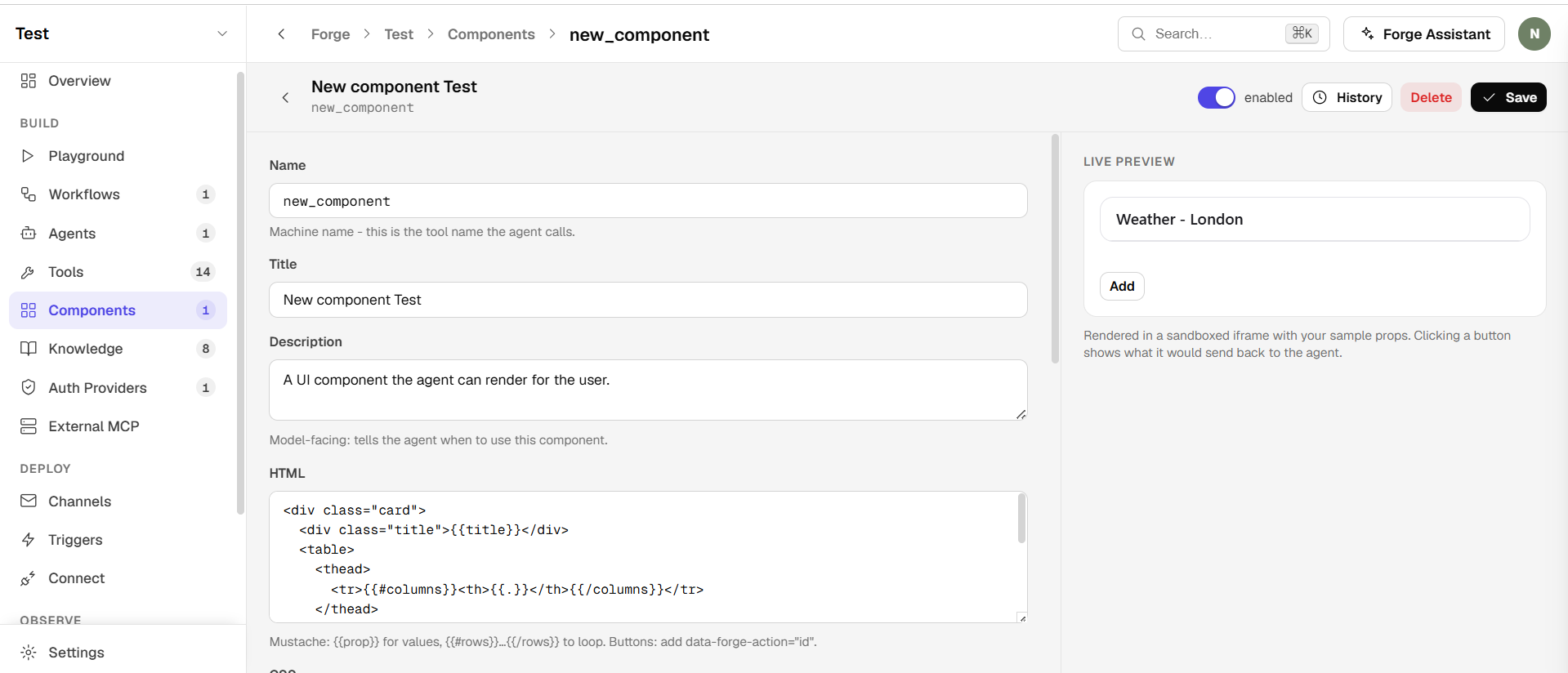
Generative UI Components
Let agents render rich, interactive UI - tables, cards, forms - instead of plain text. Author an HTML/CSS component once with a live preview; the model emits a tiny payload while the markup renders in a sandboxed iframe and never bloats the token stream. Buttons can send structured actions straight back to the agent.
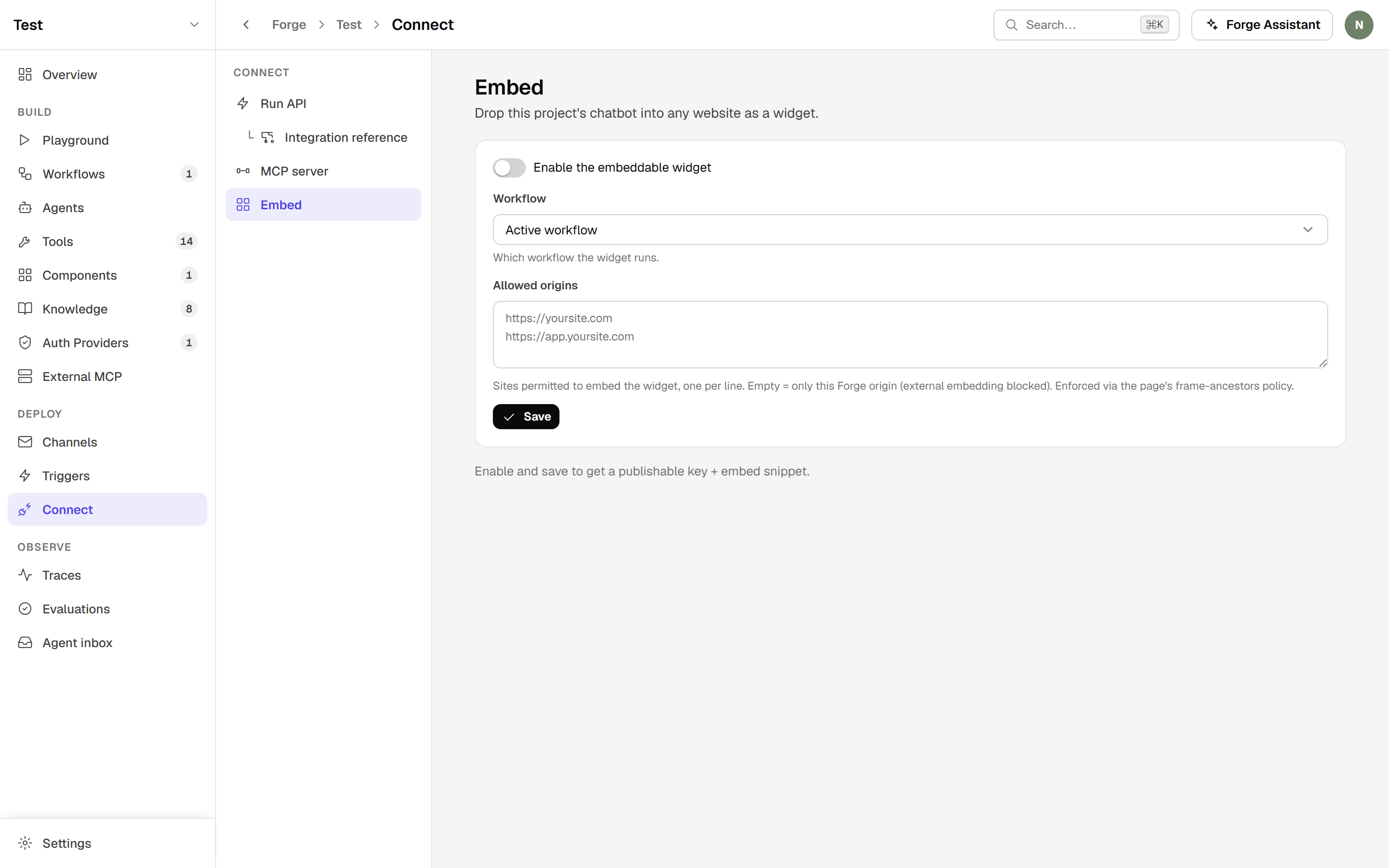
Embeddable Web Widget
Drop your assistant onto any website with a one-line script - a floating chat bubble locked to the origins you allow. End users see only the conversation; operational details (steps, tokens, cost, node names) stay private in the dashboard.
Deploy anywhere - one run API, MCP & channels
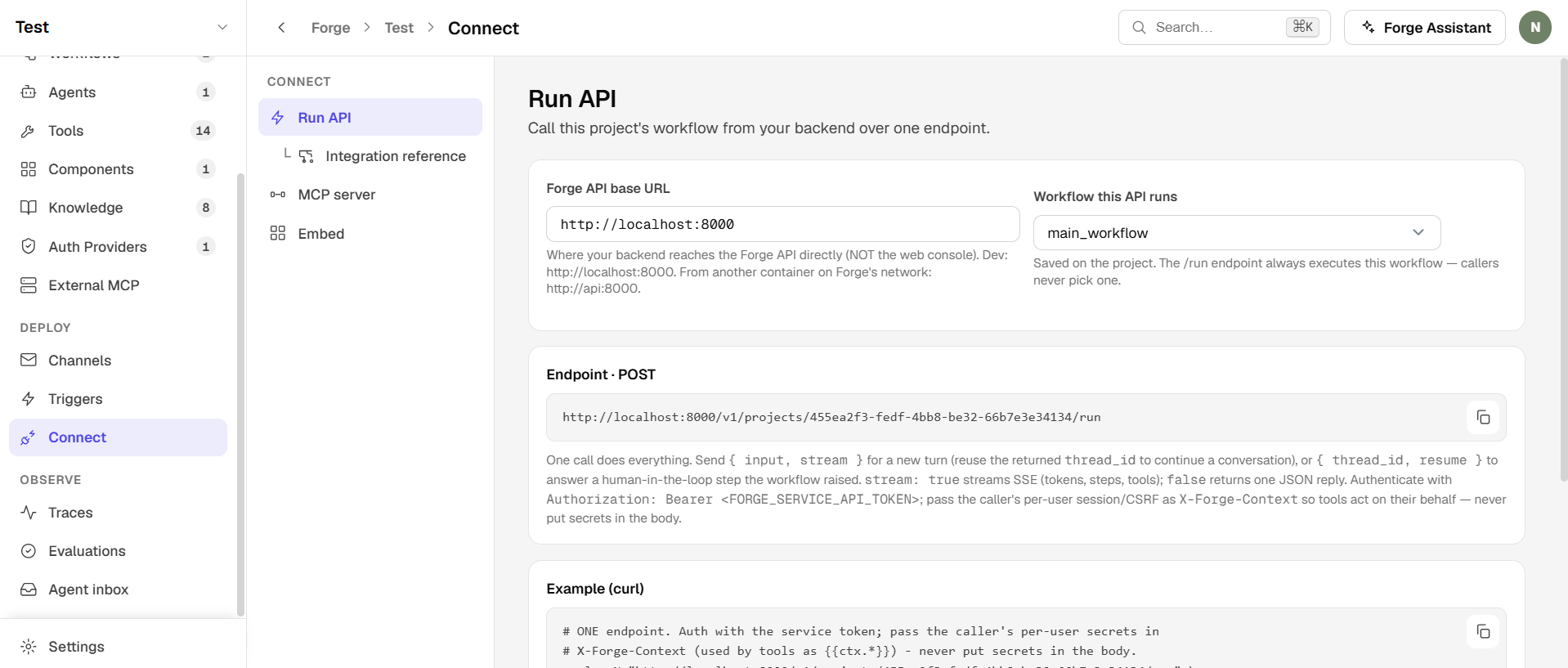
Ship the same workflow through many surfaces without rewriting it: call it server-to-server over a single run API (POST /run handles new turns, streaming, and human-in-the-loop resumes), expose it as an MCP server, deploy it to email, or drop in the web widget. Per-request caller context (X-Forge-Context) lets tools act on behalf of your end users - with secrets never in the request body.
Observability & Traces
Every run is captured as a span waterfall - model calls, tools, chains, latency, tokens, and cost - so you can see exactly what happened and what it cost. Pair it with Evaluations to catch regressions before you publish, and export traces to any OpenTelemetry collector (e.g. Langfuse).
Guardrails, budgets & governance
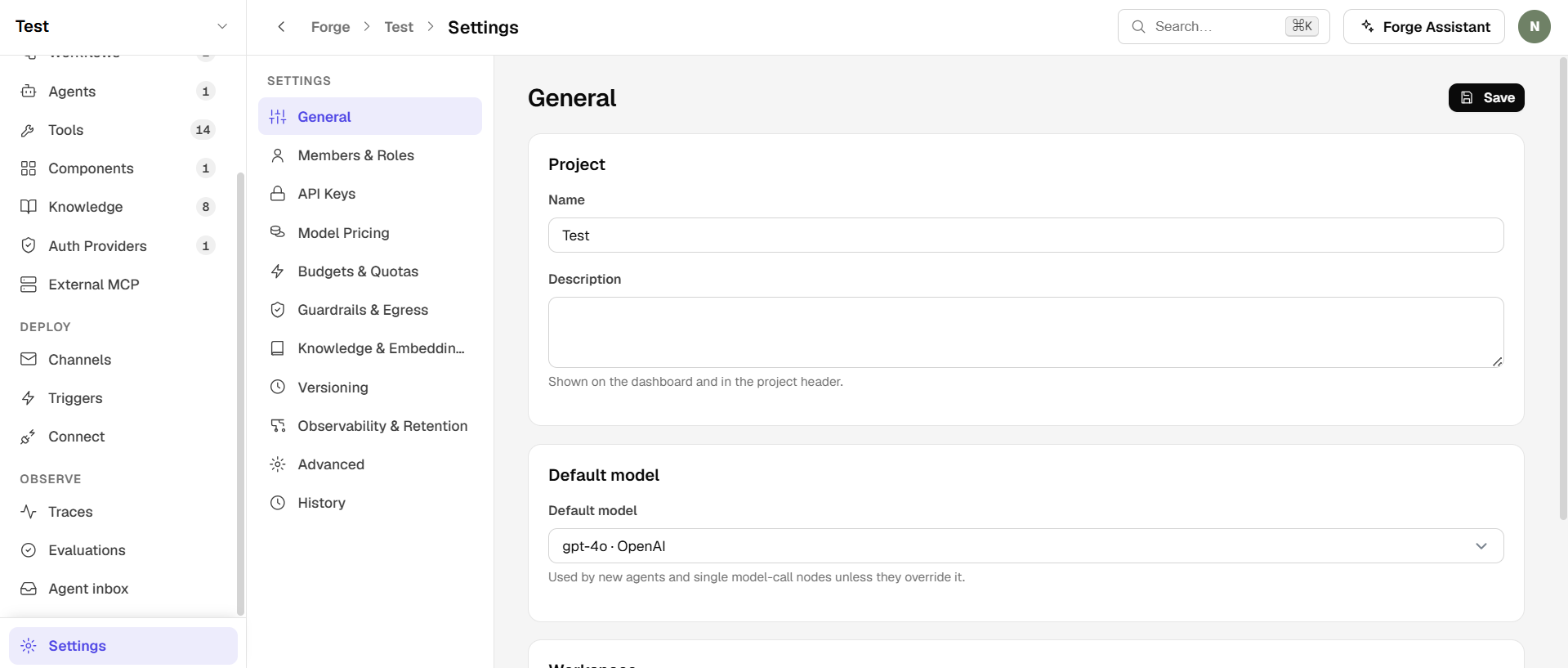
Run it like production. A project-level Guardrails & Egress policy (PII redaction, blocked terms, and a network allow/deny list) applies to every agent by default; budgets & quotas cap spend and tokens; versioning snapshots every change; and it all sits behind per-project roles / RBAC and an audit log - from one Settings surface.
And many more
- Channels - deploy a workflow to Email.
- Triggers - webhooks, schedules (interval/cron), inbound email, and polling "app events".
- Human-in-the-loop - approve/reject pauses and live handoff to an Agent inbox, with the reply delivered back over the same channel.
- Auth Providers - Bearer, API key, Basic, OAuth2 (client-credentials and 3-legged user login with auto-refresh), and CSRF/session - backed by encrypted, reference-only secrets (
secret://…). - MCP, both ways - expose your tools as an MCP server over native Streamable-HTTP/SSE (Claude Desktop, Cursor, and VS Code connect directly - no bridge), authenticated by a project key, per-user personal access tokens, or optional OAuth 2.1, publishing tool sets, knowledge, Q&A, or a whole workflow; and consume tools from external MCP servers.
- Guardrails & egress policy - one project-level I/O policy (PII redaction, blocked terms, and a network allow/deny list) enforced on every agent by default; a project can only tighten it, never loosen it.
- Import & export - move tools, workflows, agents, and components between projects as portable JSON bundles (secret values never leave).
- Evaluations - datasets scored by
contains/exact/regex/ LLM-judgefor a pass rate per workflow. - Long-term memory, response caching, retries with backoff, and per-tenant budgets.
- Multi-tenant projects & roles (owner/admin/editor/viewer/connector) with per-project RBAC, scoped revocable API keys, entity version history, and an audit log.
- Provider-agnostic models - OpenAI, Anthropic, Google, or any LangChain provider, plus an offline
fake:model so you can build the plumbing without spending a cent.
See the full User Manual for an end-to-end tour and worked examples.
Architecture
A pnpm + Python monorepo with a shared schema contract that keeps the backend and frontend in lockstep:
forge/
├── apps/
│   ├── api/        FastAPI backend - the engine (compiler, registry, middleware), tools,
│   │              auth, knowledge, tracing, MCP server, build assistant. Dockerfile +
│   │              Alembic migrations live here.   [Python]
│   └── web/        Next.js console - canvas, config panels, playground, traces. Dockerfile
│                  lives here.   [TS/React]
├── packages/
│   └── schemas/    Shared JSON Schemas - the single source of truth, imported by the
│                  backend validator/compiler AND the frontend <SchemaForm>.
├── docs/           User manual, roadmap, and media.
├── infra/          Production database swaps (Postgres row-level-security policies).
└── docker-compose.yml   Production-shaped stack (Postgres · Redis · api · worker · web).
The shared schemas are the contract behind three consumers: the backend validator (rejects bad configs on save), the compiler (compile_workflow, build_middleware), and the frontend <SchemaForm> (forms generated from the same files).
Quick start (local, zero-infra)
Prerequisites
- Python 3.11–3.13 - the backend engine
- Node 22 LTS and pnpm 9+ - the web console
- Nothing else - the local stack runs on SQLite + embedded Chroma + an in-process scheduler, so no Docker, Postgres, or Redis is required to start.
1. Configure environment
cp .env.example .env        # macOS/Linux
copy .env.example .env      # Windows
Open .env and fill in what you need (e.g. an LLM provider key). Everything is optional to boot; agents that call a model need a provider key. Never commit your .env - it is already git-ignored.
2. Backend (FastAPI engine)
cd apps/api
python -m venv .venv && source .venv/bin/activate     # .venv\Scripts\activate on Windows
pip install -e ".[dev,all]"                            # engine + tests + vectors/providers/knowledge/MCP
pytest                                                 # optional: validate the engine (offline)
uvicorn forge.main:app --reload --port 8000            # http://localhost:8000/docs
3. Frontend (Next.js console)
In a second terminal, from the repo root:
pnpm install
pnpm --filter web dev                                  # http://localhost:3000
Open http://localhost:3000 for the console and http://localhost:8000/docs for the API. On first run, sign in with [email protected] / forge-admin, or create a fresh workspace.
Run with Docker (production-shaped)
The included docker-compose.yml brings up a production-shaped stack - Postgres (app DB + durable checkpointer), Redis (shared rate-limit/idempotency + worker queue), the API, a worker, and the web console:
# Set real secrets first (FORGE_JWT_SECRET, FORGE_BOOTSTRAP_ADMIN_PASSWORD, provider keys)
docker compose up --build
With FORGE_ENVIRONMENT=production, Forge enables a hardening guard and refuses to boot with default secrets, SQLite, or a non-durable checkpointer. See apps/api/README.md and Manual §13 - Going to production for the full, annotated configuration.
Documentation
| Doc | What's inside |
|---|---|
| User Manual | Full feature tour, the node catalog, and end-to-end use cases (no developer knowledge needed). |
| Backend README | API layout, local-vs-production swaps, and dependency notes. |
| Tech stack & architecture | Every dependency and why it's there, plus request/run sequence diagrams. |
| Roadmap & status | What's shipped, what's in progress, and what's planned next (connectors, more channels, and more). |
| Changelog | Notable changes, following Keep a Changelog + SemVer. |
| Contributing | Local setup, the checks CI runs, and commit/PR conventions. |
Tech stack
| Layer | Technology |
|---|---|
| Engine | LangChain v1 · LangGraph v1 · Deep Agents - MIT framework only |
| Backend | Python · FastAPI · SQLAlchemy 2 (async) · Pydantic v2 |
| Frontend | Next.js 14 (App Router) · React 18 · TypeScript · React Flow |
| Data (local) | SQLite · embedded Chroma · in-process cache/scheduler |
| Data (prod) | Postgres 16 + pgvector · Redis 7 · Fernet/Vault secrets |
| Observability | Built-in tracer + cost accounting · OpenTelemetry / Langfuse export |
Contributing
Contributions are welcome. Forge is MIT-licensed and built to be extended.
- Fork the repo and create a feature branch.
- Backend changes: run
pytestandruff check forge migrationsfromapps/api. - Keep the shared schemas (
packages/schemas) authoritative - the validator, compiler, and frontend forms all read from them. - Open a pull request describing the change and the reasoning.
Found a bug or have an idea? Please open an issue.
License
Forge is released under the MIT License - free to use, modify, and distribute, including commercially. It builds only on the MIT-licensed LangChain/LangGraph ecosystem, with no Elastic-2.0 or commercial-license dependencies.
Yorumlar (0)
Yorum birakmak icin giris yap.
Yorum birakSonuc bulunamadi