muse-cli
Health Gecti
- License — License: MIT
- Description — Repository has a description
- Active repo — Last push 0 days ago
- Community trust — 20 GitHub stars
Code Gecti
- Code scan — Scanned 9 files during light audit, no dangerous patterns found
Permissions Gecti
- Permissions — No dangerous permissions requested
Bu listing icin henuz AI raporu yok.
CLI for your personal muse.ai AI agent: chat, side chats, feed, goals, ideas, and sessions from the terminal. No browser needed.
muse-cli
Talk to your personal muse.ai AI agent from the terminal.





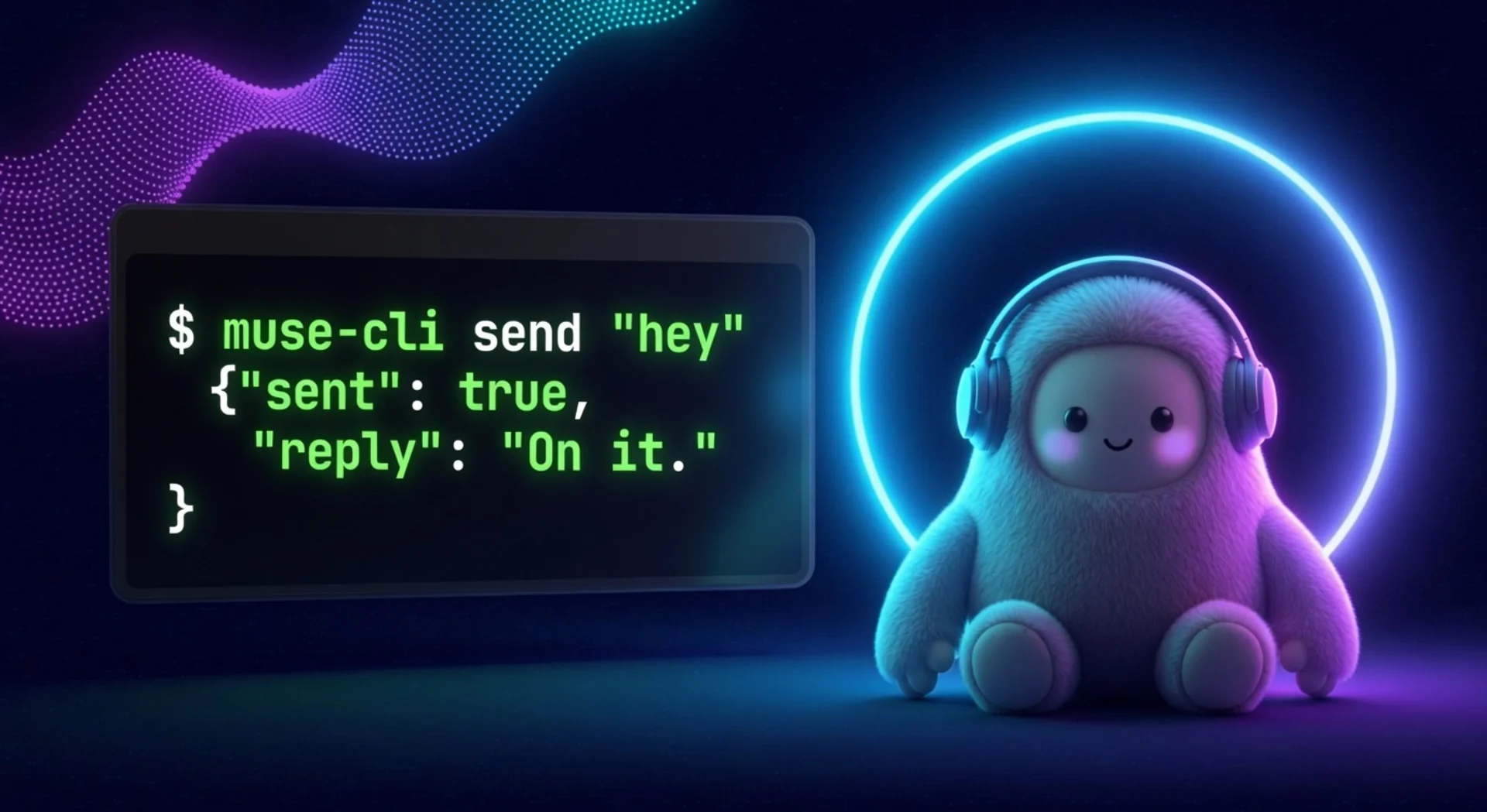
What is this?
A command-line client for your personal muse.ai AI agent: chat from the terminal, automate it with scripts, and manage side chats, feed, goals, ideas, and sessions without opening a browser. It speaks the app's own gateway protocol directly: HTTPS auth, then an encrypted Noise-XX WebSocket to your personal VM.
- Chat from the shell: send a message and get the agent's reply back as JSON.
- Script it: every command prints JSON, so it pipes into
jq, cron jobs, and other AI agents. - Full coverage: named commands for the common tasks, plus a
rawescape hatch for all 258 gateway methods. - Agent-ready: ships an agent skill so coding agents can drive your muse.ai agent for you.
Quick Start
uv tool install muse-cli # or: pipx install muse-cli / pip install muse-cli
The command is muse-cli. The name muse belongs to Muse Code on many machines.
Want the agent skill too? The installer sets up the CLI and copies the skill
to ~/.agents/skills/muse-cli:
curl -fsSL https://raw.githubusercontent.com/nikships/muse-cli/main/install.sh | bash
Upgrade with muse-cli update. In a terminal it also checks PyPI once a day and, when a newer release exists, prints that command on stderr. It does not upgrade itself. Set MUSE_NO_UPDATE_CHECK=1 to silence the notice. The check stays quiet when output is piped or CI is set. Remove with uv tool uninstall muse-cli.
Logging in is a separate one-time step. Chrome shares its cookies after you
turn on remote debugging. Follow Log in once before running
any other command.
Log in once
muse-cli borrows the login you already have in Chrome, saves those cookies
to ~/.config/muse-cli/cookies.txt (mode 600, only your user can read it),
and after that talks to muse.ai directly. Access tokens are fetched fresh
on every command. When a command later says the cookies expired, repeat this
section.
Do the steps in order. Each one checks itself before you continue.
1. Install the cookie reader
auth export uses agent-browser
to read Chrome's cookies. That package comes from npm, so you need Node.js first.
node --version    # if this fails, install Node.js LTS from https://nodejs.org
                  # and open a new terminal
npm i -g agent-browser
agent-browser --version
npm i -g needs permission to write to npm's global bin directory. If it
errors with EACCES, pick one and use it from then on: configure an
npm prefix you own,
or run the install with the same rights you use for other global npm tools.
Then check command -v agent-browser prints a path.
2. Let Chrome share cookies
Open Google Chrome, the same profile you use for muse.ai. Paste this in
the address bar:
chrome://inspect/#remote-debugging
Turn on remote debugging. The checkbox reads Allow remote debugging for
this browser instance. Leave Chrome open.
Turn this on while Chrome is already open and muse.ai is loaded. The export
can see that window only after the switch is on. The page is in Chrome 144
and newer.
Stay in this window. Starting a second Chrome with--remote-debugging-port opens a different profile, and that profile does
not have your muse.ai login.
3. Be logged in, on a muse.ai tab
In that same Chrome window, open https://muse.ai/ and log in. Leave the tab
open. The exporter reads whichever tab is active, so the muse.ai tab has to
be the one in front when you run the next command.
4. Save the login
muse-cli auth export
Chrome may ask to allow the debugging connection. Click Allow. If the
command already failed, run it again after you click Allow.
Success looks like this (the count varies):
saved 12 muse.ai cookies to /home/you/.config/muse-cli/cookies.txt
The command prints the fix on the failure itself. These are the ones it
recognizes:
| What it says | What to do |
|---|---|
| No running Chrome / remote debugging | The switch in step 2 is off. Turn it on in the Chrome you already have open, then run the command again. |
| No muse.ai tab | Step 3. Open https://muse.ai/ in that same window and leave the tab open. |
No hatch_sess |
The tab is open and you are logged out. Log in, then export again. The cookies file already on disk is left as it was. |
agent-browser is not installed |
Step 1. node --version, then npm i -g agent-browser, then a new terminal. |
| Daemon already running | A previous attempt is stuck. agent-browser close, then muse-cli auth export. |
5. Check the connection
muse-cli status
You get JSON with your VM id, how many chats you have, the unread count, and
your identity. That means install and login both worked.
Copy cookies by hand
Use this when you don't have Node, or you don't want remote debugging on.
- In Chrome, open https://muse.ai/ and log in.
- Open DevTools (F12, or Ctrl+Shift+I) → Application → Cookies →
https://muse.ai. - Copy the cookies onto one line.
hatch_sesshas to be there. Separate cookies with;(semicolon, space). A Netscape cookie jar (what curl writes) and a JSON object such as{"hatch_sess": "..."}also work.
mkdir -p ~/.config/muse-cli
printf '%s\n' 'hatch_sess=the-value-from-devtools; other_cookie=other_value' > ~/.config/muse-cli/cookies.txt
chmod 600 ~/.config/muse-cli/cookies.txt
muse-cli status
Usage
muse-cli threads                                  # main chat + side chats
muse-cli history --limit 5                        # recent messages
muse-cli history --thread <session-id> --limit 5  # one side chat
muse-cli send "summarize my unread" --wait 120    # send + wait for the reply
muse-cli watch --timeout 60                       # tail live agent events

muse-cli feed --limit 5
muse-cli feed-react <unit-id> love
muse-cli goals
muse-cli ideas
muse-cli idea-exec <idea-id>                      # agent acts on the idea

muse-cli session-start --title "trip planning"    # new side chat
muse-cli session-rename <id> "new title"
muse-cli session-archive <id>                     # also: pin, unpin, unarchive, delete
muse-cli seen <thread-id>
muse-cli wake
muse-cli raw <method> --body '{}'                 # escape hatch: any of 258 gateway methods
Every command prints JSON. Your VM is auto-discovered from your session, and a
random device id is generated on first run.
Pipe it into other tools:
muse-cli send "what's on my calendar today?" | jq -r .reply.text
How it works
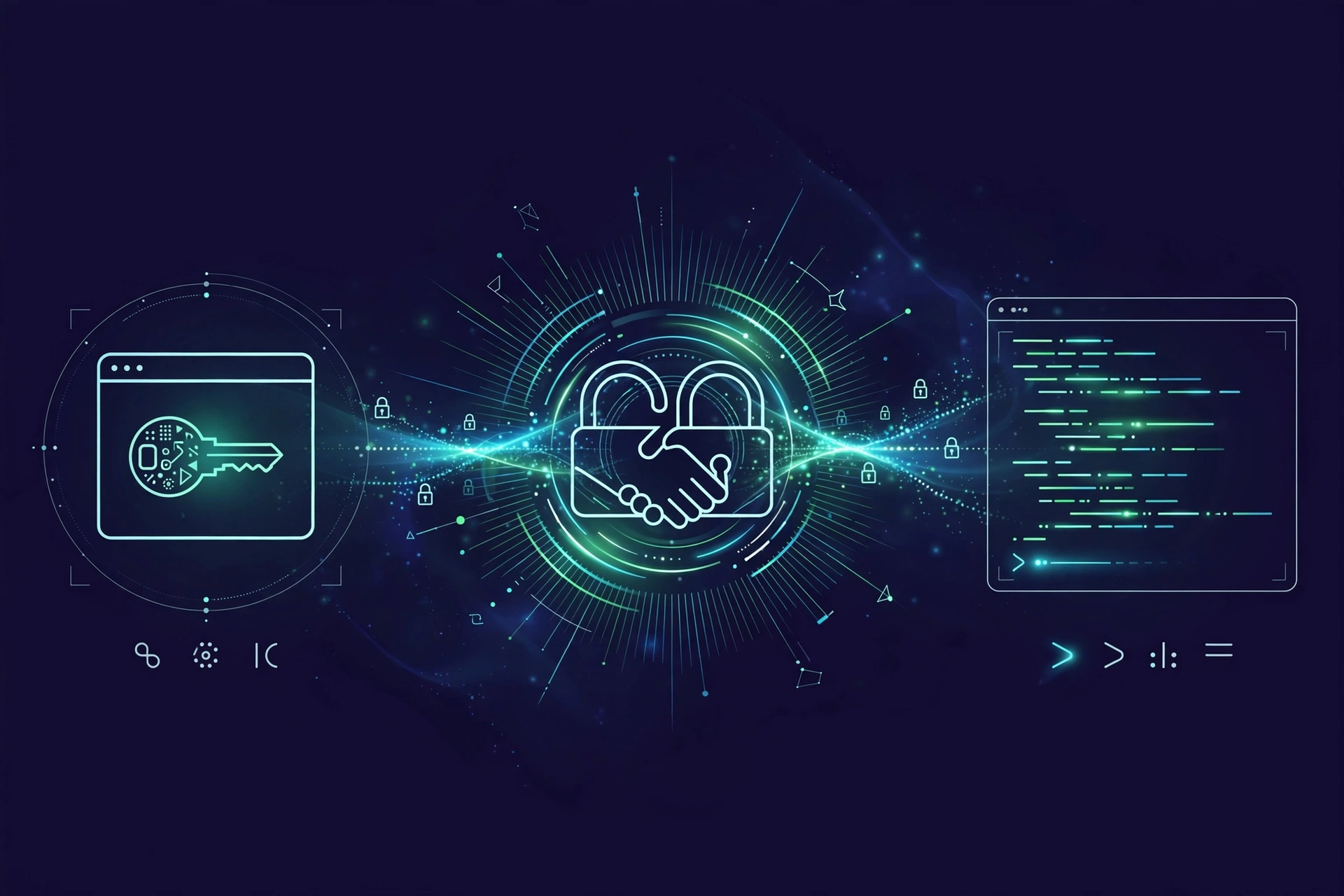
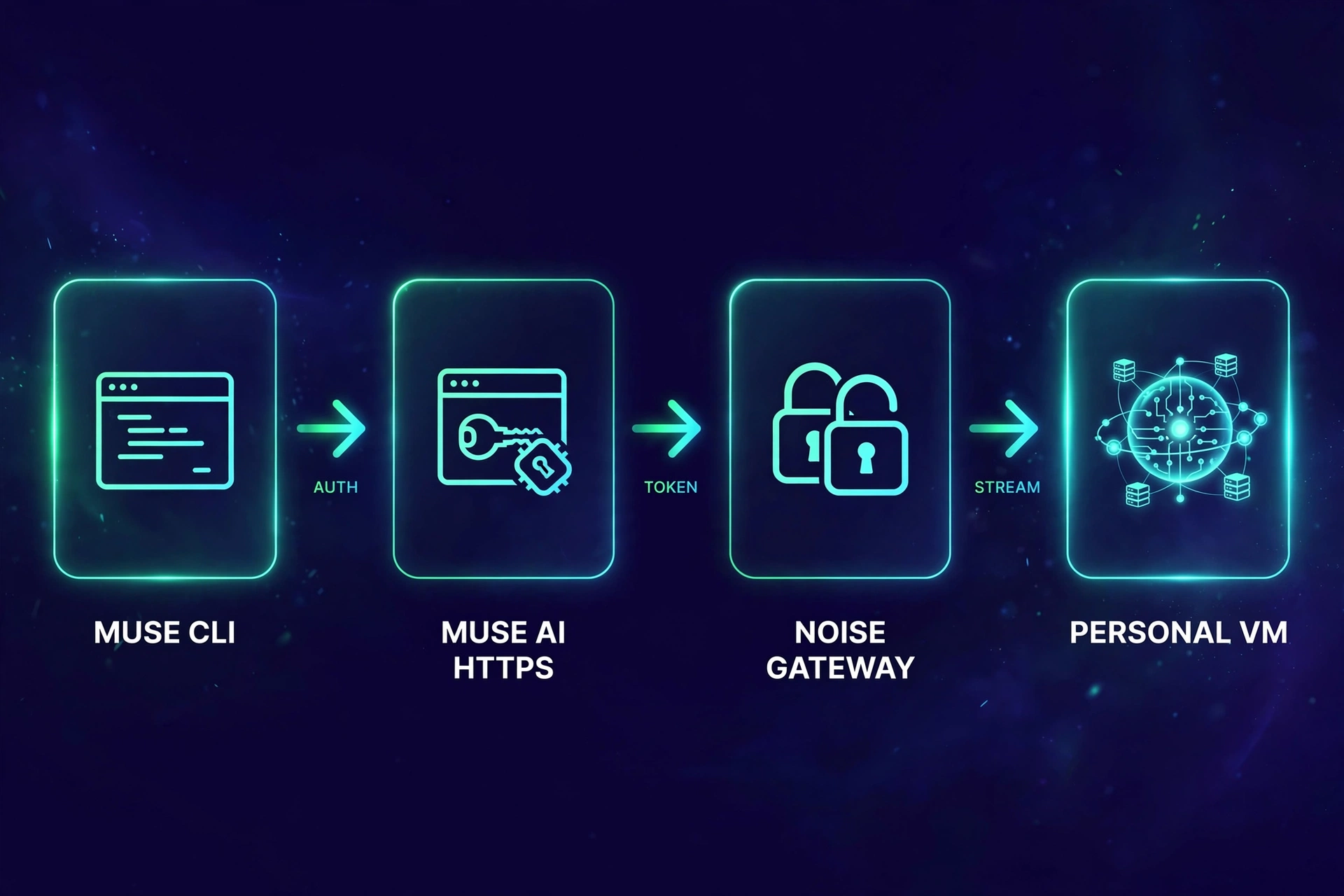
See docs/PROTOCOL.md
for the full protocol notes, including the method table and the server quirks
found during reverse engineering.
Documentation
| Resource | Description |
|---|---|
| skills/muse-cli/SKILL.md | Agent skill: install check, auth setup, command reference |
| docs/PROTOCOL.md | Gateway protocol reference: auth chain, Noise transport, framing, method quirks |
| routes.json | All 258 gateway methods with paths and services |
muse-cli raw --help |
Escape hatch for calling any gateway method directly |
Development
git clone https://github.com/nikships/muse-cli.git
cd muse-cli
uv run muse-cli --help
muse-cli/
assets/              README artwork (generated with Muse Image)
docs/PROTOCOL.md     protocol reference for re-derivation
skills/muse-cli/     agent skill
src/muse_cli/
  cli.py             argument parsing and all commands
  gateway.py         gateway client (auth, Noise transport, subscriptions)
  routes.json        258 gateway methods extracted from the web client
  desc0.bin          protobuf descriptors for the wire framing
  desc1.bin
install.sh           CLI + skill installer
pyproject.toml
Setup notes
- Login is the Log in once section above. Cookies live at
~/.config/muse-cli/cookies.txt(mode 600). Access and gateway tokens are
fetched fresh on every run. auth exportreads those cookies from Google Chrome through
agent-browser. Chrome has
to be open, with remote debugging on
(chrome://inspect/#remote-debugging) and a logged-in muse.ai tab in front.- Respect muse.ai's terms and rate limits. Internal APIs are unversioned and
can change; if calls fail, re-derive from a fresh app bundle.
Contributing
Issues and PRs welcome. If the protocol drifts, the most useful contribution
is a note of which method broke and the new server error text.
License
MIT. See LICENSE.
Yorumlar (0)
Yorum birakmak icin giris yap.
Yorum birakSonuc bulunamadi