agentgem
Health Warn
- License — License: MIT
- Description — Repository has a description
- Active repo — Last push 0 days ago
- Low visibility — Only 6 GitHub stars
Code Pass
- Code scan — Scanned 12 files during light audit, no dangerous patterns found
Permissions Pass
- Permissions — No dangerous permissions requested
No AI report is available for this listing yet.
A local web UI that introspects your coding-agent config, redacts secrets at capture, and builds a portable, composable Gem.





A local web UI that introspects your coding-agent config, redacts secrets at
capture, and builds a portable, composable Gem.
AgentGem reads your coding-agent config — skills, MCP servers, and CLAUDE.md —
redacts secrets the moment they're read, and produces a Gem: a manifest + lock
archive you can publish to a GitHub-backed registry, merge with other Gems, and deploy to
several targets. A browser can't read ~/.claude (it's sandboxed), so AgentGem runs a
small server on your machine; secrets never leave your device — what crosses any boundary
is a config shape with <redacted> in place of every sensitive value.
Built on AgentBack, ninemind's AI-native API/MCP
framework: every operation is defined once as a Zod contract and exposed as a REST
endpoint, an MCP tool, and an OpenAPI 3.1 document — so the web page and your local agent
call exactly the same thing.
What it provides
- Secret-safe capture — redaction by value and by key name, before anything reaches a
REST response, an MCP result, the live preview, or the built Gem. - A neutral Gem source — a manifest + lock archive that isn't tied to any runtime.
Build once; install into a local testbed, merge, publish, or compile to a target without
re-reading raw config. - Composition — the manifest/lock split lets small, focused Gems be reconciled into
larger agents with a single re-resolved lock, not a pile of overlapping config. - Workflow-aware recommendations — Analyze scans your agent's
session history to see which skills, MCP servers, and hooks you actually use, and
suggests ready-to-build Gems grouped by recurring workflow. - Deploy targets — Eve and OpenAI Sandbox (code-gen), Flue (materialize, deployable to
Cloudflare), and Bedrock AgentCore (managed backend); code-gen targets share a commoncomposestep. - Agent-to-agent (A2A) — export a Gem as an A2A Agent Card or a
runnable A2A server so other agents can discover and call it. - A native desktop app — a macOS/Windows/Linux build alongside the
npxCLI, hosting the same local server in its own window. - A GitHub-backed registry — publish, resolve, merge, and install composable Gems over
the same archive format. - An agent-native path — every operation is also an MCP tool, so your local agent can
build Gems over/mcpwith no browser involved.
Quickstart
Needs Node.js ≥ 22. From the directory of the agent project you want to package,
run it without installing:
npx @ninemind/agentgem         # npm
pnpm dlx @ninemind/agentgem    # pnpm
agentgem listening at http://127.0.0.1:4317
  UI:       http://127.0.0.1:4317/
  API:      http://127.0.0.1:4317/api/inventory  ·  POST http://127.0.0.1:4317/api/gem
  Explorer: http://127.0.0.1:4317/explorer/
  MCP:      http://127.0.0.1:4317/mcp
Open http://127.0.0.1:4317/, then:
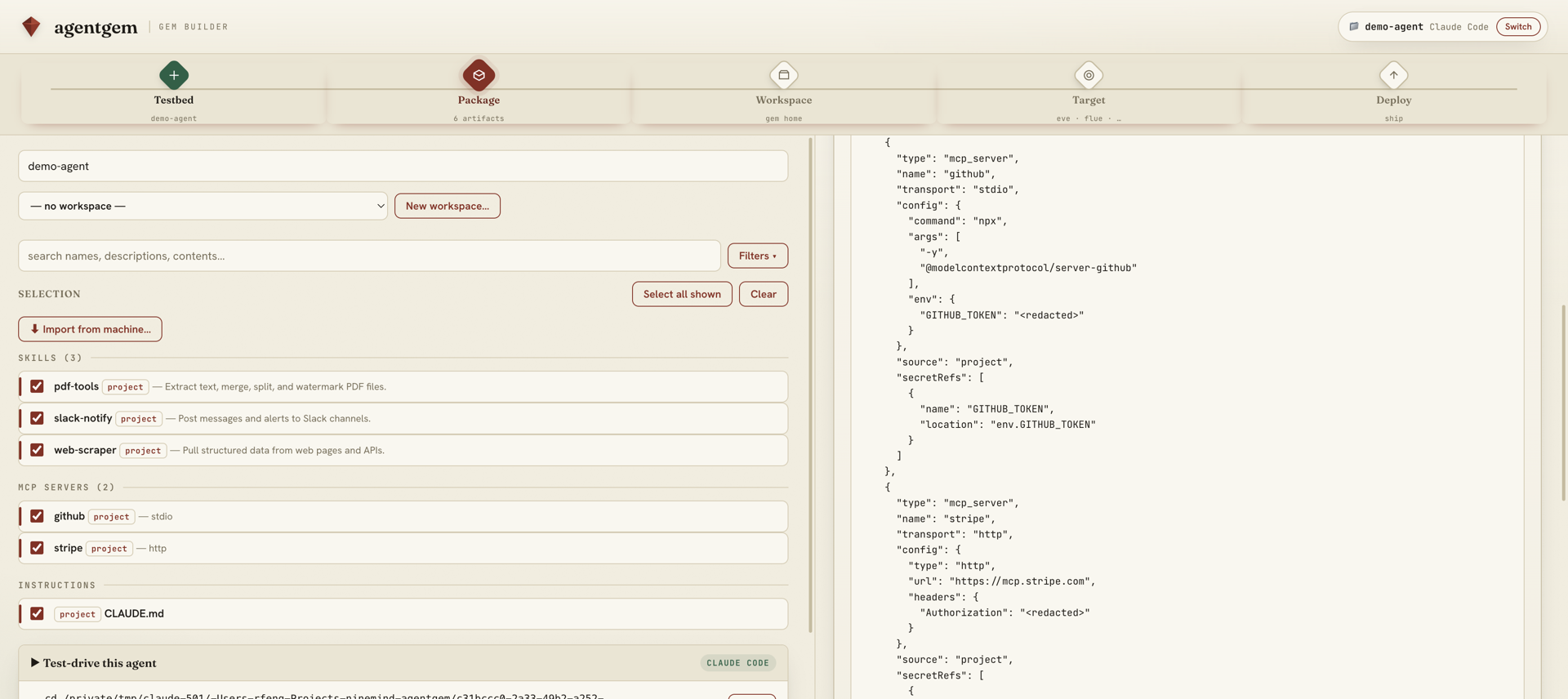
- Open a testbed — click Create / open testbed…. AgentGem detects the project
you launched from (it has a.claude/.codex) and also lists ones from your
Claude/Codex session history. Pick it and click Use this. - Pick artifacts — the project's skills / MCP servers /
CLAUDE.mdshow on the
left; Import from machine… pulls in global ones. Tick what you want, name the Gem. - Watch it seal — the live
gem.jsonrenders with every secret as<redacted>.
Download it — that archive is what every target and the registry consume.
Prefer a persistent command? Install it globally:
npm install -g @ninemind/agentgem     # npm
pnpm add -g @ninemind/agentgem        # pnpm
agentgem --port 8080                  # honors $PORT; append ?dir=/path/to/.claude for another config
| Path | What it is |
|---|---|
/ |
The Gem Builder web UI |
/explorer |
Swagger UI for the REST API (from the OpenAPI document) |
/mcp |
The MCP endpoint — the same contract, for your agent |
From source
To hack on AgentGem, clone the repo. It's a pnpm project
(npm works too), and AgentBack uses legacy decorators, so it builds with tsc
then runs dist/:
pnpm install     # or: npm install
pnpm dev         # or: npm run dev   — build + start in one step
pnpm test        # or: npm test      — tsc -b && vitest run, against compiled dist/
pnpm clean       # or: npm run clean — rm -rf dist *.tsbuildinfo (run before re-testing after moves)
See CONTRIBUTING.md for the full workflow.
Desktop app
Prefer a double-click app over the CLI? AgentGem ships a native desktop build
for macOS, Windows, and Linux — download it from
Releases (a desktop-v* build).
It hosts the same local server in its own window, adds a native folder picker, app
menu, and system tray, and never sends secrets off your machine.
The builds are currently unsigned: on macOS right-click → Open, on Windows
choose More info → Run anyway the first time.
To run or package it from source, see the desktop guide — in
short, pnpm -C desktop dev to run, pnpm -C desktop dist to build installers.
Layering
Depends on AgentBack: @agentback/core (lifecycle), @agentback/rest +@agentback/rest-explorer (HTTP + Swagger UI), @agentback/mcp + @agentback/mcp-http
(MCP over HTTP), and @agentback/openapi (the OpenAPI 3.1 document). The web UI, the REST
API, and the MCP endpoint are three boundaries over one set of Zod contracts —src/index.ts wires them onto a single RestApplication.
For deeper reference, see docs/:
getting started ·
desktop app ·
analyze ·
concepts ·
targets & deploy ·
A2A ·
registry.
License
MIT © ninemind.ai
Reviews (0)
Sign in to leave a review.
Leave a reviewNo results found