open-isms
Health Pass
- License — License: AGPL-3.0
- Description — Repository has a description
- Active repo — Last push 0 days ago
- Community trust — 18 GitHub stars
Code Fail
- Hardcoded secret — Potential hardcoded credential in .github/workflows/ci.yml
- Hardcoded secret — Potential hardcoded credential in .github/workflows/release.yml
- process.env — Environment variable access in .github/workflows/self-host.yml
- network request — Outbound network request in .github/workflows/self-host.yml
Permissions Pass
- Permissions — No dangerous permissions requested
No AI report is available for this listing yet.
Free, self-hostable ISMS for the EU NIS 2 Directive. Open-source alternative to compliance SaaS. GDPR, EU AI Act and CRA included. AGPL-3.0.
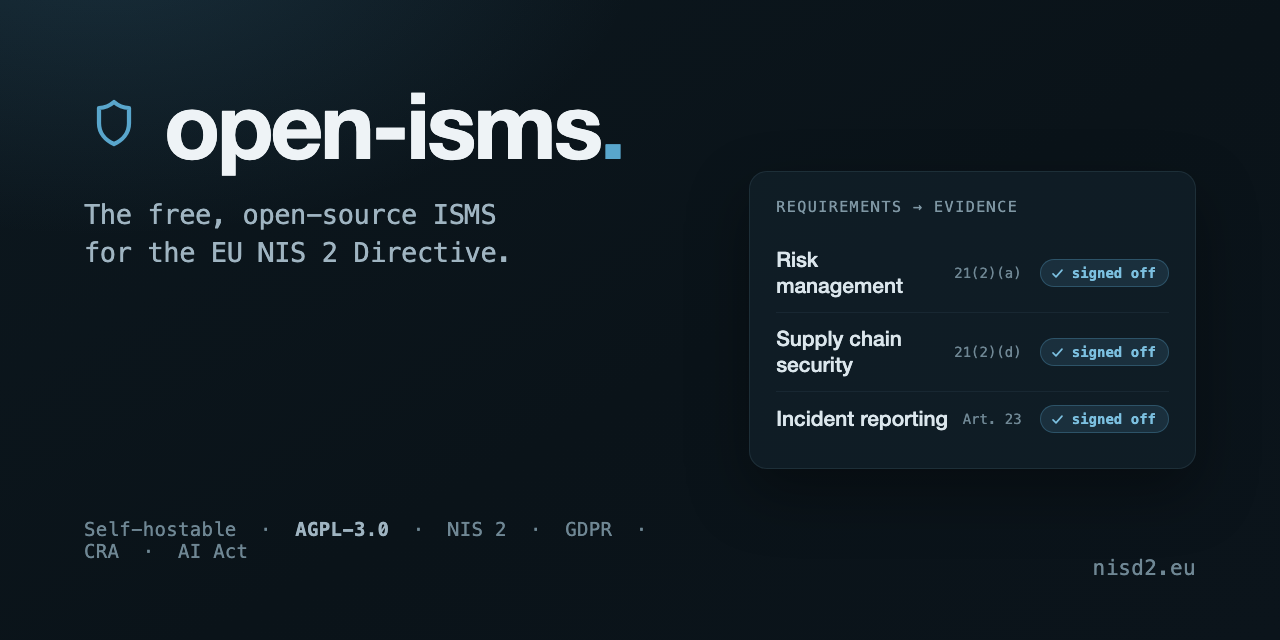







The platform behind nisd2.eu: a self-hostable Information Security Management System built for the EU NIS 2 Directive, with GDPR, the EU AI Act, and the CRA alongside it.
Most compliance tooling treats evidence as a folder of PDFs you assemble the week before an audit. open-isms inverts that. Every requirement carries an owner, a deadline, and a sign-off, so assignments, approvals, and an append-only audit trail become your evidence as you operate, not something you reconstruct after the fact.
Free and open source. AGPL-3.0. Mission: halve Europe's NIS 2 compliance bill.
What's in here
apps/
  reference/                      # minimal docker-compose demo (Postgres + Next.js)
                                  # boot stack, gates routes behind email magic links

packages/
  grc-data-model/                 # framework data + entity model (NIS 2, GDPR, EU AI Act, CRA)
  incident-notification-schema/   # NIS 2 §23(4) incident notification format
  isms-schema/                    # operational ISMS schema (audit-log, sign-off, evidence, policies, training)
  isms-ui/                        # shadcn-based UI primitives
  isms-pages/                     # pre-translated page components
  isms-lib/                       # compliance helpers (deadlines, format)
  isms-trpc/                      # tRPC setup + audit middleware

app/                              # the production SaaS — marketing + portal + supplier + training
components/  lib/  schema/  server/  drizzle/  messages/  i18n/   # SaaS app code
courses/                          # NIS 2 CEO course content + tabletop exercises + CRA SBOM
data/  docs/                      # public reference data + deployment docs
public/                           # static assets

scripts/                          # operational + release tooling
.github/workflows/                # CI + release pipeline
grc-data-model and incident-notification-schema are published to npm. The other packages are workspace-only (consumed via bun workspaces; not on npm yet).
Quick start (local dev)
git clone https://github.com/NISD2/open-isms.git
cd open-isms
bun install
bun run dev               # http://localhost:3026
Quick start (self-host the whole platform)
One command. It checks Docker, downloads the compose file, generates the
secrets, picks free ports, starts the stack and waits until it answers.
curl -fsSL https://raw.githubusercontent.com/NISD2/open-isms/main/install.sh | bash
# http://localhost:3026
Rather read it first? curl -fsSL … -o install.sh && less install.sh && bash install.sh.
By hand instead, three files and a published image, no clone and nothing
compiled:
mkdir open-isms && cd open-isms
curl -o compose.yaml https://raw.githubusercontent.com/NISD2/open-isms/main/compose.self-host.yml
curl -o .env         https://raw.githubusercontent.com/NISD2/open-isms/main/.env.self-host.example
curl -o Caddyfile    https://raw.githubusercontent.com/NISD2/open-isms/main/Caddyfile.self-host.example
# fill in the required values in .env, then:
docker compose up -d                        # http://localhost:3026
Sign-up verifies the address with a one-time code, so a fresh instance needs a
way to get you the first one. Set BOOTSTRAP_ADMIN_EMAIL andBOOTSTRAP_ADMIN_PASSWORD in .env to create your account at startup with no
mail at all, or read the code out of the log withdocker compose logs app | grep "sign-in code". Colleagues arrive by
invitation, which is an email, so set SMTP_HOST for your own relay orRESEND_API_KEY for the hosted API before inviting anyone.
nisd2.eu/docs is the full documentation:
installation, every environment variable, storage, email, TLS, updates,
backup and restore, and the platform's own data model. Its source iscontent/docs/ in this repository, so a correction is a
pull request against the same file the site renders.
Framework data loads itself: the container fills an empty requirement catalogue
from db/framework-seed.sql at startup, so a fresh install has NIS 2 in it
without a checkout or a seed script.
For the minimal workspace demo instead of the full platform:
cd apps/reference
cp .env.example .env      # set AUTH_SECRET via `openssl rand -base64 32`
docker compose up --build # http://localhost:3000
Connect an AI assistant (MCP)
Every instance, nisd2.eu and each self-hosted one, serves an MCP endpoint at/api/mcp. A connected assistant reads the company's NIS 2 walkthrough and
fills in what its items ask for: fields, registers, the asset list, ratings,
agreements and evidence uploads. It never signs. Finishing an item, deciding it
is not applicable and management's approval stay with people in the app.
It is off until a company admin turns on Allow AI assistants for this company
in Settings. Each person then connects their own assistant by signing in through
the browser or by pasting a key.
claude mcp add --transport http nisd2 https://isms.example.com/api/mcp
Tools, connection steps per client, and what the assistant is refused:
nisd2.eu/docs/self-hosting/mcp,
source in content/docs/self-hosting/mcp.md
and lib/mcp/.
Quick start (just the schema packages)
The framework data and schemas are published to npm on their own, so you can
build against them without running any of this. There is no npm package for
the platform itself: open-isms ships as a container image, see above.
bun add @nisd2/grc-data-model @nisd2/incident-notification-schema @nisd2/nis2-supply-chain-questionnaire-schema
| package | what it gives you |
|---|---|
@nisd2/grc-data-model |
219 requirements across NIS 2, GDPR, the EU AI Act, the CRA and ISO 27001:2022, with 125 cross-framework satisfaction pairs and Drizzle-compatible Postgres schemas |
@nisd2/incident-notification-schema |
the NIS 2 Article 23 incident notification format as a typed Zod schema |
@nisd2/nis2-supply-chain-questionnaire-schema |
the questions a regulated entity asks its suppliers, as Zod plus JSON Schema |
import { nis2Categories, getNis2RequirementsForCategory } from "@nisd2/grc-data-model/frameworks";
import { complianceFramework, requirement } from "@nisd2/grc-data-model/schema";
Per framework: NIS 2 12 categories / 49 requirements, GDPR 6 / 9, EU AI Act
10 / 24, CRA 10 / 21, ISO 27001:2022 5 / 116.
Legal scope
- EU Directive: 2022/2555 (NIS 2)
- German transposition: NIS2UmsuCG → revised BSIG (2025)
- Implementing Regulation: Commission Implementing Regulation (EU) 2024/2690
- Effective: 6 December 2025
- Registration deadline: 6 March 2026
Tech stack
| Layer | Tech |
|---|---|
| Framework | Next.js 16 + React 19 (App Router, SSR-first) |
| Language | TypeScript 6 strict mode |
| Styling | Tailwind CSS 4 + shadcn |
| Validation | Zod 4 |
| ORM | Drizzle 0.45 (Postgres) |
| API | tRPC 11 |
| Auth | Auth.js v5 (email and password, one-time code verification, optional Google OAuth) |
| i18n | next-intl, 10 locales (DE/EN/NL/FR/IT/ES/PL/CS/PT/RO) |
| AI | Vercel AI SDK + xAI Grok for form prefill |
| Runtime | Bun 1.3+ |
| Hosting | Coolify (self-hosted) |
Contributing
See CONTRIBUTING.md. External PRs welcome — particularly:
- New framework articles / mappings (
packages/grc-data-model/src/frameworks/) - Translation work (
messages/) - Schema improvements (
packages/isms-schema/src/tables/) - Documentation and examples
For security disclosures, see SECURITY.md.
License
AGPL-3.0-or-later for the app, scripts, and workspace-only packages.
Course content is CC BY 4.0. Everything under courses/ — lesson text, quizzes, appendices and the typeset PDF editions — may be reused, adapted and republished under your own name, including commercially. Attribution is the only condition. Chambers of commerce, associations and schools are explicitly welcome to turn it into their own guidance under their own branding.
Published npm packages have their own licenses:
| Package | License |
|---|---|
@nisd2/grc-data-model |
MIT |
@nisd2/nis2-supply-chain-questionnaire-schema |
MIT (code) + CC BY 4.0 (content) |
@nisd2/incident-notification-schema |
Dual: AGPL-3.0 + commercial |
@nisd2/isms-* (workspace-only) |
AGPL-3.0-or-later |
Reviews (0)
Sign in to leave a review.
Leave a reviewNo results found