atlas-context
Health Gecti
- License — License: MIT
- Description — Repository has a description
- Active repo — Last push 0 days ago
- Community trust — 21 GitHub stars
Code Gecti
- Code scan — Scanned 12 files during light audit, no dangerous patterns found
Permissions Gecti
- Permissions — No dangerous permissions requested
Bu listing icin henuz AI raporu yok.
Help your agent understand your life, on your terms. Local photo clues, your explanations, reviewed context and read-only MCP. Experimental alpha.
Atlas Context
Help your agent understand the life behind your requests.

Chinese translation · Product direction · Phone to Agent · Privacy · MCP setup · Roadmap · MIT license
Atlas Context is an experimental personal context layer for AI agents. The goal is to help an agent understand your experiences, interests and preferences through selected everyday photos and your own explanations, so future assistance can start with useful background. You should be able to inspect that understanding, correct it as your life changes and choose which parts to share.
For developers building personal agents, this repository provides an iOS selected-photo reflection flow, a Python review core and read-only MCP retrieval. The phone uses Apple's local Vision classifier to suggest a small set of scene questions. You explain what a moment meant, confirm your wording and separately choose what an agent may receive. This is bounded scene classification and template-based clarification, not generative photo understanding or a long-term personality model.
Status: experimental alpha. The implemented flow is choose up to five photos → local scene question → explain or correct → confirm your words → review exact export → connect → ask your agent for relevant help with citations. A fictional walk-through works without choosing any photos. Automatic USB scanning, production Atlas Memoir integration, live phone synchronization and durable preference learning remain future work. See the phone guide and validation scope.
Privacy first: nothing is selected by default. The phone export contains reviewed text, not original photos, videos, GPS, photo IDs or a full backup. Cloud access defaults off. Using a cloud Agent sends approved text to its provider; revocation blocks future reads but cannot recall previous copies. Text can still contain identifying details. Read the full privacy statement.
Try a preference and a correction
python3 -m atlas_context.phone demo --scenario personal-assistance --output ../atlas-assistance-demo
The fictional person enjoys quiet walks and flexible plans. Their many café photos were for work, not a café-hopping preference. This command creates a private MCP session and two cited user statements; no café-hopping preference is created or exported. It makes no model call. Bind session/private-server.json to your MCP host, give the agent session/private-agent-task.md and ask: “Help me plan a relaxed day off. Explain how my stated preferences affect the options.” Use a local model for the default local_only session. The phone guide explains the native photo flow and connection. Agents should read AGENTS.md first.
To run the phone experience in Xcode, generate an isolated project:
python3 scripts/create_phone_project.py --output ../atlas-phone-app
open ../atlas-phone-app/AtlasPhoneDemo.xcodeproj
Choose Try fictional walk-through, or explicitly choose up to five images with the system picker. Actual selected images start with blank explanations. Confirming a statement does not share it: the separate export screen starts with no records selected and cloud use off. Editing an explanation clears its confirmation. Clear this session removes the app's in-memory images and explanations; previously exported copies must be revoked/deleted separately.
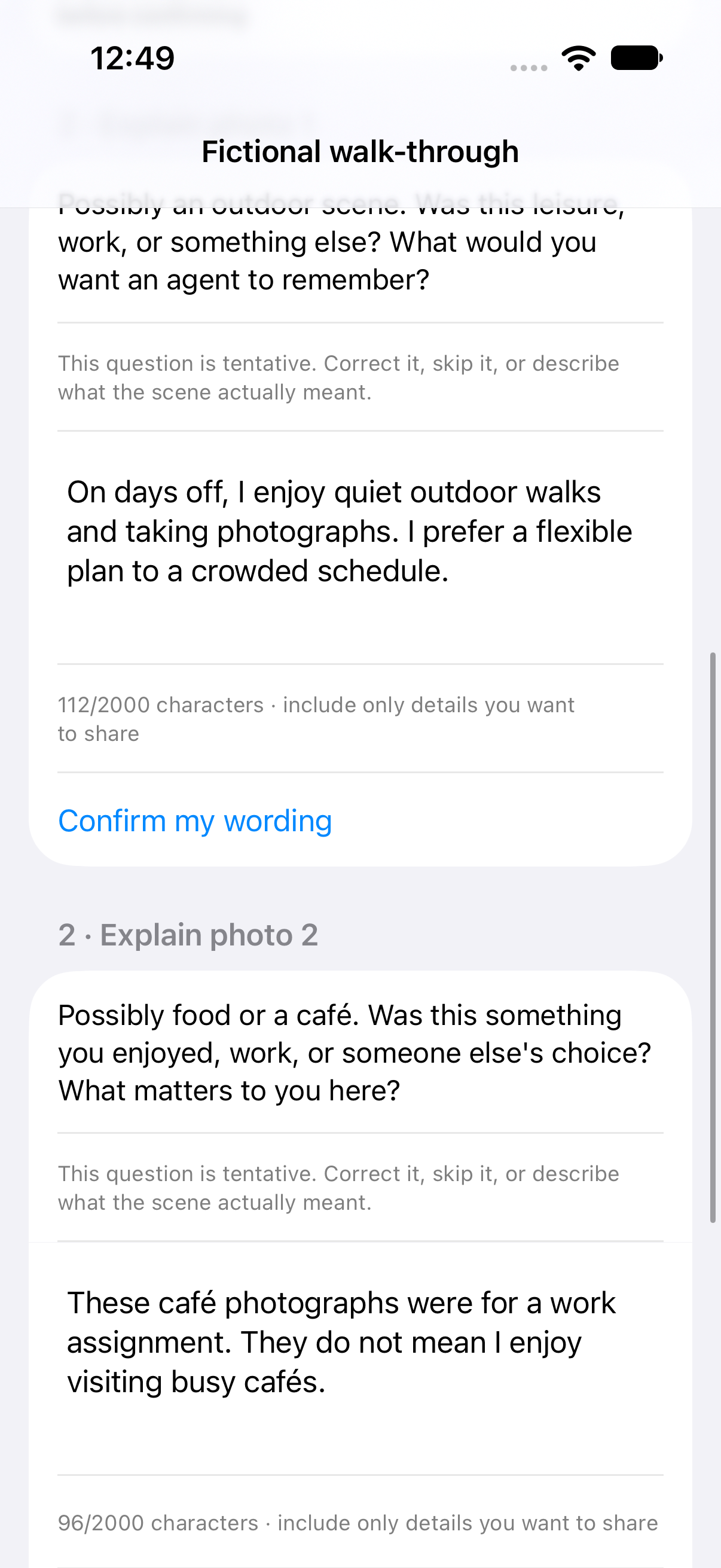
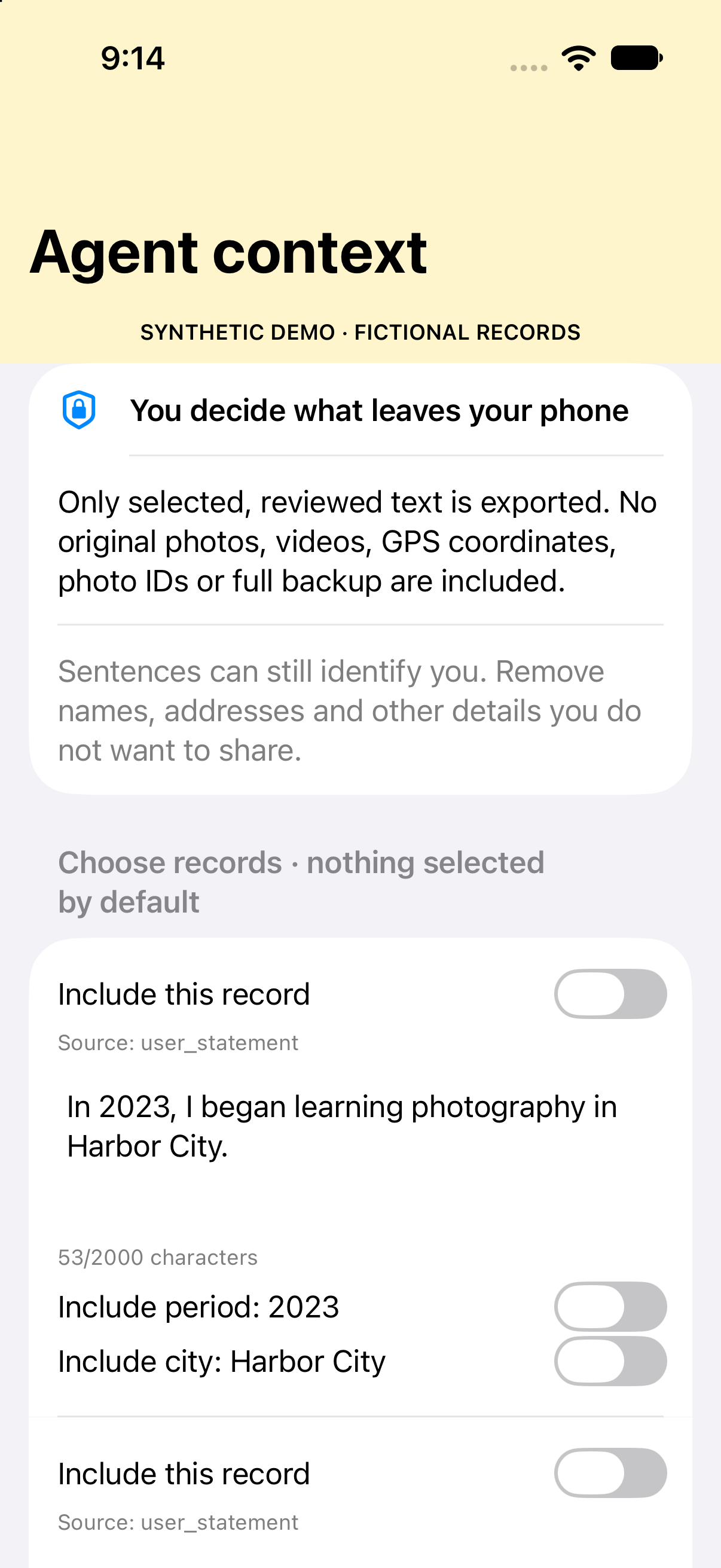
Left: the current fictional explanation flow. Right: the earlier text export component, also using fictional records. The companion uses the system picker rather than requesting full-library access; Apple's picker may download a selected iCloud photo. It is not an installed Atlas Memoir production release.
See the product background
Atlas Memoir is the native timeline and correction product behind this exploration. These are actual app views rendered in an isolated build with entirely fictional records. The pictured sharing screen is a separate feature from Agent approval. The new phone review/export component is provided separately for integration; these older screenshots do not show it.
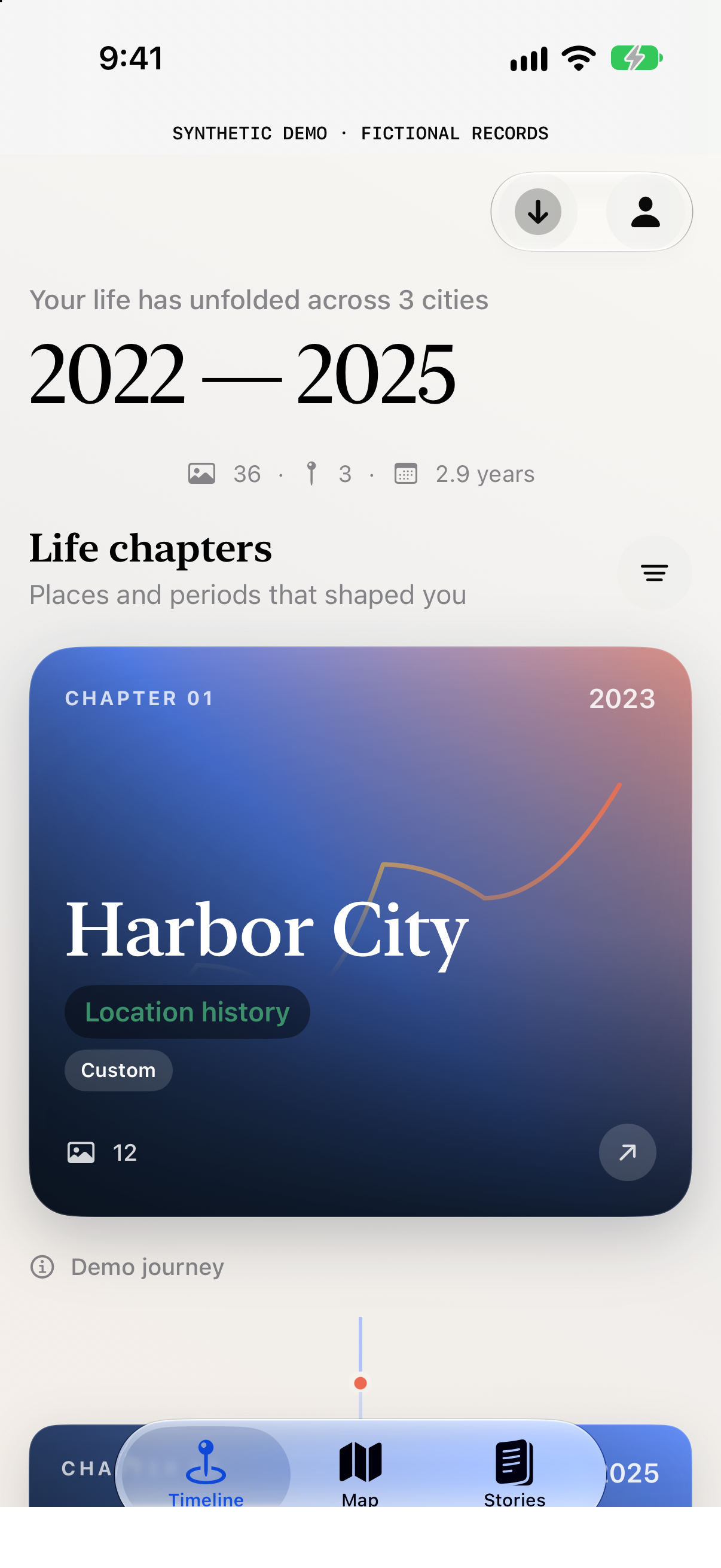
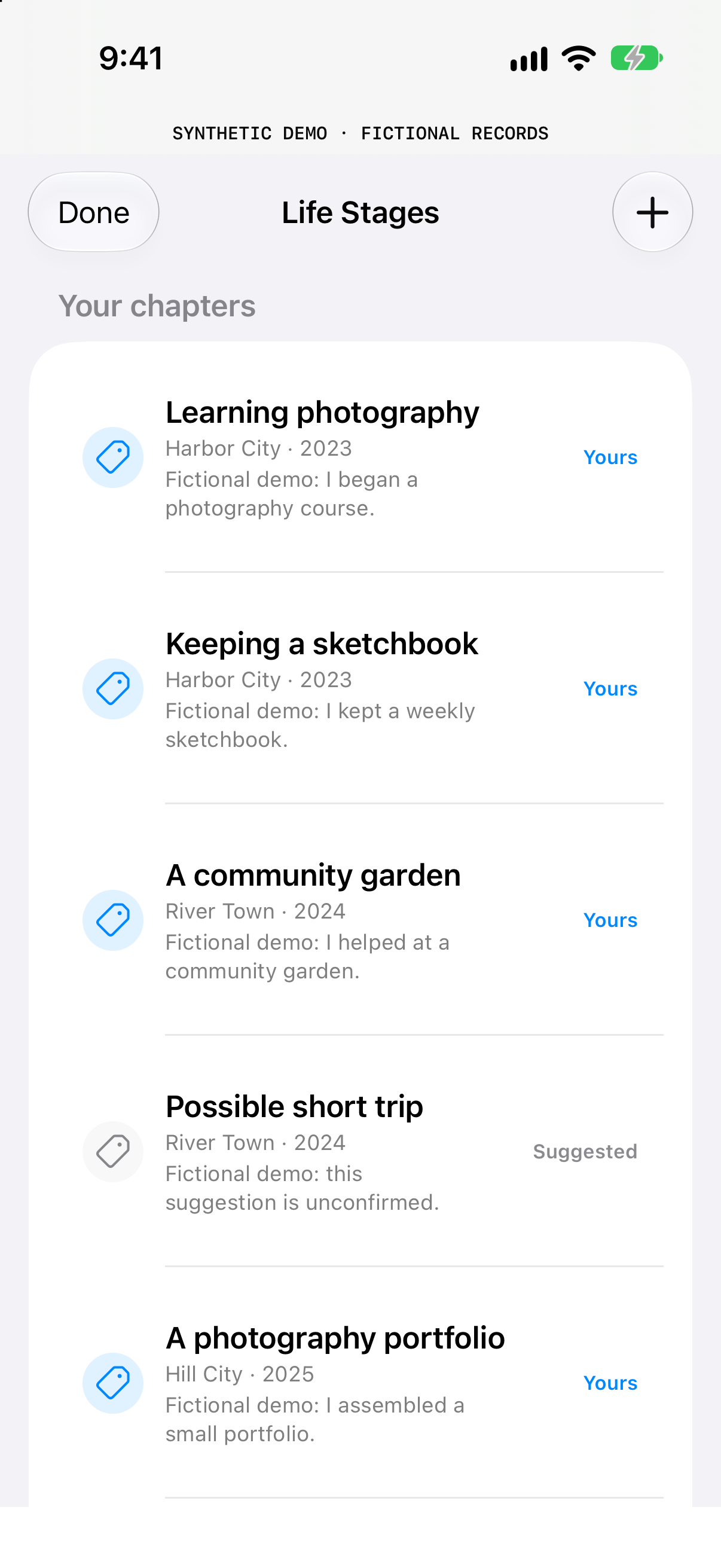
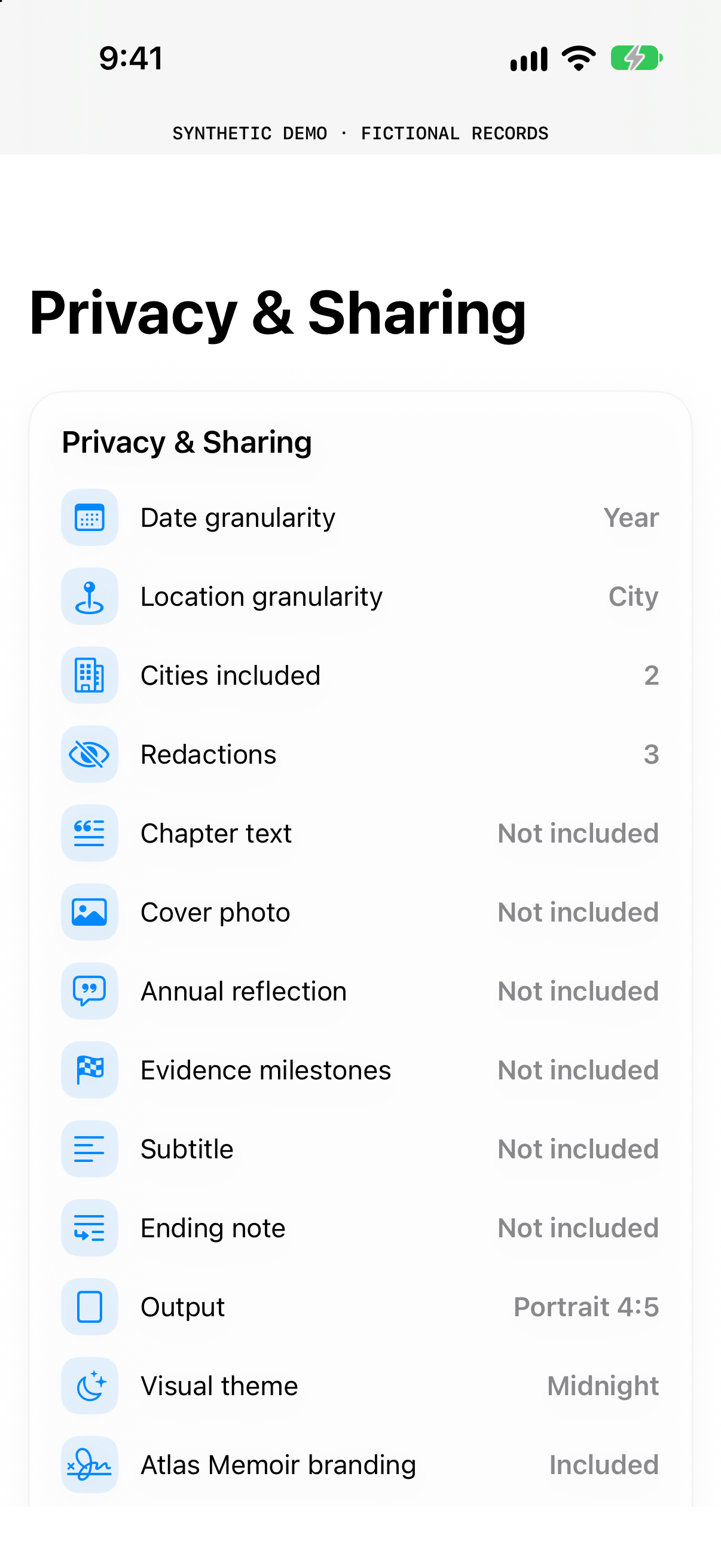
18-second screenshot walkthrough · App showcase and provenance
Why this project
A photo can provide a clue about a moment. Your explanation gives it personal meaning. A set of cafe photos might reflect a favorite pastime or work on a menu design project; the agent should ask before treating either interpretation as a preference.
The first implemented experience is selected photo clues → a template question → your explanation or correction → reviewed life context → task-scoped agent help. For example, a person can explain that weekend walks are a way to slow down and that they prefer leaving part of the day unplanned. A connected agent receives that approved context to inform its options, cite its basis and check whether the preference still applies. The project does not bundle a local language model.
Understanding someone's perspective should help an agent consider their stated goals and tradeoffs while still surfacing alternatives and blind spots. It should not turn a few images into a fixed personality label. Observations, user statements and model hypotheses stay distinct; permission to disclose a sentence does not prove it true.
The demos exercise the reflection, review and transport path. Whether this improves everyday help still needs independent user feedback and comparison against assistance without personal context. See the fictional walkthrough, success criteria and implementation boundaries.
Try it with fictional records
The core needs Python 3.10+ and the standard library only. The optional MCP integration needs Python 3.11+. No API key is needed for either synthetic demo. Run from the repository root:
python3 -m atlas_context.synthetic --output ../atlas-story-demo
python3 -m atlas_context.cli preview \
  --draft ../atlas-story-demo/private-draft.json \
  --grant ../atlas-story-demo/private-grant.json \
  --purpose write_short_bio --audience synthetic_agent --query photography
This generates a fictional three-year story: 16 drafts, 14 explicitly selected records, 13 default outgoing records and 8 query scenarios. Photography returns seven records. Unselected entries, hidden entries, raw OCR and an unsupported employer query return no evidence; an inferred trip stays labeled as inference. The approval is scripted only because the input and reviewed wording are known fictional fixtures. Real imports still require an explicit local review.
To verify the actual MCP stdio connection, create an environment outside the checkout using Python 3.11+, then run:
python3 -m venv ../atlas-env
../atlas-env/bin/python -m pip install '.[mcp]'
../atlas-env/bin/python -m atlas_context.mcp_demo --output ../atlas-mcp-demo
The MCP demo checks 16 conditions, including a narrow tool schema, approved-only retrieval, strict argument types, source revision changes, expiry, purpose/audience mismatch and revocation on the same live connection. It intentionally leaves its demo grant revoked. Generated files remain outside this repository. See demo details and host configuration.
Three actual Codex client examples are documented separately: a cited introduction, insufficient employer evidence and a revoked grant. They use fictional inputs and were manually inspected; they are not a general model-quality benchmark.
The original four-record minimal example also remains available:
python3 demo.py --output ../atlas-synthetic-runtime
python3 -m atlas_context.cli preview \
  --draft ../atlas-synthetic-runtime/private-draft.json \
  --grant ../atlas-synthetic-runtime/private-grant.json \
  --purpose write_short_bio \
  --audience synthetic_agent \
  --query photography
Choose an empty output directory. The demo never replaces existing files. Its sample grant expires after one hour; use a new empty directory to generate another demo.
The demo creates four private draft records and approves three. Default retrieval returns two approved records, excluding the inferred trip. It checks four scenarios:
| Query | Expected result |
|---|---|
Photography experience (photography) |
Two reviewed records |
| Unapproved OCR detail | No authorized evidence |
| Inferred trip, default search | No authorized evidence |
| Inferred trip, explicitly included | One record, still labeled inferred |
It also checks revocation, local citation resolution and that importing the generated media catalog leaves it unchanged. Output files are written outside the source directory. Even draft, grant and preview files without media are private runtime data.
One returned item looks like this; its opaque citation changes between demo runs:
{
  "citation": "E-4969f55dd5150e8c",
  "attribution": "user_statement",
  "wording": "user_reviewed",
  "source": "atlas_memoir",
  "text": "In 2025, I started learning photography.",
  "evidence_label": "User-written stage summary (synthetic)",
  "period": "2025"
}
The full response includes a coverage note: missing records do not establish that an event never happened. This output is a context preview, not an answer generated by an agent.
How the pieces fit
Atlas summary projection ──┐
                          ├─> Private drafts ─> Local wording review
Selected media rows ──────┘                           │
                                                     v
                                         Purpose + audience + expiry
                                                     │
                                                     v
                                         Search approved text only
                                                     │
                                                     v
                                         Context preview + citations
- Local Media Library organizes media and notes. This prototype reads explicitly selected catalog rows in read-only mode.
- Phone reflection provides local scene questions, your explanations and confirmation before separate disclosure. Its citations identify reviewed statements, with no retained handle to the original photos.
- Atlas Memoir is the intended timeline and correction interface. Its summary adapter accepts a supplied projection. A reusable SwiftUI selective exporter and fictional companion app now provide a versioned phone handoff; production app integration remains pending. Full backup envelopes are rejected.
- Atlas Context contains the reusable review and retrieval core in this repository.
- Agent integration can consume approved context using the read-only
search_life_contextMCP stdio tool. Its grant, files, purpose and audience are bound by trusted local configuration, outside model arguments.
Implemented boundaries
| Rule | Current behavior |
|---|---|
| Selected photos | System picker, up to five images; no library enumeration; local scene prompts only |
| Meaning and correction | Only confirmed user explanations become candidates; editing invalidates confirmation |
| Separate disclosure | Confirmed candidates still start unselected on the export screen |
| Explicit selection | Import creates drafts, with no implicit disclosure permission |
| Exact wording | Local approval stores the text the user chooses to disclose; no automatic prose redaction |
| Bounded access | Each query checks local purpose, audience, expiry and active status |
| Approved-only search | Searches approved text, year/month and city; private titles, raw OCR and source locations are not searched |
| Source attribution | Keeps recorded, user_statement and inferred distinct; inference is excluded by default |
| Changed records | A changed draft revision excludes that record until it is reviewed again |
| Source inspection | Opaque citations resolve through a separate trusted local function; original handles are absent from the outgoing structure |
Optional outgoing fields are a year or month, a city and a reviewed evidence label. Exact source locations and original media are not returned by the query function. Review the text itself: a sentence can still disclose personal information, regardless of which field contains it.
Current limits
- Audience and purpose are local policy labels, not authenticated identities. Grant files are trusted local configuration, not signed credentials. A process with permission to edit them can change them.
- Revision checks compare the supplied draft with its approved revision. This prototype does not watch the original app or media library for changes; a future integration must refresh drafts when sources change.
- Atlas full-backup decoding, migrations, production app integration and live source refresh are outside this prototype. The separate phone export is a minimal reviewed projection. Media adapters and phone handoff checks use fictional records, not personal libraries.
- Citations support inspection; they do not prove that reviewed wording is supported by the source. Retrieved text is marked as untrusted evidence, which does not by itself establish prompt-injection resistance in a future model.
- Sending context to a cloud model sends that text off the device. Revocation blocks future reads from this layer; it cannot recall copies already received by a client or model.
- Encryption at rest, multi-user isolation, large-library performance and actual agent answer quality have not been validated.
See MCP setup and boundaries, the evidence checklist and the roadmap for the next milestones.
Development
python3 -m unittest discover -s tests -v
python3 scripts/check_release.py
python3 -m atlas_context.cli --help
The suite covers approval rules, private-field exclusion, revision changes, expiry, revocation, read-only adapters, the real MCP subprocess transport and publication history. MCP-specific tests skip when the optional extra is absent. GitHub Actions runs core checks on Python 3.10/3.12 and MCP checks on Python 3.11/3.12. The release guard checks the public file allowlist, reviewed-media hashes, common credential/path patterns and Git history. It supports manual review; it cannot recognize every form of private content.
atlas_context/
  core.py             # Records, local approval, retrieval, local evidence lookup
  importers.py        # Summary projection and selected media catalog adapters
  cli.py              # Local import, approval and context preview commands
  synthetic.py        # Fictional three-year fixture generator
  mcp_server.py       # One read-only stdio tool, with host-bound configuration
  mcp_demo.py         # Real SDK client/server roundtrip and invalidation checks
  phone.py            # Strict reviewed phone handoff, local session and revocation
mobile/               # Local photo clues, user reflection and selective SwiftUI export
demo.py               # Generates fictional records and checks four scenarios
tests/test_context.py # Synthetic behavior tests
scripts/check_release.py
PUBLIC_FILES          # Explicit source-release allowlist
PUBLIC_MEDIA          # Exact hashes of manually reviewed synthetic showcase assets
Public code, private records
This repository contains code, documentation, synthetic fixture generators and six explicitly reviewed synthetic showcase assets. Keep real photos, videos, catalogs, OCR, notes, drafts, grants, phone exports, context exports, access logs, credentials and real-data screenshots outside every Git checkout. All other media files are rejected. .gitignore is a convenience, not a privacy boundary; ignored files can still be force-added or included in an archive.
Contributions should reproduce issues with synthetic records. See CONTRIBUTING.md. Code is released under the MIT license; personal runtime records are not part of the source release.
Yorumlar (0)
Yorum birakmak icin giris yap.
Yorum birakSonuc bulunamadi