infomarchy
Health Uyari
- License — License: MIT
- Description — Repository has a description
- Active repo — Last push 0 days ago
- Low visibility — Only 5 GitHub stars
Code Basarisiz
- exec() — Shell command execution in collector.test.ts
- process.env — Environment variable access in collector.test.ts
- process.env — Environment variable access in collector.ts
- network request — Outbound network request in collector.ts
- process.env — Environment variable access in copy-text.test.ts
- process.env — Environment variable access in history-time.test.ts
Permissions Gecti
- Permissions — No dangerous permissions requested
Bu listing icin henuz AI raporu yok.
Omarchy plugin: your wallpaper becomes a live, clickable information desk — every running AI agent (Claude Code, Codex, Grok, Ollama), 7-day heatmap, rate limits, recent prompts, machine stats. Theme-driven.
Infomarchy
Your wallpaper, promoted to information desk.
Every AI agent running on your machine, what it's doing, what it cost you, and how the box is holding up —
drawn live on the Omarchy desktop in your current theme, one glance away, one click to jump in.





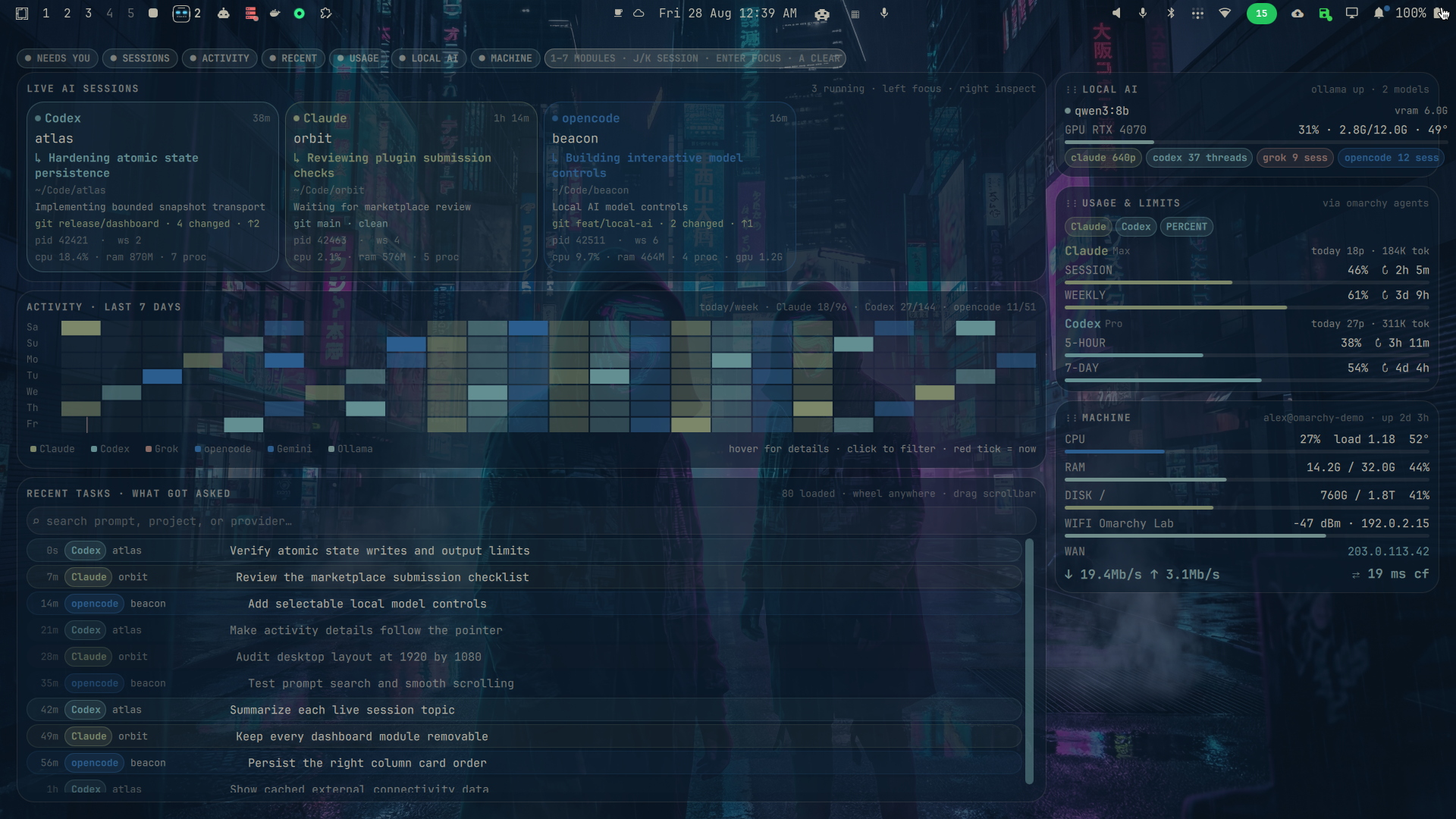
The public preview is the real plugin rendered on an empty Omarchy desktop using Infomarchy's explicit, transient demo-data mode. It contains no live prompt, hostname, username, network, path, process, or session data.
Want to see the plain desktop? Press
SUPER + Ito hide the Infomarchy cards and reveal your wallpaper. PressSUPER + Iagain to bring the dashboard back. Add the one-time key binding shown under Install.
Why
You run Claude Code in three terminals, Codex in a fourth, Grok is poking at a repo somewhere, Ollama is warming a model, and your weekly limit is quietly at 86%. The only way to know any of that is to go look — tab through windows, read titles, run nvidia-smi, open a dashboard.
Infomarchy puts all of it on the one surface you always have open and never use: the wallpaper. It's not a widget in the bar and not another window to manage. It's the desk itself, and it's always current.
What you get
🟡 Live AI sessions — who is working right now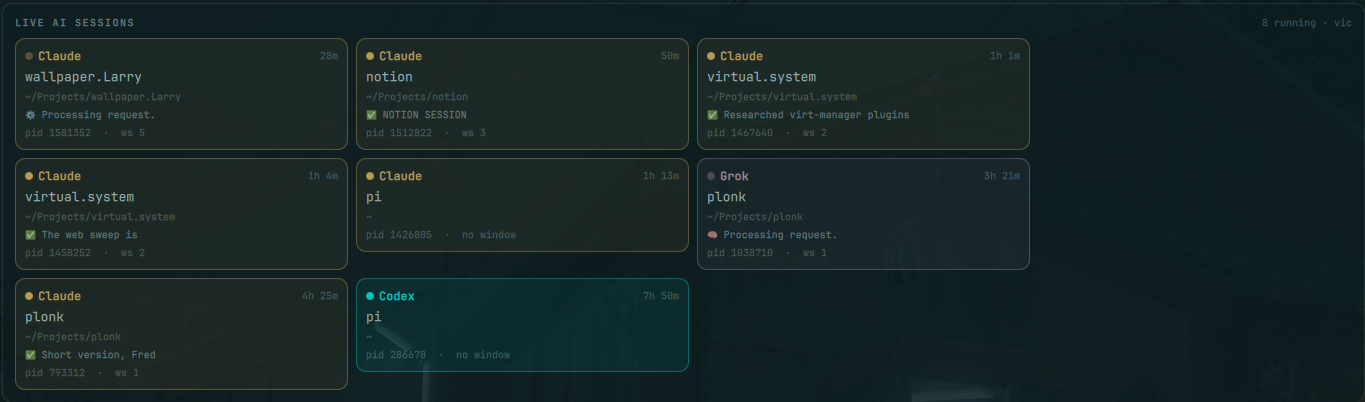
One card per running agent — Claude Code, Codex, Grok, Gemini, Hermes, opencode, aider, Ollama chats — detected straight from Agents hosted inside Herdr, Boomux, or tmux remain visible. Their large session card reports the host and its bounded identity: Herdr workspace/tab/pane, Boomux workspace/shell plus exact shell/run IDs in the snapshot, or tmux Each card also attributes live CPU, resident RAM, process-tree size, and—when Only the full per-session cards appear in Live AI Sessions; there is no duplicate compact workspace-card strip. Each large card includes its workspace number. In the session inspector, workspace buttons 1–10 can move that exact agent window silently; the current workspace is highlighted and disabled. Window thumbnails are opt-in: right-click a large session card, toggle PREVIEWS OFF/ON in its inspector, then hover a live card. Infomarchy captures only that exact address after a short delay, downsizes it to 160×90, applies a heavy blur, and displays a 320×180 still. The raw capture moves through bounded in-memory streams from Cards also show the repository branch, clean/changed state, ahead/behind counts, and merge conflicts. A Needs You strip calls out agents that appear blocked, waiting for input, or finished for review, plus repositories being shared by multiple live agents. Active Needs You signals get a faint breathing outline (the module chip glows too if the card is removed). Click the signal to focus it, 10M to snooze it for ten minutes, or × to dismiss that signal for the lifetime of its process. Snoozes and dismissals persist between the wallpaper and fullscreen overlay. The card's alert controls send deduplicated Omarchy notifications when an agent is blocked, waiting for an answer, ready for review, or ends — and, when the terminal title says so, when it has crashed (Infomarchy reads titles and Click a Needs You signal → jump straight to that agent's terminal. From the fullscreen overlay, Infomarchy closes itself after focusing the session. Click a card → Infomarchy focuses the terminal window hosting that agent. It walks the process tree up to the Hyprland client, so it works through Right-click a card → inspect it in place. The centered inspector shows its window, shortened session identity, workspace, uptime, pid, and repository state. From there you can focus the existing window or open a fresh terminal in the project directory; paths are passed as process arguments, never evaluated as shell text. |
🟢 Usage & limits — what it's costing you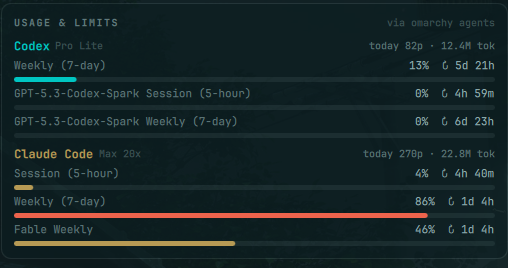
Above the limit meters sits a 7-day trend: one line per provider, tokens processed per day, three gridlines, hover any day for the exact figures. The TOKENS / ≈ $ VALUE chip switches the same lines to an estimated API value — what those tokens would have cost at published API prices — and each provider row shows today's and lifetime estimates, the share of lifetime tokens that were cache reads, and the session count. Prices come from a pinned, attributed LiteLLM snapshot ( Session (5-hour) and weekly (7-day) rate-limit meters with time-to-reset, today's prompt count and token volume, per subscription. Meters turn yellow past 60% and red past 85%, in your theme's yellow and red. Provider chips filter the card interactively. Toggle PERCENT / FORECAST to project each recognized 5-hour or 7-day meter to reset from its elapsed-window pace; young or malformed windows say Infomarchy reuses the cache that Omarchy's own 🟢 Local AIOllama up/down, every loaded model with its VRAM, GPU utilisation / memory / temperature, and lifetime totals per provider. Arrow controls select any locally installed model and show its parameter count, quantization, and disk size. LOAD pins the selected model in memory; each loaded row has its own UNLOAD action. Models at least 8 GiB—or larger than currently available accelerator/system memory—require a second CONFIRM click. Model changes go through a bounded stdin-framed helper. It validates the model name against Ollama's live |
🟡 Activity · last 7 days — when you actually work

An hour-by-hour heatmap of prompts across every provider, newest day at the bottom, with a red tick at now. The dominant provider colours each cell; intensity is volume. Cells are local wall-clock hours, so on the two DST nights a year one hour is doubled up (fall) or absent (spring). Hover a cell for the exact breakdown ("Tue 18 Aug 16:00 · 8 prompts (Claude 6, Codex 2)"). Click an hour to filter Recent Tasks to that hour; click a provider in the legend to combine a provider filter. The selected cell and provider stay outlined, and clicking either again—or clear—removes that part of the filter. The header carries today/week counts per provider.
⚪ Recent tasks — what got asked
The newest prompts across all providers — time ago, provider tag, project, and the prompt itself — so the question "what was I doing an hour ago?" has an answer on the wall. The list keeps up to 80 rows in a scrollable history, with a search box that matches prompt text, project, or provider (filtered searches can show up to 200 matches). Prompts whose exact agent session is still running stay bright and clickable; click one to jump to its terminal. Supported closed sessions are dimmed but remain interactive: hover for RESUME, then click to reopen that exact Claude, Codex, Grok, or OpenCode session in a terminal at its project directory.
Right-click a prompt for its action drawer: copy, pin/unpin, open the project, and review up to five recent prompts from the same session. Pins persist and sort above ordinary recency without changing the underlying history. Wheel and touchpad deltas are handled directly by the row beneath the pointer, and the wider scrollbar track can be clicked or dragged.
🔵 Operations intelligence — what changed, what needs you, what is healthy
Three compact cards sit beneath the live sessions:
- What Changed fingerprints each active repository and highlights it until you inspect the newest state. It summarizes staged, untracked, test, addition/deletion, and commit data; expand a row to copy changed paths or open the project.
- Next Actions turns terminal state into a short reason and an exact control: Answer, Resolve, Review, Resume, or Open Project. Permission/approval prompts, conflicts, failures, questions, and completed work no longer share one vague warning.
- Project Health combines live agent count, branch, clean/dirty state, ahead/behind and conflicts, the last commit, and the newest GitHub Actions result when authenticated
ghis available. Click a repository to filter sessions, prompts, changes, and action signals across the whole dashboard; click the project chip at the top to clear it.
All three cards are independently removable. Drag their headers left or right to reorder them; they snap into place and the order persists. The layout compacts automatically when one or two cards are hidden.
🟢🟡🔵 Machine — the boring numbers, in the corner where they belong
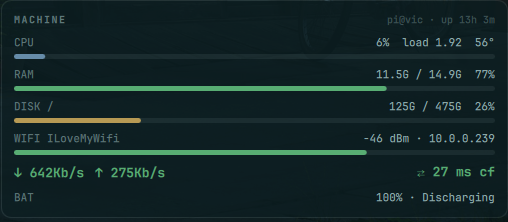
| Meter | Colour | Detail |
|---|---|---|
| CPU | theme blue | % busy, 1-min load, hottest thermal zone |
| RAM | theme green | used / total, % |
| Disk | theme yellow | used / total per mount (btrfs subvolume twins collapsed) |
| Wi-Fi | theme green | SSID, signal in dBm (bar = link quality), IPv4 |
| WAN | theme cyan | cached external IPv4/IPv6 |
| ↓ ↑ throughput | green | real-time bits/s (Kb/Mb/Gb) on the default route interface, wired or wireless |
| ⇄ latency | green / yellow / red | live ping to Cloudflare 1.1.1.1 — red on timeout |
| Battery | — | % and charging state, hidden on desktops |
Any meter goes red when it's genuinely in trouble (RAM > 90%, disk > 90%, CPU > 85%, ping dead).
The three right-column cards—Usage, Local AI, and Machine—also have draggable headers. Drag one far enough up or down to swap it with its neighbor; the card snaps into place and the order persists across overlay and shell restarts. Every section can still be removed and restored from the module strip.
⌨️ Two surfaces, one dashboard
The wallpaper is interactive wherever no window covers it (double-click or right-click the empty desk opens Omarchy's wallpaper switcher, as stock does). Press SUPER + I to hide the wallpaper dashboard and see the clean desktop; press it again to restore the cards. When you're buried in terminals, SUPER + D summons the same dashboard as a fullscreen overlay on top of everything; Esc or a click on the backdrop dismisses it.
The module strip doubles as a keyboard command strip in the overlay: 1–9 toggle modules, J/K (or arrows) select a live session, Enter focuses it, A clears activity filters, and Esc closes. The selected session gets a bright outline.
Install
sudo pacman -S --needed bun   # the collector runs on bun; Omarchy does not ship it
omarchy plugin add https://github.com/nixfred/infomarchy.git --enable --yes
omarchy restart shell    # first time only: services load at shell start
If bun is missing the desk says so in red at the top and in the sessions card, and fills in on the next refresh after you install it — no restart needed.
The plugin declares itself as a clone of omarchy.background, so Omarchy hands it the wallpaper role. Your chosen wallpaper is still there — dimmed to 32% behind the glass — and omarchy theme bg set … keeps working.
Bind the fullscreen overlay and wallpaper-dashboard toggle in ~/.config/hypr/bindings.lua (pick any free chords):
o.bind("SUPER + D", "Infomarchy: AI info desk", "omarchy-shell shell toggle nixfred.infomarchy '{}'")
-- Hide the cards to see the plain desktop; press again to restore them.
o.bind("SUPER + I", "Infomarchy: toggle wallpaper dashboard", "omarchy-shell infomarchy toggleDashboard")
git clone https://github.com/nixfred/infomarchy.git ~/.config/omarchy/plugins/nixfred.infomarchy
omarchy-shell shell rescanPlugins
omarchy plugin enable nixfred.infomarchy
omarchy restart shell
Remove
Remove Infomarchy and return to the stock wallpaper service with:
omarchy plugin remove nixfred.infomarchy --yes
omarchy restart shell
Requirements
Omarchy Quattro with third-party shell plugin support, bun (not part of the Omarchy base install — sudo pacman -S bun), iw, iproute2, and ping. Optional: nvidia-smi (GPU row hides without it), authenticated GitHub CLI gh (for the latest CI result), the omarchy.agents bar widget (for the usage card), Ollama (for the local-AI card), and Herdr/Boomux/tmux when those hosts are actually used. Infomarchy does not start or configure a multiplexer. Hyprland 0.56+ (Lua dispatch) and older (focuswindow) are both handled.
It follows your theme
There are no colours in this plugin. Infomarchy reads the active theme's colors.toml — green, yellow, red, blue, cyan, magenta, foreground, background — and falls back to Omarchy's Color singleton for anything a theme leaves out. Fonts and spacing come from Omarchy's Style, so omarchy display text size scales the desk too. Switch themes and the desk re-skins in place.
The screenshots above are the Last Call theme. A theme gallery is on the roadmap — PRs with your theme's screenshot are very welcome.
How it works
┌──────────────────────────────┐      every 4 s       ┌────────────────────────────────────┐
│ collector.ts  (bun, ~0.2 s)  │ ───── JSON ────────▶ │ InfoModel.qml                      │
│  /proc  /sys  hyprctl        │                      │  runs collector · parses snapshot  │
│  ~/.claude/history.jsonl     │                      │  reads theme colors.toml           │
│  ~/.codex/*.jsonl            │                      └──────────────┬─────────────────────┘
│  ~/.grok/active_sessions.json│                                     │ desk: InfoModel
│  ~/.local/share/opencode/*.db│                                     │
│  Ollama /api/ps /api/tags    │               ┌─────────────────────┴───────────────────┐
│  omarchy agents usage cache  │               │ InfoView.qml  (cards, heatmap, meters)  │
│  git · optional gh CI status │               └───────┬───────────────────────┬─────────┘
│  iw · ip · ping · nvidia-smi │                       │                       │
└──────────────────────────────┘                       │                       │
                                     Infomarchy.qml ◀──┘                       └──▶ Overlay.qml
                                     service · WlrLayer.Background                 overlay · SUPER+D
                                     (clonedFrom omarchy.background)               WlrLayer.Overlay
collector.tsbuilds one snapshot. It readsargvfor every pid (cheap), then lazily opens only agent processes and their ancestors, so a 1 000-process box costs ~0.2 s warm. Local files are opened once with no-follow/nonblocking semantics, must be regular files, and are read under byte/time limits. Rate baselines use private, atomic state files under$XDG_STATE_HOME/infomarchy/prev-<instance>.json. It never parses the multi-hundred-MB Claude/Codex session transcripts — only the small history/index files and OpenCode's local SQLite history.resume-session.tsmaps each supported provider to its installed CLI resume syntax and launches it throughxdg-terminal-exec. Provider, ID, and project are separate process arguments; prompt text is never executed.ollama-control.tsaccepts one bounded JSON frame over stdin, validates the requested model against Ollama's inventory, and performs only explicit load/unload operations.notification-events.tsderives bounded, stable attention and lifecycle events. The background service sends them through Omarchy's notification interface after persistent deduplication; the overlay never sends a duplicate copy.InfoModel.qmlowns the timer, the parse, the theme colours, and helpers (focusWindow, formatting).InfoView.qmlis pure presentation, hosted twice: on the background layer byInfomarchy.qml, and on the overlay layer byOverlay.qml. The background host keeps thebackgroundIPC target so Omarchy's wallpaper tooling is unaffected.
Portable by design
No usernames, hostnames or absolute paths are hardcoded anywhere. The collector honours HOME, XDG_STATE_HOME, XDG_DATA_HOME, CLAUDE_CONFIG_DIR, CODEX_HOME and OLLAMA_HOST; every source is optional and degrades to "not present" rather than failing. If you don't use Grok or OpenCode, its tag just never appears.
Tuning
omarchy-shell infomarchy refresh                                      # wallpaper collector now
omarchy-shell shell call nixfred.infomarchy refresh                   # overlay collector (only while summoned)
omarchy-shell infomarchy setWallpaperOpacity 0.5                      # 0 = solid theme bg
omarchy-shell infomarchy toggleDashboard                              # hide/show cards; keep wallpaper
omarchy-shell infomarchy setDashboardVisible true                     # explicit on/off control
omarchy-shell infomarchy toggleSection machine                        # remove/restore one dashboard card
omarchy-shell infomarchy setSection recent true                       # explicit section visibility
omarchy-shell infomarchy toggleNotifications                         # all Infomarchy alerts on/off
omarchy-shell infomarchy toggleQuietHours                            # fixed quiet window, 22:00–08:00
omarchy-shell infomarchy setDemo true                                 # sanitized screenshot data; transient
omarchy-shell infomarchy setDemo false                                # return to live local data
| Knob | Where | Default |
|---|---|---|
| poll interval | refreshMs in Infomarchy.qml / Overlay.qml |
4000 / 3000 ms |
| wallpaper dim | wallpaperOpacity in Infomarchy.qml |
0.32 |
| wallpaper dashboard | SUPER+I or wallpaper IPC above; state survives shell/plugin restarts |
visible |
| session notifications | Next Actions card or wallpaper IPC above | on |
| notification quiet hours | Next Actions card or wallpaper IPC above | off (22:00–08:00 when enabled) |
| space left for the bar | topInset in InfoView.qml |
40 px × font scale |
| provider colours | providerColor() in InfoModel.qml |
theme ANSI roles |
| add a provider | one regex in PROVIDERS in collector.ts |
— |
Data handling
Prompt and session data stays on the machine. Prompt text is stored as a 140-character redacted excerpt; the drawer's COPY EXCERPT and the search box operate on that excerpt, not the full prompt. Network checks are limited to the existing ping to 1.1.1.1, the Ollama API, a Cloudflare trace request for the public IP at most once every 15 minutes per dashboard surface, and—only when authenticated gh is installed—the newest GitHub Actions run for each active repository, cached for ten minutes. Automatic topic refinement sends recent prompt text to Ollama only when OLLAMA_HOST is loopback; pointing it at another machine disables refinement unless you set INFOMARCHY_ALLOW_REMOTE_OLLAMA=1 in the shell's environment, because that is prompt text leaving the machine. Explicit LOAD/UNLOAD clicks still target whatever host you configured. Ollama state changes happen only after an explicit card action and can only load or unload a model already present in the corresponding local inventory. Notifications are sent to the local Omarchy notification service; no session data is relayed to a remote notification provider. Multiplexer reporting reads only documented Herdr/Boomux/tmux identity variables; tmux inventory commands run only while tmux is already present, and Infomarchy never invokes Herdr or Boomux control APIs. Recent task text is credential-redacted before it reaches QML (token prefixes, KEY=value style assignments, authenticated URLs, PEM blocks, JWTs and common cloud key shapes — best effort, not a guarantee). Attention states come from terminal-title heuristics and are only evaluated while an agent is idle; a title that merely mentions "permission" or "failed" while it is still working does not raise a signal. Hover previews (off by default) capture the screen region the window occupies, so an occluded window previews whatever is drawn on top of it. Collector JSON is depth/node/byte bounded and streamed to QML in capped frames. Infomarchy has no screen-level privacy masking: prompts, projects, paths, host/network details, and session topics remain visible. The explicit setDemo true screenshot mode replaces the whole snapshot with documentation-only sample data and resets off whenever the shell restarts.
FAQ
Does it drain my battery? One bun run every 4 s (~0.2 s of CPU warm), no idle animation except the busy-dot pulse — a few percent of one core at most. Raise refreshMs if you want it lower.
The desk is black / empty. You changed QML and the shell didn't reload the service — run omarchy restart shell. (collector.ts changes are picked up live.)
Clicking a card doesn't focus anything. The card says no window — the agent isn't under a Hyprland client (SSH session, systemd service, or started from a launcher that already exited). That's expected.
Can I keep the stock wallpaper behaviour too? Yes: disable nixfred.infomarchy and Omarchy restores omarchy.background. Or keep it enabled and set wallpaperOpacity to taste.
Two monitors? One desk per screen, each sized to its own resolution.
Roadmap
- Per-card show/hide in the plugin settings schema (no QML editing)
- Task board from Claude Code
TaskCreate/ Codex goals, with completed-task history - Fleet row: other hosts' AI load over SSH/Tailscale
- Memory / vector-store growth sparkline (qdrant, LMF, …)
- Theme gallery in this README — send yours
Contributing
Issues and PRs welcome. The one rule: nothing machine-specific — if it needs your username, your path or your hostname, it needs to come from an env var or /proc. Adding a provider is a regex in collector.ts plus a colour/label in InfoModel.qml; please include a redacted sample of the data you're reading.
Credits
Built on the Omarchy shell by DHH and contributors, Quickshell, and Hyprland. The usage card stands on the shoulders of Omarchy's omarchy.agents widget.
Made by Fred Nix with Larry, Atlanta, 2026.
License
Yorumlar (0)
Yorum birakmak icin giris yap.
Yorum birakSonuc bulunamadi