no_human
Health Uyari
- License — License: MIT
- Description — Repository has a description
- Active repo — Last push 0 days ago
- Low visibility — Only 5 GitHub stars
Code Basarisiz
- exec() — Shell command execution in desktop/badge.mjs
- spawnSync — Synchronous process spawning in desktop/deriveIcons.test.mjs
- fs.rmSync — Destructive file system operation in desktop/deriveIcons.test.mjs
- process.env — Environment variable access in desktop/deriveIcons.test.mjs
- exec() — Shell command execution in desktop/docRender.mjs
Permissions Gecti
- Permissions — No dangerous permissions requested
Bu listing icin henuz AI raporu yok.
From ticket to reviewed pull request. Free and open-source, on your machine.
no_human
From ticket to reviewed pull request.
Free and open-source, on your machine.
Give it a ticket. Get back a pull request, with the evidence that it works.


getnohuman.com · Quickstart · Docs · Watch it work a sprint



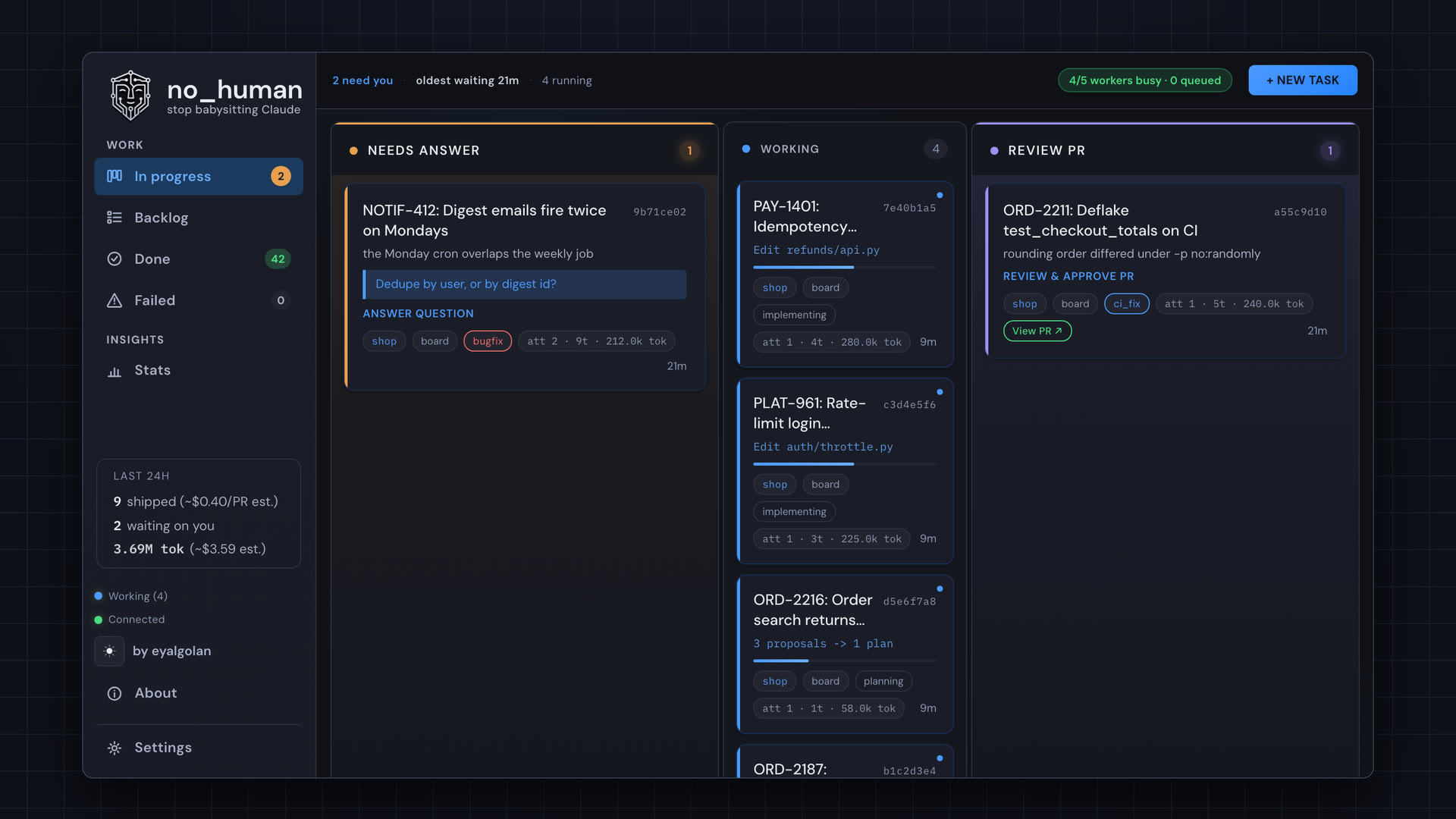
▶ Watch the loop — a ticket in, a reviewed pull request out; the whole loop in 57 seconds.
You know the loop. You ask for the change. It comes back confident and wrong in
a way that takes longer to disprove than to write. You correct it. It apologises
and does it again. And the whole time you are the one checking it ran the tests,
followed the conventions, and did not invent an API that does not exist. That is
not delegation. That is supervision, with extra steps.
no_human closes the loop instead. Hand it a ticket and walk away: it plans,
writes the change, runs your tests, and hands the work to a second model that
never saw it being written — one told to refute "done" and to cite file and line
for every finding. What lands in your inbox is a pull request that has already
been torn apart. You review and merge.
Turn the pool on and tasks run in parallel, while your engineers stay on the
work that needs them.
Every task carries a spend cap, set before it starts. Nothing to deploy: it runs
on the developer's machine, on SQLite and your existing git host.
It runs on your own Claude credential, and it is not an offline tool — your code
goes to Anthropic as prompts, and the branch and pull request go to your git
host. Exactly what leaves your machine, and what you can switch off:
docs/security.md.
Install
Whichever way you install, you need a Claude credential: an OAuth token
from claude setup-token (personal subscription or enterprise), so install the
Claude Code CLI first — npm install -g @anthropic-ai/claude-code, orcurl -fsSL https://claude.ai/install.sh | bash. The desktop app also calls
that CLI for every task. To pay Anthropic directly instead, setllm.auth_mode: "api_key" and put your ANTHROPIC_API_KEY in~/.no_human/.env.
Desktop app
Download the build for your platform from the
latest release, open
it, and paste your credential on the Connect Claude screen. The app bundles
its own Python, the server and the board — nothing to clone, no uv sync.
- macOS (Apple silicon) —
no_human-<version>.dmg, signed and notarized.
Drag to Applications. - Windows (x64) —
no_human-<version>-UNSIGNED.exe. Not code-signed yet, so
SmartScreen warns: choose More info → Run anyway. Installs per user, no
administrator prompt. - Linux (x64) —
no_human-<version>-linux-amd64.deb(recommended;sudo apt install ./no_human-<version>-linux-amd64.deb) or the.AppImage.
Each release ships a SHA-256 alongside the artifact. Platform notes and the
first-run walk-through: docs/quickstart.md.
From source
git clone https://github.com/no-human-ai/no_human.git && cd no_human
uv sync                 # installs the `nh` entry point into .venv
(cd web && npm install && npm run build)   # builds the board (cold first install can take minutes)
uv run nh init          # token, config, first repo (about 2 minutes)
uv run nh doctor        # verify the install is real before relying on it
The web build is not optional if you want the board: a source checkout ships
no web/dist, so without it nh start serves the API only and renders no UI.
Needs Python 3.12+, uv, git, and Node with
npm for the board build.
Run one task
Run nh with no arguments for the shell: your lanes, a live event tail, and an
intake you describe a task to in plain English. Every command below still works.
nh                                   # the shell
nh start                             # board + worker on 127.0.0.1:8420
nh task add https://github.com/org/repo/issues/42 --repo ~/git/repo
nh status                            # needs-you / working / waiting / done
nh review <id>                       # the reviewer's evidence checklist
nh diff <id>                         # the diff it wants to ship
nh approve <id>                      # your approval squash-lands the PR (git.approve_identity)
nh reject <id> --reason "..."        # send it back with feedback
What you get
- A plan before any code, from the ticket plus what it finds in your repo.
- An adversarial review. A different model, fresh context, read-only tools,
told to refute "done". You get a pass/fail checklist citing file and line —
never a numeric self-score. - A tamper guard. Deleted tests, new skips, an assertion turned into a
tautology — blocked before a reviewer token is spent. - Proof the fix fixed the bug. For a bug fix, the tests offered as evidence
must fail at the merge base and pass on the new tree — the reproduction gate
enforces that, and you can require it for every change. - Your tests run, locally and optionally through your CI.
- An honest stop. When it cannot finish, it parks with one specific question
instead of inventing a plausible diff.
The agent never merges
Merging is yours. gh pr merge, glab mr merge and the REST equivalents are
denied to the agent's sessions before they execute, and pushes tomain/master/release/* are refused at the git layer. nh approve is
your command: it squash-lands the pull request as the operator identity you
configure in git.approve_identity; nothing merges without a human running it. Git is driven by no_human's own code under a
distinct commit identity, not by the model; during review the backend is
read-only. Credentials live in ~/.no_human/.env (chmod 600), never in the
repo. Detail: docs/security.md.
Every task carries an enforced spend cap. nh logs <id> shows real spend
against it, per task.
Integrations
Point no_human at the tracker you already use and it pulls the tickets to your
board — a tracker's filter lives in your config, never in a task's own text,
and a transport error logs and retries on the next tick instead of crashing
the pool.
| Tracker | How tickets arrive | Filter you configure |
|---|---|---|
| Jira Cloud | Polled via REST search/jql (HTTP Basic email:token) |
integrations.jira.jql |
| Linear | Polled via the GraphQL API | integrations.linear.team_key + state_types + label |
| monday.com | Polled via GraphQL v2 | integrations.monday.board_id + status_column + todo_labels |
With write-back on (write_back, off by default), the ticket moves with the
task — matched by status category, type, or the label you name, never a
hard-coded transition id — and gets the PR link; a task that needs a human is commented on, never
transitioned. GitHub and
GitLab issues import as tasks by URL, and PRs or MRs open on your own host;
Slack and Teams get a message when a task needs you; Jenkins and CircleCI can
run your test layers and gate the loop. Setup for each:
docs/adapters.md.
Watch the Jira flow end to end — tickets synced from a Jira board, scoped,
implemented, and delivered as a review-passed pull request (click for the full
video with every step):
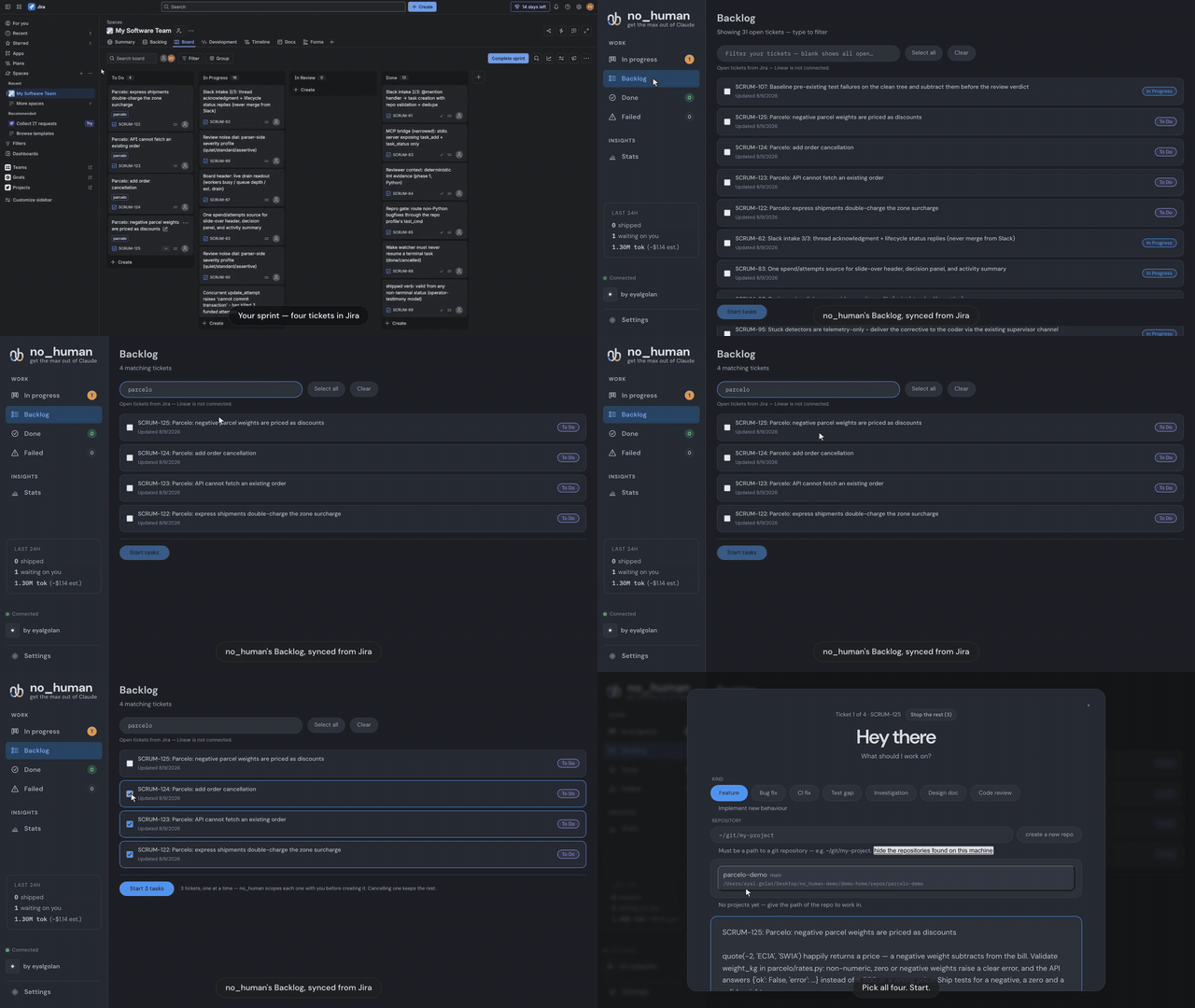
▶️ Play the full demo — 1:33, from Jira board to review-passed PR
Docs
| quickstart.md | Zero to first task, per platform |
| configuration.md | Every setting and default |
| verification.md | The gates, the bounded loop, the limits |
| security.md | Auth boundary, the never-merge rule, guards |
| blockers.md | Escalation, wake watcher, nh reply |
| adapters.md | Intake, context, VCS and CI backends |
| eval.md | Golden set, replay scoring, shadow mode |
| CHANGELOG.md | What changed, per release |
Development
uv sync
uv run pytest -q
uv run nh --help
Issues and pull requests welcome; run uv run pytest -q before submitting.
License
MIT — see LICENSE. The licence covers the code, not the name:
TRADEMARK.md is the policy on using "no_human" and the logo.
Packaging a binary carries obligations the source tree does not, listed in
THIRD-PARTY-NOTICES.md.
Yorumlar (0)
Yorum birakmak icin giris yap.
Yorum birakSonuc bulunamadi