culprit
Health Uyari
- License — License: MIT
- Description — Repository has a description
- Active repo — Last push 0 days ago
- Low visibility — Only 5 GitHub stars
Code Gecti
- Code scan — Scanned 12 files during light audit, no dangerous patterns found
Permissions Gecti
- Permissions — No dangerous permissions requested
Bu listing icin henuz AI raporu yok.
RCA for agent-driven development: find what introduced a bug and verify a fix is complete before committing. Deterministic, offline, MCP-native.
culprit




Root-cause analysis for a pull request or branch. Read-only — never modifies your repo or PR.
Runs as a CLI, a CI gate, or an MCP server your coding agent (or subagent) calls to verify a fix is complete before it commits.
Given a PR or branch, culprit classifies it as a bugfix or feature:
- Bugfix — blames the lines the fix removed (at base revision) to rank the commits that introduced it, then adds context:
- Suspect set — the ranked introducing commits
- Intent — the author's original goal (introducing PR + linked issue)
- Lifecycle — which releases shipped the bug, plus hotspot files
- Completeness — untouched call sites, a missing test, or a revert
- Feature — maps the blast radius: reverse-import dependents, covering tests, high-risk shared modules.
Example
rca --html report.html on a bugfix — a one-line formula silently broken by a perf
commit, shipped across three releases. QA risk score, introducing commit intent,
line-evolution timeline (created → broke (red) → fix (green)), test impact, co-change
gaps, reviewer suggestions.
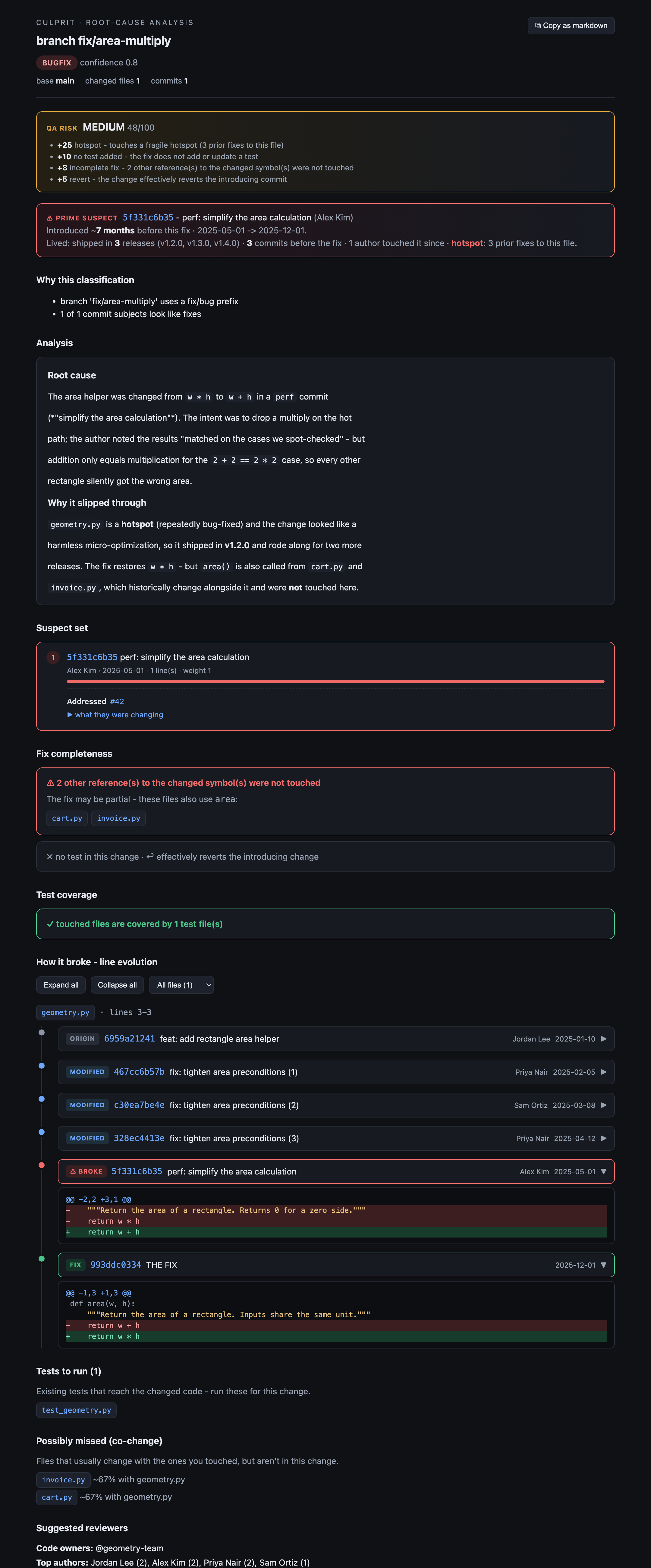
Single self-contained HTML file. No server, no CDN. Opens offline, attaches to CI.
Architecture
The deterministic git work (diff parsing, git blame/git log -L, suspect set,
reverse-import map) emits structured JSON. The LLM narrative is isolated behind aReasoningAdapter — HarnessAdapter for Claude Code (no key needed), ClaudeAPIAdapter
for standalone use (claude-opus-4-8 default, --fast for claude-sonnet-4-6).
  PR / branch / stack trace
    -> pr_context (diff, changed files, commits, host links)
    -> classify (bugfix vs feature, with evidence)
         bugfix  -> suspect -> evolution -> intent / lifecycle / completeness / test_gap
         feature -> blast_radius (importers, covering tests, high-risk modules)
    -> report.build -> QA risk score   (+ test_impact, coupling, owners, coverage)
    -> optional LLM "why" narrative
    -> output: JSON | HTML | markdown | --select-tests | --fail-on (CI exit code)
Full module map and data shapes: docs/ARCHITECTURE.md.
Accuracy
Suspect-finding is benchmarked against 50 real regressions — 25 from
git, 25 from systemd —
where the introducing commit is known from each fix's Fixes: trailer (author-verified
ground truth). culprit is run exactly as you would: given only the fix commit, it blames
the removed lines to rank the commits that introduced the bug.
| Metric | Result |
|---|---|
| Introducing commit ranked #1 (top-1) | 50% (25/50) |
| Introducing commit in the top-5 suspect set | 66% (33/50) |
Fully deterministic and offline, on large C codebases the engine has never seen.
Reproduce: python benchmarks/run.py (clones the repos, scores every case).
Install
uvx culprit                          # runs from PyPI on demand, no install step
uvx --from "culprit[api]" rca        # include the Claude API reasoning layer

pip install culprit                  # permanent install
pip install "culprit[api]"           # + anthropic SDK
pipx install culprit                 # isolated CLI
pip install -e ".[dev]" && pytest    # from source
PR metadata uses the GitHub CLI when available (brew install gh && gh auth login).
For public repos, rca --pr N falls back to the unauthenticated REST API (GitHub and
GitLab) — set GITHUB_TOKEN / GITLAB_TOKEN to raise rate limits. Without either,
culprit uses local git only (no PR title/labels).
Hosts: deep links work for GitHub, GitLab, Bitbucket, and Gitea. For self-hosted
forges set host = "gitlab" in .culprit.toml or CULPRIT_HOST.
Languages: suspect/timeline are language-agnostic (git blame/log -L). Blast
radius detects imports across JS/TS, Python, Go, Java/Kotlin, Ruby, C/C++, C#, PHP,
Rust, Scala, Swift.
Usage
rca                          # current branch vs configured base (or HEAD~1)
rca --last                   # latest commit only
rca --pr 16786               # specific PR (uses the PR's own base)
rca --repo /path --base main
rca --mode api --fast        # Claude API reasoning, sonnet model
rca --json                   # structured JSON output only
rca --html report.html --open
rca --trace crash.txt        # RCA from a stack trace, no fix/PR needed
rca --verify-fix patch.diff  # check a diff for completeness before committing
rca --select-tests           # print tests to run for this change (CI-pipeable)
rca --pr 16889 --bisect "pytest tests/test_x.py::test_y"
rca --pr 16889 --fail-on high   # exit non-zero when QA risk >= high
rca serve --repo /path          # local web UI with base picker (http://127.0.0.1:8722)
CI
culprit signals risk via exit code only — no PR comments, no writes. Copyexamples/github-actions/culprit-pr.yml
into .github/workflows/:
- uses: actions/checkout@v4
  with: { fetch-depth: 0 }
- uses: actions/setup-python@v5
  with: { python-version: "3.12" }
- run: pip install "culprit>=0.3.0"
- env: { GH_TOKEN: "${{ github.token }}" }
  run: rca --pr ${{ github.event.pull_request.number }} --html culprit-report.html --no-save --fail-on high
- if: always()
  uses: actions/upload-artifact@v4
  with: { name: culprit-report, path: culprit-report.html }
MCP server
culprit ships an MCP server that works with any MCP-compatible client over stdio:
Claude Code, Cursor, Windsurf, VS Code, Codex CLI, Zed, Continue.dev, Cline, Amazon Q,
Goose, or any agent built on the MCP SDK. Requires Python 3.10+ and
uv (brew install uv).
Claude Code (plugin — recommended): installs the MCP server and a skill that
tells the agent when to reach for it (RCA on a regression, verify_fix before a commit):
/plugin marketplace add noordeen123/culprit
/plugin install culprit@culprit
Claude Code (MCP server only):
claude mcp add culprit -- uvx --from "culprit[mcp]" culprit-mcp
Other clients — add to your client's MCP config (mcpServers key; file location
varies by client):
{
  "mcpServers": {
    "culprit": {
      "command": "uvx",
      "args": ["--from", "culprit[mcp]", "culprit-mcp"]
    }
  }
}
Tools (11):
| Tool | Description |
|---|---|
analyze |
Full RCA in one call — classify + suspects/blast-radius + risk + test impact |
find_suspects |
Rank commits by likelihood of introducing the bug |
get_evolution |
Per-commit line history via git log -L for the buggy range |
get_intent |
Introducing commit: message body, linked PR, referenced issues |
check_completeness |
Call sites the fix didn't touch |
verify_fix |
Check a proposed diff before committing — complete/partial/risky |
get_risk_score |
QA gate score (0–100, low/medium/high) with contributing factors |
get_blast_radius |
Feature change impact: dependents, covering tests, high-risk files |
get_test_impact |
Minimal test set to run for this change |
classify_change |
Bugfix vs feature with evidence |
from_trace |
RCA from a stack trace — no diff or PR required |
The Claude Code plugin above bundles this skill for you. For a non-plugin setup (or
another agent), copy examples/claude-code-skill/SKILL.md
into .claude/skills/rca/ and fill in <REPO_PATH> / <BASE_BRANCH>.
vs git bisect
git bisect |
culprit | |
|---|---|---|
| Input | A reliable failing test | The fix diff (or a stack trace) |
| Method | Checks out commits and runs the test | Blames the fix's lines + git log -L |
| Speed | Minutes (~log₂N test runs) | Instant |
| Output | First bad commit | Suspect set, line evolution, intent, lifecycle, completeness, risk score |
| Confidence | Proof | Strong heuristic |
--bisect "<cmd>" runs a real bisect as an optional confirmation layer — in a throwawaygit worktree so your checkout is never touched. When the first failing commit matches
the blamed suspect, the HTML report stamps it confirmed by git bisect. --good /--bad override the search bounds.
HTML report
--html PATH produces a single self-contained file (no CDN, opens offline). For a bugfix
it renders a line-evolution timeline: for each line the fix touched, every commit that
ever changed it from creation through the breaking commit (red) to the fix (green), each
node expandable to its diff. Also includes:
- TL;DR banner and lifecycle strip (releases that shipped the bug)
- Introducing-PR intent card and fix-completeness callout
- Deep links on every commit / PR / file, plus weight bars on suspects
- Per-file filter and a copy-as-markdown button
rca --pr 16889 --html rca.html --open
rca --pr 16889 --html rca.html --narrative-file why.md   # embed a pre-written narrative
Configuration
Base branch resolution order: --base flag → CULPRIT_BASE env → .culprit.toml → HEAD~1.
# .culprit.toml
base = "origin/main"
--last forces the latest-commit view regardless of config.
Tests
pip install -e ".[dev]" && pytest
Yorumlar (0)
Yorum birakmak icin giris yap.
Yorum birakSonuc bulunamadi