Cairn
Health Uyari
- License — License: NOASSERTION
- Description — Repository has a description
- Active repo — Last push 0 days ago
- Low visibility — Only 5 GitHub stars
Code Gecti
- Code scan — Scanned 12 files during light audit, no dangerous patterns found
Permissions Gecti
- Permissions — No dangerous permissions requested
Bu listing icin henuz AI raporu yok.
Agentic incident-analysis copilot: MCP tool servers, a cost-aware model router, an approval-gated write path, and a companion npm CLI for platform analysis, a live dashboard, and log chat.
Cairn





An agentic incident-analysis copilot. Ask "why did checkout latency spike at
3am?" in plain English; Cairn queries the observability stack, correlates
against the deploy timeline, retrieves the relevant runbook, and proposes a
root cause with evidence — and can execute a remediation, behind a human
approval gate.
This repository implements docs/architecture.md.
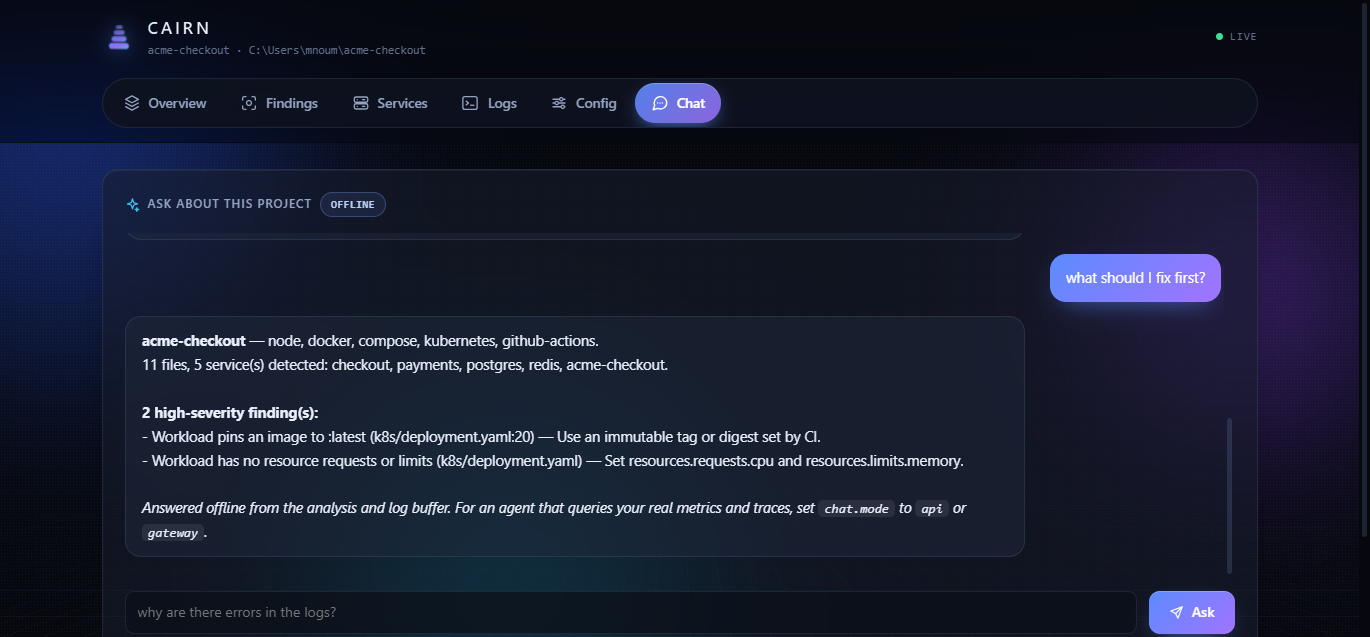
The dashboard
The companion npm package (npx @nouman-amjad/cairn dashboard) serves a live
local dashboard over any project — no build step, no dependencies, no network.
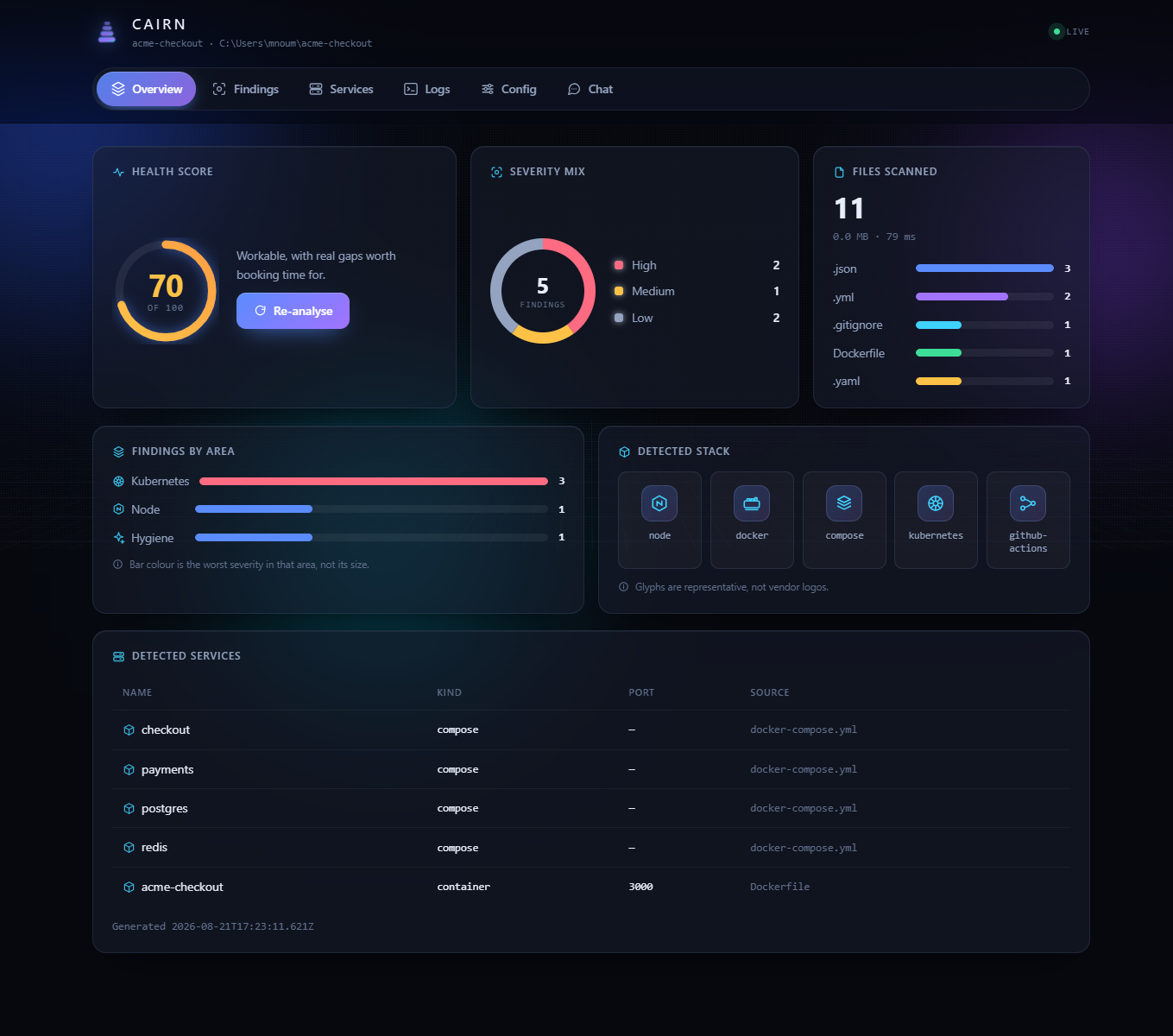
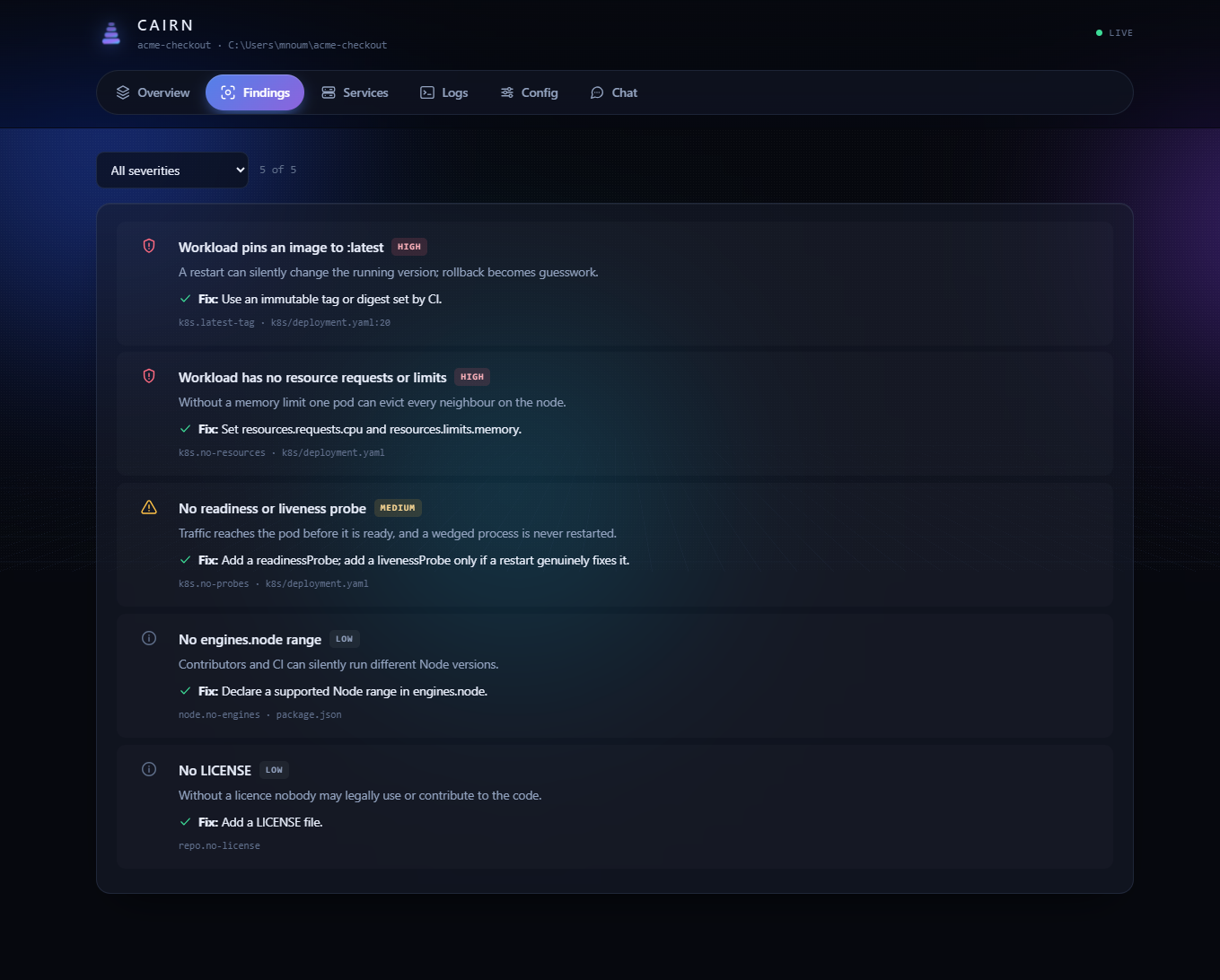
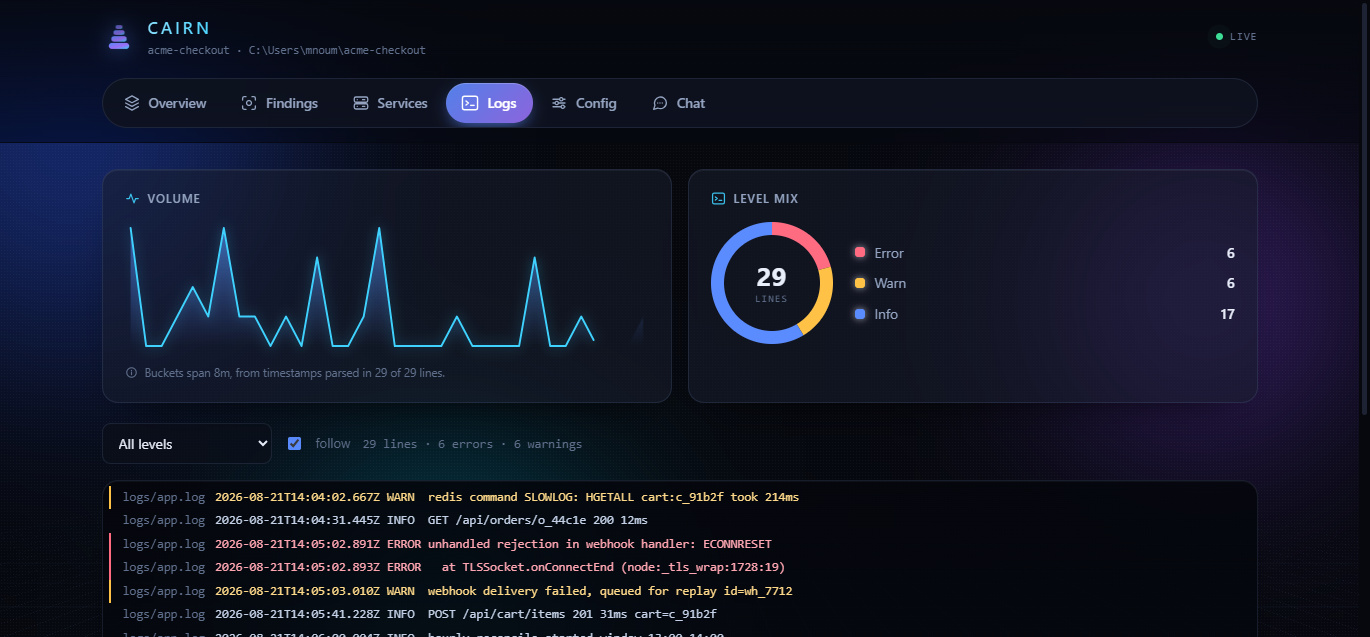
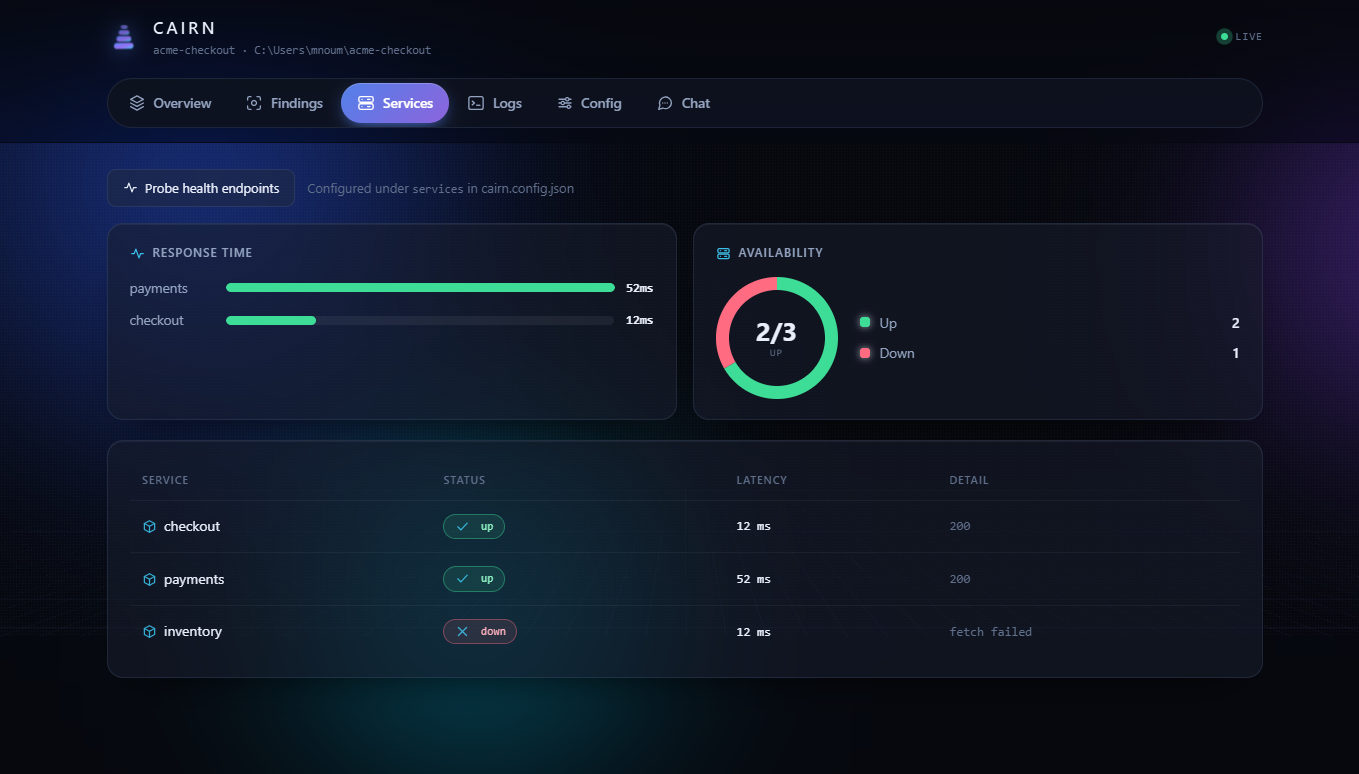
The four commitments, and where they live in the code
| Commitment | Where it is enforced |
|---|---|
| Tools are the product. Every capability is an MCP tool; the agent has no privileged path to any backend. | services/cairn-mcp-*, packages/cairn-mcp-kit |
| Inference is a routed resource. A cost-and-sensitivity router splits work between a local 8B and a frontier model. | routing.py |
| Write actions are never autonomous. A durable approval state machine with idempotency keys and an append-only audit log. | service.py |
| The eval harness is a first-class service. 30 scenarios with ground-truth causes and 7 gated metrics. | services/cairn-eval |
Layout
packages/
  cairn-core/          domain model, config, auth, DB, sensitivity, artifacts
  cairn-mcp-kit/       MCP scaffolding: identity, OPA guard, result capping, versioning
services/
  cairn-gateway/       OIDC, rate limits, cost budgets, circuit breaker, SSE fan-out
  cairn-orchestrator/  the agent loop as a state machine persisted to Postgres
  cairn-router/        model routing, cost accounting, vLLM + Anthropic clients
  cairn-approval/      approval state machine and the Slack gate
  cairn-mcp-observability/  metrics, logs, traces, deploys, artifacts
  cairn-mcp-runbooks/       hybrid search, ingest, past-incident recall
  cairn-mcp-actions/        approval-gated write tools
  cairn-eval/          30 scenarios, 7 metrics, the CI gate, a seeded stack
  cairn-cli/           `cairn ask "why did checkout spike?"`
ui/                    Next.js: chat, trajectory viewer, approvals
cairn-deploy/          Helm chart, ArgoCD app-of-apps, OPA bundle, prompts
cairn-infra/           Terraform: VPC, EKS, RDS, Karpenter, IRSA, S3
docker/                one Dockerfile for all Python services, plus vLLM
docs/adr/              14 architecture decision records
cairn-deploy and cairn-infra are vendored here for review. In production
they are separate repositories with separate lifecycles — see
ADR-013.
Getting started
make install     # uv sync + npm ci
make up          # Postgres (pgvector), Redis, MinIO, OPA
make migrate
make test        # 246 tests
make selfcheck   # 21 module self-checks
make eval        # 30 scenarios through the real agent loop
No GPU and no API key are needed for any of the above. make eval runs in
heuristic mode, which exercises the whole pipeline — loop, tool capping,
persistence, the seven metrics, the gate — with a scripted stand-in instead of
a model. See the caveats.
To run against real models, set CAIRN_ROUTER_ANTHROPIC_API_KEY and pointCAIRN_ROUTER_VLLM_URL at a vLLM server.
Debugging with an MCP client
Every MCP server speaks stdio as well as Streamable HTTP:
make mcp-stdio
# or, the way an outside user would:
uvx cairn-mcp-observability --stdio
Point Cursor, Zed or any other MCP client at it and you see exactly what the agent sees.
That costs about twenty lines (ADR-002)
and pays for itself the first time a tool result looks nothing like you
expected.
What is and is not verified
Being specific, because "it works" is not a claim worth making vaguely.
Verified by running it here:
- 246 tests pass against a real PostgreSQL 16 + pgvector, including the
approval-gate safety properties (no self-approval, no double execution, no
execution without approval, an append-only audit log enforced by a database
trigger) and the router property that restricted data never reaches a cloud
model — checked exhaustively across every task class and tier state. - 21 module self-checks pass.
- The Alembic migration applies cleanly to a real database.
- 12/12 OPA policy tests pass.
- The 30-scenario eval runs end to end through the real agent loop; all seven
metrics are above target and the gate correctly blocks both a simulated
regression and a below-target run. - The UI typechecks and builds. The CLI's five commands resolve.
Not verified here, and why:
- Eval accuracy numbers. The committed baseline is heuristic mode, which
scores the harness rather than the agent. Real numbers needmake eval-record
against a live router. The LLM cause judge is built but not calibrated —
nobody has labelled 100 runs, so κ is unknown. - Terraform. No
terraformbinary in this environment;fmt,validate
andtflintrun in CI. Nothing has been applied to an AWS account. - Helm rendering.
helm lint,templateandkubeconformrun in CI for
all three environments. They were not run locally. - Every cost figure in
docs/cost.md. The accounting that
would measure them is built and tested; the traffic to populate it does not
exist. - The vLLM performance table. Arithmetic from memory bandwidth, not
measurement.docs/inference.mdgives the benchmark
command and a falsification threshold. - Chaos testing. Phase 7 of the roadmap has not been run.
docs/roadmap.md tracks this phase by phase.
Documentation
docs/architecture.md— the design this implementsdocs/adr/— 14 decision records, each with its consequencedocs/security.md— threat model and where each control livesdocs/inference.md— GPU sizing, KV-cache arithmetic, vLLM flagsdocs/cost.md— the cost model, including whether the GPU pays for itselfdocs/operations.md— runbook: what pages, what to dodocs/roadmap.md— phases, risks, and what is actually doneservices/cairn-eval/README.md— how to read a gate failure
Yorumlar (0)
Yorum birakmak icin giris yap.
Yorum birakSonuc bulunamadi