oc8
Health Gecti
- License — License: LGPL-3.0
- Description — Repository has a description
- Active repo — Last push 0 days ago
- Community trust — 22 GitHub stars
Code Gecti
- Code scan — Scanned 12 files during light audit, no dangerous patterns found
Permissions Gecti
- Permissions — No dangerous permissions requested
Bu listing icin henuz AI raporu yok.
Open-source AI business orchestration platform for running governed AI agents across ERP, CRM, Microsoft 365 and other business systems.
oc8

The AI Business Orchestration
Become an AI-first business today.
oc8 is an open-source, self-hosted AI agent orchestration platform for businesses. It lets AI agents securely work across ERP, CRM, Microsoft 365, Odoo, Slack and other business systems through MCP, with human approvals, guardrails and audit trails.
Getting Started · Architecture · Roadmap · Deploy · Security
- 🔒 Isolated AI Agents — each agent runs in its own container, with
access only to what oc8 explicitly grants it. - 📚 RAG Knowledge Base Management — retrieval-augmented knowledge,
scoped per agent or department. - 🧠 Works With Any LLM — Anthropic, OpenAI, OpenRouter, local Ollama,
or any OpenAI-compatible endpoint. - 🛡️ Sovereign by Design — self-hosted; your data and credentials never
leave infrastructure you control. - 🏢 Scoped and Built for Enterprise Usage — tenant isolation, audit
trails, and approval thresholds from day one. - 🔌 Works With Your Existing Stack — oc8 orchestrates the CRM, ERP,
and tools you already run; nothing to rip out and replace. - 🧑⚖️ Human in Control — every consequential action waits for approval
unless you've explicitly said otherwise. - 🧩 Extensible in Every Direction — the capa system: connectors,
skills, tool packs, and department templates as installable folders. - 🔗 Built on Open Protocols — every tool call goes through the same
governed MCP gateway, compatible with standard agent tooling. - 📈 Built to Scale — from a single agent to a full digital workforce.
- 🗂️ Knowledge & Tool Management for Agents — assign exactly what each
agent can read, call, and use. - 🏙️ Your Digital Company — departments, agents, and approvals that
mirror how your business actually runs.
Status: oc8 is under active development. Read
Scope and limitations before a production
deployment.
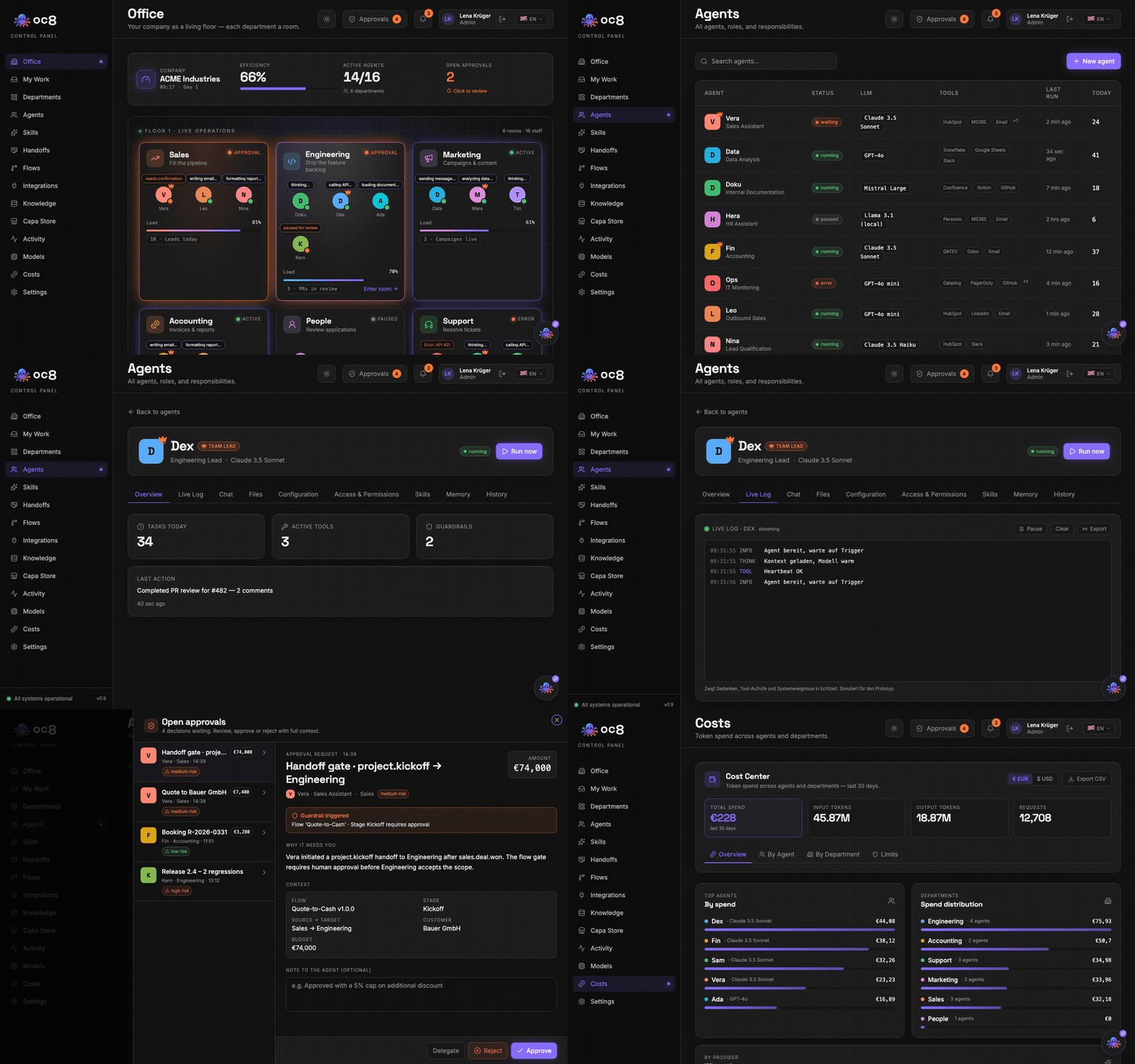
oc8 turns "hire someone to do this" into a configuration you can inspect,
approve, and audit. You describe the outcome, the agent proposes how it'll
get there, and every consequential step — a write, a send, a spend past a
threshold — waits for a human unless you've explicitly said otherwise. Your
existing software landscape stays exactly where it is — oc8 orchestrates it,
it doesn't replace it.
oc8 is for you if
- ✅ you want an AI agent to actually do recurring work — triage tickets,
draft and send replies, update records in a real business system — not just
answer questions in a chat window. - ✅ you need to know, after the fact, exactly which agent did what, when, and
under whose approval — not just trust that it behaved. - ✅ you'd rather self-host on infrastructure you control than hand your
business data and credentials to someone else's cloud. - ✅ you want to plug in the tools you already use (a CRM, a helpdesk, a
knowledge base) without hand-rolling an integration for each one — or
ripping out and replacing what already works. - ✅ "run this in an isolated container, not my agent host" is a requirement,
not a nice-to-have.
How it works
| Step | What happens |
|---|---|
| 1. Describe | State the outcome in plain language: "classify incoming tickets, draft a response, escalate anything about billing." |
| 2. Configure | Assign a model, the knowledge and tools it needs, and the autonomy/escalation boundary — or let the built-in Copilot draft the configuration for you to review. |
| 3. Run | The agent executes on a schedule, an event, or a chat message; every governed action is checked against its permissions before it happens. |
| 4. Govern | Anything over a value threshold or on an always-ask list waits for a human — from the inbox, or from Telegram/WhatsApp. |
| Works with |
 Claude Code |
 Codex |
 opencode |
 nanoclaw |
 Bash |
 HTTP / MCP |
 OpenRouter |
Any agent runtime that can be sandboxed and driven through oc8's gateway is hireable.
What's under the hood
                         ┌─────────────────────────┐
                         │        caddy (edge)      │
                         └────────────┬─────────────┘
                    ┌──────────────────┴───────────────────┐
                    │                                       │
           ┌────────▼────────┐                    ┌─────────▼─────────┐
           │     frontend      │                    │      backend       │
           │  (React/Vite SPA) │◄──────REST/WS──────│  (FastAPI, API v1) │
           └────────────────────┘                    └─────────┬──────────┘
                                                                 │
                     ┌───────────────────┬───────────────────┬─┴───────────────┐
                     │                   │                   │                 │
              ┌──────▼──────┐    ┌───────▼──────┐   ┌────────▼───────┐  ┌──────▼──────┐
              │   worker      │    │  scheduler    │   │ ingestion-worker│  │  postgres    │
              │ (run executor)│    │ (cron/trigger)│   │  (RAG ingest)   │  │  + pgvector  │
              └───────┬───────┘    └───────────────┘   └─────────────────┘  └─────────────┘
                      │
                      │ isolated-runtime agents (opt-in per agent)
                      ▼
              ┌──────────────────────┐
              │  runtime-provisioner   │  the ONLY process with Docker socket access
              └──────────┬─────────────┘
                         │ one container per agent — spawned, reaped, never shared
        ┌────────────────┼────────────────┬────────────────┐
        │                │                │                │
  ┌─────▼─────┐    ┌─────▼─────┐    ┌─────▼─────┐    ┌─────▼─────┐
  │  agent A   │    │  agent B   │    │  agent C   │    │  agent N   │
  │ container  │    │ container  │    │ container  │    │ container  │
  │ own tools, │    │ own tools, │    │ own tools, │    │ own tools, │
  │ own creds  │    │ own creds  │    │ own creds  │    │ own creds  │
  └────────────┘    └────────────┘    └────────────┘    └────────────┘
Every isolated agent gets its own container — no shared filesystem, no shared
credentials, no visibility into another agent's tools or data. Theruntime-provisioner is the only process in the stack that ever touches the
Docker socket, so the backend and worker processes themselves never carry
that (host-root-equivalent) privilege.
| System | What it owns |
|---|---|
| Microkernel core | Agents, runs, approvals, memory, tools, secrets — no vendor-specific logic. |
| Capas | Everything Odoo-, Slack-, or vendor-specific. A connector, tool pack, or skill is a folder, not a fork. |
| MCP tool gateway | The one and only MCP server an agent ever sees; every external call is governed and auditable here. |
| Postgres + RLS | Row-level security keyed on a tenant GUC set per transaction — the enforced isolation primitive, not application-level filtering. |
| Runtime isolation | An agent runs in-process by default, or in its own Docker/Podman container for stronger blast-radius containment — either way, it only ever sees the knowledge, tools, and credentials oc8 explicitly grants it, never anything more. |
| Secret store | Envelope-encrypted credentials (AES-256-GCM, per-tenant DEK under an operator-held KEK) — never plaintext, never in the codebase. |
Full write-up, request-flow walkthrough, and design decisions: ARCHITECTURE.md.
What oc8 is not
| It's not... | Because... |
|---|---|
| A chatbot | An agent here does work — writes, sends, updates records — not just answers questions. |
| A no-code automation builder | Automations are scoped to what a governed agent can safely do, not arbitrary workflow graphs. |
| A prompt-management tool | Prompts are one input to an agent's configuration, not the product. |
| A hosted service | oc8 runs on infrastructure you control; there's no account to create with us. |
| A place to paste secrets into chat | Credentials live in an encrypted secret store the agent never reads directly — see ARCHITECTURE.md. |
Quick start
Follow the complete Getting Started guide, or use
the guided local installer:
# Run oc8 locally (Docker)
git clone https://github.com/oc8-ai/oc8.git
cd oc8
./scripts/quickstart.sh          # macOS / Linux
# PowerShell on Windows:
./scripts/quickstart.ps1
The scripts check Docker, ask which mode to run (Community — empty, real
password setup; Demo — seeded bilingual ACME showcase behind a real
password login, good for a hosted walkthrough on a custom domain; or Dev —
seeded ACME data with an unauthenticated instant login, localhost only, never
expose it), create missing .env secrets without overwriting existing values,
build and start the stack, wait for its health endpoint, and print the URL. A
fresh Community installation opens the local administrator setup wizard. Then
configure a model, create an agent, and run a first task.
Non-interactive/scripted runs (no terminal attached) default to Community mode
with no custom domain, same as before — set OC8_QUICKSTART_MODE
(community/demo/dev) and OC8_QUICKSTART_DOMAIN to preset the answers
instead of being prompted.
Your first automation
- Create an agent and state one clear outcome under Mission & Automation.
- Select its model, knowledge, and the minimum tools it needs.
- Choose when it starts: manually, on a schedule, or from a capa event.
- Define autonomy and escalation boundaries.
- Test with a low-risk task, then review activity and audit events.
You can alternatively tell the OC8 Copilot what you want, for example:
"Prepare an agent that classifies support requests and escalates payment or
security cases." It will create a reviewable proposal — it never activates or
changes anything without an authorized person applying it. The Copilot
receives capabilities, not credentials: it cannot read secret values, shell
into hosts, or apply changes itself.
Security model
- Credentials are stored in an encrypted secret store and are not exposed to
normal agents or the OC8 Copilot. - OAuth and secret entry happen in dedicated human-controlled flows.
- Capas are executable code and therefore a trust boundary; install only
code you have reviewed and trust. - The reference runtime provisioner is the only Compose service with Docker
socket access. That access remains host-root-equivalent.
Read SECURITY.md, DEPLOY.md, and
SCOPE_AND_LIMITATIONS.md.
FAQ
Why not just give my agent framework direct API access to my tools?
Because then nothing stops an over-threshold action from executing before a
human sees it. oc8's MCP gateway is the one path every tool call takes, which
is what makes an approval threshold enforceable instead of advisory.
Do I need Kubernetes to run this?
No. The reference deployment is a single docker compose up — Postgres,
Redis, the backend and its workers, the frontend, and a Caddy edge proxy.
Can I add my own integration without forking the core?
Yes — that's what the capa system is for. A data-only capa (a skill, a
department template, a tool pack's guardrail presets) needs no code at all;
see capas/README.md.
What happens if I don't configure any approval thresholds?
Guardrail presets shipped by a capa give you a sound default (e.g. always
requiring approval for a deletion, since it carries no monetary value to
threshold against) — you don't have to hand-assemble a policy from scratch.
Roadmap
See ROADMAP.md for what's shipped and what's next — currently:
core agent/department/approval model, provider-neutral model routing,
knowledge and memory with budgets, the capa framework, the MCP tool
gateway, guardrail presets, Docker/Podman runtime isolation, an optional
HMAC-chained audit trail, and encrypted backup/restore are all shipped;
sandboxed execution for community-trust capas is next.
Repository map
| Path | Purpose |
|---|---|
backend/ |
API, workers, data model, agent runtime, migrations, tests |
frontend/ |
React/TanStack operator experience |
capas/ |
Open connector, skill, channel, and runtime extensions |
docs/ |
Deployment, operational, security, and getting-started guides |
docker-compose.yml |
Reference deployment |
Development and verification
cd backend
python -m pytest
python -m ruff check src tests

cd ../frontend
npm run lint
npm run test:unit
npm run build
For a clean-install Compose smoke test:
./scripts/community-compose-fresh-install-smoke.sh
Documentation
Structured like Odoo's documentation:
- Documentation hub
- User documentation — run and operate oc8
- Install and maintain
- Developer documentation — build capas
- Contributing — work on oc8 core
Reference:
- Getting Started
- Architecture
- Roadmap
- Deployment guide
- Scope and limitations
- Backup and restore
- Capa guide
- Security policy
- Contributing
About
oc8 comes out of the BOP Alliance, a network of
software partners spanning thousands of projects across dozens of
countries, after years spent connecting business systems by hand. An
agent in oc8 isn't tied to one application — it reaches the ERP, the CRM,
the file store, and the accounting system in the same run, because they
all speak one open protocol. Open by default, sovereign by design, human
in control, built together with the community rather than a vendor
roadmap decided behind closed doors.
Contributing and license
Please read CONTRIBUTING.md,
CODE_OF_CONDUCT.md, and SECURITY.md.
oc8 Community (backend/ and frontend/) is licensed under the GNU Lesser
General Public License v3.0 or later (LGPL-3.0-or-later), see
LICENSE. A third-party dependency audit is
recorded in THIRD_PARTY_LICENSES.md. Each capa
under capas/ also has its own license and provenance; see
capas/README.md. Contributions are accepted under
the Developer Certificate of Origin —
see CONTRIBUTING.md.
Yorumlar (0)
Yorum birakmak icin giris yap.
Yorum birakSonuc bulunamadi