kleoth
Health Uyari
- License — License: Apache-2.0
- Description — Repository has a description
- Active repo — Last push 0 days ago
- Low visibility — Only 5 GitHub stars
Code Uyari
- network request — Outbound network request in app/branding-src/generate.mjs
Permissions Gecti
- Permissions — No dangerous permissions requested
Bu listing icin henuz AI raporu yok.
Local-first macOS app: Wispr Flow-style dictation, bot-free meeting recording and Loom-style screen recording. Meetings transcribed on device with Whisper; bring your own AI (Claude Code, Codex, Ollama, OpenRouter); files you own.
Kleoth





Local-first voice, meetings and screen capture for macOS.
Kleoth is an open-source Mac app for system-wide dictation, bot-free meeting recording and screen recording with transcripts. What it records and transcribes are plain files in ~/Kleoth that you own; transcription can stay on your Mac, and the AI steps run on whatever you already use.
- Dictate anywhere. Hold fn+shift, speak, let go: cleaned-up text lands in whatever app has focus — an editor, a terminal, an AI chat, mail. Wispr Flow-style voice typing with a personal dictionary and a searchable history. Speech-to-text runs on ElevenLabs Scribe with your own key.
- Record meetings without a bot. Your mic and the call's audio (Zoom, Meet, Teams, anything that plays sound), recorded on your Mac with nobody joining the call. Transcribed on device with Whisper, summarized in the meeting's own language, saved as Markdown and JSON. A local, open-source alternative to Granola, and a bot-free one to Otter, Fireflies and tl;dv.
- Record your screen (beta). A display or a region, with system audio and your mic, as a small MP4. Transcribed on device afterwards; the viewer highlights each word as it is spoken. Loom-style, but nothing is uploaded. No trimming, sharing or export yet.
Bring your own AI — or none. Summaries and dictation clean-up run on whatever you already use: Claude Code, Codex, a local Ollama or LM Studio server, OpenRouter, or Apple's on-device model. Kleoth doesn't sell you another AI subscription. Which providers, and what each needs →
No account. No database. Local-first by design.
kleos (Greek κλέος) — "that which is heard." From the Proto-Indo-European root *ḱlew‑, "to hear."
Dictation: Wispr Flow-style voice typing in any app
Hold fn+shift, speak, let go: Kleoth transcribes what you said, cleans it up with one short
language-model pass (fillers and false starts gone, never translated) and pastes it into whatever
app has focus. If you know Wispr Flow or Superwhisper, it is the same hold-to-talk idea. Double-tap
for hands-free; from the next release, a hold that runs long can go hands-free too — tap ⌘ or click
the pill. In an editor, an AI chat or a terminal, a long spoken ramble comes back as the text you
would have typed — paragraphs, a list where you listed things; a quick chat message is pasted as
heard. A personal dictionary biases recognition toward your names and jargon, and every dictation
lands in a searchable history.
Speech-to-text runs on ElevenLabs Scribe with your own key; the clean-up
runs on your AI provider. From the next release, a dictation that can't be transcribed keeps its
audio: it waits in History, and the pill's Retry — or History's "Try again", in the cloud or on
this Mac — transcribes it later. More about dictation →
Meetings: a local alternative to Granola, a bot-free one to Otter, Fireflies and tl;dv
Kleoth records your microphone and the call's audio directly on your Mac — Zoom, Google Meet,
Teams, a browser tab, anything that plays sound. No bot joins the call, and the audio stays on
your Mac unless you choose cloud transcription.
- Transcribed on device by Whisper (WhisperKit on the
Apple Neural Engine). No account, no API key. The language is detected automatically — English,
Russian and dozens more — or pinned in Settings. - You vs. Them, exactly — your mic and the system audio are separate channels, so who said what
needs no diarization guesswork. - Cloud transcription when it matters — one click sends a meeting to ElevenLabs Scribe, with
your key; the on-device version is kept alongside. - Summaries in the meeting's language — TL;DR, overview, action items and per-speaker
highlights, written after each transcription by your AI provider (on Automatic, the first one
Kleoth finds — see Bring your own AI). - Files, not a database — every meeting is a folder of audio,
transcript.md,summary.mdand
JSON in~/Kleoth. Grep it, sync it, delete it.
Screen recording: Loom-style, local (beta)
Pick "Record screen…" in the menu-bar popover (or hover the pill, shown while dictation is on), drag
a region or take the whole display, and Kleoth records it with system audio and your microphone as one small H.264 MP4 (about 22 MB
per minute) in ~/Kleoth/screen-recordings/. Each recording is transcribed on device afterwards
and opens in a viewer with the transcript beside the video: the spoken word is highlighted, clicking
a word seeks, double-clicking corrects it. It is a beta — no trimming, sharing or export yet.
More about screen recording →
Bring your own AI
Kleoth doesn't sell you another AI subscription. Summaries and dictation clean-up need a language
model, and Kleoth uses whatever you already have, in this order, unless you pick one in
Settings → Accounts:
| Provider | What it needs | Summaries | Dictation |
|---|---|---|---|
| Local server (Ollama, LM Studio, any OpenAI-compatible URL) | the server running, default http://localhost:11434/v1 |
✓ | ✓ |
| Claude Code | the claude CLI installed and signed in |
✓ | ✓ (slow — several seconds per cleanup) |
| Codex | the codex CLI installed and signed in |
✓ | — |
| OpenRouter | an API key | ✓ | ✓ |
| Apple on-device | macOS 26 with Apple Intelligence on | — | ✓ |
Codex only summarizes (no dictation cleanup path); Apple's on-device model only cleans up
dictation and needs macOS 26 with Apple Intelligence turned on in System Settings.
Speech-to-text is separate from all of these: Whisper runs on device for meetings, screen
recordings and retries, and ElevenLabs Scribe, with your key, transcribes
dictation and anything you send to the cloud. More in docs/ai-providers.md.
Long meetings on Ollama need a larger context than Ollama's default, which can be as small as
4096 tokens: start the server with OLLAMA_CONTEXT_LENGTH set to 32768 or more
(OLLAMA_CONTEXT_LENGTH=32768 ollama serve; for the Ollama app, runlaunchctl setenv OLLAMA_CONTEXT_LENGTH 32768 and restart it). Ollama's OpenAI-compatible
endpoint (the /v1 URL Kleoth uses) has no way to set the context size per request, and an
over-long prompt is reportedly cut from the start without an error — the summary may then cover
only the end of the meeting.
Nothing is sent anywhere you did not sign up for: the CLIs run as the binaries you installed,
with their own login; the local server and Apple's model never leave the machine.
If Kleoth is useful to you, starring the repo helps other Mac users find it. ⭐
Requirements
- macOS 14.4 or later. Apple Silicon recommended (the on-device model runs on the Neural Engine).
- ~600 MB one-time download for the Whisper model on first transcription, then fully offline.
- API keys are optional. An ElevenLabs key is needed for dictation and cloud transcription;
summaries can run on a provider that needs no key at all (see Bring your own AI).
Screenshots
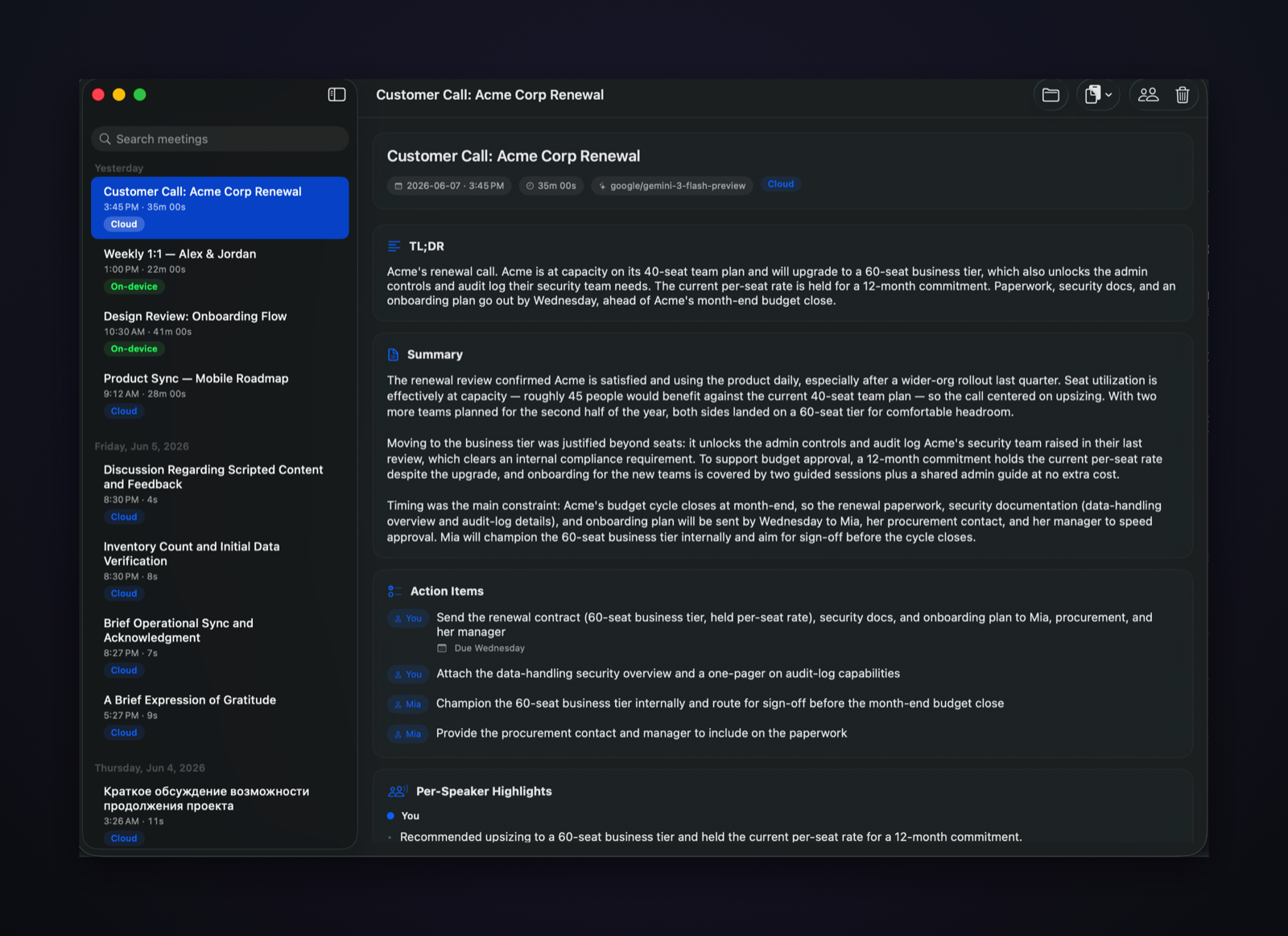
The History window — searchable, day-grouped meetings with a TL;DR, summary, action items, and per-speaker highlights.
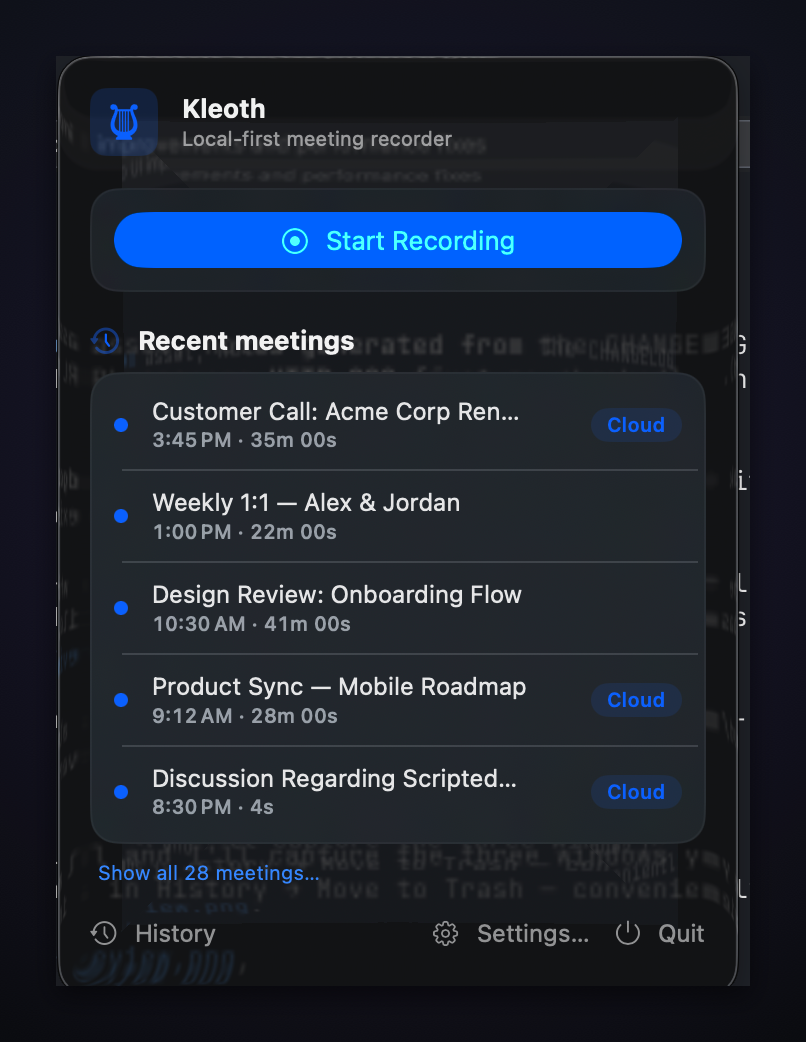
The menu-bar popover — start a recording and reach recent meetings.
Install
⬇ Download Kleoth-0.4.0.dmg
(13.7 MB · SHA-256)
— or browse all Releases.
Open the DMG and drag Kleoth.app onto the Applications folder. Kleoth lives in the menu bar
(the lyre icon).
First launch (current builds are self-signed)
Until Kleoth ships notarized builds, macOS Gatekeeper will warn that it is from an unidentified
developer. This is expected — the app is signed, just not yet with an Apple-issued Developer ID.
- In Applications, right-click Kleoth.app → Open (don't double-click the first time).
- In the dialog, click Open again. macOS remembers the choice; subsequent launches are normal.
This step exists only because notarization requires an Apple Developer Program membership (planned —
see Roadmap). The build is otherwise complete and signed.
Permissions Kleoth requests, and why
| Permission | Why | When |
|---|---|---|
| Microphone | Record your side of the conversation. | First recording. |
| System Audio Recording | Record the other participants (the audio your Mac plays). Shown under Privacy & Security → Screen & System Audio Recording. | First recording. |
| Keychain | Store your optional API keys securely. Click "Always Allow" so you are not re-prompted. | When you save a key, or on a re-signed build. |
| Calendar (optional) | Name a meeting from the calendar event you're in. Decline freely. | If you grant it. |
| Accessibility (optional) | Dictation only: watch for the fn+shift chord system-wide and send the ⌘V that pastes the dictated text. | When you turn dictation on in Settings. |
| Screen Recording (optional) | Screen recording only: capture the display or region you picked. Kleoth's own pill and picker are never in the frame. | The first time you start a screen recording. |
Everything except the microphone and system-audio grants is optional. The only place Kleoth sends
audio is ElevenLabs Scribe, with your key: each dictation, and a meeting or recording you choose to
transcribe in the cloud.
Quick start
- Open Kleoth from the menu bar and click Start Recording (or use the global hotkey).
- Have your meeting. The menu-bar icon shows you're recording.
- Click Stop. The recording is saved to your meeting list as Untranscribed — you can start
another recording immediately. - Open the meeting and click Transcribe (free, on device) — or turn on "Transcribe
automatically after recording" in Settings. When it finishes you have the transcript and, if an
AI provider is available (see Bring your own AI), the summary. The same content is on disk at~/Kleoth/meeting-<timestamp>/astranscript.mdandsummary.md.
That's it — no key required for steps 1–4.
Configuration
Open Settings from the menu bar. Everything here is optional:
- ElevenLabs API key — enables the per-meeting "Fully transcribe" (Cloud) action. The key
needs thespeech_to_textpermission. - OpenRouter API key — one way to get AI summaries and the dictation clean-up pass (see
Bring your own AI for the others). Note: if your
OpenRouter account blocks providers that may train on your data, choose a no-train model (e.g.z-ai/*,deepseek/*,google/*,meta-llama/*); accounts that enforce Zero Data Retention
will also findgoogle/*blocked (404zdr-violation-by-account) — the defaultz-ai/glm-5.3-flash
works under both guardrails; relax them at openrouter.ai/settings/privacy to use Gemini. - Summary model — any OpenRouter model slug. Default:
z-ai/glm-5.3-flash. - Transcription language — Auto (detect per meeting) or pin a specific language.
- Dictation — enable hold-to-talk (fn+shift), pick the polish model (default
google/gemini-3.5-flash-lite, the fastest correct one measured — ~0.9 s; if your account blocks
Google the polish falls through toz-ai/glm-5.3-flash), edit your personal dictionary (one term per line; the first 100 are
sent with each dictation), reset the pill position. Needs an ElevenLabs key; without an
AI provider the raw transcript is pasted as-is.
Keys are stored in the macOS Keychain and are never printed or committed.
CLI
The repo also ships a kleoth command-line tool for the same pipeline (audio file → transcript →
summary → Markdown), independent of the app:
swift run kleoth transcribe meeting.m4a   # ElevenLabs Scribe; diarized; saves the meeting
swift run kleoth summarize  <dir|file>    # transcribe (if needed) + AI summary  (--model <slug>)
swift run kleoth rename     <dir>         # assign real names to speaker_0 / speaker_1 …
swift run kleoth render     <dir>         # re-render summary.md from summary.json (no API calls)
Run swift run kleoth <subcommand> --help for flags. The CLI resolves keys from environment
variables (ELEVEN_API_KEY, OPENROUTER_API_KEY), a local .env, or~/.config/kleoth/config.json.
kleoth summarize --max-output-tokens <n> sets the summary's output-token budget (default 8192;
an answer cut off at that limit is retried once with twice the budget). It applies to OpenRouter
and local servers only — the Claude Code and Codex CLIs take no output cap.
Free summaries in Claude Code: the
summarize-meetingproject skill produces the samesummary.json/summary.mdusing your Claude Code session — no OpenRouter key, zero API cost.
Just ask it to summarize a meeting folder.
Integrations
- Raycast extension —
integrations/raycast-extension/. Toggle/Start/Stop Recording, Search
Meetings (open/copy summary, transcript, and paths), and Latest Summary. Import withnpm install && npm run devin that directory. - Shortcuts / App Intents — Start/Stop/Toggle recording as app intents (see
app/Sources/KleothApp). Note: SwiftPM builds don't run Apple's App Intents metadata extractor, so
intents may not auto-surface in Spotlight; the URL scheme and hotkey work regardless. kleoth://URL scheme —kleoth://record,kleoth://stop,kleoth://toggle,kleoth://summarize-latest. Callable fromopen, scripts, Raycast, etc.- Global hotkey — bind a system-wide shortcut for toggle-recording in Settings.
Data & privacy
Recording and on-device transcription never leave your Mac, and nothing ever goes to a Kleoth
server — there isn't one. What does leave, and when:
- Audio goes only to ElevenLabs Scribe, with your key: each dictation, and a meeting or
recording you choose to transcribe in the cloud. - Transcripts go to your AI provider: a meeting's, for its summary, right after it is
transcribed; a dictation's, for clean-up. On Automatic (the default) that is the first
provider Kleoth finds — local server, Claude Code, Codex, OpenRouter, Apple — so with no local
server running and the Claude Code or Codex CLI signed in, your transcripts go to Anthropic or
OpenAI under your account.
To keep them on your Mac, pick a local server (Ollama, LM Studio) or, for dictation, Apple's
on-device model in Settings → Accounts (see Bring your own AI).
Each meeting is one self-contained folder, ~/Kleoth/meeting-yyyy-MM-dd-HHmmss/:
mic.m4a · system.m4a · meeting.m4a   # your audio (mic, system, 2-channel combined)
transcript.json · transcript.md       # the transcript (raw + rendered)
summary.json   · summary.md           # the AI summary (if generated)
speakers.json                         # speaker_0 / speaker_1 → display names (You / Them)
meta.json                             # metadata: duration, tier, timestamps, consent
Dictations are text: ~/Kleoth/dictations/<yyyy-MM-dd>.json holds the raw and polished text, the
target app, language, and models per utterance; the audio clip is deleted as soon as it has been
transcribed. Only a dictation whose transcription failed or was stopped keeps its clip, in~/Kleoth/dictations/audio/, until it is transcribed or deleted. The personal dictionary is a
plain JSON array at ~/.config/kleoth/dictionary.json.
Screen recordings are plain files in ~/Kleoth/screen-recordings/: screen-<timestamp>.mp4 plus ascreen-<timestamp>.json sidecar holding the title and the word-timed transcript. Editing a word in
the viewer rewrites only the sidecar; the movie is never touched.
Consent: recording conversations is regulated and the rules vary by jurisdiction — many places
require all-party consent. Kleoth records both sides without a visible bot; that is a UX choice,
not legal cover. Get every participant's consent before recording. The app surfaces a consent
acknowledgement and stamps it into each meeting's meta.json.
Build from source
# Core library + CLI (deployment target macOS 13)
swift build && swift test                  # builds; runs the unit suite

# Menu-bar app (deployment target macOS 14.4)
swift build --package-path app             # compile-check the app + capture packages
bash app/setup-signing.sh                  # one-time: create the local "Kleoth Self-Signed" cert
bash app/make-app.sh release               # bundle, sign, install to /Applications

# Package a distributable DMG (self-signed tier)
bash app/make-dmg.sh                        # → app/dist/Kleoth-<version>.dmg (prints SHA-256)
The release process (version bump, the notarized public tier, tagging, gh release) is documented
in docs/RELEASING.md.
Architecture
Two SwiftPM packages. Package 1 (repo root, macOS 13) is KleothCore — models, networking
seam, transcription (ElevenLabs Scribe client + the engine-agnostic Transcriber protocol),
summarization (OpenRouter client), rendering, speaker mapping, storage, and the meeting pipeline —
plus the kleoth CLI. Package 2 (app/, macOS 14.4) is the KleothApp SwiftUI menu-bar agent
and KleothCapture (Core Audio process-tap for system audio, AVAudioEngine for the mic, and theLocalTranscriber built on WhisperKit). The only non-Apple core dependency isswift-argument-parser; the app adds WhisperKit and KeyboardShortcuts.
Roadmap
- Notarized builds — Gatekeeper-clean install (needs Apple Developer Program enrollment). The
signing/notarization pipeline is already wired inapp/make-dmg.sh, pending the certificate. - Homebrew cask —
brew install --cask kleothonce releases are notarized. - Sparkle auto-update.
- Whisper model-size picker — trade accuracy for speed/size.
- A default-engine toggle (on-device vs. cloud) and live captions are under consideration.
License
Apache License 2.0, except the Raycast extension
(integrations/raycast-extension/), which is MIT-licensed — the Raycast Store requires MIT for
published extensions.
Acknowledgments
- WhisperKit (Argmax) — on-device Whisper inference on
Core ML / the Apple Neural Engine. - KeyboardShortcuts (Sindre Sorhus) — the
global hotkey. - ElevenLabs Scribe — optional cloud speech-to-text.
- OpenRouter — optional AI summaries across many models.
Yorumlar (0)
Yorum birakmak icin giris yap.
Yorum birakSonuc bulunamadi