claude-proxy-rs
Health Uyari
- No license — Repository has no license file
- Description — Repository has a description
- Active repo — Last push 0 days ago
- Low visibility — Only 5 GitHub stars
Code Gecti
- Code scan — Scanned 12 files during light audit, no dangerous patterns found
Permissions Gecti
- Permissions — No dangerous permissions requested
Bu listing icin henuz AI raporu yok.
OpenAI-compatible proxy for Claude Pro/Max - use with Cline, Roo Code, Kilo Code
claude-proxy-rs
Unified API proxy for Claude Pro/Max subscription.
Use your existing Claude Pro/Max subscription with AI coding assistants and tools that support either OpenAI-compatible or Anthropic native APIs, including Cline, Roo Code, Kilo Code, and more.
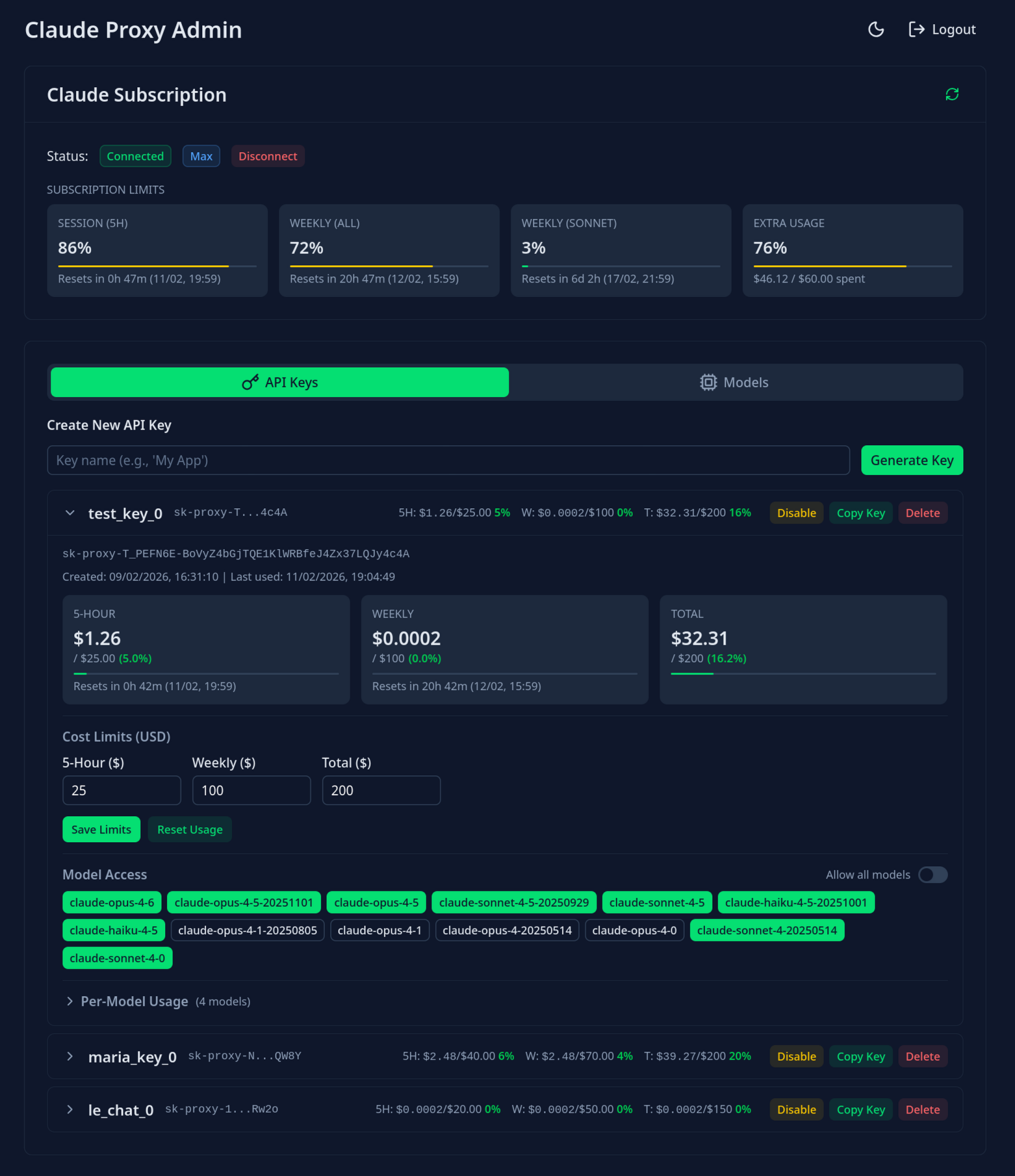
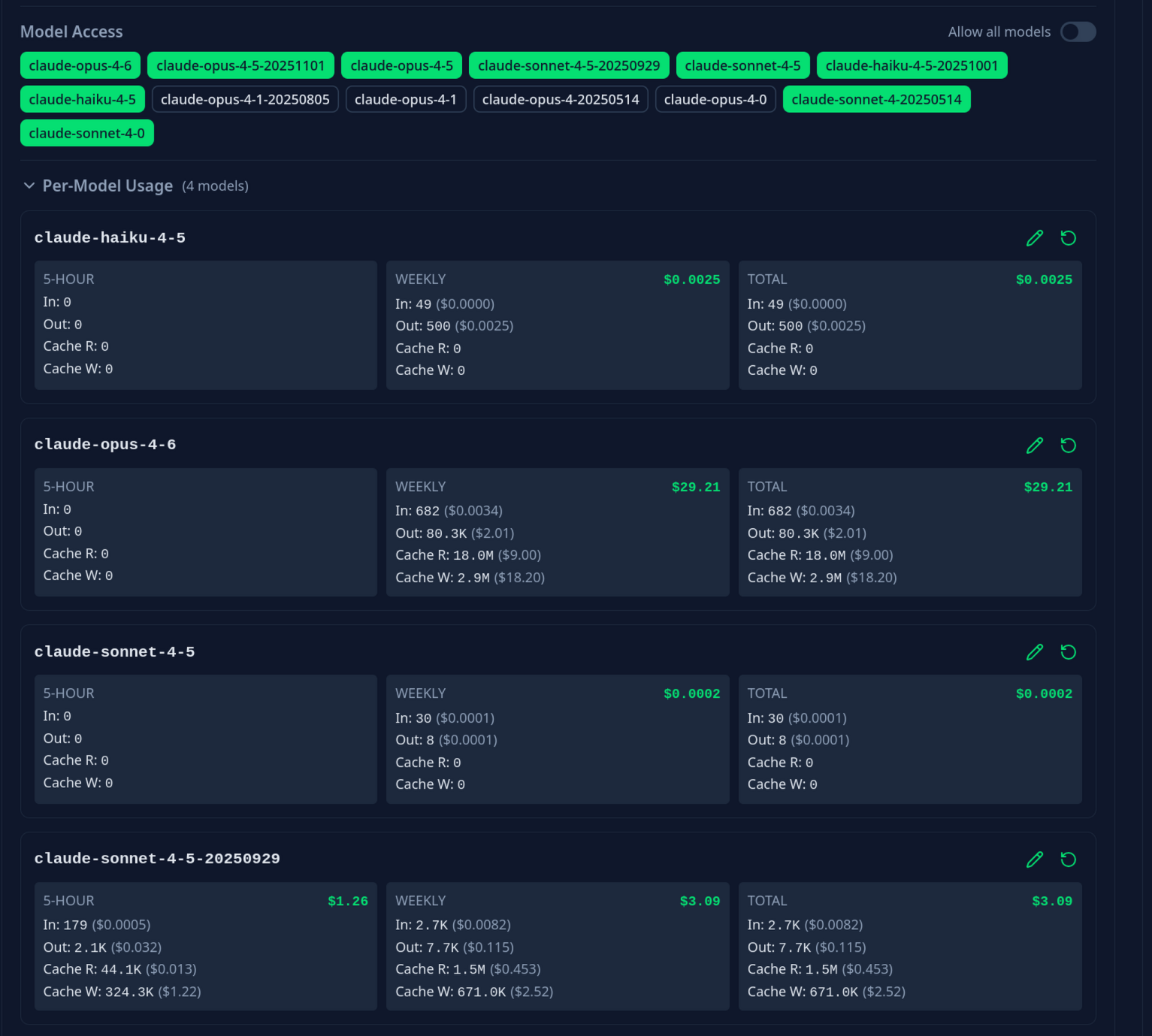
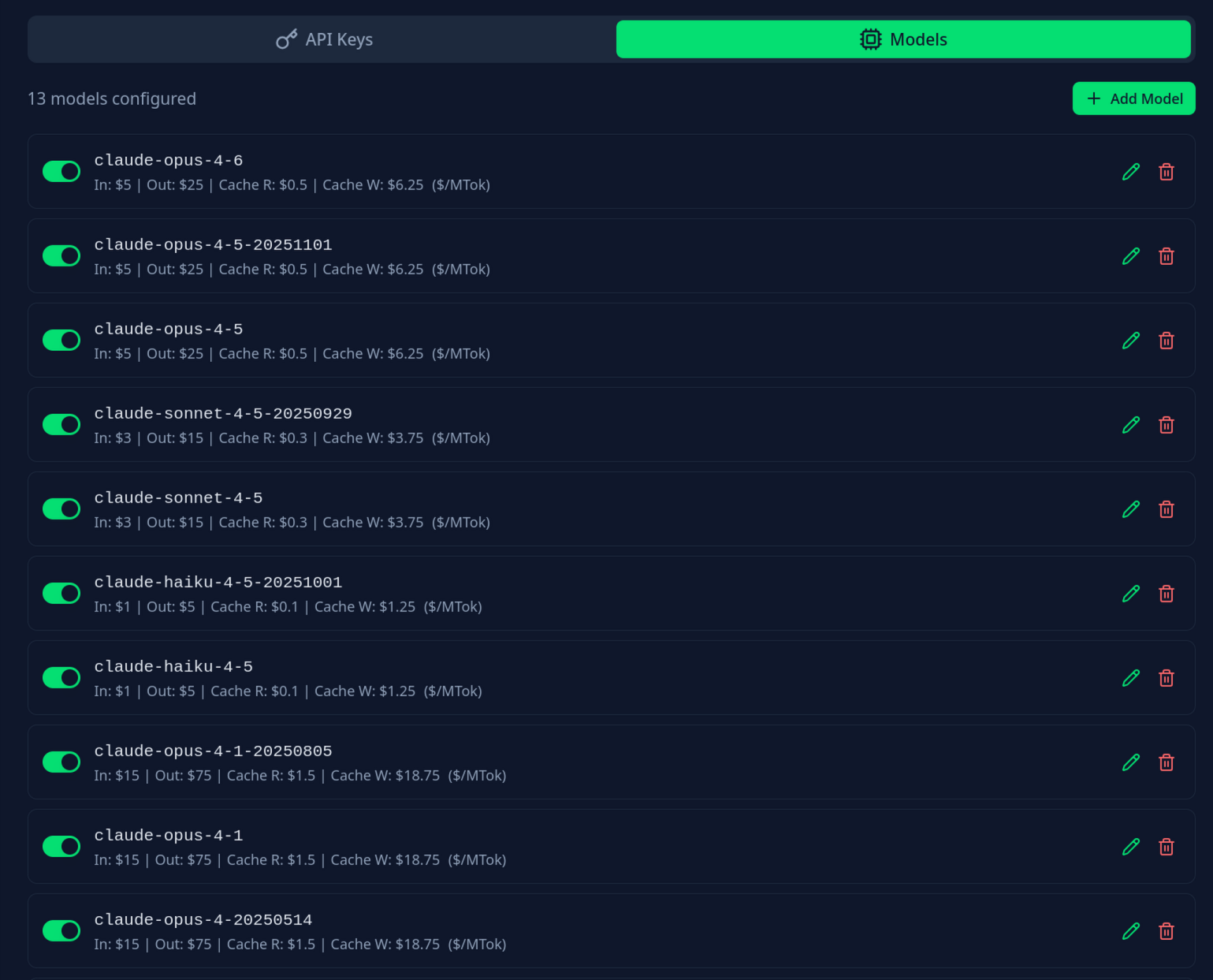
Admin UI
| Overview | API Keys | Models |
|---|---|---|
 |
 |
 |
Features
- Dual API support: OpenAI-compatible (
/v1/chat/completions) and Anthropic native (/v1/messages) - OAuth authentication with Claude Pro/Max subscription
- Admin UI (Vue 3 SPA) for managing OAuth, API keys, models, and usage
- Streaming support with keep-alive pings (prevents timeouts during extended thinking)
- Tool/function calling, image inputs (base64)
- Extended thinking mode (configurable via model suffix or native API parameters)
- Automatic prompt caching (auto-injects cache breakpoints for tools, system, and conversation history)
- Token counting (
/v1/messages/count_tokens) - Per-key cost-based rate limiting (5-hour/weekly/total limits in USD, synced with subscription windows)
- Per-key model access control (allow all or whitelist specific models)
- Per-model usage tracking with cost calculation (input/output/cache pricing)
- Usage history — time-series charts for cost and tokens, breakdowns by model and API key (24h/7d/30d)
- User-facing usage dashboard at
/admin/usage— no admin auth required, authenticate with yoursk-proxy-*key - Dynamic model management (add/remove models, configure per-token pricing)
- Key enable/disable toggle
- Configurable cloaking mode (
always/never/auto) - Single binary deployment (admin UI embedded via memory-serve)
Installation
Requirements
- Rust >= 1.94.0 (edition 2024)
- Bun >= 1.3.0
- Vite+ (
vpCLI) — unified frontend toolchain - just command runner
Build & run
# Create .env with required admin credentials
cp .env.example .env
# Edit .env with your credentials

just build   # builds admin UI + release binary
just run     # or: cargo run
Open http://127.0.0.1:4096/admin, log in, connect your Claude account via OAuth, and generate API keys (sk-proxy-*).
Configuration
Environment variables are loaded from .env or the environment.
| Variable | Default | Description |
|---|---|---|
CLAUDE_PROXY_ADMIN_USERNAME |
(required) | Admin username |
CLAUDE_PROXY_ADMIN_PASSWORD |
(required) | Admin password |
CLAUDE_PROXY_HOST |
127.0.0.1 |
Bind address |
CLAUDE_PROXY_PORT |
4096 |
Port |
CLAUDE_PROXY_CORS_ORIGINS |
localhost |
CORS: localhost, *, or comma-separated origins |
CLAUDE_PROXY_CLOAK_MODE |
auto |
Cloaking: always, never, auto (skips cloaking for Claude Code clients) |
CLAUDE_PROXY_CAPTURE_DIR |
(unset) | Optional directory for redacted request/response captures. Enable only for debugging. |
Admin sessions use HttpOnly cookies with a 30-day sliding expiration. Basic Auth is also accepted.
Request captures
Set CLAUDE_PROXY_CAPTURE_DIR=/path/to/captures to write one directory per inference request. Captures include redacted client headers, inbound JSON, prepared Anthropic JSON, upstream response headers, and either upstream_body.txt or raw upstream_stream.sse chunks.
Capture files may contain prompts, tool results, code, and model outputs. API keys, authorization headers, and cookies are redacted from headers, but the capture directory should still be treated as sensitive.
Data storage
All data (OAuth credentials, API keys, usage) is stored in a Turso embedded database:
- Linux:
~/.local/share/claude-proxy/proxy.db - macOS:
~/Library/Application Support/claude-proxy/proxy.db - Windows:
%APPDATA%\claude-proxy\proxy.db
Usage
OpenAI-Compatible API
from openai import OpenAI

client = OpenAI(base_url="http://127.0.0.1:4096/v1", api_key="sk-proxy-...")

response = client.chat.completions.create(
    model="claude-sonnet-4-6",
    messages=[{"role": "user", "content": "Hello!"}]
)
print(response.choices[0].message.content)
Anthropic Native API
from anthropic import Anthropic

client = Anthropic(base_url="http://127.0.0.1:4096", api_key="sk-proxy-...")

response = client.messages.create(
    model="claude-sonnet-4-6",
    max_tokens=1024,
    messages=[{"role": "user", "content": "Hello!"}]
)
print(response.content[0].text)
Both APIs accept x-api-key: sk-proxy-... or Authorization: Bearer sk-proxy-....
IDE Extensions
Cline / Roo Code / Kilo Code (Recommended)
Use the native Anthropic provider:
| Setting | Value |
|---|---|
| API Provider | Anthropic |
| API Key | Your sk-proxy-... key |
| Use custom base URL | ✓ Enabled |
| Base URL | http://127.0.0.1:4096 |
| Model | claude-sonnet-4-6 (or any model) |
Extended thinking works via the extension's built-in controls — no model suffixes needed.
Custom Tool Names
Claude subscription OAuth is sensitive to the tool names sent to the native Anthropic API. Claude Code uses a fixed set of mcp_* tool names; third-party tools often send their own names such as shell, patch, ask_followup_question, or update_todo_list.
In cloaking mode, the proxy best-effort normalizes known third-party tool names to Claude Code-compatible names before forwarding the request upstream. Tool descriptions and input schemas are kept intact, and response tool calls are mapped back to the client's original names before returning to the tool.
Unknown or colliding tool names fail locally with 400 Bad Request instead of being forwarded upstream. This is intentional: new tool vocabularies should be captured, reviewed, and added explicitly.
Current tested support:
| Tool | API mode tested | Status | Notes |
|---|---|---|---|
| Claude Code | Anthropic native | Supported | Treated as first-party shape; cloaking is skipped in auto mode. |
| ForgeCode | Anthropic native | Supported | Tested with tool normalization for fs_search, Read, Write, undo, remove, patch, multi_patch, shell, fetch, skill, todo_write, todo_read, and Task. |
| Roo Code | Anthropic native | Supported | Tested with tool normalization for ask_followup_question, attempt_completion, codebase_search, list_files, new_task, read_file, skill, search_files, switch_mode, and update_todo_list. |
| Kilo Code | Anthropic native | Not verified | Expected to work if it uses a supported tool vocabulary; capture and add aliases if it returns a local unknown-tool 400. |
| Cline | Anthropic native | Not recently verified | Basic native Anthropic shape should work; custom tool names may need aliases. |
Some aliases are semantically approximate because Anthropic only accepts the Claude Code-compatible name set. The model still sees the original tool description and schema, which are the primary signals for how to call the tool.
Alternative: OpenAI Compatible
| Setting | Value |
|---|---|
| API Provider | OpenAI Compatible |
| Base URL | http://127.0.0.1:4096/v1 |
| API Key | Your sk-proxy-... key |
| Model ID | claude-sonnet-4-5(high) |
Extended thinking suffixes (OpenAI mode only):
Opus 4.6 — adaptive thinking with effort parameter:
| Suffix | Effort |
|---|---|
(low) |
low |
(medium) |
medium |
(high) |
high |
(xhigh) / (max) |
max |
Older models (Sonnet 4.5, Opus 4.5, etc.) — manual thinking with budget_tokens:
| Suffix | Budget Tokens |
|---|---|
(low) |
1,024 |
(medium) |
8,192 |
(high) |
32,000 |
(xhigh) |
64,000 |
(16000) |
Custom value |
Available Models
claude-opus-4-6,claude-sonnet-4-6(latest, adaptive thinking)claude-opus-4-5,claude-sonnet-4-5,claude-haiku-4-5claude-opus-4-1,claude-opus-4-0,claude-sonnet-4-0
API Endpoints
OpenAI-Compatible
POST /v1/chat/completions— streaming supportedGET /v1/models
Response extensions (ignored by standard clients):
| Field | Location | Description |
|---|---|---|
reasoning_content |
choices[].message |
Extended thinking output |
cache_creation_input_tokens |
usage |
Tokens written to prompt cache |
cache_read_input_tokens |
usage |
Tokens read from prompt cache |
Request extensions:
| Field | Description |
|---|---|
reasoning_effort |
low/medium/high/max — alternative to model suffix |
Anthropic Native
POST /v1/messages— streaming supportedPOST /v1/messages/count_tokensGET /v1/models
Admin
GET /admin— Admin UIGET /admin/usage— User-facing usage dashboard (Bearer key auth)
Health
GET /health
Development
just run # Start backend (cargo run)
For frontend hot reload, run in a second terminal:
cd admin-ui && vp install && vp dev
# Open http://localhost:5173/admin/
Regenerating the API client
The TypeScript client in admin-ui/src/client/ is auto-generated from the OpenAPI spec. After changing backend routes or types, regenerate it with:
just openapi # dumps spec via --openapi flag (no running server needed), then regenerates client
All recipes
just check    # fmt + clippy + tests + frontend checks
just build    # build UI + release binary
just fmt      # format Rust code
just lint     # clippy + frontend lint
just test     # Rust unit tests
just openapi  # regenerate TypeScript client
just deploy   # build + deploy to server
just logs     # tail server logs
just status   # server systemd status
just restart  # restart server service
just test-api # integration tests against running proxy
Yorumlar (0)
Yorum birakmak icin giris yap.
Yorum birakSonuc bulunamadi