ollmo
Health Warn
- License — License: NOASSERTION
- Description — Repository has a description
- Active repo — Last push 0 days ago
- Low visibility — Only 5 GitHub stars
Code Pass
- Code scan — Scanned 12 files during light audit, no dangerous patterns found
Permissions Pass
- Permissions — No dangerous permissions requested
No AI report is available for this listing yet.
A production-grade RAG platform with hybrid retrieval, multi-tenancy, and streaming chat.
ollmo
Open LLM Orchestrator
Your data never leaves — build your own AI productivity tools from your knowledge base.
A production-grade RAG platform with hybrid retrieval, multi-tenancy, and streaming chat.
Built with Go + Fiber (backend) and Next.js App Router + shadcn/ui (frontend).
Live Demo · Quick Start · Documentation · Roadmap · Contributing
English | 简体中文
Why ollmo
Most AI application platforms bury you in workflows, nodes, plugins — dozens of concepts and hundreds of settings before the AI can actually help. AI should make things simpler, not the other way around.
ollmo converges everything into three steps: upload documents, ask questions, get answers with sources. One-command deployment, up and running in ten minutes.
- Simple — Does one thing and does it well: turn your documents into an assistant you can talk to.
- Easy — Up in ten minutes, no need to learn a system more complex than your business.
- Restrained — No concept stacking, no redundant configuration. Complexity stays inside; simplicity stays with you.
Features
- Hybrid Retrieval — Dense vectors on Milvus + lexical matching via MySQL FULLTEXT, fused with RRF, with KB-level rerank configuration; built-in retrieval testing with an adjustable keyword ↔ semantic weight slider.
- Multi-Tenancy — Logical isolation across MySQL, Milvus, and MinIO; every table carries
tenant_id. - Document Pipeline — Upload (drag & drop, paste, multi-file) → parse (MinerU / local parser) → chunk → embed → index, fully async via Asynq + Redis.
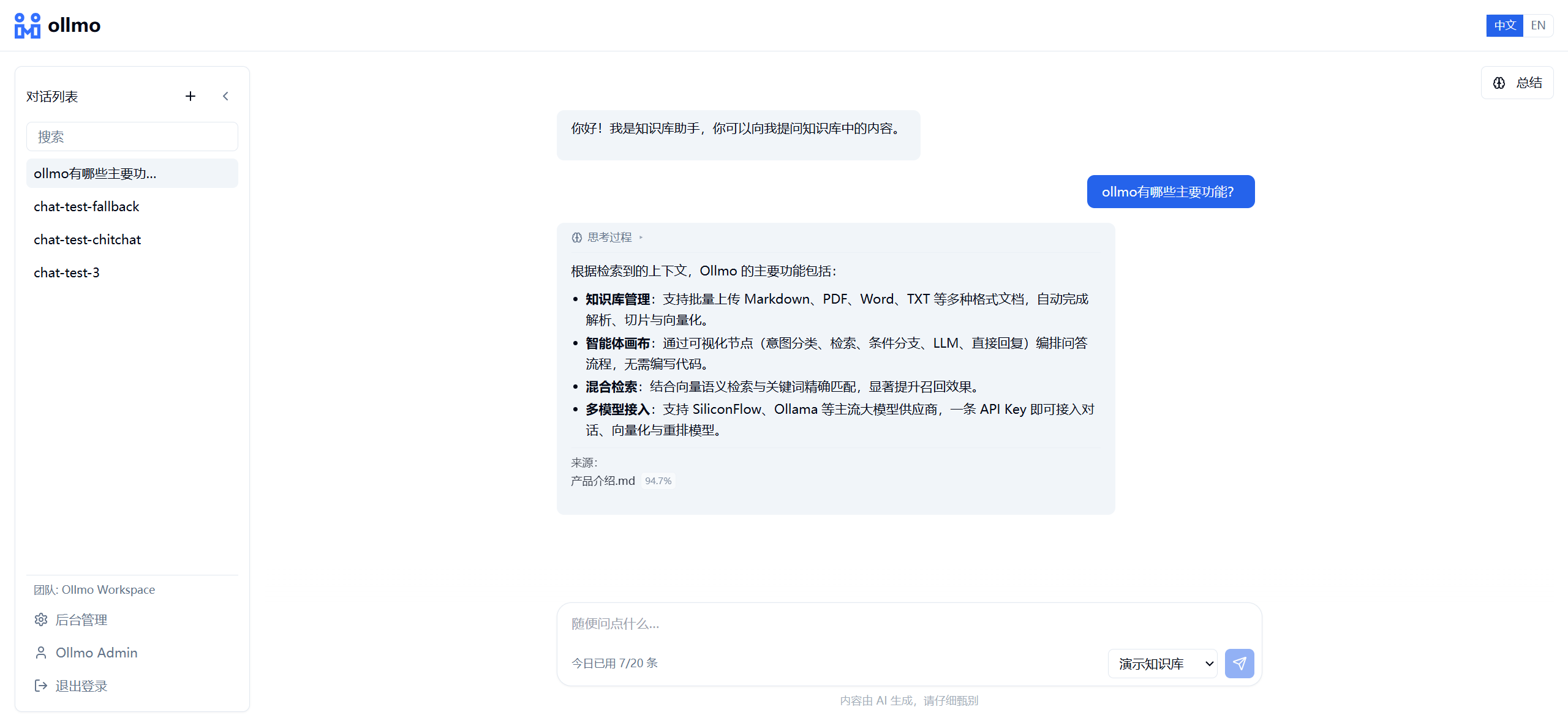
- Streaming Chat — Real-time SSE streaming with source citations. Doubao-style greeting from agent opening message.
- Auto-Memory — Long conversations are automatically summarized in the background (async LLM task); summaries are injected into later sessions for cross-conversation continuity. Toggleable site-wide.
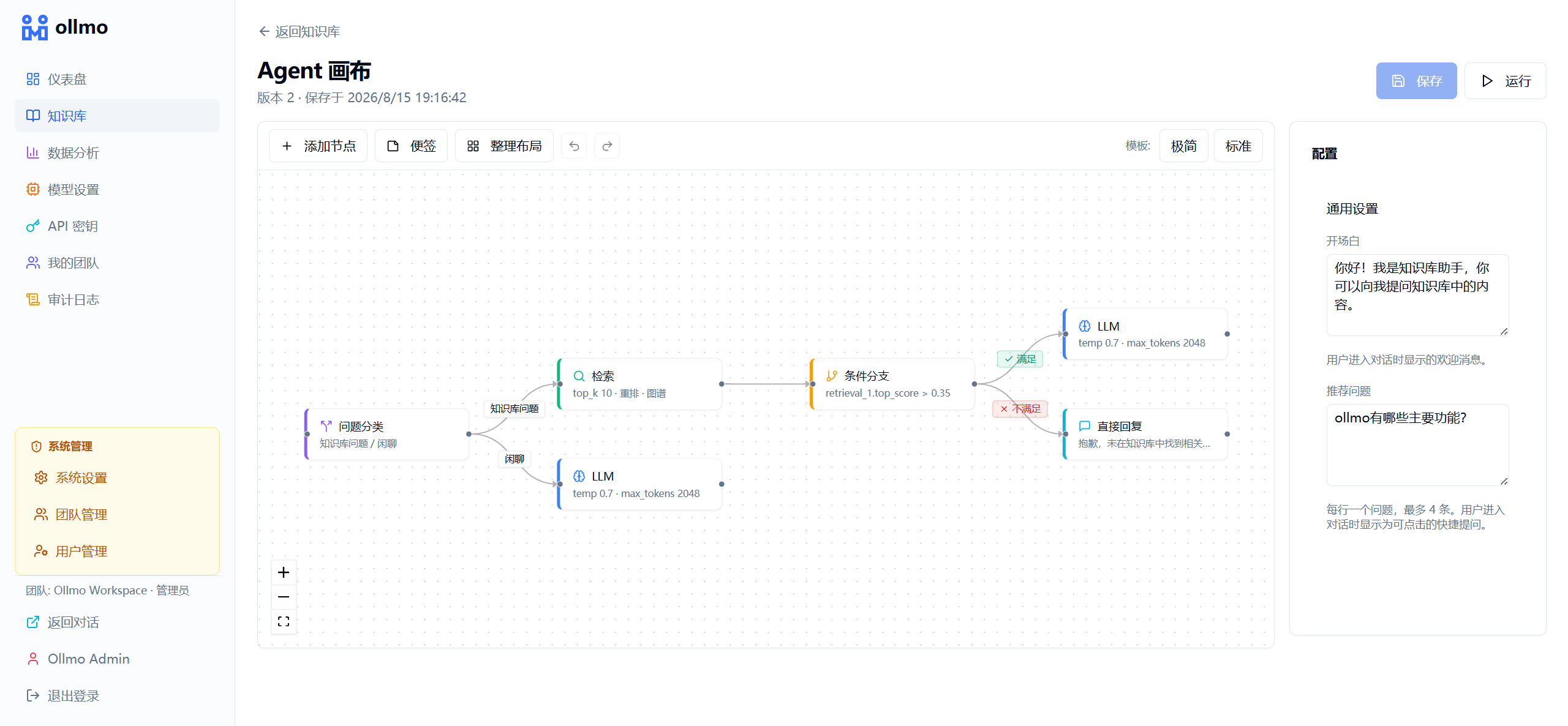
- Agent Canvas — Visual agent pipeline (React Flow): intent classification → retrieval → condition branch → LLM → direct reply. Node outputs are referenceable variables (
{node.output}) in prompts and conditions, enabling LLM chaining and generic branching; per-node debug shows output variables, and nodes highlight live during execution. In-canvas undo/redo and sticky notes. Per-KB system prompt, temperature, top_k, rerank toggle, opening message, and LLM selection. - Ingestion Pipeline Canvas — Visual ingestion DAG (React Flow): source → parser → chunker → embedder → sink, with configurable parsing options, chunking strategy, and batch size.
- GraphRAG — LLM-powered entity & relation extraction at ingestion; entity matching enriches retrieval context at query time.
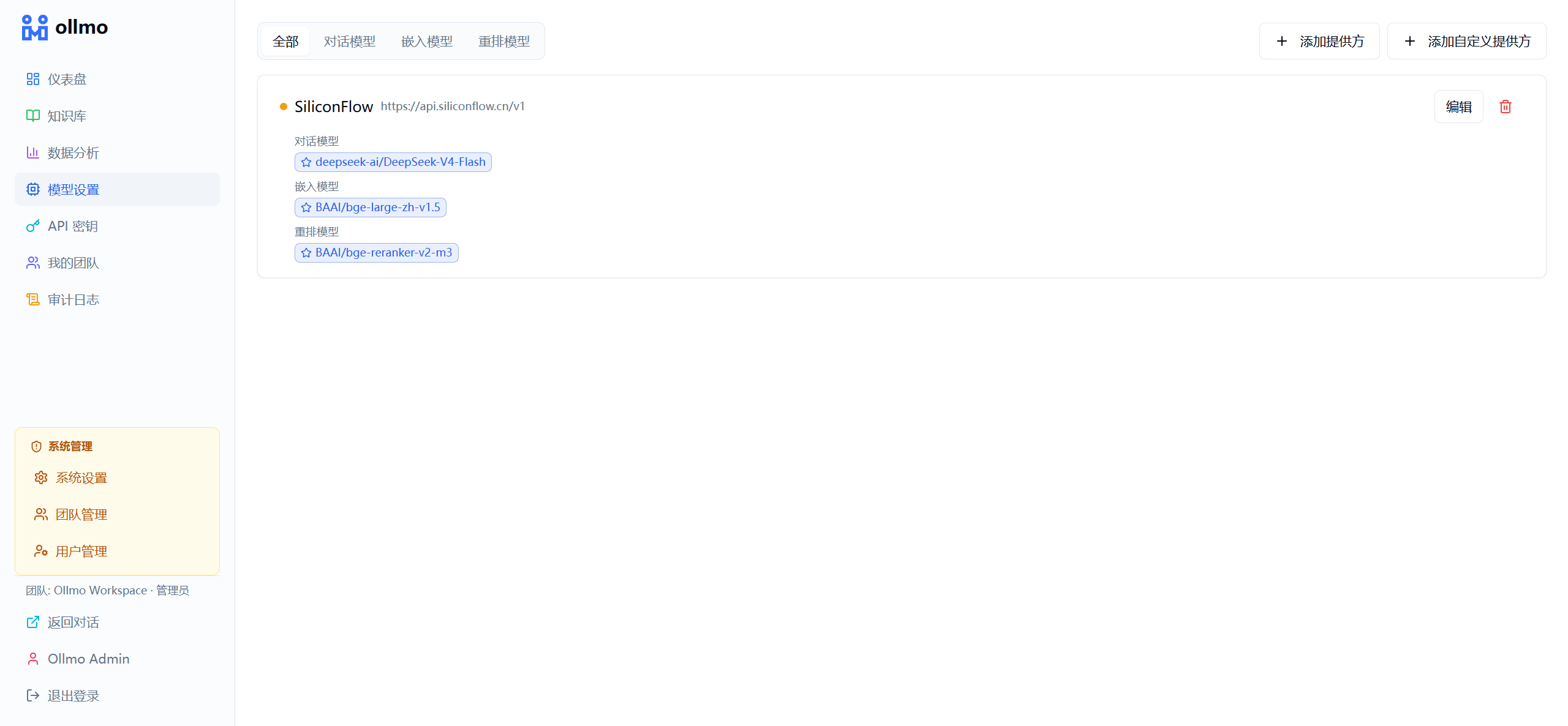
- Configurable Models — Tenant-level LLM / Embedding / Rerank provider management via web UI, with per-KB overrides. Two-column popup selector (provider list on left, models on right) for intuitive model switching. Selection priority: KB config → tenant default → config.yaml.
- Team & Access Control — Invitation-based membership with owner / admin / member roles, per-user daily message quotas, KB-level membership (viewer / editor / owner).
- Admin Console — Super-admin user management, tenant management with plan & quota control (free / pro / enterprise), system settings (registration toggle, auto-memory), analytics dashboard, and audit logging.
- External API — API-key authenticated programmatic access (search, KB management, streaming chat).
- Internationalization — Chinese / English UI with server-side message contracts. No locale in URL paths.
Tech Stack
| Layer | Choice |
|---|---|
| Backend | Go 1.26+ / Fiber / GORM |
| Frontend | Next.js 15 (App Router) / React / shadcn-ui |
| Database | MySQL 8.0 (utf8mb4) — metadata |
| Vector DB | Milvus 2.5+ — dense vector retrieval |
| Object Storage | MinIO (S3 compatible) — original docs, parsed output, thumbnails |
| Task Queue | Asynq + Redis — parsing, embedding, index rebuild, auto-summarization |
| Document Parser | MinerU (containerized, GPU optional) + local fallback parser |
| Auth | Local account (email + password + JWT) |
Architecture
                    ┌─────────────────────────────────────────────────────┐
                    │                   Next.js Web (3001)                 │
                    └────────────────────────┬────────────────────────────┘
                                             │ HTTP / SSE
                    ┌────────────────────────▼────────────────────────────┐
                    │                Go API Server (8080)                 │
                    │  Fiber · JWT auth · Tenant isolation · RESTful API  │
                    └───────┬────────────┬──────────────┬─────────────────┘
                            │            │              │
                   ┌────────▼──┐  ┌──────▼──────┐  ┌───▼────────────┐
                   │  MySQL    │  │   Redis     │  │    MinIO       │
                   │ metadata  │  │ task queue  │  │  file storage  │
                   └───────────┘  └──────┬──────┘  └────────────────┘
                                         │
                                ┌────────▼────────┐
                                │  Asynq Worker   │
                                │ parse · embed · │
                                │   summarize     │
                                └────────┬────────┘
                                         │
                                ┌────────▼────────┐
                                │     Milvus      │
                                │ dense (vectors) │
                                └─────────────────┘
Project Layout
ollmo/
├── server/                 # Go backend (API + worker share the same binary)
│   ├── main.go             # Entry point: `go run . api|worker|migrate`
│   ├── internal/           # Business domains (one package per domain)
│   │   ├── agent/          # Agent canvas config & execution
│   │   ├── analytics/      # Usage statistics & activity feed
│   │   ├── apikey/         # API key management & middleware
│   │   ├── audit/          # Audit logging
│   │   ├── auth/           # Authentication (email + password + JWT)
│   │   ├── chat/           # Streaming chat with citations
│   │   ├── doc/            # Document lifecycle, chunking, worker
│   │   ├── embedding/      # Embedding model management
│   │   ├── graph/          # GraphRAG (entity extraction & retrieval)
│   │   ├── invitation/     # Team invitation system
│   │   ├── kb/             # Knowledge base CRUD
│   │   ├── llm/            # LLM model management
│   │   ├── memory/         # Auto-summarization & cross-session context
│   │   ├── pipeline/       # Ingestion pipeline canvas config
│   │   ├── rerank/         # Rerank model management
│   │   ├── search/         # Hybrid retrieval (dense + lexical + rerank)
│   │   ├── site/           # Site-wide settings
│   │   ├── team/           # KB membership & access control
│   │   ├── tenant/         # Tenant, plan & quota management
│   │   ├── user/           # User management
│   │   └── ...
│   ├── pkg/                # Shared infrastructure (db, vector, clients)
│   └── config.yaml
├── web/                    # Next.js frontend
│   ├── app/                # App Router pages ('/' chat, '/dashboard/*' admin)
│   ├── components/         # UI + feature components (agent, pipeline, etc.)
│   ├── lib/                # API client, i18n, utils
│   └── messages/           # i18n message files (zh, en)
├── deploy/                 # Dockerfiles
├── docker-compose.yml      # Full-stack local deployment
└── Makefile                # Dev & build targets
Quick Start
Prerequisites
1. Clone & configure
git clone https://github.com/ollmo-go/ollmo.git
cd ollmo
cp .env.example .env
2. Start infrastructure
make up
This starts MySQL, Redis, MinIO, Milvus, and the Asynqmon dashboard.
| Service | URL | Credentials |
|---|---|---|
| MySQL | localhost:3306 |
ollmo / ollmo_dev_pwd |
| MinIO Console | http://localhost:9001 | minioadmin / minioadmin |
| Milvus | localhost:19530 |
— |
| Asynqmon UI | http://localhost:8081 | — |
3. Run database migrations
make migrate
4. Start backend (API + worker)
# Terminal 1: API server
make server

# Terminal 2: Asynq worker (parsing, embedding, auto-summarization)
make worker
5. Start frontend
make web # http://localhost:3001
6. One-click install
Open http://localhost:3001 — the install wizard appears on first visit. Fill in the admin email, password, and optionally a SiliconFlow API key. On confirm, the system automatically:
- Creates the admin tenant and super-admin user
- Seeds a SiliconFlow provider with LLM (DeepSeek-V4-Flash), embedding (BGE-Large-ZH), and rerank (BGE-Reranker-V2-M3) models
- Creates a demo knowledge base with a standard-template agent canvas (intent classifier → retrieval → condition → LLM / direct reply + free-chat branch)
- Uploads a demo document that is automatically parsed, chunked, and embedded
After install, you can immediately ask questions on the home page — no manual configuration needed.
Registration is disabled by default after install. Enable it via System Settings when you are ready to invite users.
Full stack via Docker
make up-full # Builds & starts everything (infra + server + worker + web)
Configuration
| Source | Purpose |
|---|---|
server/config.yaml |
Backend defaults (DB, Redis, MinIO, Milvus, MinerU, JWT, quotas) |
.env |
Environment overrides for Docker deployment |
| Web UI → Settings | Per-tenant LLM / Embedding / Rerank models (with default selection) |
| Web UI → KB Settings | Per-KB embedding / rerank model override |
| Web UI → Agent Canvas | Per-KB agent config (system prompt, LLM, retrieval params, opening message) |
| Web UI → Pipeline Canvas | Per-KB ingestion config (parser, chunker, batch size) |
| Web UI → System Settings | Site-wide settings (registration toggle, auto-memory) — super admin only |
Model selection priority: KB-level config → tenant default → config.yaml fallback.
Development
- All development happens on the
devbranch.mainis release-only. - Modules are organized by business domain, not technical layer. Each domain package contains its own
model.go/repo.go/service.go/handler.go. - Comments are kept in English and minimal — only where the intent is non-obvious.
make build         # Build server binary + web
make build-docker  # Build Docker images
make clean         # Remove build artifacts
Documentation
- Live Demo — Try it before you deploy.
Roadmap
-
Phase 1 — MVP: KB/document CRUD, document parsing, embedding, hybrid retrieval, streaming chat with citation, local auth + tenant isolation.
-
Phase 2 — Configurability: Multi LLM/Embedding/Rerank providers, KB editing with re-indexing, rerank, multi chunking strategies, drag & drop upload, i18n.
-
Phase 3 — Intelligence: Ingestion Pipeline canvas (React Flow), GraphRAG, Agent canvas, Memory, role-based access control, external API, team management.
-
Phase 4 — Production Readiness: Analytics dashboard, audit logging, conversation management (search / rename / export / pin), auto-memory summarization, super-admin console (users, tenants, plans & quotas, system settings), registration toggle.
-
Phase 5 — Document Intelligence:
5.1 Document Preview & Citation Tracing
- In-chat citation clicks jump to the source document with the cited passage highlighted
- Document viewer: PDF render, markdown/text preview, page navigation
- Chunk-to-source mapping (chunk → document → page/offset)
- Side-by-side view: chat + source document
5.2 Advanced Document Parsing
- Table extraction: preserve table structure as HTML for structured retrieval
- Image extraction: store images in MinIO, embed captions, support vision LLM Q&A
- Layout-aware parsing: recognize headers, footers, columns, footnotes
- OCR improvement: scanned document support with language detection
5.3 External API Expansion
- Full CRUD via API key: upload documents, create/manage KBs, list conversations
- OpenAPI/Swagger documentation at
/api/v1/docs - Rate limiting per API key (requests/min, tokens/day)
- Webhook callbacks for document processing events (parsed, embedded, failed)
Contributing
- Fork the repository and create your branch from
dev. - Ensure
make buildpasses before submitting a PR. - Keep changes focused — one feature or fix per PR.
- Follow existing code style: English comments, domain-driven package structure.
License
Apache License 2.0 with additional conditions. See LICENSE for details.
In short:
- ✅ Free for personal use, internal enterprise use, and commercial application development.
- ❌ Operating a multi-tenant SaaS service similar to ollmo requires a commercial license.
- ❌ Removing or modifying the ollmo brand, LOGO, or copyright notices in the console is prohibited.
Reviews (0)
Sign in to leave a review.
Leave a reviewNo results found