lich
Health Pass
- License — License: AGPL-3.0
- Description — Repository has a description
- Active repo — Last push 0 days ago
- Community trust — 12 GitHub stars
Code Pass
- Code scan — Scanned 12 files during light audit, no dangerous patterns found
Permissions Pass
- Permissions — No dangerous permissions requested
No AI report is available for this listing yet.
A terminal-first harness for coding with AI agents — real PTYs, git worktrees, diffs and pull requests in one window

lich
English · 简体中文
A terminal-first harness for coding with AI agents.
Open your projects, run agents like Claude Code, Codex and Opencode in real terminals, and keep git — worktrees, diffs and pull requests — in view without leaving the window.





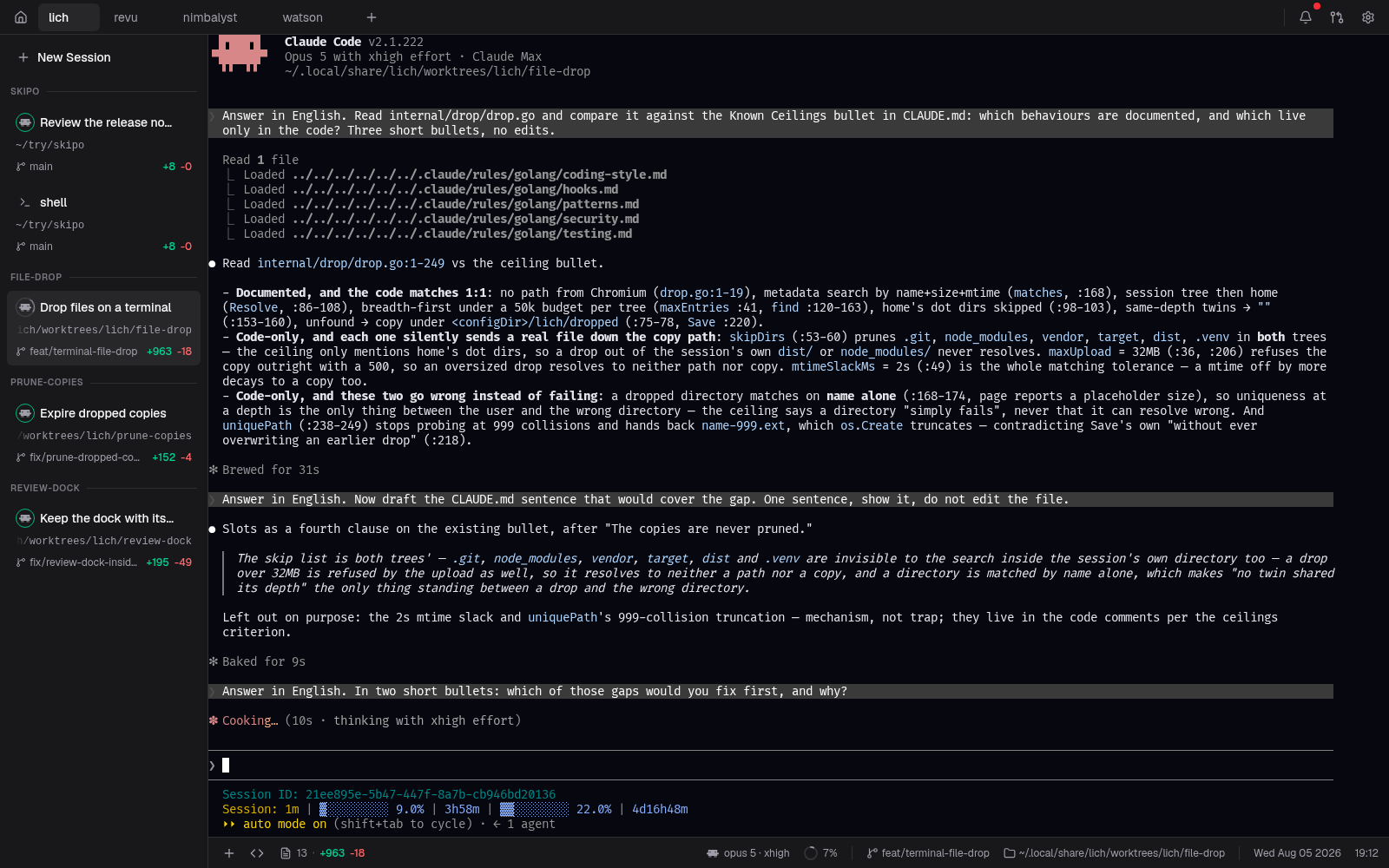
About
lich is a harness for AI coding agents — a desktop app that wraps a
terminal-first workspace around them. Open several projects, run a session (or
many) per project, drive an agent in each, and watch git state — branches,
diffs, worktrees, pull requests — without ever leaving the window. It ships as a
single static Go binary that opens its UI in your system's Chromium-family
browser in --app mode — no Electron, no bundled webview (decision record:docs/chromium-shell.md).
It is built to get out of the way of the work — the terminal stays a real
terminal, and git stays where you can see it. Development is active: bugs and
feature requests belong in
Issues, and what changed in each
version is in CHANGELOG.md.
Features
- Bring your own agent. Claude Code
(Anthropic), Codex (OpenAI),
opencode (SST) and
Crush (Charm) are all first-class:
point lich at each binary in Settings, pick the default, or choose per session. - Terminal-first sessions. Real PTY-backed shells, several per project,
rendered by xterm.js on the GPU (WebGL). Search the scrollback (Ctrl+F); the
buffer survives a full page reload. A Warp-style footer followscdand
surfaces git status, and for a Claude session it names the model, fills a ring
with the context window in use, and — if you ask it to — prices what the
session has spent. - Projects and sessions. Projects sit on a top tab bar; the
+reopens one
you recently closed or opens the OS folder picker for the rest. Session cards
carry the working directory, branch, a diff badge, an untracked-line count and
the number of the branch's pull request. - Git worktrees, built in. Spin one up from any base branch — search it,
local or remote, even across dozens of branches — and lich seeds the new
checkout with your gitignored.env*files, hands it a stable dev-server port
derived from its path (LICH_WORKTREE_PORT) and runs a per-project setup
script before the agent starts. The sidebar groups sessions by the worktree they belong to, and a kept
worktree's session resumes its conversation later. - Review, and hand the review back. A CodeMirror diff dock shows the working
changes beside a live file tree — collapse or expand every file at once, open
one in your editor, attach one to the session. Right-click a selection to write
a comment against those lines; the batch is handed over as a single prompt,
pasted into the session unsent.
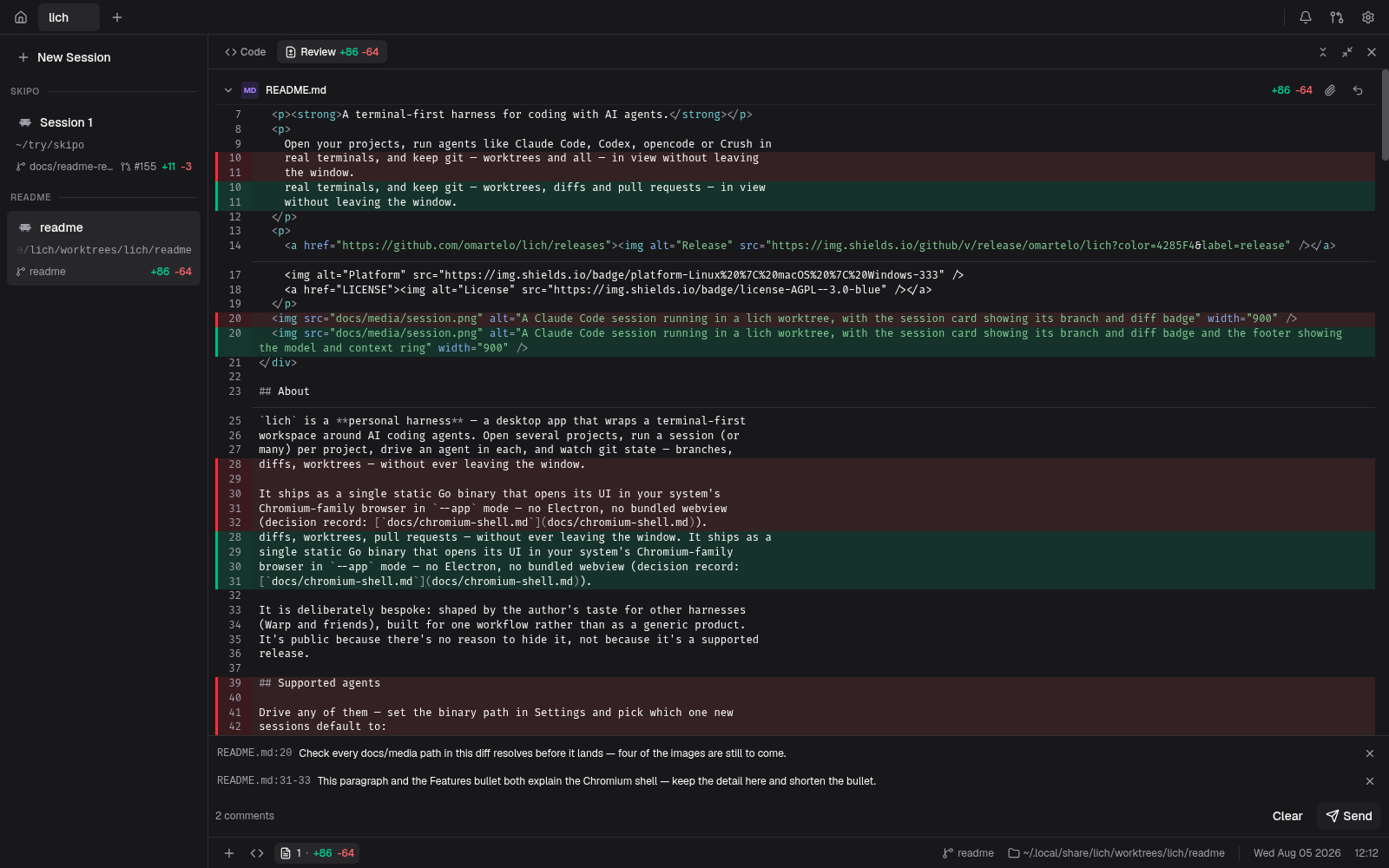
Comments written on the diff, handed to the session as one prompt.
- Pull requests, end to end. A button in the tab bar lists the repository's
open pull requests — quick filters plus GitHub's own qualifiers (is:draft,review:approved,is:merged) — and Open in Session checks one out into
its own worktree. A pull request opens full-screen: overview, checks, commits
and the whole diff beside a file tree. Review it where you read it — a thread
opens inline under the line it is about, and your own comments wait as pending
until Submit review sends them together — approve it, and merge it (squash,
merge commit or rebase) with the methods the base branch actually accepts. - Themes, yours or someone else's. Bundled light and dark, plus imported JSON
that recolors the interface and the terminal palette independently. Install a
pack from a git repository and update it in place when it ships a new version;
Save template writes a starter naming every supported color. Format and
repository layout:docs/themes.md. - The rest of the window.
Ctrl/Cmd+Kjumps between sessions and
projects. A session waiting on your input raises a toast and a dot on the bell,
collected in a titled dropdown; with the
lich plugin installed, a Claude
session also titles its own card and refreshes git the moment it writes a file.
Settings › Help opens the log folder and a pre-filled bug report.
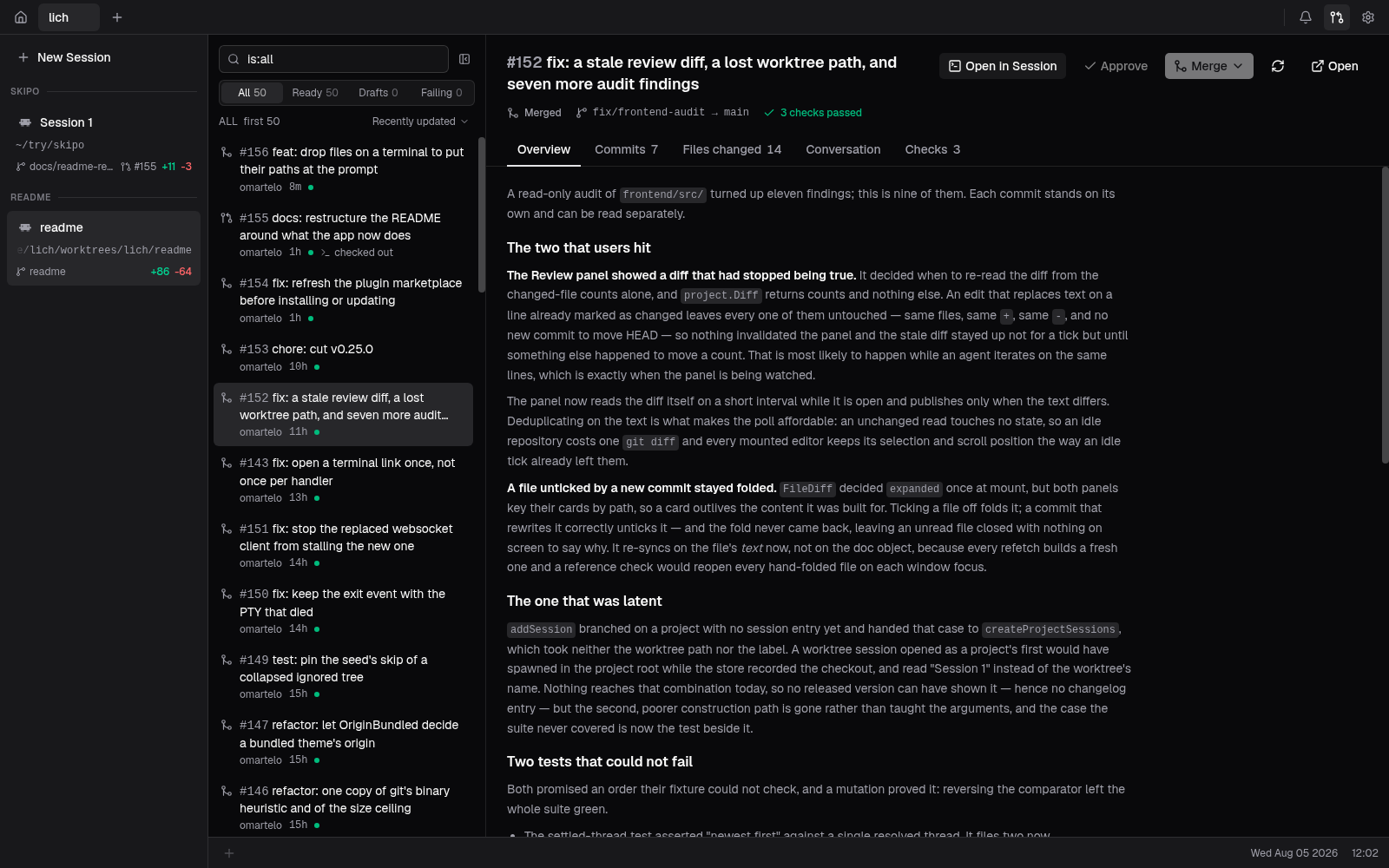
The repository's pull requests, filtered by GitHub's own qualifiers.
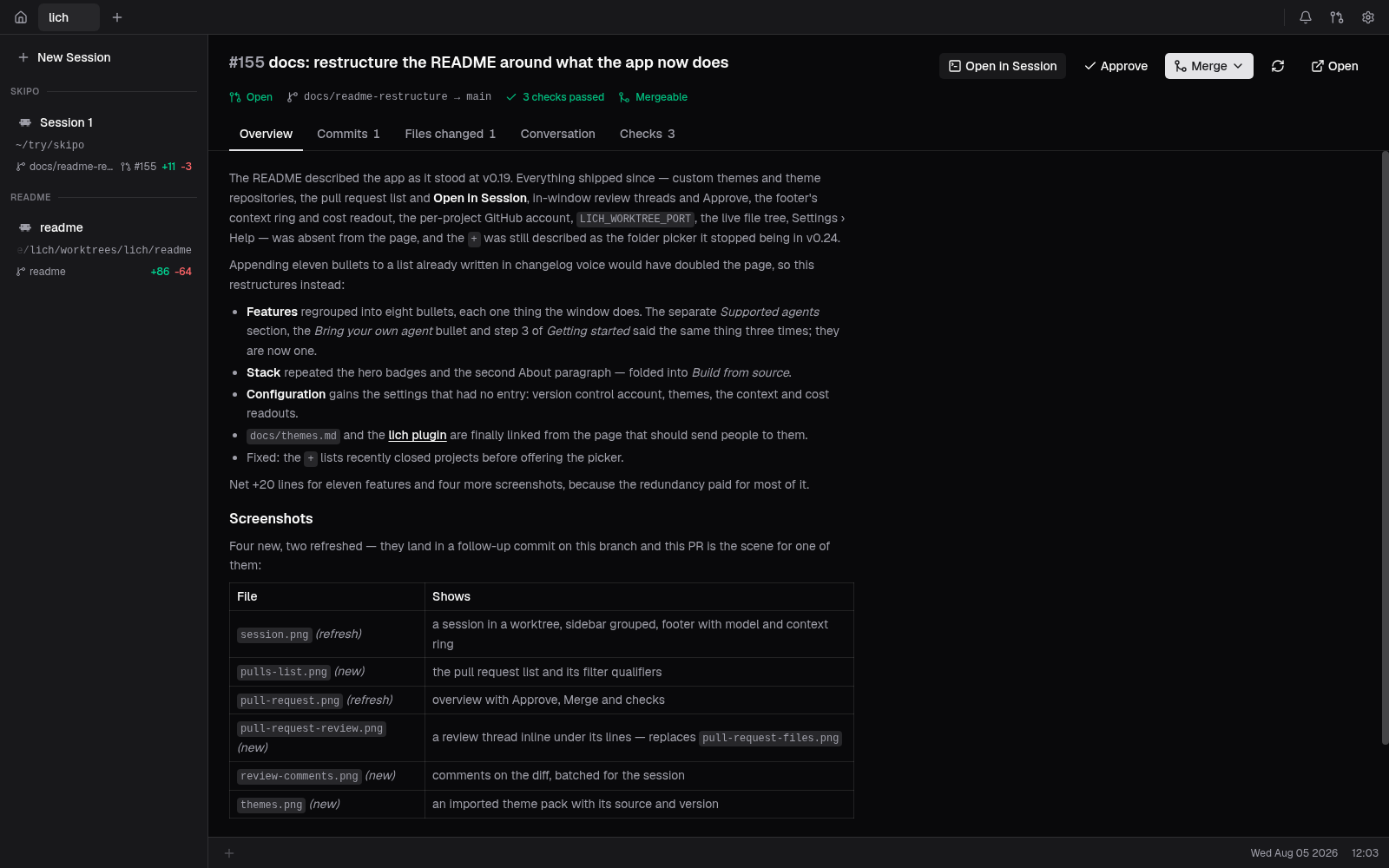
Read, approved and merged in place.
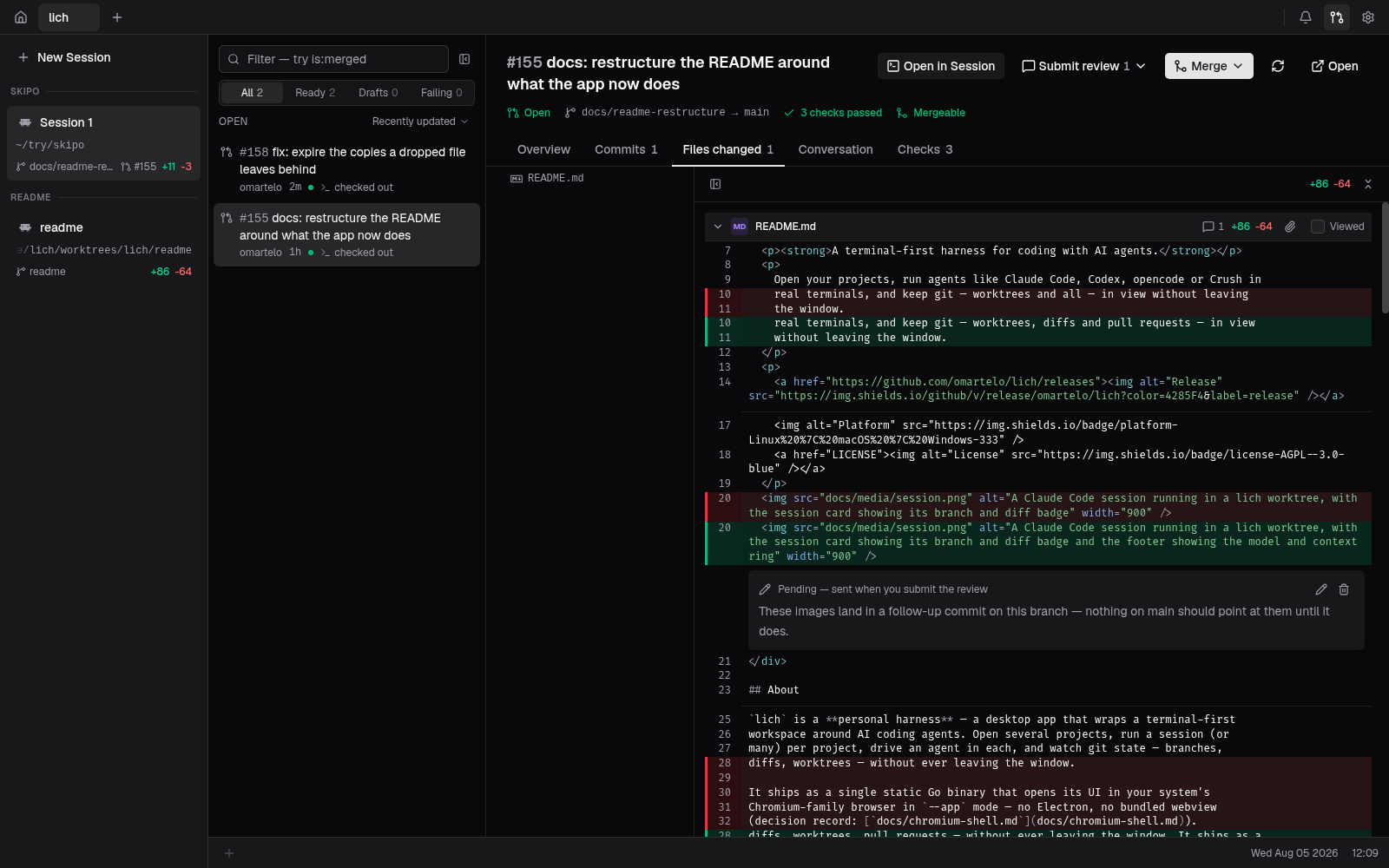
A review written on the diff itself — each comment pending until you submit them together.
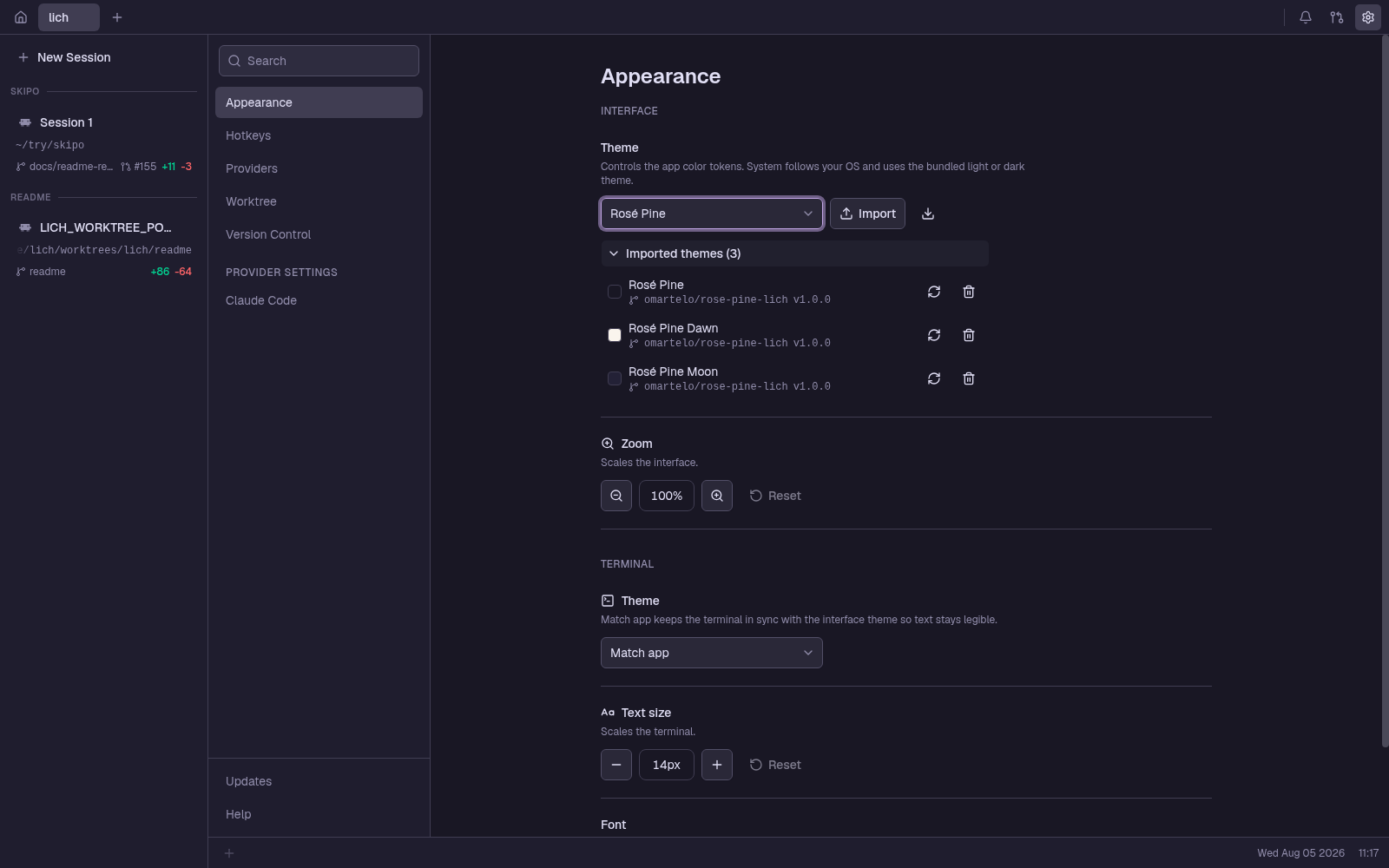
A theme pack installed from a git repository, updated in place.
Install
One line — detects your distro, verifies the checksum, and installs the native
package and its dependencies through your package manager:
curl -fsSL https://raw.githubusercontent.com/omartelo/lich/main/install.sh | sh
| Platform | Get it | Needs at runtime |
|---|---|---|
| Linux | install.sh above, or AUR lich-bin (yay -S lich-bin) |
chromium / google-chrome / brave on PATH, plus zenity |
| macOS (experimental) | brew install omartelo/tap/lich |
Chrome / Chromium / Edge / Brave in /Applications |
| Windows (experimental) | installer from Releases | Chrome / Edge / Brave |
Manual per-distro packages and the static binary: INSTALL.md. The
macOS and Windows binaries are unsigned — Gatekeeper and SmartScreen warn until
notarization/signing ship. Homebrew installs sidestep the Gatekeeper prompt;
a binary downloaded from the Releases page needs its quarantine flag cleared by
hand.
Getting started
- Install and launch
lich. - Open a project — the
+in the tab strip lists what you closed recently
and opens your OS folder picker; point it at a git repository. - Point lich at your agent — in Settings › Providers, set the binary path
for Claude Code, Codex, opencode or Crush, and choose a default. - Start a session — New Session spawns a terminal running your agent in
the project. - Branch off a worktree (optional) — create one from any base branch;
lich seeds it and drops you into a fresh session.
Configuration
- Agents — set each provider's binary path in Settings, and pick which one
new sessions default to. Claude Code's section also holds the footer's context
ring and its cost readout — the cost one off by default, since the figure only
means something when you are billed per token. - Worktrees — a per-project setup script (Settings › Worktree) runs in a new
worktree's terminal ahead of the agent; a.worktreeincludefile tunes which
gitignored files get copied over. - Version control — a project can name the GitHub account
ghruns as
(Settings › Version Control), for a repository only one of your accounts can
see. It governs what lich reads from GitHub, not what git pushes. - Appearance & hotkeys — themes, fonts and key combos in Settings; UI
preferences persist inlocalStorageunderlich.*keys (inside lich's
Chromium profile at~/.config/lich/chromium-profile), imported themes as JSON
under<config-dir>/lich/themes. - Workspace — projects and sessions persist in SQLite at
<config-dir>/lich/lich.db. Closing a session does not delete it.
Privacy & updates
Everything runs on your machine. No account, no sign-in, no telemetry — the
backend is a token-authenticated loopback listener, and nothing leaveslocalhost except the update check: a version ping to GitHub Releases at startup
and hourly. Updates apply in place on Windows/macOS and through the AUR on Arch.
Settings › Help says what the log file carries — paths, project and branch names,
your gh login, never a session token — before you attach it to a bug report.
Build from source
Pure-Go backend (Go 1.25, CGO_ENABLED=0) serving an embedded React 18 /
TypeScript / Vite frontend over a token-authenticated loopback listener (HTTP RPC
- WebSockets). Terminals are xterm.js with the WebGL addon; the code and diff
surfaces are CodeMirror 6. Prerequisites are Go 1.25+, Node + pnpm and
Task — no C toolchain, no system dev libraries.
task dev      # hot-reload dev mode (Vite on :9245)
task build    # production binary -> bin/lich
task run      # build + run
task test     # Go + frontend suites
Package a Linux release locally (needs
nfpm):
task package # .deb + .rpm + Arch .pkg.tar.zst in bin/
License
AGPL-3.0-only © 2026 omartelo
lich is free software: you can use, study, modify and redistribute it under
the terms of the GNU Affero General Public License v3. Any distributed or
network-served derivative must be released under the same license. Releases
up to and including v0.9.0 remain MIT-licensed.
Reviews (0)
Sign in to leave a review.
Leave a reviewNo results found