right-agent
Health Uyari
- License — License: Apache-2.0
- Description — Repository has a description
- Active repo — Last push 0 days ago
- Low visibility — Only 5 GitHub stars
Code Gecti
- Code scan — Scanned 12 files during light audit, no dangerous patterns found
Permissions Gecti
- Permissions — No dangerous permissions requested
This is a multi-agent framework that operates via your Claude subscription and uses Telegram as its primary user interface. It is designed to run autonomous tasks in secure, isolated sandboxes, handling the backend infrastructure, memory, and tunneling for you.
Security Assessment
Overall risk: Medium. The tool is designed with a strong security posture, explicitly aiming to isolate agents from sensitive host files like SSH keys and .env variables by utilizing an NVIDIA sandbox environment by default. The automated code scan passed with no dangerous patterns, no hardcoded secrets were found, and it does not request dangerous system permissions. However, because the fundamental purpose of this software is to orchestrate agents that inherently execute commands and interact with external services, a baseline level of risk remains. Users must trust the maintained sandbox boundaries, especially if they explicitly opt out of sandboxing for specific agents that require host access.
Quality Assessment
The project is actively maintained, with its most recent push occurring today. It uses the permissive Apache-2.0 license and includes clear, detailed documentation. The primary concern is its extremely low community visibility. With only 5 GitHub stars, the codebase has not been widely peer-reviewed or battle-tested by a broader audience, making it a relatively immature tool.
Verdict
Use with caution — the architecture is fundamentally secure and the code is clean, but the project's early stage and lack of community adoption mean it has not yet been proven at scale.
agents that run on your claude subscription. multi-agent, sandboxed by default. polished telegram surface.



 an agent that ships as a product
the choices are made. sandboxed by default. lives in telegram. runs on one subscription, shared across agents.
the problem · what we picked for you · quick start · what you get · how it stays safe · how it compares · roadmap
the problem
in most agent setups, the agent runs as your user. it can read every file you can read — ssh keys, aws credentials, mcp tokens, every .env under your home.
docker helps with the filesystem. it doesn't help with mcp credentials — they get forwarded into the container as environment variables. the agent, and any bash command it runs, can read them.
getting a working setup also costs a weekend: chat backend, memory store, tunnel, sandbox layer — pick them, wire them.
right agent fixes both. the pieces are picked, the wiring is done, telegram is your only console.
what we picked for you
every agent inside its own sandbox. security first; usability never sacrificed for it. nothing else gets a vote.
we make the choices for you and polish what we ship. the box is closed:
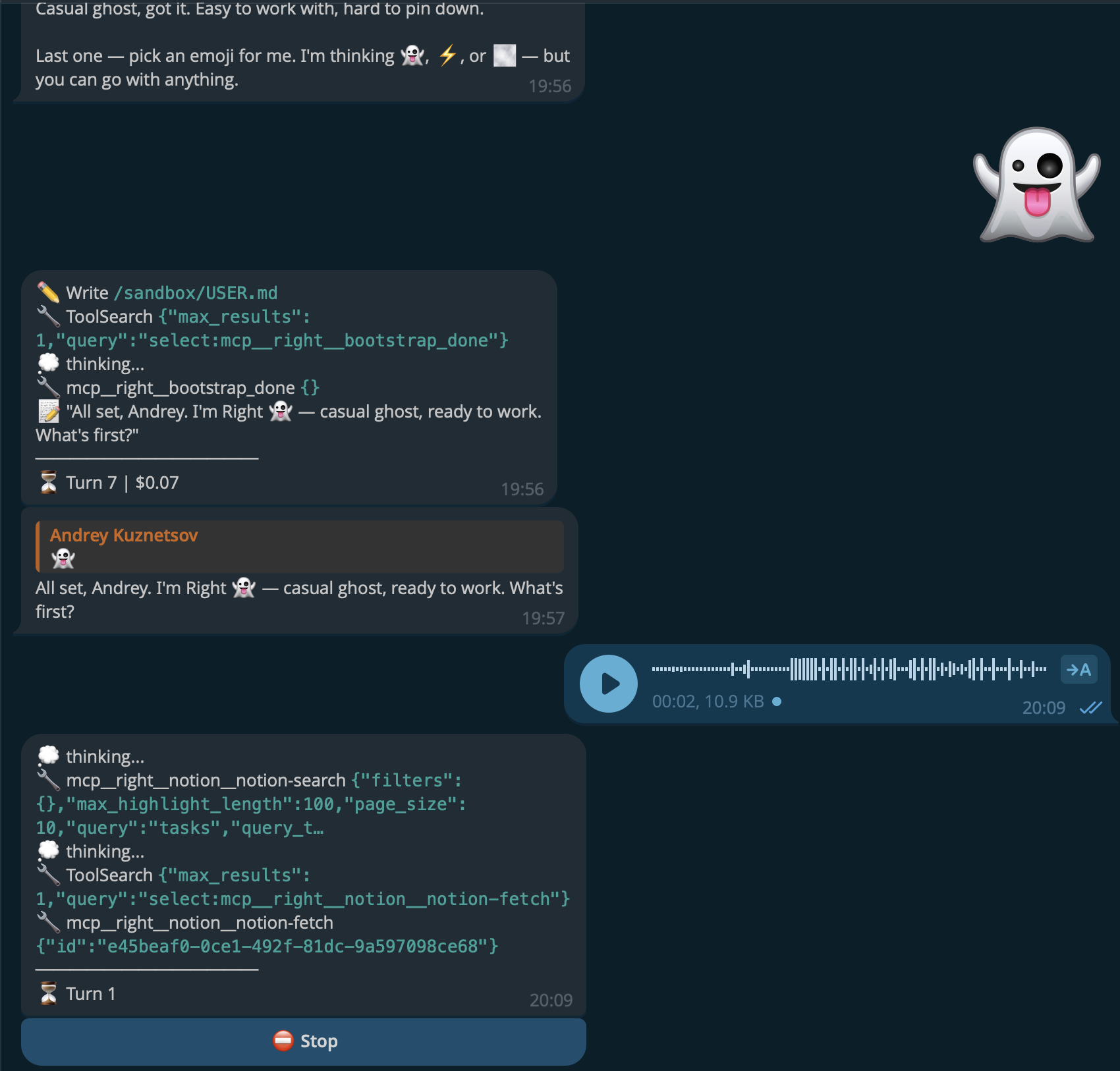
- chat surface. telegram. dm, groups, topics — polished, with attachments both ways, media groups, voice notes. not a matrix of telegram + slack + discord + web ui.
- memory. hindsight cloud (semantic recall, recommended) or local
MEMORY.md(no cloud dependency). picked at agent init. - model provider. your claude subscription.
claude -p, no api keys per agent. anthropic has been restricting third-party wrappers —claude -pis first-party, unaffected. - tunnel. cloudflared. free, secure, production-grade.
- sandbox. nvidia openshell, on by default. the only opt-out is for agents that need host access (e.g. computer-use, browser automation), and that's set explicitly per-agent.
the consequence: features arrive slowly. we polish what's here before adding what's next. if a knob isn't exposed, we haven't found a way to add it without making the product worse for everyone already using it.
quick start
prerequisites:
- claude code cli
- telegram bot token from @BotFather
- cloudflared authenticated with a cloudflare account (for telegram webhook ingress)
- hindsight cloud api key (optional, for semantic memory)
curl -LsSf https://raw.githubusercontent.com/onsails/right-agent/master/install.sh | sh
right init
right up
full install guide: docs/INSTALL.md.
what you get
 multiple agents on one subscription
each agent is a separate claude code session in its own sandbox: separate identity, separate memory, separate telegram thread. no per-agent api key. all of them run on your one claude subscription.
memory that survives restarts
two memory backends, picked at agent init.
hindsight cloud stores every turn append-only and recalls what's relevant on the next turn, scoped per-chat. the agent remembers who you are, what you were working on yesterday, and which stack you run, without replaying the whole transcript.
MEMORY.md is a local file the agent maintains itself. no cloud, no semantic recall, simpler.
identity that writes itself
the first session with a fresh agent is a bootstrap, not a chat. the agent answers questions about who it wants to be (name, tone, boundaries, relationship with you) and writes IDENTITY.md, SOUL.md, USER.md itself. those files load into every system prompt afterwards. on restart, on model swap, on upgrade, the agent stays itself.
one place to run it from
after right up, the terminal is done. claude login, mcp authorization, file attachments, cron notifications, /doctor, /reset. all in telegram.
how it stays safe
an agent you leave running long-term will eventually fetch a poisoned webpage, install a hostile skill, or accept a malicious memory through an mcp tool. the design assumes this. what matters is what the agent can reach when it does.
on a typical agent setup, the agent has direct access to:
- every mcp token in
.mcp.json: linear, notion, gmail, sentry, github - your claude oauth refresh token
- your
~/.sshand dotfiles - your source tree
- your
~/.aws,~/.config/gcloud, kubectl configs - any
.envfile under your home directory - the workspace and memory of every other agent on the host
one compromised turn, and an attacker has all of it.
the sandbox boundary
every claude code session runs inside an nvidia openshell sandbox. the agent reads and writes only inside its own workspace. nothing in ~/.ssh, ~/.aws, ~/.config/gcloud, or your source tree is reachable. no other agent's files are reachable. no escape route.
openshell is purpose-built for ai agents, not a container runtime stretched to fit. tls inspection, domain allowlists, and request logging are per-sandbox primitives.
credentials live outside the sandbox
mcp tokens, oauth refresh tokens, and claude auth live on the host inside a single aggregator process. the sandbox sees a proxy endpoint, never the raw token. four auth patterns are detected and refreshed automatically: oauth, bearer, custom header, query string.
worst case for a compromised agent: it misuses a tool while it's running. it cannot exfiltrate the credential.
the topology
show diagram
flowchart TB
  U[You]

  subgraph CLOUD["Cloud"]
    direction LR
    TG[Telegram API]
    CF[Cloudflare]
    ANT[Anthropic API]
    HS[(Hindsight Cloud)]
    EXT[(Linear · Notion · Gmail · …)]
  end

  subgraph HOST["Host"]
    B1[Bot · agent one]
    B2[Bot · agent two]
    AGG[MCP Aggregator]
    CFD[cloudflared]
    OS[OpenShell gateway]

    subgraph SANDBOX_1["Sandbox · agent one"]
      A1[Claude Code]
      I1[(Identity)]
    end

    subgraph SANDBOX_2["Sandbox · agent two"]
      A2[Claude Code]
      I2[(Identity)]
    end
  end

  U --> TG
  TG --> CF
  CF --> CFD
  CFD --> B1
  CFD --> B2
  B1 --> TG
  B2 --> TG

  B1 --> A1
  B2 --> A2

  A1 <--> I1
  A2 <--> I2

  A1 --> OS
  A2 --> OS
  OS --> ANT
  OS -->|MCP| AGG

  AGG --> HS
  AGG --> EXT

  style CLOUD stroke:#6b8fbf,stroke-width:2px
  style HOST stroke:#6bbf59,stroke-width:2px
  style SANDBOX_1 stroke:#E8632A,stroke-width:2px
  style SANDBOX_2 stroke:#E8632A,stroke-width:2px
what egress looks like
outbound traffic from the sandbox goes through openshell's policy engine. tls is terminated per-request. the destination is matched against the domain allowlist, and the request is logged. nothing leaves silently.
the default policy is permissive. one line in agent.yaml switches to restrictive: anthropic and claude endpoints only.
how it compares
| typical agent setup | right agent | |
|---|---|---|
| sandbox | container, no built-in rules | openshell: policy engine, tls inspection |
| credentials | tokens live next to the agent | host-side aggregator; agents never see them |
| mcp secrets | copied into every agent | one aggregator, one location |
| memory | replay full history each turn | append-only; hindsight or local file |
| identity | system prompt in a config file | agent writes its own identity files |
| control surface | cli + config + dashboards | one telegram thread |
| claude billing | api key per agent | one claude subscription |
| scope | configurable everything | one opinionated path |
other agents ship breadth and leave the wiring to you. right agent ships one path and does the wiring itself.
roadmap
shipped:
- multi-agent orchestration, sandboxed by default
- mcp aggregator with auto-detected oauth, bearer, header, query-string auth
- evolving identity: agent writes its own
IDENTITY.md/SOUL.md/USER.md - append-only memory: hindsight cloud or local
MEMORY.md - telegram as single control plane: login, mcp auth, files, cron
- group chats, topic routing, media groups in both directions
- declarative cron with telegram notifications
- agent backup & restore
right doctorend-to-end diagnostics
next:
- credential providers for
gh,gcloud,aws,kubectl: zero-token clis inside sandboxes - native browser automation
- agent templates: shareable configs with mcps, skills, identity presets
- auto-skills: agent writes its own skills from repeated tasks
- per-turn budget caps for chat (currently cron-only)
- agent-to-agent communication
full tracker on github issues.
docs
- installation — full prerequisites
- security model — policies, credential isolation, threat model
- architecture — internal topology, sqlite schema, invocation contract
- prompting system — how agent system prompts are assembled
license
apache-2.0.
credits
built on claude code, nvidia openshell, and process-compose.
Yorumlar (0)
Yorum birakmak icin giris yap.
Yorum birakSonuc bulunamadi